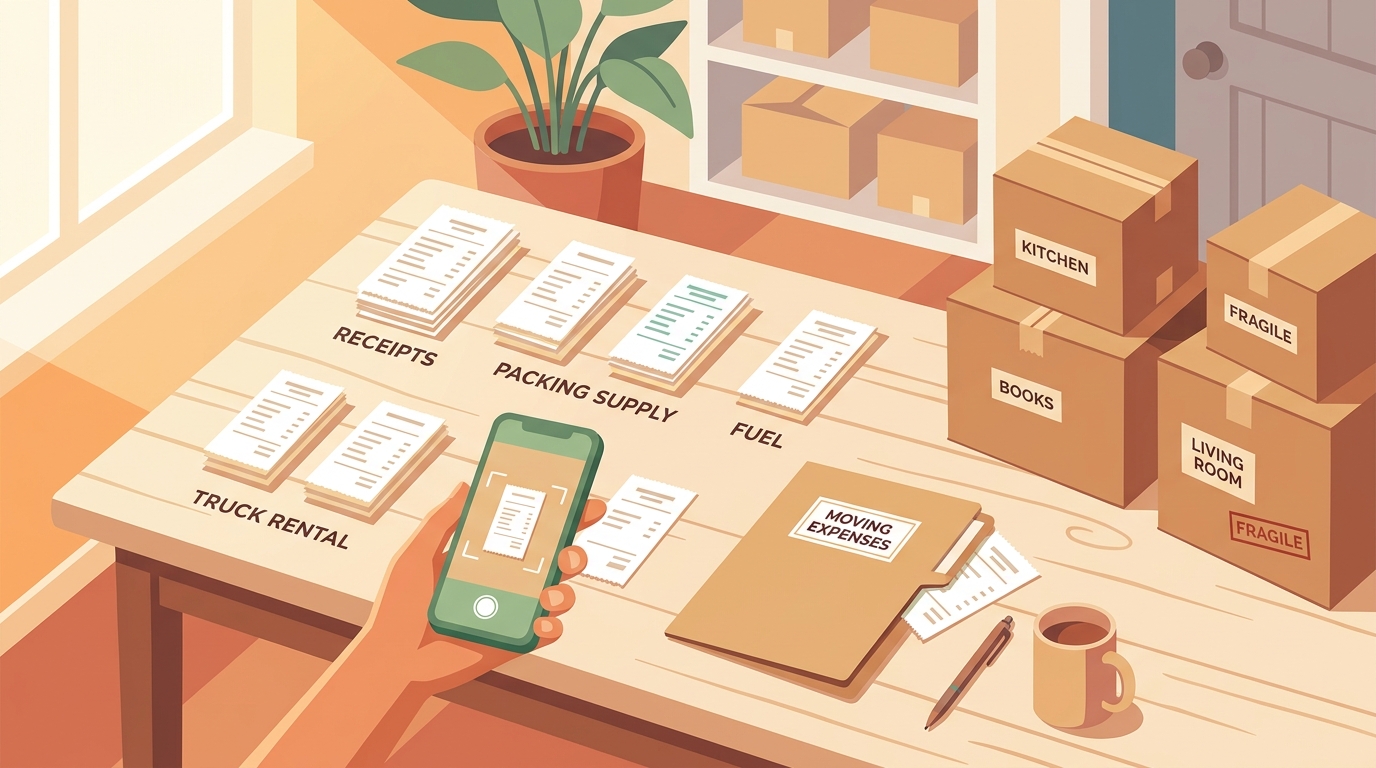
Moving turns ordinary purchases into a paper trail. The truck, boxes, tape, storage unit, hotel, tolls, fuel, meals you cannot deduct, cleaning supplies you probably cannot deduct, and the receipt you swore you put in the glove compartment all arrive in the same week. If you need to track receipts moving expenses, the goal is not to create a perfect archive after the move. The goal is to catch proof while the expense is still fresh, label it clearly enough for tax or reimbursement review, and keep it connected to the household items, boxes, dates, and destinations it belongs to.
The tax piece deserves honesty up front. The Internal Revenue Service says the federal moving expense deduction is generally limited to eligible active-duty Armed Forces members moving because of a military order and permanent change of station, with certain intelligence community rules beginning in 2026. The IRS Instructions for Form 3903 also separate deductible moving costs from nondeductible costs such as meals. That does not mean other movers should ignore receipts. State rules, employer reimbursements, military reimbursement reviews, insurance claims, security deposits, and personal budgeting can all depend on proof.
Moving is common enough, and expensive enough, that receipt discipline matters before the boxes come out. The U.S. Census Bureau reported that 11.8% of the U.S. population moved to a different residence in 2024. The National Association of REALTORS 2024 buyer and seller profile, summarized by REALTOR associations, put the median distance between a buyer's new home and previous residence at 20 miles. Pew Research Center has also reported broad concern about housing affordability, including 69% of Americans saying they were very concerned about housing costs in a 2024 survey. A move is not a small errand. It is a household project with real money attached.
Why moving receipts disappear exactly when you need them
Receipt loss is not a character flaw. It is a predictable moving problem. During a normal month, purchases happen in a few familiar places: groceries, gas, pharmacy, online orders, maybe a hardware store. During a move, the expense map explodes. You pay movers through one portal, buy boxes from a store, reserve storage online, fill the car twice, pay tolls through an app, buy packing paper at the last minute, and send a deposit through a property manager site that calls the payment something unhelpful like resident services.
Moving creates too many categories at once
The same receipt can mean different things depending on why you bought it. A roll of tape used for household goods may belong in moving supplies. A utility setup fee may be a new-home cost, not a moving deduction. A hotel stay during travel may matter for a qualifying move, while dinner during that hotel stay does not. A storage unit might be relevant if it holds household goods in transit, but not if it becomes a long-term overflow closet. This is why the category needs to be captured at the time of purchase, not guessed six weeks later.
Reimbursement and deduction records are different jobs
Tax records ask one question: does this expense meet the rule? Employer reimbursement asks another: does this expense match the policy? Insurance asks another: does this document prove value, loss, or replacement? A strong receipt system keeps the original proof and adds context, so the same record can answer more than one question. That context might be the move date, household member, box number, old address, new address, trip segment, or item involved.
The first rule is capture before cleanup
Do not wait for a quiet Sunday to organize moving receipts. Moving does not create quiet Sundays. Capture the receipt immediately, even if the category is rough. A blurry photo taken in the parking lot is usually better than a perfect plan you never use. You can clean categories later. You cannot recreate the parking receipt that blew out of the cup holder during the final dump run.
The best moving receipt system is not the most elaborate one. It is the one that catches proof before the move turns it into a rumor.
1. Start one moving-expense folder before you buy anything
The first method is boring, which is why it works: create one dedicated place for the move before the first receipt appears. Not a pile on the counter. Not a label inside your regular tax folder. One move folder with a name, a start date, and a short list of categories you expect to use.
Use the same folder name everywhere
Give the move one name and reuse it across email, cloud storage, notes, and your inventory system. Something like 2026 Seattle Move or Peterson Move August 2026 is enough. Create subfolders for mover invoice, packing supplies, storage, travel, lodging, mileage, reimbursements, new-home setup, deposits, and tax review. If you expect employer reimbursement, add a folder named submit to employer. If you may qualify for a deduction, add review for tax preparer.
This naming discipline matters because receipts rarely stay in one format. Some arrive as paper. Some arrive by email. Some hide inside apps. Some are screenshots. Some are PDFs. A single project name lets you search later across Gmail, files, phone photos, and notes without remembering the vendor name.
Build the category list around decisions
Categories should match the decisions you need to make later. A generic category like miscellaneous moving is useless. Better categories include mover, storage in transit, packing supplies, vehicle fuel, tolls and parking, lodging, reimbursement submitted, reimbursement received, and not deductible. That last one is important. Keeping nondeductible or personal expenses visible prevents accidental claims and keeps the review clean.
The IRS says eligible moving expenses can include moving household goods and personal effects, storage and traveling expenses including lodging, while meals are not deductible. Even if you are not eligible for the federal deduction, that distinction is still useful. It helps you understand what the move actually cost instead of mixing travel food, duplicate purchases, and mover invoices into one stressful total.
Make paper receipts digital immediately
Keep an envelope in the car, but do not let the envelope become the system. Photograph each paper receipt the same day, then place the paper in the envelope as backup. The digital copy should carry the category and date in the file name or note. A useful name is 2026-08-04-packing-tape-home-depot-42-18. A bad name is IMG_7291. Future you should not need forensic training to find a roll of tape.
2. Photograph every receipt the moment you pay
Receipt tracking fails when it depends on memory. The most reliable habit is also the smallest: every time money leaves your account for the move, take a photo or screenshot before you leave the moment. Paper receipt, app confirmation, toll charge, moving deposit, storage reservation, hotel bill, or online order, capture it right away.
Take two images: receipt and context
For paper receipts, take one close photo of the receipt and one context photo if the expense connects to physical items. If you bought bins, tape, mattress bags, or packing paper, photograph the items in the cart or next to the boxes they will support. If you paid for storage, screenshot the reservation and photograph the unit number when you arrive. Context turns a charge into a record.
This pairs naturally with a moving inventory. If you are already building a moving inventory list, attach the packing or storage receipt to the boxes, furniture, or room it supports. The receipt proves cost. The inventory proves what the cost was for. Together they are much stronger than either one alone.
Use screenshots for email and app receipts
Email receipts are searchable until they are not. Vendor names vary, subject lines get vague, and some receipts live behind app logins. Screenshot the confirmation screen and save the email PDF when available. For app-based purchases, include the date, vendor, amount, and confirmation number in the screenshot. If the app only shows the last four digits of a card and a vague service label, add your own note immediately.
Do not rely on bank statements as the main record. A credit card line that says hardware store, 86.41 tells you money moved. It does not prove what you bought, whether it was for the move, or whether part of the purchase was personal. Bank statements are backup evidence, not a receipt system.
Capture refunds and reimbursements too
A moving receipt folder that only records spending can overstate the cost of the move. Track refunds, returned supplies, mover credits, deposit refunds, employer reimbursements, government reimbursements, and insurance payments in the same project. The IRS specifically notes that you cannot deduct moving expenses covered by government reimbursements or paid directly by the government if they are excluded from income. Even outside federal deductions, reimbursements need to be matched to the original expense so you do not submit the same cost twice.
3. Attach receipts to the household items and boxes they belong to
Most people track moving receipts in financial categories. That is necessary, but it is incomplete. A move is also a physical chain of custody. The receipt for packing materials belongs to boxes. The receipt for movers belongs to the furniture and household goods they handled. The receipt for a replacement part belongs to the appliance, shelf, crib, desk, or bed frame that needed it.
Connect the receipt to the thing, not just the vendor
If you buy a mattress bag, furniture blanket, or wardrobe box, attach that proof to the item or box it protected. If movers damage a dresser, a receipt for the move plus a photo of the dresser before loading gives you a clearer claim record. If you replace a missing cable, bracket, shelf peg, lamp shade, or remote after the move, connect the replacement receipt to the item record so the cost does not disappear into hardware store fog.
This is where Vorby fits naturally. A household inventory lets you keep photos, receipts, notes, locations, and ownership context around the item itself. You can record the sofa before the move, add photos of its condition, attach mover paperwork, and update the location after delivery. That is more useful than a folder full of receipts with no connection to what was moved.
Use box numbers as receipt anchors
For packed goods, create simple box numbers and use them in receipt notes. Box K-03 might hold coffee gear, mugs, and the kettle. If you buy specialty dividers or packing paper for that box, note K-03 on the receipt record. If something breaks, the packing expense, box photo, and item list already live together. Vorby's piece on what is in that box makes the same point from the unpacking side: a room label is not a contents record.
This does not require cataloging every fork. Focus on high-value, fragile, easy-to-lose, or immediately needed items: electronics, tools, documents, kitchen gear, bedding, medical equipment, hobby gear, and anything stored separately. The point is to create enough connection that later questions can be answered without opening six boxes or scrolling through 400 photos.
Separate personal, shared, landlord, and employer property
Moves get especially messy when household property overlaps. Roommates may split moving supplies. A company may pay for some relocation costs. A landlord may provide appliances or fixtures that should not be treated as your property. If you are moving into a shared home, Vorby's pre-move-in inspection checklist for roommates is a useful companion because it separates condition records from belongings.
For receipt tracking, ownership notes prevent bad math. Mark each expense as mine, household, roommate split, employer reimbursable, landlord related, or not claimable. If two roommates share truck rental costs, save the full receipt and record who paid what. If an employer reimburses only the truck but not supplies, mark that difference the day you submit the claim.
4. Separate deductible, reimbursable, and personal expenses from the beginning
The biggest receipt-tracking mistake is pretending every moving cost belongs in one bucket. It does not. Some costs may be deductible for eligible taxpayers. Some may be reimbursable by an employer or government program. Some may help with insurance or deposit documentation. Some are simply the cost of feeding tired people pizza after the truck leaves.
Know the federal deduction limits before you sort
For current federal taxes, most civilian moves do not qualify for the moving expense deduction. The IRS states that qualifying active-duty Armed Forces members may be eligible when the move is due to a military order and incident to a permanent change of station. IRS Form 3903 is the reporting path for qualifying moving expenses, and the instructions identify major buckets such as moving household goods and personal effects, storage and insurance in transit, and travel to the new home. Meals are not deductible.
That rule does not make receipt tracking optional. It makes labels more important. Use a category called federal review only for expenses that could plausibly belong under the IRS rule. Use state tax review if your state has its own treatment. Use employer reimbursement if a relocation policy is involved. Use personal move cost for everything else. A clean folder helps a tax professional, HR reviewer, or your own future self avoid guesswork.
Turn policy language into categories
If your employer, military office, relocation company, scholarship program, church, or family arrangement will reimburse part of the move, read the policy before you spend. Then turn the policy into categories. If the policy reimburses truck rental but not packing supplies, create those exact labels. If it requires original receipts over a dollar threshold, flag those purchases. If it needs proof of payment, keep the receipt and the card statement line together.
Do not wait until submission week to discover the rules. Reimbursement portals often reject receipts for tiny reasons: missing name, no date, no payment proof, bundled personal items, or no explanation of business purpose. Add a note to each receipt while you still remember the answer.
Create a permanent not deductible category
A not deductible category is not a failure pile. It is a safety feature. Meals, house-hunting trips, temporary living costs after arrival, home purchase costs, decorating, duplicate household goods, and convenience purchases may matter to your budget, but they should not be mixed into a tax category without review. IRS rules and employer policies differ, so the safe move is to record the expense accurately and label it honestly.
This is also useful for budgeting. Moving usually includes both necessary costs and stress costs. Seeing the difference helps you understand the real move, not the fantasy version where every hardware store run was essential and nobody bought a fourth tape measure.
5. Track mileage, lodging, storage, and mover paperwork as events
Some moving expenses are not a single receipt. They are events with a start, end, route, purpose, and related documents. Mileage, lodging, storage, truck rental, and professional movers all need a little more structure than a snapshot.
Use a trip log for mileage, tolls, and parking
Create a simple trip log with date, starting point, destination, purpose, odometer or mileage, tolls, parking, and related receipt links. If a trip combines moving errands and personal errands, say so. If you are eligible to claim moving mileage, the IRS standard mileage rate can matter, but the record still needs the date and purpose behind the miles. A toll receipt without a route note is weaker than a toll receipt attached to the moving trip it belongs to.
Keep the log lightweight. Do not build a spreadsheet so elaborate that nobody uses it. A note with one row per trip is enough: old apartment to storage unit, 18 miles, delivered boxes B-01 through B-10, toll 4.50, parking 2.00. The details are small, but together they make the expense legible.
Store lodging records with the route
For long-distance qualifying moves, lodging may matter while meals do not. Even for nonqualifying moves, hotel records can matter for reimbursement, personal budgeting, or documenting why the move cost more than expected. Save the booking confirmation, final folio, taxes and fees, proof of payment, and cancellation or modification notices. If the stay covered multiple people, note who stayed and why.
Do not rely only on the booking email. Hotels often change the final amount after taxes, parking, pet fees, or incidentals. The final folio is the cleaner record. Put it in the same folder as the trip segment so the receipt tells a complete story.
Treat storage and movers like contracts, not receipts
Storage and professional moving paperwork should include more than the payment receipt. Save estimates, signed contracts, inventory sheets, bill of lading, insurance or valuation choices, delivery confirmations, claim forms, photos, and final invoices. If household goods are stored in transit, record move-in and move-out dates for the storage unit and what went inside. If you are using a household inventory, connect storage records to the boxes or rooms involved.
The Insurance Information Institute advises homeowners and renters to keep inventories with descriptions, purchase dates, model numbers, receipts, and photos, and to store that record somewhere safe. That advice becomes especially practical during a move. Movers, storage units, trucks, and temporary housing all introduce moments where belongings can be damaged, lost, or disputed. Receipts are part of the proof, but the item record is what explains the loss.
6. Do a weekly receipt audit until the move is closed
The final method is the one that keeps the whole system from becoming another box marked miscellaneous. Once a week during the move, audit the receipt folder. The audit is not a financial deep dive. It is a 20-minute cleanup that catches missing proof before the trail goes cold.
Match receipts against payment accounts
Open the cards, bank accounts, payment apps, and reimbursement portals used for the move. Scan for move-related charges that do not have receipts in the folder. If you see storage, fuel, hardware store, hotel, mover, toll, parking, truck rental, or shipping charges, find the receipt or add a note explaining why it is missing. Missing receipt notes are better than silence because they preserve the story while you still remember it.
Also look for split payments. A deposit may hit one card and the final mover invoice may hit another. A hotel may show an authorization and a final charge. A returned box purchase may show as a refund days later. Weekly review catches these before the account history becomes a blur.
Make a tax and reimbursement packet before you unpack completely
Do not wait until tax season or HR's deadline. When the move is mostly done, create a packet with one summary sheet and folders for each category. Include totals, dates, vendors, payment method, reimbursement status, and links to receipts. For any expense that may be deductible, include the rule or policy reason it is in review. For any expense that was reimbursed, show the reimbursement received and the related original expense.
If you work with a tax preparer, the packet should make their job easier, not force them to reconstruct your move from a pile of images. If you submit to an employer, it should match the policy categories. If you keep it for your own records, it should be clear enough that you can understand it next year.
Keep the record with your household inventory
After the move, receipts still have value. They can support insurance claims, warranty claims, storage disputes, roommate settlements, and future moves. Vorby's digital home inventory guide for renters covers the broader reason: belongings need records that survive moves, leases, and storage changes.
When you unpack a new purchase, repair an item, replace something damaged, or move a box into long-term storage, update the item record and attach the receipt. A moving folder closes eventually. A household inventory keeps living with the home.
FAQ: tracking receipts for moving expenses
Are moving expenses tax deductible for everyone?
No. The IRS generally limits the federal moving expense deduction to eligible active-duty Armed Forces members moving because of a military order and permanent change of station, with certain intelligence community rules beginning in 2026. Some state, employer, or reimbursement rules may still make receipts important.
What moving receipts should I save?
Save mover invoices, truck rental records, packing supplies, storage bills, fuel, tolls, parking, lodging, shipping, insurance or valuation paperwork, and reimbursement records. Also save receipts for replacement or repair costs tied to items damaged or lost during the move.
Can I deduct meals during a move?
No for the federal moving expense deduction. The IRS Instructions for Form 3903 state that meals are not deductible moving expenses, even when travel or lodging may qualify.
How long should I keep moving receipts?
Keep tax-related records for as long as your tax professional recommends for your situation. For household proof, keep important moving, storage, insurance, warranty, and item receipts with your home inventory as long as the belongings or possible claims matter.
Is a photo of a receipt enough?
A clear photo is usually much better than no receipt, especially if it shows vendor, date, items, amount, and payment proof. Keep the original when possible, and attach a note explaining the move purpose, category, and related item or trip.
Moving gets easier when the record is built while the proof is still in your hand. Vorby gives your household one clear place to keep receipts, item records, box photos, and moving notes together. Start the move with a record you can trust.


