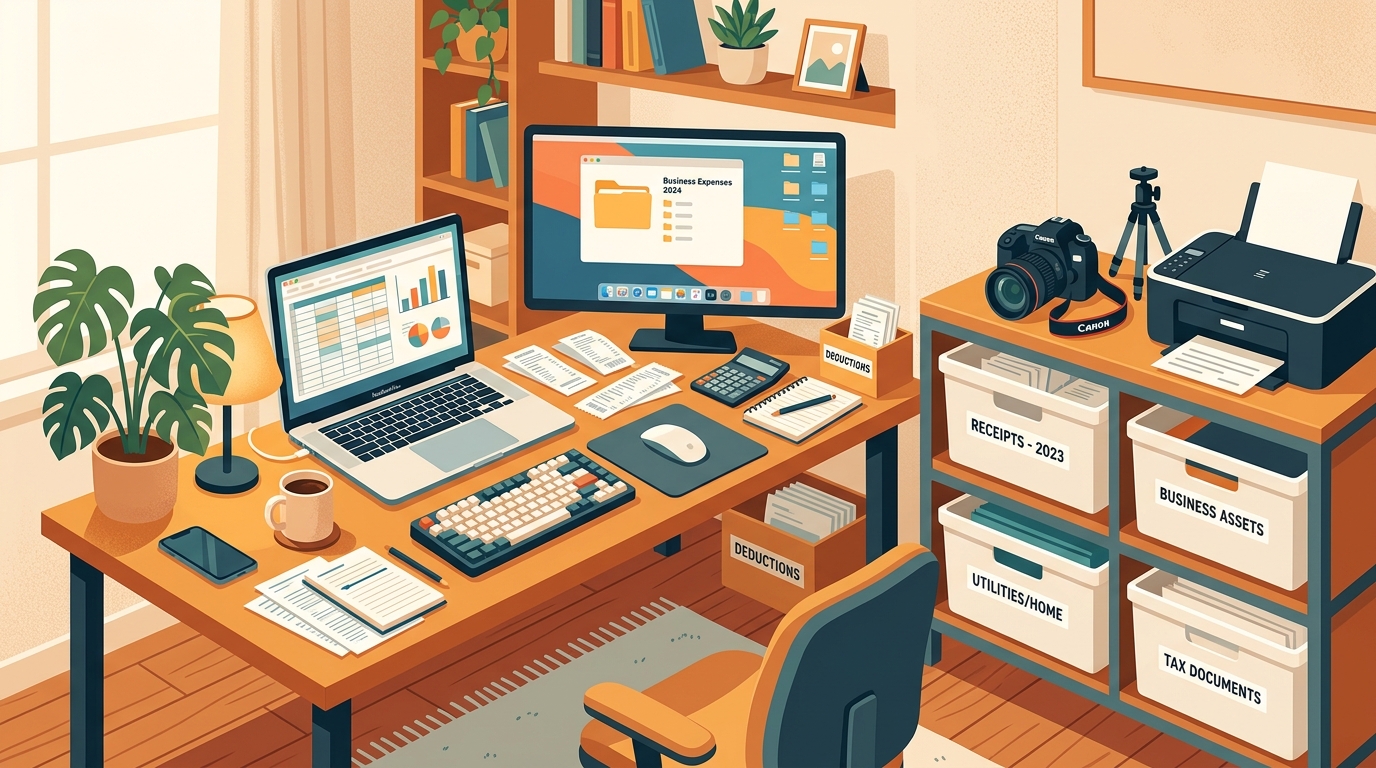
Inventory freelancers home office systems are not about making tax season prettier. They are about proving what belongs in your business space, what you paid for it, where it lives, how it is used, and whether the record will still make sense when a tax preparer asks for support months later.
Freelancers and self-employed people live in a gray zone that ordinary household organization rarely handles well. The same apartment may hold a personal laptop, a client camera, a printer used by the family, a desk chair bought for full-time contract work, storage bins for business files, and a router that supports both Netflix and billable calls. The home office deduction sits inside that reality. It rewards clean documentation and punishes vague memory.
The useful question is not "Can I deduct this?" while standing in front of a pile of receipts. The useful question is "What proof would make this purchase understandable six months from now?" Inventory turns that question into a repeatable household habit, not a once-a-year rescue mission during tax season under real deadline pressure alone.
The IRS explains in Publication 587 that taxpayers claiming business use of a home need records that show the part of the home used for business, that the space is used regularly and exclusively when required, and the depreciation and expenses for the business part. A home inventory does not decide your deduction. It gives you the evidence to discuss that deduction with confidence.
Why freelancers need a home office inventory before tax season
Most freelancers start with receipts. That is understandable, but receipts alone are thin evidence. A receipt proves a purchase happened. It rarely proves that the item belonged in your home office, that it stayed there, that it was used for client work, or that it should be separated from the rest of the household.
Home work is common, but home records are messy
Pew Research Center reported that about 15 million U.S. workers were self-employed, roughly 10% of the workforce, and that 60% of self-employed workers whose jobs could be done from home worked from home all the time. The U.S. Census Bureau has also found that the share of people working from home remains more than double its pre-pandemic level. That means a lot of business activity now happens beside laundry baskets, kids' backpacks, spare bedrooms, and shared dining tables.
Those numbers matter because the home office is no longer a rare exception. It is a normal operating base for consultants, designers, coaches, writers, developers, bookkeepers, therapists, creators, tutors, and solo service providers. Normal does not mean simple. When business work moves into the home, the proof has to fit the home too.
That ordinary household context is exactly why documentation matters. If your work area is obvious only to you, your records need to make it obvious to someone else. A clear inventory can show that the desk, monitor, filing cabinet, microphone, printer, shipping scale, camera bag, or storage shelf was part of a business setup, not a random collection of household purchases.
The deduction depends on use, not vibes
The IRS home office rules turn on practical facts: the space, the use, the expenses, and the connection to a trade or business. If a freelancer uses a spare room only for client work, the records should tell that story. If a living room corner is used for both business and family life, the records should not pretend otherwise.
Inventory is the bridge between the tax rule and the real room. It documents what is in the work area, what each item is for, what it cost, and whether it is used only for business or partly for personal life. The result is not a magic deduction. It is a cleaner record that helps you avoid guessing.
Tax support overlaps with household protection
The Insurance Information Institute recommends creating a home inventory with descriptions, purchase dates, model and serial numbers, receipts when available, and photos or video. That advice is usually framed around insurance claims, but it maps neatly to freelancer recordkeeping. The same camera record can support a business asset file, warranty claim, replacement estimate, and insurance conversation.
Vorby is built for that overlap. A desk chair is not only a line in an expense category. It is a chair in a room, with a purchase date, receipt, photo, condition note, owner, and use case. When the item record carries the proof, the household file becomes more useful than a tax folder by itself.
That is the standard to aim for: every important office item should be understandable without opening five apps or searching three email accounts.
What the IRS home office rules mean for inventory records
This is practical organization guidance, not tax advice. A qualified tax professional should tell you what qualifies, which method to use, and how to handle depreciation, allocation, and state-specific issues. Your job is to keep records that make those decisions factual.
Document the space first
Publication 587 says your records should show the part of your home used for business. Start with the room or area before you list the objects. Measure the workspace. Photograph it from several angles. Record whether it is a separate room, a portion of a room, a storage area, or another specific area of the home.
For freelancers in small spaces, the location note matters. A bedroom closet used for business file storage, a studio corner used for product photography, or a garage shelf used for wholesale samples can be easy to forget later. Inventory makes those areas concrete by tying items and records to the place where they are kept.
Keep proof of regular and exclusive use when it applies
The IRS regular use test asks whether a specific area is used for business on a regular basis. Incidental or occasional use is not enough. The exclusive use test, when it applies, asks whether that part of the home is used only for the trade or business. Your inventory should not overstate either point.
If a chair, desk, and monitor are in a dedicated office, label them that way. If a printer is shared by the household, label it as shared. If supplies are stored in a cabinet that also holds personal items, record the business shelf, bin, or labeled area. Clean notes protect you from turning a useful system into an exaggerated one.
Separate assets from ordinary expenses
A freelancer's home office includes both durable assets and routine expenses. Durable assets might include a computer, monitor, desk, chair, camera, printer, microphone, lighting kit, storage cabinet, or external drive. Ordinary expenses might include paper, ink, postage, shipping supplies, cleaning items for the office, software invoices, or repair receipts.
Inventory is strongest for assets because the record follows the item over time. For recurring expenses, a receipt system may be enough. For purchases that stay in your home, attach the receipt to the item, add the location, record the serial number when relevant, and update the item if you sell, replace, return, or move it.
That timeline matters for larger purchases. A $25 pack of printer paper may only need a receipt and category. A $1,600 laptop may need a receipt, serial number, setup date, warranty, repair history, replacement note, disposal note, and a business-use explanation. If the asset might be depreciated, reimbursed, insured, sold, or converted to personal use later, the inventory record should carry that history.
Build an inventory that matches how freelancers actually work
The best inventory is not the most elaborate one. It is the one you can maintain during a normal week. Freelancers need records that survive client deadlines, travel, shared households, and the annual scramble to close the books.
Start with the work zone
Walk through the home office with your phone and capture the room as it exists today. Take wide photos of the workspace, then close-ups of the items that matter. For electronics, photograph serial numbers, model labels, ports, and distinguishing details. For furniture, photograph the item in place and attach the receipt if you have it.
Use names that explain purpose, not just identity. "Dell monitor for design work" is better than "monitor." "File cabinet for client contracts" is better than "cabinet." The point is to make search and review easier when you no longer remember the purchase.
Then capture receipts and order confirmations
Receipts are still important. IRS recordkeeping guidance across small business publications consistently focuses on keeping supporting documents for expenses, including receipts, invoices, paid bills, and similar proof. The problem is that receipts get separated from the objects they support.
Vorby's guide on scanning receipts for tax deductions is a useful companion habit: capture the receipt immediately, name it clearly, and add the business context while it is fresh. For home office inventory, the next step is attaching that proof to the actual item or room record.
Make shared use visible
Many freelancers do not live alone. A spouse, partner, roommate, child, or visiting family member may use the same printer, router, table, closet, or storage cabinet. Shared use is not a moral failure. It is a recordkeeping fact.
Create simple labels: business-only, personal-only, mixed use, shared household, client equipment, reimbursed, returned, donated, or replaced. Those labels make the record honest. They also help prevent a tax folder from accidentally swallowing ordinary household spending.
A useful home office inventory does not make bold claims. It makes the room legible.
What to include in a freelancer home office inventory
You do not need to catalog every pen. Start with the items that would matter if you had to explain your home office deduction, replace business equipment after a loss, or answer a tax preparer's question quickly.
Core workspace items
- Desk, chair, and work surface: Record purchase date, cost, location, condition, and whether the item is business-only or shared.
- Computer, monitor, tablet, and phone: Add serial numbers, model names, receipts, warranty details, and notes about business use.
- Printer, scanner, router, and networking gear: Capture photos, receipts, location, and whether the device supports household use too.
- Lighting, microphones, cameras, and stands: These matter for consultants, coaches, creators, photographers, podcasters, and anyone selling expertise over video.
Storage, supplies, and documents
- File cabinets and document boxes: Note what business records they hold and where they live.
- Business inventory or samples: Label bins, shelves, and product groups clearly, especially if personal storage is nearby.
- Shipping and packaging supplies: Record shelves, bins, label printers, scales, mailers, and recurring supply receipts.
- Reference materials: Books, manuals, binders, and training materials should include purchase proof when they are business-related.
Proof fields that make the record useful
Each meaningful item should have a clear name, room or area, business use note, purchase date, cost, receipt, photo, model or serial number, warranty record, owner, and status. If an item is used partly for business, add a plain-language note rather than trying to bury the complication.
This is also where a dedicated inventory app beats a generic note. In a flexible workspace such as Notion, you can build a database if you have the patience. Vorby's comparison of Vorby vs. Notion for home inventory explains the difference between a purpose-built household inventory and a blank system you have to design yourself.
How to organize receipts, photos, and expenses without creating a tax junk drawer
A tax junk drawer is any system where every potentially deductible thing goes in, but nothing is easy to prove later. A better system has fewer categories, clearer notes, and stronger connections between the item, the room, and the receipt.
Use rooms and tax categories together
Rooms tell you where the thing lives. Tax categories tell you why it might matter. You need both. A printer in the home office might be tagged as equipment, electronics, shared household, and home office. A shelf in the garage might be tagged as storage, business inventory, and shipping supplies.
Do not force the category to carry the whole story. The category "office supplies" is too broad to explain a mixed Costco receipt, a printer cartridge, a chair mat, and a label maker. Add short notes that say what happened: "business file storage bins, two of six bins on receipt, stored in office closet."
Attach proof to the item, not just the year
Annual folders are convenient until you need to find a receipt by object. An item-centered record is more durable. If your laptop was bought in 2024, repaired in 2025, replaced in 2026, and sold in 2027, the record should follow the laptop, not sit across four unrelated folders.
This helps beyond taxes. Vorby's home inventory for homeowners insurance guide covers the claim side of the same discipline: photos, serials, receipts, values, and clear item descriptions. Freelancers benefit because business equipment can be both tax-relevant and financially painful to replace.
Create a monthly review habit
Once a month, review new items and receipts. Look for missing purchase dates, unlabeled photos, shared-use notes, duplicate records, returned items, and expenses that should be reviewed by your tax preparer. This should take minutes, not hours.
The goal is not to do tax prep twelve times a year. The goal is to keep facts fresh. A note written the day you bought a monitor is more reliable than a February memory of why there is a $429 electronics charge on a credit card statement.
Use the review to close loops too. Mark returns as returned, warranties as expired, old gear as sold or donated, and reimbursed client purchases as reimbursed. If you replaced a chair, moved the printer, or shifted storage from the office closet to the garage, update the location while you can still picture the change. Small maintenance keeps the inventory from turning into another stale spreadsheet.
Special situations freelancers should document carefully
Some home office records deserve extra care because they blur the line between personal life and business life. These are the places where a simple inventory note can prevent later confusion.
Shared spaces in apartments and family homes
NAR's 2024 migration reporting found that job location did not play a role in the purchase decision for 43% of recent clients because they continued to work remotely. Remote work has changed how people choose and use homes, but many freelancers still work from small apartments, blended households, or multipurpose rooms.
If your office is a separate room, record it clearly. If your work happens in a defined portion of a room, record that defined portion honestly. Photograph the setup and avoid claiming personal furniture as business-only when it is not. A practical inventory should help you describe reality, not decorate it.
This is also helpful inside the household. When business property is labeled, family members know which bins hold client files, which shelf has shipping supplies, and which equipment should not wander into a school project or weekend hobby. Organization is not only for the IRS. It keeps the workspace usable during the year.
Equipment used for both client work and personal life
Cameras, laptops, tablets, phones, routers, and microphones often serve both business and personal purposes. For those items, the record should include a use note. Examples: "used for freelance product photography and personal family photos" or "router supports household internet and home office video calls."
That note does not calculate a deduction. It prepares the question for your tax professional. It also prevents a future you from treating every business-adjacent purchase as if it were purely business property.
Storage of inventory, samples, and supplies
Some self-employed people use home space to store product samples, resale goods, client materials, tools, or shipping supplies. The IRS has specific home office rules and exceptions around certain inventory and product sample storage situations, so this is an area to document carefully and discuss with a professional.
Inventory records are especially useful here because the evidence is physical. Photograph shelves and bins. Label product groups. Keep purchase and sales records separate. Record when stock moves in or out. If the space changes, update the photos instead of relying on last year's layout.
FAQ: freelancer home office inventory and deductions
Do freelancers need a home inventory to claim a home office deduction?
The IRS does not require a specific app or inventory format, but Publication 587 says records should show the business part of the home, qualifying use, depreciation, and expenses. A home inventory is a practical way to organize that proof.
What home office items should I photograph first?
Start with the workspace, desk, chair, computer, monitor, printer, router, storage, business tools, and anything with a serial number or meaningful cost. Then attach receipts or order confirmations where available.
Should shared household items go in my business inventory?
Yes, if they are relevant, but label them as shared or mixed use. A clear shared-use note is better than pretending a household printer, router, or table is business-only.
How long should freelancers keep home office records?
Publication 587 says to keep records as long as they are important for any tax law, usually at least three years from the return due date or filing date, or two years after the tax was paid, whichever is later. Some asset and depreciation records may need to be kept longer.
Can Vorby replace my accountant or tax software?
No. Vorby organizes the physical proof, photos, receipts, locations, and item notes that make tax prep cleaner. Your accountant or tax software still handles the tax decisions and filing.
Turn the home office into a record you can trust
Freelancer tax prep gets easier when the home office is documented while the details are fresh. Start with the room, record the items, attach the receipts, label shared use honestly, and review the file monthly.
Vorby gives freelancers one place to keep the proof behind a working home office. Build your inventory at Vorby and make every business asset easier to find, explain, and protect.


