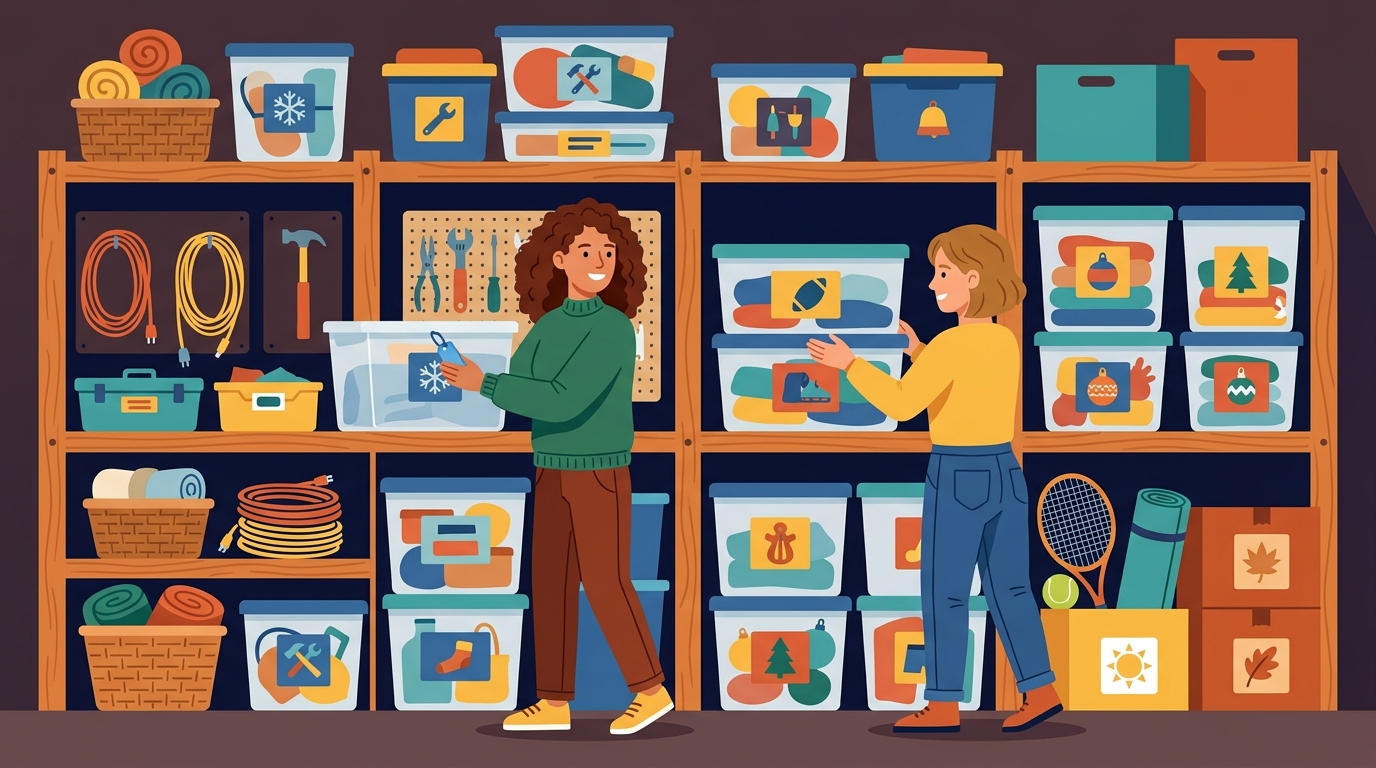
Organize storage bins shared by more than one person and the first problem is obvious: unlabeled bins turn into mystery boxes. The second problem is more annoying because it looks solved. A bin says "holiday," "tools," or "college," but the contents drift, one roommate borrows something, another adds overflow, and six months later the label is a polite lie.
A shared garage, attic, basement, or storage unit needs a labeling system that survives normal people. People move fast. They put things away while tired. They forget who bought the camping stove. They remember the blue lid, not the exact shelf. A good system has to work when someone is looking for a winter coat at 7 a.m., when a roommate is moving out, and when a family member is trying to find the air mattress without texting everyone.
This checklist treats labels as household infrastructure, not decoration. It combines storage organization, home inventory, ownership notes, and a light maintenance routine so the label on the outside keeps matching the stuff inside.
Start with the shared-storage problem, not the bin
Most bin systems fail because people buy containers before they decide what the containers need to answer. In a shared space, the label has to do more than name a category. It has to tell everyone what belongs in the bin, who owns the contents, where the bin lives, and what should happen when something is removed.
Shared storage has more failure points than personal storage
Personal storage can survive a little chaos because one person carries the context. Shared storage cannot. If three roommates use one basement corner for outdoor gear, each person may remember a different version of what is inside. One person thinks the tent is shared. Another person bought it. A third person borrowed the mallet and never put it back.
That is why shared labels need more precision than labels in a private closet. "Camping" is better than nothing, but "camping, shared, tent stakes checked May 2026" is a working label. It gives the next person a category, a permission cue, and a freshness cue.
Use facts from the way people actually live
Shared living is not a fringe arrangement. Pew Research Center has reported on the rise of adults sharing homes, driven partly by parents living with adult children, and the U.S. Census Bureau reported that about two-thirds of U.S. households in 2020 were family households. Lots of storage is shared by roommates, partners, adult children, parents, and extended family, not just by one tidy person with a label maker.
The system should assume multiple memories, multiple ownership claims, and multiple access habits. If a label only makes sense to the person who made it, it is not a shared label. It is a diary entry taped to a tote.
There is also a money reason to be stricter with shared bins. The National Association of REALTORS tracks how households change through buying, selling, and moving decisions, and those transitions are exactly when stored belongings get disputed, abandoned, duplicated, or lost. A labeling system is a small control that travels through those bigger life changes. It helps a household know what is staying, what is leaving, and what should not be bought again.
Make labels do four jobs
- Identify: What category is inside this bin?
- Locate: Where does this bin belong when it is not being used?
- Assign: Is the bin shared, personal, borrowed, seasonal, or donate-ready?
- Verify: When was the bin last checked, and does the outside still match the inside?
Those four jobs keep the system practical. If a label cannot answer them, the household will eventually have to inspect the bin from scratch, which defeats the point.
The shared storage bin labeling checklist
Use this checklist before you print anything permanent. It works for garages, attics, basements, closets, sheds, and paid storage units. The goal is not perfect categorization. The goal is fast recognition and fewer arguments.
1. Pick bin categories that match retrieval
Label categories by how people look for things, not by how the items entered the home. "Outdoor party supplies" is better than "misc garage." "Winter outerwear" is better than "clothes." "Baby gear to return to Maya" is better than "kids." A category should make the next search easier.
Useful shared categories include holiday decor, camping gear, sports equipment, winter clothing, backup bedding, tools, paint and repair supplies, documents, electronics and cords, guest supplies, donation items, family photos, kids' keepsakes, and move-out items. If one category needs too many exceptions, split it.
2. Put ownership on the label
Every shared bin should name ownership status. Use simple terms: shared, Brian, Michelle, roommates, landlord, borrowed from Ana, return to Dad, or household. Ownership is especially important for expensive items, sentimental items, and things that might leave during a move.
If ownership is mixed, write that clearly. A bin can say "camping, mixed owners, see inventory" or "holiday decor, household plus Quinn ornaments." That is not overkill. It prevents the move-out week problem where one person grabs the whole bin because their wreath is inside it.
3. Add location and shelf position
Bins move. Labels need a home address. Use a simple storage map: garage A2, attic left wall, basement shelf 3, storage unit back-right, or closet top shelf. Put the location on the label and put matching location markers on shelves.
Location labels are boring, which is why they work. They also help new roommates and family members put things back without asking. If your storage unit has no shelves, create zones with tape, colored tags, or a quick phone photo of the layout.
4. Date the last contents check
A date turns a label from a promise into a record. Write "checked July 2026" or "updated after move-in, July 2026." If the bin changes often, date the last major update. If it is seasonal, date it when the season ends.
The date helps everyone decide how much to trust the label. A bin checked last month can be opened with confidence. A bin last checked in 2021 deserves inspection before anyone buys duplicates.
5. Add a short inventory cue
Do not list every tiny item on the outside. Use a short inventory cue: "tent, tarp, lanterns," "gift wrap, bags, ribbon," or "router boxes, cords, adapters." The cue should name the items people are most likely to search for.
For detailed contents, connect the label to a digital inventory. A simple app record can hold photos, receipts, model numbers, notes, and ownership details that would clutter the bin itself. This is especially helpful when one bin holds a mix of shared items and personal items, such as guest bedding plus one roommate's spare quilt, or household tools plus a drill owned by one person.
A shared label is not a decoration. It is an agreement about what is inside, who can use it, and where it goes back.
Design labels roommates can actually follow
Pretty labels fail when they are too vague, too small, or too precious to update. Shared storage needs labels that can be read from a few feet away and edited when life changes. If updating the label feels like ruining the design, the design is wrong for shared storage.
Use plain language over aesthetic language
Choose labels that sound like a person searching under mild stress. "Backup bedding" beats "sleep essentials." "Tax documents 2021-2025" beats "archives." "Tools, shared, common use" beats "hardware." The best label is the one nobody has to interpret.
Roommates and family members should be able to add to the system without learning your personal taxonomy. If a label requires a tour, simplify it.
Make labels visible on two sides
Label the front and at least one side of every bin. Storage bins rotate when people pull them down, stack them, or shove them back into a unit. A side label prevents the classic storage-unit crouch where someone has to drag out six totes to find the only visible front.
For clear bins, put the label on the outside anyway. Visibility helps, but contents change, and clear plastic still turns into a blur when the bin is full. For opaque bins, use large contrast labels and avoid tiny handwriting.
Use color as a backup, not the whole system
Color coding is helpful for quick scanning, but it should never be the only information. Use color for broad zones: green for outdoor gear, red for holidays, blue for documents, yellow for shared household supplies, and gray for tools. Then write the category and ownership in words.
This matters in shared homes because not everyone sees or remembers colors the same way. A color tag can guide the eye, but the text has to carry the meaning.
Connect labels to inventory and receipts
Labels tell people what should be inside. Inventory proves what is inside. In shared storage, that proof matters because bins often hold valuable, sentimental, or reimbursable items.
Photograph each bin after labeling
Take one photo of the closed bin with the label visible and one photo of the open contents. If the bin includes electronics, tools, appliances, sports gear, or anything insured, photograph brand names, model numbers, and serial numbers when visible.
The Insurance Information Institute recommends creating a home inventory, keeping proof of value such as receipts and appraisals, and including belongings kept in self-storage facilities. That advice is useful even when you are not thinking about a claim. It is the same recordkeeping habit that prevents shared storage from becoming guesswork.
Save receipts where the label points
If a shared bin holds purchased items that might need reimbursement, warranty support, or insurance documentation, save the receipt with the item record. This is especially useful for power tools, camping equipment, storage racks, holiday electronics, small appliances, luggage, and moving supplies.
Paper receipts fade and disappear. A photo of the receipt attached to a bin inventory gives the household a durable record. It also makes ownership clearer when two people split a purchase.
Use a shared inventory app for the details
A label should stay brief. The detailed record should live somewhere searchable. Vorby is built for that kind of household memory: photos, item names, locations, owners, receipts, notes, and the difference between personal and shared belongings.
If your household is deciding whether a spreadsheet is enough, compare the tradeoffs in Vorby's spreadsheet vs app guide for shared household tracking. Spreadsheets can work for a small list, but storage bins become easier to maintain when photos, locations, and receipts live with the item instead of in separate tabs and group chats.
Set rules for taking things out and putting things back
A bin label can be perfect and still fail if removal rules are vague. Shared storage needs a simple borrow-and-return habit so the label keeps matching reality after the first weekend project.
Create a checkout habit for high-value or shared-use items
You do not need a library system for every blanket. You do need a quick note when someone takes the drill, tent, air mattress, folding table, pressure washer, or shared luggage. The note can be in Vorby, a shared note, or a group chat thread. It should say who took it, when, and where it is being used.
This is not about suspicion. It is about not buying duplicates because nobody knows where the original went. It also helps when an item needs to be cleaned, repaired, or returned before the next person needs it.
Mark incomplete bins immediately
If someone removes part of a set, mark the bin as incomplete. Use a small tag that says "missing mallet," "air pump with Sam," or "needs new batteries." Do not wait for the next person to discover the problem while packing for a trip.
Incomplete-bin tags are especially useful for camping gear, sports equipment, tools, party supplies, and holiday lights. These categories fail quietly because the missing piece is only obvious at the worst possible time.
Decide what counts as shared before move-out week
Roommate storage gets tense when ownership is undocumented. If your household has mixed-owner bins, make the decision early: what stays with the home, what belongs to individuals, what was bought together, and what should be split or reimbursed.
For the emotional version of this problem, use Vorby's guide to handling ownership disputes when roommates move out. Storage bins are often where those disputes become physical: one tote, three memories, and no record. Labels plus inventory reduce the drama before it starts.
Build a storage map for garages, attics, basements, and units
Labels work best when the space itself has a map. Without zones, every cleanup becomes a new arrangement, and every new arrangement makes old labels less useful.
Give each storage area a simple zone code
Use letters for walls or sections and numbers for shelves. Garage A1 can be the top-left shelf, A2 the next shelf down, and B1 the right wall. A storage unit can have front-left, front-right, middle, and back zones. The code does not need to be elegant. It needs to be stable.
Put zone labels where people can see them. Painter's tape is fine for the trial run. Permanent labels can come later, after the household proves the layout works.
Store by access frequency
Put frequently used shared items near the front and rarely used items high, low, or deep. Tools, sports gear, backup paper goods, and seasonal outerwear should be easier to reach than memory boxes and once-a-year holiday decor.
This is where shared storage differs from personal storage. The person who organizes the area may not be the person who retrieves the item later. Prime space should go to the categories most people need, not to the preferences of the organizer.
Use a photo map for paid storage
Paid storage units deserve extra documentation because the space is away from home and harder to browse. Take a wide photo from the door after organizing, then add the zone names to your inventory notes. If a bin moves, update the photo after the next visit.
Statista tracks self-storage in the United States as a large consumer industry, which matches what many households already know: overflow storage is common enough to need real systems. If you are paying monthly for space, a searchable inventory helps you avoid paying to store duplicates, mystery items, or things nobody wants.
Maintain the system without turning it into a hobby
The best labeling system is the one people can repair quickly. Shared storage does not stay perfect. The goal is to notice drift early and reset it before every bin becomes a junk drawer with a lid.
Schedule two seasonal checks
Check shared storage twice a year, ideally when seasonal items already move: spring and fall, or after winter holidays and before summer travel. Open the bins that changed, update labels, photograph new contents, and remove items that no longer belong.
Do not audit every paperclip. Focus on bins where a wrong label causes real pain: tools, documents, sports gear, holiday supplies, guest bedding, camping gear, and shared purchases. If the household also tracks consumables, pair this with a household supplies restocking checklist so backup supplies do not sprawl across every shelf.
Use a donation and return bin
Shared storage gets clogged when nobody wants to make a final decision. Create one donation bin and one return bin. Label them clearly, date them, and review them monthly. If an item is borrowed, write who it returns to. If an item is donation-ready, set a deadline.
This keeps transitional items from contaminating permanent bins. A holiday bin should not become half decor and half "maybe donate." A tools bin should not hold items that belong to a neighbor. Transitional items need their own temporary home.
Make the rule short enough to remember
Write one household rule for shared storage: "If you add, remove, borrow, or move something, update the label or the inventory." That is the whole maintenance system. Anything longer becomes a policy document nobody reads.
For a fuller home record beyond bins, Vorby's guide to building a personal inventory of everything you own shows how to move from one organized storage area to a complete household inventory without trying to catalog the entire home in one weekend.
FAQ
What should I write on storage bin labels for shared spaces?
Write the category, ownership status, location, last checked date, and a short contents cue. For example: "Camping, shared, garage B2, checked July 2026, tent and lanterns."
How do I organize storage bins shared with roommates?
Sort by retrieval category, label ownership clearly, create a simple storage map, and keep a shared inventory with photos. Add a borrow-and-return habit for items people remove often.
Are clear bins better than opaque bins?
Clear bins help with quick recognition, but they still need labels because contents change and bins get stacked. Opaque bins work well when the labels are large, readable, and placed on two sides.
How often should shared storage bins be checked?
Check active bins twice a year and after any move-in, move-out, seasonal change, or major project. Low-use memory boxes can be checked less often if ownership and location are already clear.
What is the easiest way to stop labels from becoming wrong?
Make one rule: when someone adds, removes, borrows, or moves something, they update the label or the digital inventory right away. Small updates prevent full re-sorts.
Turn labels into household memory
Shared storage works when every bin tells the truth. Clear labels, simple zones, ownership notes, and a searchable inventory turn garages, attics, basements, and storage units into spaces people can actually use. The win is not a prettier shelf. It is a household that can find things, return things, and stop buying what it already owns.
Vorby gives shared households one place to track what they own together and where it belongs. Make the bins visible, and the whole storage system gets easier to trust.


