Having a simple home inventory list template is one of those small things that can make a huge difference when you need it most. Think of it as your go-to record for everything you own, which is absolutely critical for insurance claims if you ever face something unexpected like a theft or fire.
Getting started is way easier than it sounds, especially with downloadable templates in formats you already know, like Excel, Google Sheets, or PDF. Taking this one step now could be the very thing that protects your financial well-being down the road.
Why a Home Inventory Is Your Financial Safety Net
Let's be honest, the thought of creating a home inventory can feel like a massive chore. But it's genuinely one of the most powerful financial tools you can have.
Imagine the worst-case scenario: a fire, a flood, a break-in. Now, try to recall every single thing you own from memory for an insurance claim, all while dealing with the stress of the situation. It’s a nearly impossible task.
A detailed home inventory list flips the script. Instead of chaotic guesswork, you have a straightforward process. It’s undeniable proof of ownership and value, which helps ensure you get a fair and complete settlement from your insurance provider. Without it, you could be leaving thousands of dollars on the table just because you couldn't remember or prove what you lost.

The Real Cost of Being Unprepared
The financial gap between having an inventory and not having one is staggering. Studies show that homeowners without detailed records typically recover only 40-50% of what their belongings are actually worth. That’s a huge loss.
In contrast, those with a comprehensive list can recover up to 90% of their claim's value. Not only that, but documented claims get processed much faster, often in just 7-14 days instead of the typical 30-45 days it can take for unsubstantiated ones. You can dig deeper into the benefits of a home inventory for insurance to see just how big the impact is.
And this isn’t just about the big-ticket items like your TV or sofa. It’s about everything from your clothes and shoes to every pot and pan in your kitchen. The value of all those smaller things adds up fast, and a solid inventory makes sure they aren't forgotten.
A home inventory is more than just a list; it’s a proactive financial strategy. It’s the difference between a swift, fair recovery and a prolonged, frustrating battle for compensation when you're at your most vulnerable.
Protecting Your Most Valuable Possessions
For items that hold significant monetary or sentimental value, a detailed inventory isn't just nice to have, it's essential. This is especially true for things like insuring valuable jewelry like diamond rings, where proof of value is paramount.
Think about the items that would be incredibly difficult or expensive to replace:
- Electronics: Your laptop, cameras, and home theater system, complete with serial numbers.
- Collections: Any artwork, antiques, or valuable memorabilia you've gathered over the years.
- Important Documents: Things like passports, birth certificates, and property deeds that you (hopefully) keep in a fireproof safe.
Documenting these with photos, receipts, and professional appraisals provides the concrete evidence you need for proper insurance coverage and a smooth claims process. This simple act turns your list into a powerful shield for your family's assets.
The scary reality is that an estimated 70-80% of homeowners are underinsured simply because they don't have accurate records of what they own. That’s a risky gamble that a good home inventory can fix.
Picking the Right Inventory Template for Your Life
Finding the perfect home inventory template is a lot like picking the right tool for a job; the best one really depends on you. There's no single solution that works for everyone. The whole point is to choose a format you'll actually stick with, turning this from a one-off project into a sustainable habit.
For some, the robust features of a spreadsheet are a perfect fit. For others, the sheer simplicity of a printable checklist is all they need to finally get started. The key is to stop hunting for a flawless system and just pick one that feels manageable.
Comparing the Go-To Template Formats
You’ll generally find three main options out there: Excel, Google Sheets, and good old-fashioned printable PDFs. Each has its own strengths and weaknesses. Figuring out which one aligns with your style is the first big step.
To make it easier, let's break down how these common formats stack up against each other. This quick comparison should help you pinpoint the best starting point for your own inventory project.
Template Format Comparison Guide
| Format | Best For | Key Advantages | Potential Drawbacks |
|---|---|---|---|
| Microsoft Excel | Those who want powerful offline features and are comfortable with spreadsheet software. | Works without internet, strong sorting/filtering, automatic calculations for total value. | Clunky to share and collaborate; requires manual backups to stay safe. |
| Google Sheets | Anyone who values collaboration, accessibility from any device, and automatic saving. | Cloud-based for easy access/sharing, real-time updates with others, auto-saves. | Requires an internet connection for most features; can be slow with huge inventories. |
| Printable PDF | People who prefer a low-tech, tactile approach or want a simple way to start. | Very straightforward, no software needed, feels less intimidating. | Not searchable, no auto-calculations, editing is a pain, easily lost or damaged. |
Ultimately, the goal is to get your information documented in a way that's secure, accessible, and easy to update. While a PDF is a great first step, a digital format is where the real power lies.
It’s no surprise that digital solutions are taking over. The use of digital home inventory tools has skyrocketed, with Google Sheets templates alone being downloaded over 2 million times globally, a whopping 320% jump since 2019. This is largely because our phones make it incredibly easy to snap photos and log items as we go.
Make That Template Your Own
Once you've picked your format, it's time to personalize it. A generic template is a decent start, but a customized one is a seriously powerful tool. You need to think like an insurance adjuster and add columns that capture the exact details they would demand in a claim.
Go beyond just the item name. A truly effective home inventory needs to be tailored to your stuff. For instance, a vintage camera collector needs completely different fields than someone who is just documenting major appliances. Our comprehensive home inventory checklist is a fantastic resource for figuring out what details matter most.
At a minimum, make sure your template has these essential columns:
- Item Name & Description: Get specific. Not "TV," but "Samsung 65-inch QLED 4K Smart TV, 2023 model."
- Photo/Video Link: This is non-negotiable proof. Set up a folder in Google Drive or Dropbox and link directly to each item's photo.
- Purchase Date & Price: This establishes the item's original cost. Snap a picture of the receipt and link to that, too.
- Serial & Model Number: Absolutely critical for electronics and appliances. It's definitive proof of ownership that can't be disputed.
- Estimated Current Value: For insurance, this helps you track if things have depreciated or, in some cases, appreciated over time.
- Room/Location: This seems simple, but it's essential for organizing your documentation process and finding things later.
By customizing your template, you’re turning a simple list into a detailed, personal database of your assets. That level of detail is exactly what transforms an inventory from a chore into an invaluable lifeline during a stressful insurance claim.
A Practical Room-by-Room Inventory Method
Let’s be honest. The biggest thing stopping most people from creating a home inventory isn't a lack of tools; it's the sheer, paralyzing overwhelm. Staring at a lifetime of belongings with a blank spreadsheet open is a recipe for procrastination.
The only way to beat that feeling is with a system. A repeatable method that chops the entire project into small, manageable chunks. This room-by-room approach turns a monumental task into a series of small, achievable wins.
To get some momentum, fight the urge to start with the most cluttered space. Don't go straight for the garage or that packed home office. Instead, pick a small, contained room. The guest bathroom is a perfect candidate. It has a limited number of items, and you can probably knock it out in under an hour. That quick success gives you a huge psychological boost, proving you can do this and motivating you to keep going.
Starting Small and Building Confidence
Once you’ve finished that first small room, you'll have a feel for the workflow. You’ll know how you want to describe items, snap clear photos, and plug the details into your chosen home inventory list template. It's a low-stakes practice run that helps you smooth out any kinks in your process before tackling the more complex areas.
Think of it as a warm-up. You wouldn't run a marathon without training, so don't try to inventory your entire house in one shot. After the bathroom, maybe move to a hallway or a small bedroom. Each completed room reinforces the habit and makes the next one feel less intimidating.
Tackling High-Density Areas
With a few small wins under your belt, you’re ready for the bigger challenges: the kitchen, the living room, and the home office. These spaces are usually packed with everything from large appliances to tons of small, valuable electronics.
The key here is to be systematic. Don’t just wander around the room grabbing things at random. Pick one corner and work your way around clockwise. Document everything in that section before moving on. This simple trick keeps you from missing items and brings order to the chaos.
For these major areas, make sure to get specific:
- Kitchen: Document every major appliance (refrigerator, oven, dishwasher) with its brand, model, and serial number. Take group photos of your dishes and cookware, but photograph valuable small appliances like a stand mixer or a high-end blender individually.
- Living Room: Your focus should be on furniture, electronics (TV, sound system, gaming consoles), and significant decor like artwork or rugs. Always get a shot of the serial numbers on the back of your electronics; a quick phone photo is all you need.
- Home Office: This is often ground zero for valuable tech. Catalog your computer, monitors, printer, and any other specialized equipment. Don't forget to document expensive furniture like an ergonomic chair or standing desk.
Handling Collections and Clutter
So, what about the really tough spots? The closets, attics, and drawers filled with years of stuff can feel impossible. The secret is to stop trying to document every single thing. Instead, group similar, low-value items into a single entry.
Instead of listing every paperback book you own, create one entry: "Paperback Book Collection (approx. 40 books)" and take a photo of the shelf. This saves immense time while still providing the necessary documentation for an insurance claim.
This "batching" method is a lifesaver for categories like:
- Collections of DVDs, CDs, or vinyl records.
- Sets of tools in the garage.
- Kitchen utensils in a drawer.
- Children's toys in a storage bin.
For spaces like closets, organizing things first can make the inventory process way smoother. If you need some help getting started, check out these closet storage organization ideas to simplify the space before you begin documenting.
This simple workflow (choosing a format, adding key details, and attaching a photo) is the core of the entire process.
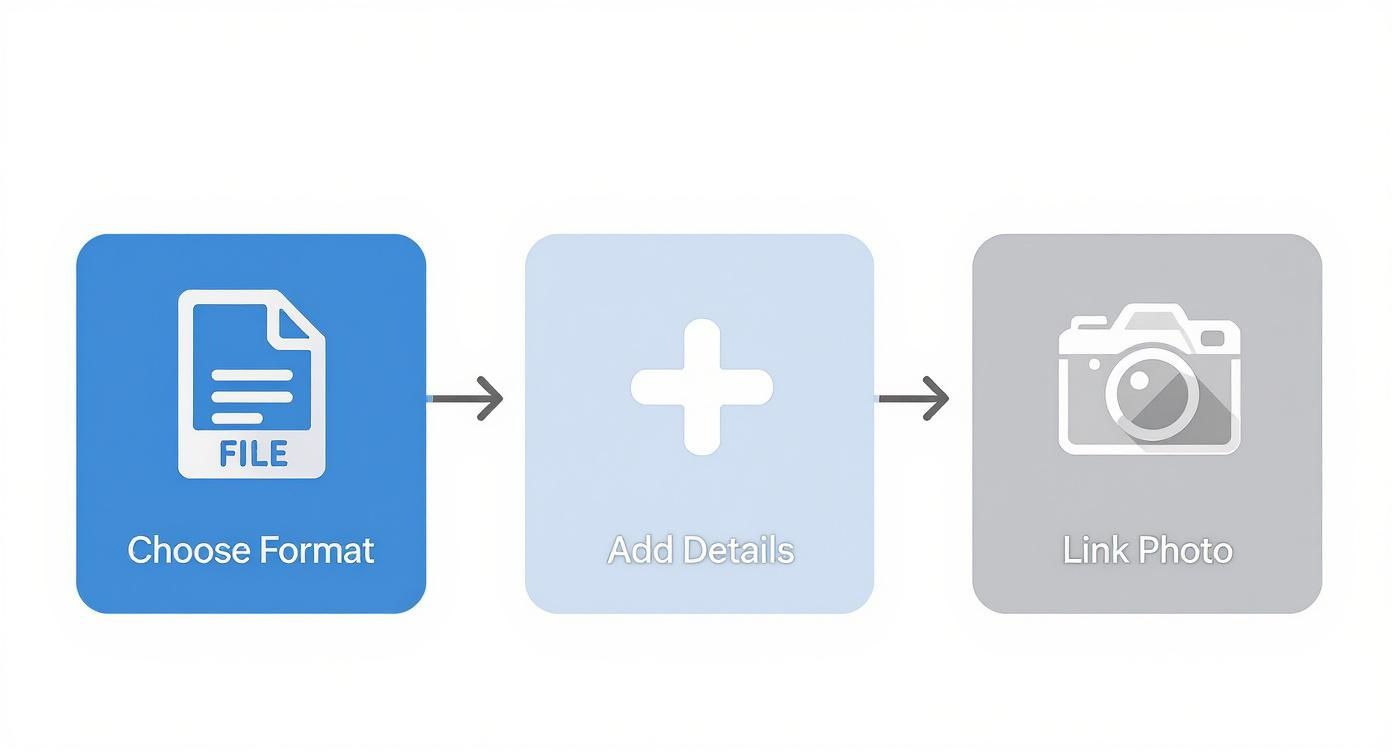
Seeing it visually reinforces that the core task is straightforward, which helps cut through that feeling of complexity.
Photographing and Valuing Your Items
Photos are your most powerful evidence, so make them count. Take clear, well-lit pictures of every important item. For your high-value possessions, take multiple shots, including close-ups of serial numbers, brand logos, or any unique identifying marks. A short video walkthrough of each room is also a great way to supplement your photos, giving a sweeping overview of your belongings in context.
Estimating value can be tricky. For anything you bought recently, the price on the receipt is your best friend. For older items, a quick search on eBay for similar used products can give you a realistic "actual cash value." But for things like antiques, art, or fine jewelry, a professional appraisal is really the only way to establish an accurate value for insurance.
Your Inventory Is Only as Good as Its Proof
A basic spreadsheet is a great starting point, but let's be honest, in a real emergency, it might not be enough. To make your inventory truly effective, you need to think like an insurance adjuster. That means backing up your claims with undeniable proof. Fortunately, the technology you already own can turn a simple list into a powerful, dynamic system that does the hard work for you.

The financial stakes here are higher than most people realize. The National Association of Insurance Commissioners estimates that unsubstantiated property claims cost insurers around $5.6 billion a year. For homeowners, that translates directly to smaller checks; without solid documentation, you could get a settlement that’s 35-50% lower than what your stuff was actually worth. You can dig into more data on how detailed lists impact claims by checking out these insights on inventory spreadsheets.
Smart Tools for a Smarter Inventory
You don't need a degree in IT to build a bulletproof inventory. The smartphone in your pocket is all you really need to create a rich, multimedia record that’s nearly impossible to dispute.
Think beyond just a list of items. Your phone is your key to layering proof upon proof.
Here are a few simple but game-changing tools to start using:
- Scanner Apps: Ditch the shoebox full of fading receipts. Use an app like Adobe Scan or Microsoft Lens to create a searchable digital file for every major purchase, warranty, and manual.
- Cloud Storage: This is non-negotiable. Save all your inventory photos, videos, and scanned documents to a service like Google Drive, Dropbox, or OneDrive. It keeps your records safe from the very disasters you're preparing for.
- Video Walkthroughs: This is one of the fastest ways to document everything. Just walk through each room, narrating as you go. Point out valuable items, open closets, and describe what you're seeing. It provides incredible context.
The goal is to create multiple layers of proof. A spreadsheet entry is good, a photo is better, and a photo with a linked digital receipt is undeniable. This approach makes your inventory virtually bulletproof.
Taking It a Step Further with Automation
Once you've got the basics covered, you can use some clever tricks to make your inventory an active part of your home management system, not just a static file you forget about.
One of my favorite methods is using QR codes. You can generate unique QR codes for storage bins or high-value electronics. A quick scan with your phone can instantly pull up the item's details in your spreadsheet, including photos and manuals. It’s a lifesaver for figuring out what’s in that dusty box in the attic without having to tear it open.
This is where dedicated platforms really shine. When you connect your inventory template to a service like Vorby, you can automate these tedious tasks. Instead of manually linking photos or typing in receipt details, the system helps you streamline the entire process. We break down the advantages in our guide to home inventory software.
These systems sync across all your devices, so your inventory is always up-to-date and accessible. They can also send you reminders to do an annual review or check on expiring warranties. This is what prevents your hard work from becoming obsolete. Your inventory becomes a living document that evolves with your home, always ready when you need it most.
How to Keep Your Inventory Safe and Up to Date
Finishing your home inventory feels like a huge win. But here’s the hard truth: a list you create once and then forget about quickly loses its value. Think of your inventory as a living document, not a time capsule. Its real power comes from being accurate and ready the moment you actually need it.
To keep it that way, you need a simple, sustainable maintenance plan. This doesn't mean you have to spend hours on it every week. The key is finding a realistic rhythm that prevents all your hard work from becoming obsolete.
Building a Simple Update Schedule
The best way to maintain your inventory is to get into a regular update habit. Without it, your list can quickly fall out of sync with your actual possessions, creating blind spots in your insurance coverage or just making it harder to find things.
A simple yet highly effective schedule has two parts:
- Annual Review: Set a calendar reminder once a year to do a full walkthrough. This is a great thing to tie to your insurance policy renewal. Look for items you've sold or discarded and check if your valuations are still realistic.
- Situational Updates: Get into the habit of making quick updates after big changes. This means adding that new laptop right after you buy it, noting valuable gifts, or updating the list after a home renovation project.
This two-pronged approach ensures your inventory remains a reliable tool. The annual check-in catches the broad strokes, while the quick situational updates keep it precise all year long.
Safeguarding Your Inventory Data
Your home inventory contains a ton of personal information, from what you own to how much you paid for it. Protecting this data is just as critical as creating the list in the first place. You need a strategy that shields it from both physical disasters (like a fire) and digital threats (like a hard drive failure or cyberattack).
The core principle here is redundancy. Never, ever keep your inventory in just one place. If your only copy is on a laptop that gets destroyed in a flood, your list is gone forever right when you need it most.
A truly secure home inventory exists in multiple locations at once. The gold standard is the 3-2-1 backup rule: at least three copies of your data, on two different types of media, with one of those copies stored completely off-site.
This strategy ensures that no single point of failure can wipe out all your hard work.
Putting Your Security Strategy into Practice
This sounds more complicated than it is. A multi-layered storage plan is pretty straightforward and uses tools you probably already have. The goal is to create a secure, accessible system that protects your data from just about anything.
Here’s a practical, three-part plan to lock down your inventory:
- Primary Cloud Storage: Use a trusted cloud service like Google Drive, Dropbox, or OneDrive as your main hub. This gives you access from any device, anywhere, and your changes are saved automatically. This is your working copy.
- External Hard Drive: Grab an inexpensive external hard drive and make a complete backup of your inventory (spreadsheet, photos, receipts, everything) once a month. The crucial part? Store this drive off-site. Keep it at your office, in a safe deposit box, or with a trusted family member.
- Digital Security Measures: Protect the files themselves. You can password-protect your spreadsheet or PDF documents to add another layer of security. Most importantly, enable two-factor authentication (2FA) on your cloud storage account. This one simple step makes it significantly harder for anyone else to access your sensitive files.
You’ve downloaded the templates and you’re ready to dive in, but a few questions are probably rattling around in your head. That’s perfectly normal. Tackling a home inventory for the first time always brings up some tricky "what-if" scenarios.
Let's clear those up right now. Think of this as the expert-in-your-corner section, designed to give you the confidence to push through those sticking points.
What Is the Best Way to Value My Possessions?
Getting the value right is crucial, especially for insurance, but it can feel like throwing darts in the dark. The best method really depends on what you're looking at.
For most of your everyday stuff (furniture, kitchen gadgets, decor) you’re looking for the Actual Cash Value (ACV). This is just a fancy term for what it would cost to replace the item today, minus depreciation for age and wear. The easiest way to get a quick, realistic number is to search for similar used items on eBay or Facebook Marketplace. That’ll give you a solid ballpark figure.
But that approach just doesn’t work for your more valuable or unique items.
- Recent Purchases: This is the easy one. Just use the price from the original receipt. It’s the most accurate valuation you can possibly have.
- Antiques, Art, and Collectibles: These things often go up in value, not down. For these, a professional appraisal is non-negotiable. It's the only way to get a valuation your insurance provider will take seriously.
- Jewelry and Heirlooms: Just like art, these need an appraiser. Their true worth is often way beyond the original purchase price, and you need that documented.
How Much Detail Is Really Necessary?
It's so easy to fall down a rabbit hole here, trying to document every single fork and t-shirt. Don't do it. The goal is to find that sweet spot between being thorough and actually getting the job done.
Here’s a practical rule of thumb I always recommend: individually photograph and list any single item that would cost you more than $50 to $100 to replace. Anything less than that? Group it. This is a massive time-saver.
For example, nobody has time to list 20 different shirts. Instead, create one entry: "Men's Casual Shirts (approx. 20)" and snap a quick photo of them hanging in the closet. That's all the proof you need, and it saves you a ton of tedious work.
Save your high-effort documentation, like logging serial numbers and attaching receipts, for the big-ticket categories: electronics, major appliances, power tools, and designer goods.
Should I Inventory Items I Plan to Get Rid Of?
This comes up a lot, especially when you're decluttering at the same time. The short answer is a hard no. Your home inventory needs to be a clean, accurate record of what you own and intend to keep.
Adding items you’re about to sell, donate, or toss just clutters your list and makes it inaccurate. Worse, it could inflate the perceived value of your belongings and complicate a potential insurance claim down the road.
If you put an item on your inventory, you're telling your insurer, "I would want this replaced or be paid for its loss." So, stick to what actually matters to your household right now. If you're selling stuff, make a separate list for that. Keep your official home inventory list template focused on its real job: protecting your financial well-being.
Ready to transform your home inventory from a simple list into an intelligent, automated system? With Vorby, you can use image recognition to catalog items, parse email receipts to add new purchases, and use QR codes to see what's in every box at a glance. Start your free trial and discover a smarter way to stay organized.