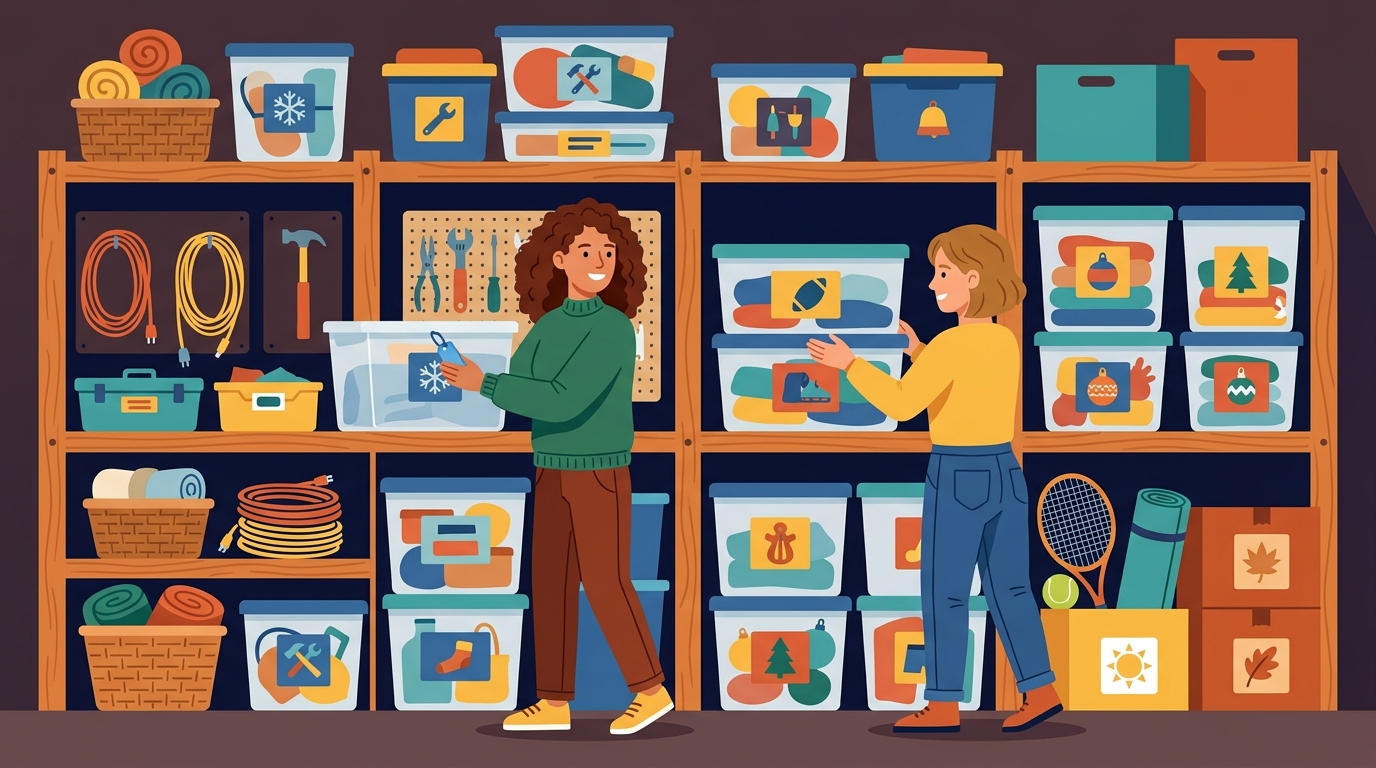
If you want to stop losing household items, the solution is not buying another tray, yelling across the house, or promising yourself you will be more careful tomorrow. Small items disappear because shared homes run on invisible habits. One person drops keys by the door, another leaves them in a coat pocket, someone moves the TV remote while cleaning, and the charging cable that used to live by the sofa migrates to a bedroom, a backpack, or the car.
The items are not actually vanishing. They are being returned to different places by different people, with no shared rule for what counts as "away." That is why the same home can feel organized on Sunday and chaotic by Wednesday.
This guide is for households where people spend real time looking for keys, remotes, charging cables, reading glasses, earbuds, gift cards, batteries, measuring tapes, pet leashes, or the one adapter everyone needs five minutes before leaving. The fix is a simple household system: fewer default locations, clearer ownership, visible labels, and a lightweight inventory habit for anything that tends to wander.
Why small household items go missing so easily
Small items are hard to manage because they live at the intersection of convenience, memory, and other people's routines. A couch throw can only be in so many places. A phone charger can be plugged into any outlet in the house. Keys can hide under mail, in yesterday's pants, inside a gym bag, or on the kitchen counter behind a cereal box.
Shared homes create competing habits
The problem gets worse as soon as more than one person uses the same space. The U.S. Census Bureau defines a household as all people occupying a housing unit, whether they are related or not. That plain definition matters because it captures the reality of modern homes: roommates, couples, kids, adult children, aging parents, and visitors all create item movement.
Pew Research Center has also documented the growth of multigenerational living, reporting that 59.7 million Americans lived in multigenerational family households in March 2021, or 18% of the U.S. population. More people under one roof means more hands picking things up, more opinions about where things belong, and more chances for small shared items to land in temporary places.
Small items lack visual authority
Large belongings announce themselves. A vacuum, bicycle, winter coat, or stand mixer is hard to miss. Small items do not. They blend into surfaces, slide into drawers, and get covered by paper, laundry, toys, and mail. Because they take up so little space, people also feel less guilty putting them somewhere "just for now."
That phrase is the beginning of most household item loss. The item is placed somewhere convenient for the person using it, not somewhere predictable for the next person who needs it. The system fails because it relies on individual memory instead of shared visibility.
Replacing missing items becomes a hidden household cost
A lost cable is rarely expensive by itself, but the pattern adds up. Families buy duplicate chargers, extra remotes, spare glasses, backup keys, batteries they already own, and tools they later discover in a closet. The Insurance Information Institute recommends creating a home inventory with photos, serial numbers, receipts, and regular updates because household belongings are easier to manage and claim when they are documented. That same principle applies at a smaller scale: when you know what you own and where it belongs, you buy fewer duplicates and waste less time searching.
Start with a reset, not a shopping trip
The fastest way to stop losing small things is to reset the home before buying more organizers. Baskets, bins, hooks, and trays help only after you know which items actually need a home. Otherwise, you end up with attractive clutter containers and the same old search parties.
Make a ten-item lost list
Do not inventory the whole house first. Start with the ten items your household searches for most often. A good list might include house keys, car keys, mailbox keys, the main TV remote, streaming remotes, USB-C chargers, Lightning cables, reading glasses, tape measures, scissors, pet medication, or the garage opener.
Write the list in plain language everyone understands. "Black Apple TV remote" is better than "remote." "Long white USB-C cable for the living room" is better than "charger." Specific names prevent the common shared-home problem where three people are talking about three different objects with the same label.
Find the current landing spots
For each item, ask where it was found the last three times it went missing. This is more useful than asking where it "should" go. The current landing spots reveal how people actually move through the home. Keys might land near the front door, on the kitchen island, and inside work bags. Charging cables might cluster near the sofa, bed, desk, and car.
Patterns are helpful, even when they are messy. If an item repeatedly appears in two rooms, the home may need two assigned versions of that item. If it appears in six rooms, the item needs a stronger rule, a label, or a physical home that is easier than every alternative.
Remove duplicate confusion
Duplicates are not always bad. In fact, the right duplicate can reduce conflict. The problem is unlabeled duplicates that float around without purpose. Four identical black charging bricks in different rooms can create more confusion than one clearly labeled "living room charger" and one clearly labeled "desk charger."
If you already have a lot of bins, labels, and shared storage, compare your setup with Vorby's shared storage bin labeling checklist. The key idea is the same for small items: labels work when they name a real behavior, not just a container.
Create designated spots that people will actually use
A designated spot only works if it beats the nearest flat surface. If the key hook is hidden behind a closet door, people will use the counter. If the remote basket is across the room from the couch, the remote will live in the cushions. Designated spots have to be obvious, low-friction, and close to the moment when the item leaves someone's hand.
Use point-of-use homes
Point-of-use storage means keeping the item where it is used, not where it looks neat in a photo. The TV remote belongs near the TV seating area. Reading glasses belong where reading actually happens. The dog leash belongs at the door used for walks. The tape measure belongs near the drawer or shelf where people start household tasks.
This is where many tidy systems fail. They choose a storage spot based on aesthetics, then punish everyone for acting like normal humans. A better system accepts the route people already take and places the home directly in that route.
Limit each item to one primary home
Every frequently lost item needs one primary home. Not a general zone, not "somewhere in the entry," not "probably the junk drawer." One home. A hook, tray, labeled cup, drawer divider, magnetic strip, cable clip, small bin, or shelf label is enough.
The primary home should be easy to describe in one sentence: "The main remote lives in the tan basket on the coffee table." If you cannot say the location that clearly, the location is not clear enough for a shared household.
Make the home visible before you make it pretty
Open storage is usually better for high-turnover small items. A shallow tray beats a covered box for keys. A labeled cable clip beats a drawer full of cords. A clear bin beats an opaque basket for batteries, adapters, and glasses cases. Once the habit sticks, you can make the setup prettier. In the beginning, visibility matters more than style.
The best place for a frequently lost item is not the most elegant spot. It is the spot people can use when they are tired, distracted, and carrying three other things.
Build a small-item map for the whole household
A small-item map is a simple list of the things people search for and where each one belongs. It can live on paper inside a cabinet, in a shared note, or in a home inventory app. The format matters less than the agreement. Everyone needs the same answer to the question, "Where does this go?"
Group items by function.
Organize the map by how items are used, not by how the house is decorated. Common groups include entry items, media items, charging items, repair items, paperwork items, pet items, school items, and guest items. This makes the system easier to remember because the category matches the moment of use.
For example, entry items might include keys, sunglasses, wallets, transit cards, garage openers, and reusable shopping bags. Media items might include remotes, game controllers, HDMI adapters, headphones, and spare batteries. Repair items might include tape measures, scissors, Allen keys, picture hooks, and the tiny screwdriver that somehow becomes the most important object in the home twice a year.
Assign owner, home, and backup location.
Each item on the map should answer three questions: who is responsible for it, where does it live, and where is the backup if the primary one is unavailable? This is especially useful for shared items. A family may decide that one person owns the spare key box, another owns the remote basket, and another owns the cable drawer.
This is not about blame. It is about reducing the number of people who assume someone else handled it. When an item has no owner, it becomes everyone's problem and no one's habit.
Use photos for items that are easy to confuse.
Photos help when small items look similar. A picture of the correct cable, remote, adapter, or battery pack prevents people from grabbing the wrong thing and moving it to another room. The Insurance Information Institute specifically recommends photo records for home inventories because images make belongings easier to identify. That advice is just as useful for the small items that keep derailing daily routines.
If you want a broader version of this exercise, Vorby's guide on building a personal inventory walks through how to document belongings without turning the project into a second job.
Fix the highest-friction categories first
You do not need to organize every small item at once. Start with the categories that cause the most daily interruption. In most homes, that means keys, remotes, cables, glasses, and shared utility items.
Keys and wallets
Keys need a landing spot within arm's reach of the door people actually use. A hook, wall pocket, tray, or small shelf all work. The important part is that keys leave the hand before the person enters the rest of the house. If keys travel to the kitchen, bedroom, office, or laundry room, the system has already lost.
For households with multiple drivers, label spare keys by vehicle and purpose. "Subaru spare" is better than a mystery key on a ring. If a key is rarely used, store it in a secure backup spot and record where it lives. Everyday keys and backup keys should not share the same messy bowl.
Remotes and controllers
Remotes disappear because they are used while people are relaxed. No one wants to stand up and file a remote in a drawer after watching a movie. Put a remote basket, tray, or caddy exactly where people naturally reach. If there are multiple remotes, label the back with the device name: TV, soundbar, Apple TV, Roku, fan, lights.
Game controllers need charging homes too. A controller that can be returned and charged in one motion is far more likely to be put away than one that requires finding a cable first.
Cables, adapters, and chargers
Cables are the hardest small-item category because they breed in drawers and vanish in backpacks. Divide them into three types: fixed cables that stay in one place, travel cables that live in bags, and backup cables that live in storage. Do not let all three types mix.
Use labels or colored ties for room-specific chargers. A cable marked "sofa" has a better chance of returning to the sofa than a plain white cable that belongs everywhere and nowhere. For shared households with lots of communal supplies, the same logic applies to pantry and utility items. Vorby's household supplies restocking checklist is a useful companion when cables, batteries, bulbs, and cleaning basics all need a shared system.
Reading glasses, earbuds, and everyday carry items
Items used in multiple rooms need either a primary home or intentional duplicates. Reading glasses can have a pair near the bed and a pair near the favorite chair, but each pair should still have a home. Earbuds should have a charging home, not a rotating series of pockets. Gift cards, transit cards, and membership cards should live with wallets or in one labeled card envelope.
The mistake is treating mobility as an excuse for randomness. Mobile items need stronger homes, not weaker ones, because they are already designed to travel.
Use household rules that do not require perfect people
The best organization system assumes people will be distracted. Kids will rush. Roommates will clean quickly before guests arrive. Someone will unplug a charger and forget where it came from. A good system survives that because it makes the right action easier than the wrong one.
The one-touch return rule
A one-touch return means the item can be put away with one motion. Drop keys in tray. Place remote in basket. Clip cable into holder. Slide glasses into cup. If returning an item requires opening a closet, moving another bin, reading a tiny label, and closing a lid, people will avoid it.
Use this rule when choosing storage. Every extra step reduces compliance. This is not laziness; it is household physics.
The closing sweep
A closing sweep is a two-minute reset at a natural transition point. Before bed, before leaving for work, or after the kids go upstairs, one person scans the high-loss zones: entry, couch, kitchen counter, desk, and bedside table. Anything from the ten-item lost list goes home.
This works better than a vague cleaning routine because it has a narrow target. You are not cleaning the house. You are rescuing the items that cause tomorrow's search.
The no-mystery-drawer rule
Every home has a junk drawer. That is fine. The problem is the mystery drawer, where useful items disappear into a pile with no categories. Use small dividers or bags inside the drawer: batteries, adapters, writing tools, tape, spare keys, glasses accessories, and hardware. The drawer can still be casual, but it cannot be a black hole.
If roommates or family members disagree about whether to use a spreadsheet, shared note, or app for this kind of tracking, Vorby's comparison of a spreadsheet versus an app for shared household tracking lays out the tradeoffs clearly.
When a home inventory app helps
You do not need software for every object in the house. A hook can solve keys. A basket can solve remotes. A labeled cable pouch can solve travel chargers. An app becomes useful when the item has value, moves between rooms, is shared by multiple people, or needs context beyond a label.
Track the items that create arguments or duplicate buys
Use a home inventory app for items that people repeatedly ask about: spare keys, specialty chargers, seasonal adapters, tools, warranty items, electronics, glasses, medical devices, storage-bin contents, and shared household supplies. The goal is not to catalog every paperclip. The goal is to make the annoying questions answerable.
For example, "Where is the HDMI adapter?" should not require opening six drawers. The answer should be visible: office cable drawer, second divider, labeled video adapters. If the adapter has a photo, owner, and location, the next person can find it without starting a group investigation.
Attach receipts, photos, and notes where they matter
NAR's home buyer research regularly emphasizes how housing affordability and limited inventory shape household decisions, including how people use the space they already have. When homes, apartments, and shared living spaces are expensive, it makes sense to manage belongings instead of casually replacing them.
Receipts and photos help with that. The Insurance Information Institute recommends storing proof of value, recording serial numbers, and updating home inventories after big purchases or annual check-ins. For small household items, you can use the same habit selectively: add receipts for electronics, photos for confusing adapters, notes for where spares live, and ownership details for shared purchases.
Make it searchable for everyone
The biggest advantage of a digital system is search. Someone can type "remote," "USB-C," "mailbox key," or "reading glasses" and get the agreed location. That is better than relying on the one person who remembers where everything is, especially in families and roommate homes where responsibility is unevenly distributed.
Vorby is built for this kind of household visibility. Use it for the belongings that need a photo, location, owner, receipt, or shared answer. Leave the purely obvious items to hooks and baskets.
A simple seven-day plan to stop losing small household items
If the system feels too big, run it as a one-week reset. The point is not perfection. The point is to create a few shared defaults that remove the daily friction.
Days 1 and 2: observe and list.
For two days, write down every item someone searches for. Do not fix anything yet. Just capture the pattern. Note where the item was supposed to be, where it was found, who needed it, and whether it caused a delay, argument, duplicate purchase, or extra errand.
At the end of day two, pick the top ten. These are the only items in scope for the first reset.
Days 3 and 4: assign homes.
Choose one primary home for each item. Use the point-of-use rule and the one-touch return rule. Add labels where confusion is likely. If an item genuinely needs duplicates, assign each duplicate to a room or person. If an item has value or keeps causing confusion, add it to Vorby with a photo and location.
Do not buy new organizers unless the item has no workable home. Most homes already have a tray, bowl, cup, divider, pouch, hook, or basket that can serve the first version of the system.
Days 5 to 7: test and adjust.
For three days, use the system without scolding people. If an item keeps missing its home, the home is probably in the wrong place or has too many steps. Move the home closer to use, make it more visible, or reduce the number of competing locations.
At the end of the week, keep what worked and change what did not. A household system should feel boring by the time it succeeds. The win is not a beautiful drawer. The win is leaving the house without asking where the keys are.
FAQ: stopping lost keys, remotes, cables, and other small items
What is the best way to stop losing keys at home?
Put one key tray, hook, or wall pocket within arm's reach of the door you use most. Everyday keys should never travel deeper into the house unless they are actively being used.
How do I keep TV remotes from disappearing?
Use an open basket or tray at the exact seating area where the remotes are used. Label the back of each remote by device so people know what belongs in the basket.
How should I organize charging cables in a shared home?
Separate fixed chargers, travel chargers, and backup cables. Label room-specific cables and keep backups in one divided drawer or pouch so everyday cables stop migrating.
Should I use a home inventory app for small items?
Use an app for small items that are valuable, shared, easy to confuse, or repeatedly lost. Photos, locations, owners, and notes make the answer searchable for everyone.
What if my family or roommates do not put things back?
Make the return spot easier. Move it closer, remove lids, use open trays, and reduce steps. If people still miss the spot, the system is probably designed for an ideal version of the household, not the real one.
Make small-item organization a household habit.
Small-item organization works when the home has clear landing spots, shared names, and a short list of belongings worth tracking. Keys, remotes, cables, glasses, and adapters stop disrupting the day when everyone can see where they belong.
Vorby gives households one place to track the small belongings that create daily friction. Create a clear home for the things people search for most, then make the answer easy for everyone to find.