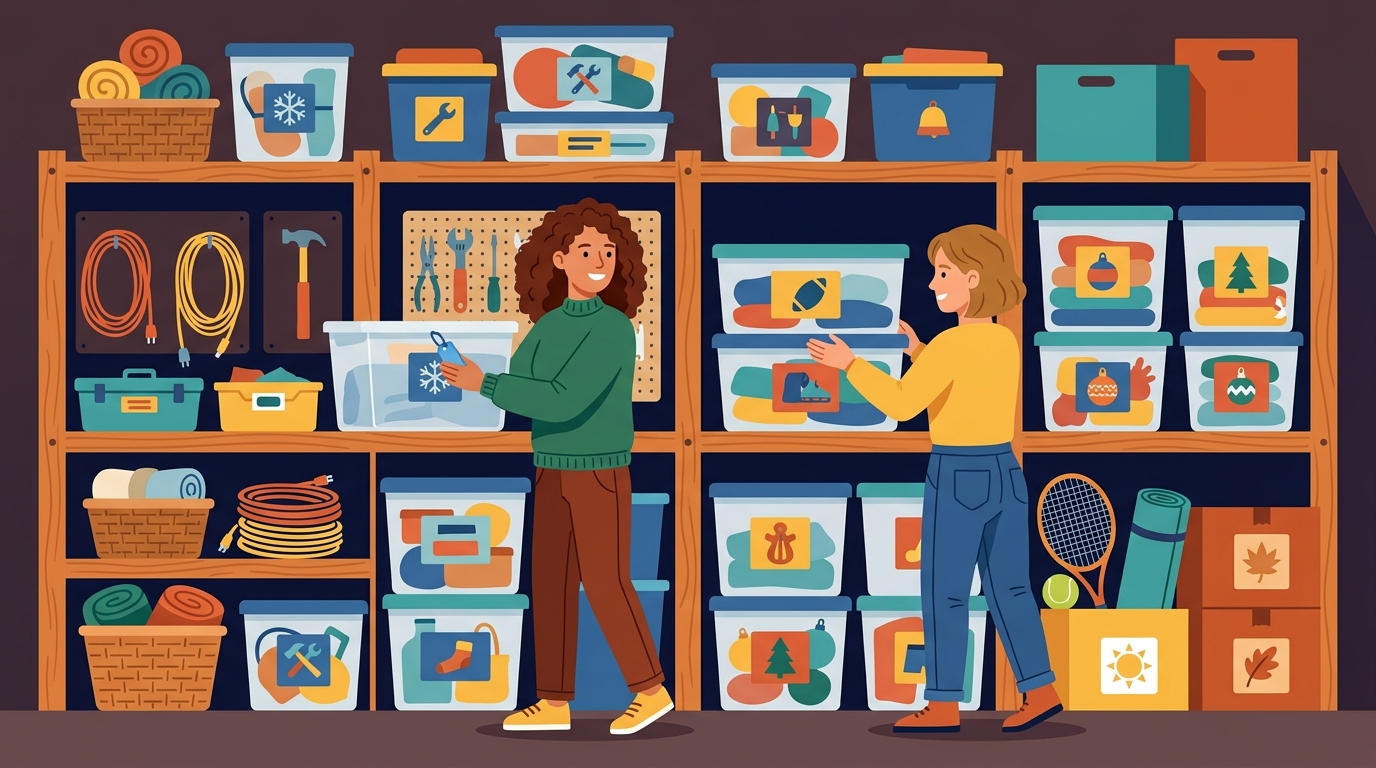
Shared storage organization checklist sounds like the least glamorous roommate agreement in the world until the garage door opens and everyone realizes nobody knows whose camping stove is missing, which bins are safe to stack, or whether the holiday lights belong to the house or to the person who moved out last spring.
Shared storage spaces collapse for predictable reasons. Garages, attics, basements, storage closets, and off-site units collect the things people do not need today but cannot quite let go of. In a roommate home, those items also carry ownership, permission, money, receipts, and move-out questions. A private closet can survive on one person's memory. A shared attic cannot.
The fix is not a perfect Pinterest garage or a Saturday where everyone pretends they love label makers. The fix is a checklist that turns shared storage into a working system: clear zones, labeled containers, visible ownership, documented high-value items, simple permission rules, and a maintenance rhythm roommates can keep when life gets busy.
Why shared storage falls apart in roommate homes
Roommate storage chaos is rarely caused by one messy person. It is usually caused by a space that has no shared rules. When nobody owns the system, every item becomes an exception. One roommate stores ski gear beside the toolbox. Another adds a box of kitchen overflow. A third borrows the step ladder, leaves it by the car, and forgets it ever had a home.
Shared living makes memory unreliable
Pew Research Center reported that nearly 79 million U.S. adults lived in shared households in 2017, equal to 31.9% of the adult population. The National Center for Family and Marriage Research, using U.S. Census and American Community Survey data, found that 6.5 million single young adults lived with a sibling or roommate in 2022. Shared homes are common enough that the garage, attic, and storage closet need systems built for more than one memory.
That matters because people remember belongings from different angles. The person who bought the folding table remembers the receipt. The person who uses it for game night remembers where it was last seen. The person who moved it into the attic remembers which corner it occupies. If those facts never meet, the household becomes dependent on group texts and guesses.
Storage creates permission problems
Shared storage blurs the line between available and owned. A drill on an open shelf looks borrowable. A labeled bin feels private. A cooler that everyone used last summer may still belong to one person. The more useful an item is, the faster casual access starts to feel like shared ownership.
That is why storage organization has to include permission. The label should not only say what is inside. It should tell roommates whether the contents are shared, personal, borrowed, fragile, off limits, or ask first. A neat shelf without permission rules is just a tidier argument waiting for a deadline.
Garages and attics hide expensive mistakes
The Insurance Information Institute recommends creating a home inventory with descriptions, purchase details, make and model information, serial numbers for major appliances and electronics, and proof of value such as receipts. It also reminds people not to forget belongings kept off site. Shared storage spaces are exactly where households forget things that matter: tools, bikes, electronics, sports gear, seasonal equipment, small appliances, and inherited items.
For renters, that record can matter after theft, fire, water damage, or a move-out dispute. A box marked miscellaneous is not useful evidence. A bin label, photos, owner notes, and receipts can be.
The roommate shared storage checklist
Use this checklist as the backbone of the project. It works for garages, attics, basements, storage cages, utility closets, and small storage units. Do not try to solve every household habit in one pass. Make the storage space understandable first, then make it pretty if anyone still has energy.
1. Hold a 30-minute storage reset meeting
- Pick one storage area: Choose the garage, attic, storage closet, or unit. Do not start with the whole home.
- Name the decision maker for the session: One person keeps the checklist moving so the group does not spend 20 minutes debating extension cords.
- Set the goal: Agree that the goal is to find, protect, and respect stored belongings, not to judge anyone's stuff.
- Decide what counts as shared storage: Include only spaces that more than one roommate can access or is affected by.
The meeting should produce simple agreements. Who can access the space? What items are shared? What items are personal but stored in common space? Which categories are causing the most problems? If you need a wider household framework, Vorby's shared inventory app guide explains how shared homes can track ownership, location, and responsibility without turning the whole place into a spreadsheet.
2. Empty by zone, not by optimism
- Create four landing zones: Keep, donate, return to owner, and decide later.
- Limit the decide later pile: Use one bin or one corner so it cannot become the new mess.
- Photograph the before state: A quick photo helps roommates understand what changed and makes future resets easier.
- Group duplicates: Put all tools, cords, seasonal decor, camping gear, sports gear, documents, and appliances together before assigning storage locations.
Emptying everything at once can be satisfying, but it also creates a disaster if the group runs out of time. Work shelf by shelf or corner by corner. The best storage reset is the one that ends with the car able to fit back in the garage.
3. Decide ownership before you label
- Mark each item as shared, personal, borrowed, landlord-owned, or unknown: Use sticky notes at first.
- Assign one owner for personal items: If two people disagree, keep the item in the unknown pile until they resolve it.
- Record shared purchases: Note who paid, who reimbursed, and what happens if someone moves out.
- Flag fragile or sentimental items: These need safer locations and stronger permission rules.
Ownership is the part people skip because it feels awkward. Skip it and the awkwardness simply waits until a move, breakup, sublet, or damage claim. A label that says "kitchen overflow" is helpful. A label that says "kitchen overflow, shared, house stays with current lease" is better.
Build zones that match how roommates actually search
A shared storage space should not be organized around perfect categories. It should be organized around retrieval. Roommates do not search for "miscellaneous household support equipment." They search for the air mattress, the Halloween bin, the drill, the luggage, or the Wi-Fi router box.
Use retrieval zones
Start with the categories people actually ask about in the group chat. Most roommate homes need zones like tools and repairs, seasonal decor, sports and outdoor gear, kitchen overflow, household supplies, documents, electronics boxes, moving supplies, cleaning equipment, guest items, and items waiting to leave the house.
Put frequent-use zones where people can reach them without climbing, unstacking, or moving someone else's belongings. Put low-use zones higher, deeper, or farther back. Attics are fine for holiday decor and empty luggage. They are terrible for the vacuum attachments people need every week.
Separate shared items from personal overflow
Personal overflow is normal in roommate homes. Someone may need to store winter clothes, a bike box, keepsakes, or furniture from a previous apartment. That is fine, but personal overflow should not be mixed with shared household gear.
Give personal items clear boundaries. Use owner-labeled bins, shelves, or tape marks. If space is tight, assign each roommate a storage quota rather than letting the fastest mover quietly claim the good shelf. The point is not to police every inch. The point is to prevent the shared drill from disappearing under one person's college boxes.
Create a retrieval map
A storage map can be as simple as a photo with labels. Stand at the entrance, take a wide shot, and mark zones: tools left wall, holiday bins top shelf, camping gear blue rack, personal bins back right. Keep the map in the household chat or inventory system.
This is especially useful for attics, basement corners, and storage units, where people cannot see everything at once. A map also helps new roommates understand the system without needing the unofficial tour from the person who created it.
Shared storage works when the next person can find an item, understand who owns it, and know whether they are allowed to use it without sending a detective-level group text.
Label bins so the label stays true
A label is not a decoration. It is a promise about what someone will find inside. In shared storage, that promise needs more detail than a single category word. The label should help roommates retrieve items, respect ownership, and update the system when contents change.
Use the five-part shared label
- Category: Tools, camping, winter, documents, kitchen overflow, holiday decor, moving supplies.
- Owner or status: Shared, Maya, landlord, borrowed from Alex, unknown owner.
- Permission: Use anytime, ask first, do not remove, return same day, fragile.
- Location code: Garage shelf A2, attic back left, storage unit rack B.
- Last checked date: Month and year are enough.
A useful label might read: "Camping, shared, ask before overnight trips, garage B2, checked Aug 2026." That line gives everyone more practical information than a beautiful label that says "adventure." Vorby's shared storage bin labeling checklist goes deeper on bin labels, QR codes, and how to keep the outside of the bin matched to the inside.
Add photos for closed bins
Closed bins are where good systems go to die. Once the lid is on, nobody wants to open three bins to find one extension cord. Photograph the contents before the lid goes on. For mixed bins, take one overhead shot and one close-up of important items.
If you use Vorby, add the bin as a location or container, then add key items inside it with photos and notes. That creates a searchable record for the things that disappear into opaque plastic. You do not need to catalog every candle. Catalog the items roommates search for, borrow, replace, argue over, or need for insurance.
Use QR codes only when they reduce work
QR codes can be excellent for shared storage when they open a living inventory for that bin or shelf. They are overkill when they send people to a dead spreadsheet nobody updates. Use QR codes for bins with changing contents, expensive equipment, shared tools, seasonal gear, or move-out-sensitive items.
Keep the visible label useful even without scanning. A roommate standing in a cold garage should not need a phone, signal, and app login just to know whether the blue bin holds holiday lights or printer cables.
Track receipts, condition, and responsibility for stored items
Shared storage is not only about finding things. It is about proving what existed, who owned it, what it cost, and who was responsible for it. That sounds formal until something gets wet, stolen, broken, or claimed by the wrong person during move-out.
Document the items most likely to cause trouble
Do not start by inventorying every mug. Start with items that are expensive, shared, fragile, borrowed, hard to replace, frequently used, or stored out of sight. Common examples include bikes, power tools, camping equipment, small appliances, electronics, furniture, musical gear, luggage, holiday decor, sports equipment, emergency supplies, and important household documents.
For each item, record the name, owner, location, condition, purchase date if known, receipt if available, serial number if relevant, and permission rule. This matches the spirit of the Insurance Information Institute's home inventory guidance, which emphasizes descriptions, purchase details, make and model information, serial numbers, and proof of value. For appliances in particular, Vorby's guide to tracking shared household appliances is a natural next step.
Keep receipts with the item record
Receipts become surprisingly important in shared homes. They show who paid, when the item was purchased, whether it is under warranty, and what replacement value might be. If a shared dehumidifier breaks, the receipt tells the group whether repair, return, warranty service, or replacement makes sense.
Email receipts are easiest because they can be searched and attached to an item record. Paper receipts should be photographed before they fade, then stored with the item record or in a household receipts folder. The goal is not to create a courtroom exhibit for every plastic bin. The goal is to stop important facts from living in one roommate's inbox.
Assign responsibility without creating a storage dictator
Every shared storage zone should have a responsible person, but that does not mean one roommate becomes the household warehouse manager. Responsibility means someone notices when labels drift, reminds the group before move-out, or checks that borrowed items came back.
Rotate responsibility by zone or by quarter. One person owns tools and repairs. Another owns seasonal bins. Another owns moving supplies and donations. This keeps maintenance light and avoids the classic roommate trap where the organized person becomes permanently responsible for everyone else's belongings.
Set borrow, return, and move-out rules
Storage systems fail when items leave without a trace. Roommates do not need a bureaucracy for every hammer, but they do need rules for shared, expensive, fragile, or easy-to-misplace items.
Use a simple borrow rule
Create three permission levels. Green items can be used anytime and returned to the same place. Yellow items require a quick message before use. Red items should not leave storage without owner approval. Put the permission level on the label and in the item record.
This works because it lowers the social friction of asking. Instead of guessing whether the cooler is fair game, a roommate sees "yellow, ask before overnight use" and sends the text. Small clarity prevents big resentment.
Make returns visible
A borrowed item should return to its labeled location, not just to the room. If the socket set belongs on garage shelf A2, the return is not complete when it lands on the washing machine. For frequently borrowed items, use a checkout note in the household chat or inventory record: who took it, when, and when it came back.
Keep this lightweight. Use it for tools, camping gear, party supplies, appliances, sports equipment, and anything that tends to vanish at the exact moment another person needs it.
Do a move-out audit before packing starts
Roommate move-outs are where casual storage assumptions become expensive. Schedule a storage audit two to four weeks before anyone leaves. Walk the shared spaces, identify personal items, confirm shared purchases, settle reimbursements, and decide what stays with the household.
The audit should cover bins, shelves, furniture, appliances, tools, electronics, cleaning supplies, documents, and borrowed items. Take updated photos after the audit. If a deposit dispute or ownership question appears later, the household has a dated record instead of four different memories.
Maintenance rhythm: keep the system alive
The goal is not to reorganize the garage every month. The goal is to prevent entropy from winning quietly. A light rhythm keeps labels accurate, receipts attached, and shared items findable.
Use the one-in, one-update habit
When a new shared item enters storage, update the system immediately. Add the owner, photo, location, permission rule, and receipt. When an item moves, update the location. When an item leaves, mark it donated, sold, returned, discarded, or taken by owner.
This habit is more important than the first big cleanout. A storage system is only trustworthy if people believe it reflects reality. One minute at the moment of change saves 20 minutes later.
Schedule seasonal checks
Check shared storage at natural household moments: lease renewal, before winter, before summer, after holidays, before a move, after a bulk purchase, or after a major cleanout. Seasonal checks should be short. Open high-use bins, confirm labels, remove trash, update photos, and move items that landed in the wrong zone.
If you live with roommates who hate meetings, pair the check with something practical. Ten minutes before a house dinner. Fifteen minutes before bulk trash pickup. One garage pass before the first camping trip of the season. Organization works better when it rides along with real life.
Use a shared inventory as the source of truth
A shared inventory keeps the storage system from depending on the person with the best memory. It gives roommates one place to look before asking, buying duplicates, borrowing the wrong thing, or assuming an item is lost.
Vorby is built for this kind of household record: photos, locations, ownership notes, receipts, warranty details, and searchable item context. Use it for the items that need shared visibility, not for every object in the house. That keeps the system useful instead of exhausting.
Shared storage organization FAQ
How do roommates organize a shared garage?
Start by creating zones for tools, seasonal items, sports gear, household supplies, personal overflow, and items leaving the house. Label each zone and container with owner, permission, location, and last checked date.
What should be on a shared storage organization checklist?
Include access rules, ownership labels, retrieval zones, bin labels, photos, receipts for valuable items, borrow rules, a storage map, and a seasonal maintenance schedule. The checklist should answer what it is, where it belongs, who owns it, and who can use it.
Should roommates label personal items in shared storage?
Yes. Personal items stored in a shared garage, attic, or storage closet should have the owner's name and any handling notes. Clear labels protect the owner and reduce accidental use by other roommates.
How do you stop roommates from using stored items without permission?
Use visible permission levels: use anytime, ask first, and do not use. Put the rule on the label and in the shared inventory so nobody has to guess.
Do roommates need a home inventory for shared storage?
They should keep a practical inventory for valuable, shared, borrowed, or easy-to-lose stored items. Photos, receipts, ownership notes, and locations help with insurance, move-outs, repairs, and everyday finding.
Turn the checklist into a household habit
A shared storage organization checklist works because it removes guesswork from the least glamorous parts of living together. Roommates do not need to become professional organizers. They need a system that shows what exists, where it belongs, who owns it, and what can be used without drama.
Start with the messiest shared area, label the containers that cause the most confusion, and document the items that would be expensive or annoying to replace. Once that first zone works, the rest of the home gets easier.
Shared homes run better when shared belongings are visible. Vorby gives roommates one place to make storage clear, searchable, and fair. Start your household record at Vorby.