Think of the last time you spent 15 frantic minutes tearing the house apart looking for something. Car keys? That one specific charger? Your kid’s favorite toy? We’ve all been there. Now, what if you had a personal librarian for everything you own, a system that knows exactly where everything is, so you don't have to?
That’s the simple idea behind automated inventory management software. It’s not about spreadsheets or sticky notes. It's about creating a searchable digital map of your physical world, transforming home organization from a nagging chore into a simple, automated process.
Taming Household Chaos with Smart Inventory
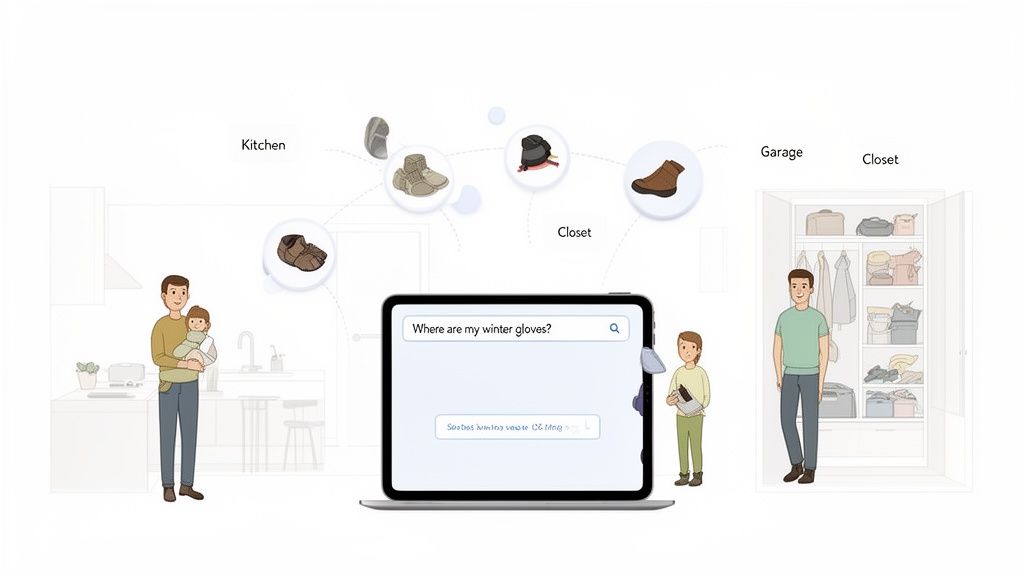
Imagine knowing, instantly, which box in the attic holds the winter gloves. This isn't some far-off fantasy or a tool reserved for massive warehouses. It’s about bringing that same powerful logic right into your home to solve a universal problem: the quiet chaos of misplaced, forgotten, and re-bought items that clutter our lives.
From overflowing junk drawers to those mystery boxes you haven’t opened since the last move, our old-school methods just don't hold up. The sheer volume of our stuff is overwhelming. The first step to fixing this is admitting that our brains aren't built to be databases. For most of us, the real goal is to finally solve clutter issues for good.
From Manual Mess to Automated Success
This is where automated inventory management software completely changes the game. It acts as a digital brain for your home, remembering everything so you don't have to. Instead of guessing where you stashed the holiday decorations, you just type "ornaments" and get a precise location.
This shift is powered by surprisingly simple tech that does the heavy lifting:
- Effortless Cataloging: Modern tools use AI and image recognition. You snap a photo of a box's contents, and the system automatically identifies and tags the items. No more tedious typing.
- Instant Retrieval: A quick search is all it takes to find what you need. It saves you from that panicked hunt right before you need to leave the house.
- Reduced Mental Load: When you offload the job of remembering where thousands of items are, you free up a surprising amount of mental energy and cut down on that low-grade stress that comes from disorganization.
The real power here isn't just about knowing what you have. It's about getting back your time and peace of mind by making your stuff effortlessly findable when you actually need it.
Ultimately, this technology gives homeowners and busy families a real handle on their belongings. It replaces frustrating guesswork with calm certainty, helping create a home that truly works for you.
Why Your Brain Isn't a Good Filing Cabinet Anymore
For generations, the default home inventory system was a combination of good old-fashioned memory and maybe a spreadsheet you dusted off for insurance claims. You just remembered where you put things. Simple enough. But in today’s world, with the sheer volume of stuff in the average household, that old-school approach isn't just inefficient anymore; it's a direct line to stress and wasted money.
Imagine trying to manage a modern library with a handful of sticky notes. It sounds absurd, but that's what we're doing with our homes.
Think about a typical busy family trying to keep track of everything manually. The holiday decorations are in a few boxes, but which ones? The warranty for that fancy new coffee maker is somewhere in the office, but digging it out burns 20 minutes you don't have. This constant, low-level friction creates a significant mental load, turning your home into a landscape of question marks instead of a place to relax.
The hidden costs of this disorganization pile up fast. Studies suggest the average person spends hours every single month just looking for misplaced items. This isn't just about lost time; it's about the money you waste repurchasing something you already own but couldn't find, like that specific charging cable or a fresh pack of batteries.
The Breaking Point: Scale and Complexity
What really shatters manual systems is the sheer complexity of modern belongings. We're not just talking about furniture and clothes anymore. A typical home now contains a dizzying array of items, each with its own set of details that are flat-out impossible for one person to remember.
This is where the limits become painfully obvious:
- Electronics: Laptops, tablets, smart speakers, and all their cousins come with warranties, purchase dates, and model numbers that are critical for repairs or returns. Who can remember all that?
- Seasonal Items: Holiday decorations, camping gear, and winter coats create a rotating inventory that’s a nightmare to track as it moves in and out of storage closets and dusty attics.
- Tools and Hobby Gear: Specialized equipment for DIY projects, gardening, or hobbies adds another layer of complexity. You need to find that one specific wrench right when you need it, not after an hour of searching.
Trying to manage this ever-growing collection with memory alone is like trying to navigate a city with a hand-drawn map from a decade ago. It’s outdated, unreliable, and you're guaranteed to get lost.
This system overload is precisely why automated inventory management software has become a practical necessity, not a luxury. It’s not about being a perfectionist. It's about finally acknowledging that our homes have become too complex for analog methods and it's time for a smarter, more organized approach.
The Smarter Features That Actually Organize Your Home
The real magic behind today's inventory software isn’t a single trick; it’s a collection of clever features working in concert. These tools are designed to do the heavy lifting for you, turning what used to be a monumental chore into a few simple taps on your phone.
Let's break down what these features actually do and how they come together to create a seamless system for your home. Think of them as specialists on your personal organization team; each has a specific job, but they all report back to a central brain that gives you the complete picture of what you own and where it is.
Manual vs Automated Home Inventory Features
Before we dive into the specific features, it helps to see just how different this approach is from the old way of doing things. The gap between a spreadsheet and a smart inventory app is massive.
| Feature | Manual Method (e.g., Spreadsheet) | Automated Software (e.g., Vorby) |
|---|---|---|
| Data Entry | Manual typing of every detail | Snap a photo; AI identifies and catalogs the item |
| Search | Exact keyword matching (Ctrl+F) | Natural language questions ("where are my gloves?") |
| Location Tracking | Vague notes ("Garage, blue box") | Scannable QR/NFC tags for exact box contents |
| Accessibility | Limited to one device; hard to share | Shared access for the whole family with permissions |
| Updating | A constant, manual chore | Quick updates from your phone in real-time |
| Visuals | None, just text | A searchable photo gallery of everything you own |
As you can see, automated tools don't just speed up the old process; they fundamentally change how you interact with your belongings.
Snap a Photo to Catalog Anything
The days of painstakingly typing "Black KitchenAid Stand Mixer, Model KSM150PSER" into a spreadsheet are officially over. Modern software uses powerful image recognition to identify and log your belongings from a single photo.
Just snap a picture, and the system instantly recognizes what it is, suggests a category, and adds it to your inventory. This means you can catalog that new power tool before you even toss the box. You can learn more about how AI-powered recognition makes the process almost effortless.
This one feature is a total game-changer because it demolishes the biggest barrier to getting started: the sheer effort of data entry. What once took minutes per item now takes seconds.
Find Anything with a Simple Question
Forget trying to remember what you called something or which specific keyword you used. The best systems incorporate natural language search, letting you find things just by asking a question like you would a person.
You can simply type or ask:
- "Where are my winter gloves?"
- "Show me all our board games."
- "Do we have any AAA batteries left?"
The software scans your entire inventory in an instant and points you to the exact location, whether it's a specific drawer, a labeled box in the garage, or a shelf in the closet.
This transforms your inventory from a static list into a dynamic, conversational assistant. It's less like a database and more like having a personal helper who has memorized the location of everything you own.
Create a Smart Map of Your Home
For everything tucked away in opaque bins and boxes, QR code and NFC tagging creates an interactive map of your storage spaces. You can generate a unique QR code for each container.
When you scan it with your phone, you get an instant pop-up list of everything inside without ever having to pull it down and open it up. This is a lifesaver for seasonal items, keepsakes, or anything exiled to the attic or garage. It turns chaotic storage areas into an organized, searchable library.
While these tools were born in the business world, their adoption in our daily lives is exploding. The automated inventory software market, valued at USD 4.47 billion in 2026, is projected to hit USD 10.5 billion by 2035. This growth is fueled by cloud-based systems that make powerful tracking accessible to everyone. You can dig into more insights on this expanding market at businessresearchinsights.com.
Manage Your Household as a Team
A home isn't run by one person, so your inventory system shouldn't be, either. Look for features like sharing and permissions, which let you create a central household inventory that everyone in the family can use and update.
You can grant different levels of access, so your kids can find their own sports gear, but they can't accidentally delete the warranty information for the new TV. This collaborative approach gets everyone on the same page and finally puts an end to the "Honey, have you seen my...?" questions that echo through every busy home.
Implementing Your Automated Inventory System
Jumping into an automated inventory system might feel like a massive undertaking, but the secret is to treat it like any other home organization project: one step at a time. You don't need to catalog your entire house in a single weekend. A gradual, room-by-room approach is way more manageable and, frankly, more effective in the long run.
The best way to get started is by picking a single, high-impact area. This could be your kitchen pantry, the garage workshop, or even that one closet you’re always a little afraid to open. By focusing your initial efforts, you'll master the software’s features and see tangible results fast. That quick win builds the momentum you need to tackle the rest of the house.
Your Practical Starting Guide
Getting organized is a process, not a race. Before you even open the app, it's a good idea to declutter before implementing. There's no point in cataloging stuff you don't even want. Once you've cleared out the noise, follow these simple phases to get your system humming.
Choose Your Pilot Zone: Start small. Select a contained area where you can learn the workflow without feeling overwhelmed. Think a single tool drawer, one bookshelf, or that box of cables under your desk. The goal is to get a feel for snapping photos and adding descriptions on a small scale.
Batch Process Your Items: Work in focused bursts. Set aside 30 minutes to catalog everything on one shelf or in one cabinet. This "batching" method is far more efficient than randomly adding items from all over the house.
Label as You Go: This is a game-changer for items going into storage boxes. As you pack a box, generate and stick a QR code on it right then and there. This is incredibly helpful if you're getting ready for a move or just doing a seasonal clothing swap. You'll know exactly what’s inside a box the moment you seal it. You can see how a good barcode program for inventory makes this process even faster.
This straightforward process boils down the entire task of home inventory into three core actions: snap a photo, tag the item or container, and later, search to find it.
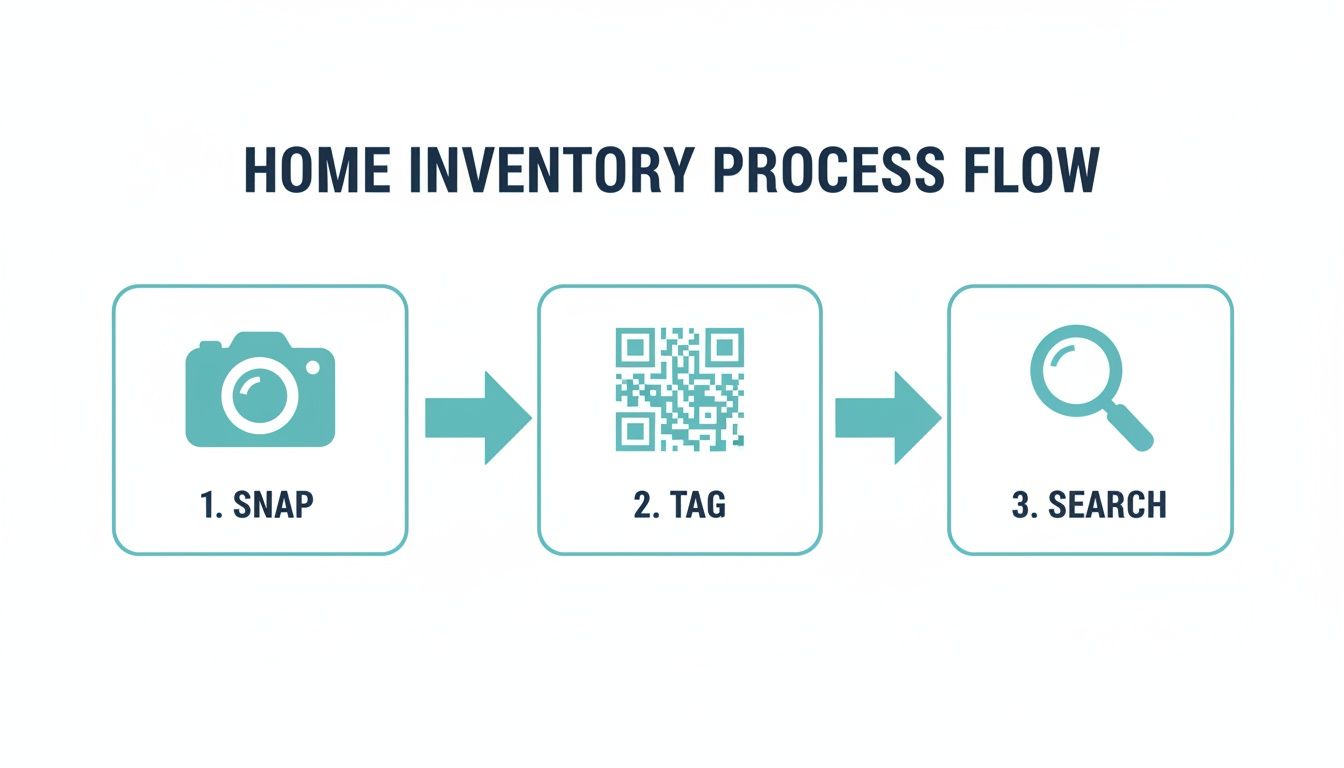
As you can see, the whole workflow is built for speed and simplicity, breaking what feels like a huge job into quick, repeatable steps.
Turning a Big Project Into Small Wins
Once your pilot zone is done, you'll have a much better handle on the process. From there, it’s all about expanding your efforts. Maybe you decide to tackle one room each weekend. Or maybe you commit to cataloging ten new items every day. The beauty of automated inventory management software is that it adapts to your pace and your schedule.
Remember, the goal is progress, not perfection. Every single item you add is a small victory that makes your home more organized and your life a little bit easier.
The system is designed to grow with you. By taking a methodical, step-by-step approach, you can transform what seems like a daunting project into a series of achievable goals. You're essentially building a complete, digital map of your home at a pace that feels comfortable and rewarding. Before you know it, you'll have a fully searchable inventory right at your fingertips.
The Real Benefits: Reduced Stress and Reclaimed Time
An organized home is a great side effect, but the real magic of automated inventory management software runs much deeper. It's about fundamentally rewiring your relationship with your belongings, transforming the daily chaos into a sense of calm and giving you back your two most precious resources: time and peace of mind.
The most immediate win? You can finally stop the frantic searching. Think about the last time you tore the house apart looking for that one specific charging cable, a spare set of keys, or your kid’s favorite toy. That 15-minute hunt doesn’t just waste time; it injects a needless shot of adrenaline and frustration into your day. Now, imagine just asking your phone, "Where are the spare batteries?" and getting an instant, exact answer.
More Than Just Tidy Shelves
This reclaimed time adds up fast, but the financial savings are just as real. A properly managed inventory puts a dead stop to accidental duplicate purchases. You’ll never again buy a new HDMI cable only to discover you already had three tangled in a mislabeled box in the garage. This kind of clarity prevents wasteful spending and cuts down on household clutter.
Beyond the daily conveniences, a digital inventory delivers some serious practical advantages:
- Insurance Claims: If you ever face a fire, flood, or theft, producing a detailed, photo-documented list of your possessions can make a world of difference. It simplifies and speeds up the claims process, helping ensure you get fair compensation without a painful back-and-forth.
- Estate Planning: A complete inventory creates a clear, organized record of assets. This small step can make the incredibly difficult process of settling an estate significantly smoother and less stressful for your loved ones.
- Peace of Mind: This one is harder to measure but impossible to ignore. Simply knowing what you have and where it is lifts a constant, low-level mental weight. It’s a feeling of control that extends far beyond your closets and storage bins.
The Power of Knowing
This same drive for real-time visibility is exactly why businesses are jumping on board. Globally, the need for efficiency has caused a huge spike in the adoption of cloud-based inventory platforms. This isn't a small trend, as the market is projected to explode from USD 2.7 billion in 2026 to a massive USD 9.4 billion by 2036. You can dive deeper into the data behind this inventory software market growth on futuremarketinsights.com.
Ultimately, an automated inventory is less about organizing your stuff and more about organizing your life. It’s a system that gives back hours to your week and removes a layer of everyday friction.
The end goal isn't just a tidier home, although that’s a fantastic bonus. It’s the cumulative effect of countless saved minutes, fewer frustrating moments, and the quiet confidence that comes from knowing your household is truly under control.
Here's How Vorby Works for Your Home

It’s one thing to understand the theory behind automated inventory management software, but it’s something else entirely to see it untangle real-life household chaos. This is exactly where Vorby comes in, bridging that gap with a design built from the ground up for the beautiful mess of modern family life. It’s made to solve the common frustrations we all feel, making powerful tech feel simple and, most importantly, actually useful.
Instead of just listing a bunch of features, Vorby delivers practical answers. For a busy parent, its natural language search means finding that one specific missing toy is as easy as asking your phone, "Where are the Legos?" If you’re a collector, you can use its detailed photo cataloging and warranty tracking to protect your valuable items, ensuring every last detail is safe and easy to pull up.
An Inventory That Actually Thinks Like You Do
Vorby’s entire approach is built around one core idea: getting organized shouldn't feel like another chore on your to-do list. It should just happen in the background.
This is possible because it weaves several key functions into one seamless experience:
- AI-Powered Recognition: You just snap a photo, and Vorby figures out what the item is. This completely removes the tedious data entry that makes most of us give up before we even start.
- Shared Family Access: Finally, you can create a single, synchronized inventory for your whole household. Now everyone can find what they need, putting an end to the constant "Honey, where is the...?" game.
- Smart Location Mapping: Stick a QR code on a storage bin, and you can see a full list of what’s inside without ever opening the lid. Your garage or attic suddenly becomes a searchable database.
By focusing on these real-world problems, Vorby turns your home into a smart, organized space. It’s the complete answer for anyone who wants to manage their physical world with the same ease they manage their digital one.
You can learn more about how the Vorby’s platform brings all this to life in your home.
Have Questions? We’ve Got Answers.
Jumping into a new way of organizing your home always brings up a few questions. We get it. Below are some of the most common things people ask when they're thinking about using an automated inventory system for their personal stuff.
Is This Going to Be a Nightmare to Set Up for My Whole House?
Not at all, and here’s why: you don’t do it all at once. The key is to start small and let the system grow with you.
Modern inventory apps are designed for you to chip away at the project, not conquer it in one overwhelming weekend. Pick a single room to start, maybe the kitchen or your home office. Then, just catalog a few things whenever you have a spare moment.
Features like image recognition make adding items incredibly fast; you can often get something logged in just a few seconds. Think of it less as a massive project and more as a series of small, satisfying wins. Before you know it, you'll have a complete picture of your home without the burnout.
How Secure Is My Data in a Cloud-Based System?
This is a big deal, and any reputable service treats it that way. Leading platforms protect your information with the same security measures used by banking and financial apps, specifically end-to-end encryption. This keeps your data scrambled and unreadable both when it's being stored and when it's being sent over the internet.
When you're picking a service, look for one that's upfront about its security practices. Things like permission controls for sharing inventories are also essential. They give you the power to decide exactly who sees what, keeping your personal info locked down.
With the right system, you can rest easy knowing your household data, from photos of valuables to warranty details, is kept private and secure.
Can I Really Use This to Track Warranties and Receipts?
Absolutely. In fact, this is where a digital inventory system truly shines and goes way beyond just knowing where your stuff is. It becomes a central hub for all the important information tied to your belongings.
Imagine this:
- Snap a photo of a receipt and link it directly to the item you bought. No more fading ink or crumpled paper.
- Upload the PDF manual for your new coffee maker so you can find it instantly.
- Set a reminder for when a warranty is about to expire, so you never miss a claim deadline.
The next time an appliance gives you trouble, you won’t be rummaging through a cluttered file cabinet. You’ll just search for "refrigerator" in the app and instantly pull up its purchase date, warranty info, and user manual. It's all right there, organized and ready when you need it.
Ready to stop searching and start finding? Vorby brings all these features together in a simple, powerful platform designed for your home. Begin organizing your world today. Start your free trial at Vorby.