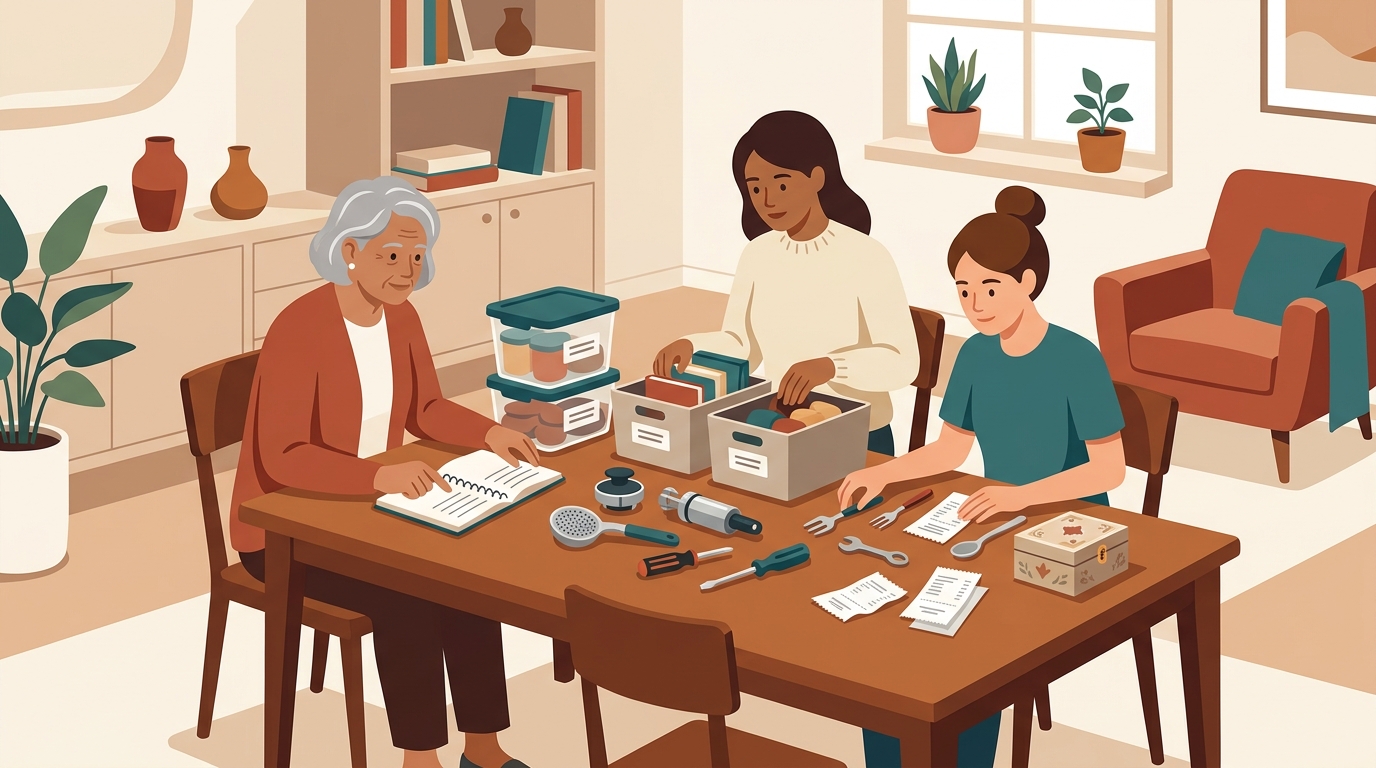
Estate planning home inventory is the unglamorous piece of planning that makes the rest of the paperwork easier to use. A will can name heirs, a trust can direct distribution, and a power of attorney can clarify authority, but families still have to answer practical questions inside the house: what exists, where it is, what it is worth, who should receive it, what has a receipt, and which objects carry sentimental history that does not show up in a legal document.
That practical layer matters more as families age, blend households, downsize, and share caregiving. The U.S. Census Bureau reported that the population age 65 and over reached 55.8 million in 2020, or 16.8% of the country, after growing at the fastest decade rate since the late 1800s. Pew Research Center has also found that 59.7 million U.S. residents lived in multigenerational households in March 2021, 18% of the population. More adults are helping parents, adult children, spouses, siblings, and relatives manage homes full of belongings, documents, tools, vehicles, collectibles, photos, and inherited items.
A home inventory does not replace legal advice. It gives your attorney, executor, trustee, partner, and family a clear household record to work from. When assets are visible, distribution is less stressful, insurance claims are easier, and family decisions become less dependent on memory during a difficult week.
Why home inventory belongs in estate planning
Estate planning often starts with documents because documents are what attorneys prepare. That makes sense, but the lived reality of an estate starts in rooms, closets, garages, safes, storage units, and email inboxes. Families do not inherit abstract assets. They inherit furniture, tools, artwork, appliances, jewelry, electronics, paperwork, collections, vehicles, family photos, and boxes of things nobody labeled because everyone assumed there would be time.
Legal instructions still need household facts
A will can say that personal property should be divided equally. It rarely lists every serving dish, framed print, camera lens, tool chest, bike, instrument, laptop, safe deposit box key, or inherited watch. That gap creates work for the person handling the estate. They have to identify belongings, separate personal property from household property, estimate value, find proof, locate receipts, and decide what needs appraisal.
A home inventory gives that person a head start. It can show which items were considered valuable, which were insured, which had sentimental notes, which were purchased together, which belonged to a spouse or partner, and which were already promised through a written instruction. Even when the legal document controls the final decision, the inventory helps everyone see the facts.
Memory is a risky estate plan
Adults often carry an enormous amount of household information in their heads. They know which drawer holds the safe key, which necklace was inherited, which tools belong to a neighbor, where the original appliance receipts live, and why one box of old dishes matters. If that person becomes ill or dies, the family loses the map at the exact moment they need it most.
The Insurance Information Institute recommends creating a home inventory with photos, descriptions, serial numbers, receipts, and values because it makes insurance claims easier after fire, theft, or another loss. Those same details are useful for estate planning because they turn memory into a durable record. The point is not to document every spoon. The point is to preserve enough context that your family is not guessing under pressure.
Distribution becomes less emotional when facts are clear
Family conflict often starts with uncertainty. Was the painting valuable? Did Dad intend for anyone specific to receive the tools? Was the jewelry insured? Is that storage unit full of keepsakes, donations, or items that belong to an adult child? When nobody knows, every decision can feel loaded.
A clear inventory does not remove grief, but it reduces avoidable friction. It gives the executor a working list, gives heirs a shared reference point, and gives sentimental belongings written context before stories get lost. If you have already started organizing a shared family home, Vorby's multigenerational household inventory guide is a useful companion for the family logistics side of the same problem.
It also helps families move at the right speed. After a death, some tasks are urgent, such as securing the home, finding policies, and protecting valuables. Other decisions should wait until grief has settled. An inventory lets the executor identify what must be handled now and what can be reviewed later with more care.
The kindest estate plan is not only legally valid. It is findable, understandable, and practical for the people who have to use it.
What to include in an estate planning home inventory
An estate planning inventory should be broad enough to help your family understand the household, but focused enough that you will actually finish it. Start with categories that are financially valuable, legally important, hard to replace, emotionally meaningful, or likely to cause confusion.
High-value household property
Document furniture, rugs, artwork, antiques, jewelry, watches, musical instruments, cameras, computers, appliances, power tools, bicycles, sporting gear, collectibles, and specialty equipment. For each item, include a photo, description, brand, model, serial number if available, purchase date, estimated value, receipt, appraisal, warranty, and current location.
Do not overcomplicate the first pass. A photo of the dining room set with a note about when and where it was purchased is better than waiting until you can research every manufacturer. The Insurance Information Institute's home inventory guidance says an incomplete inventory is better than no inventory. That is especially true for estate planning because a partial map still helps the next person make better decisions.
Financial and legal document locations
A household inventory should record where important documents are stored without turning the inventory into an unsafe archive of sensitive data. Include the location of wills, trusts, powers of attorney, health care directives, property deeds, vehicle titles, insurance policies, tax records, birth certificates, passports, marriage certificates, divorce decrees, loan documents, safe combinations or key locations, and safe deposit box details.
For sensitive records, document existence and access. You might write, "Trust binder in fireproof safe, executor has instructions," rather than uploading scans of identity documents into a general household tool. The goal is to prevent a search, not expose private information to everyone with access to the inventory.
This is also useful when an attorney, financial planner, or insurance agent asks for household context. You can share a summary of locations and categories without handing over every private document. That keeps the conversation organized and keeps sensitive material in the right hands.
Sentimental items and family history
Estate planning is not only about market value. The old quilt, recipe box, military medals, framed photo, rocking chair, record collection, handmade table, or holiday serving platter may matter more than an expensive appliance. Add a short note about where the item came from, who made it, who cared about it, and any known wishes for its future.
This is where an inventory becomes a family record. A simple note such as "Grandma Ruth's silver serving set, used every Thanksgiving, ask Michelle before donating" can protect meaning that a receipt never captures. For couples combining homes later in life, Vorby's article on ways couples can inventory and merge homes can help separate duplicates, keepsakes, and shared purchases before they become future estate questions.
How to document ownership, value, and proof
Estate planning inventory works best when every important item answers three questions: who owns it, what proof exists, and what should happen if someone else has to make decisions. You do not need formal legal language in every note, but you do need enough structure to avoid ambiguity.
Separate owner, user, and intended recipient
Ownership is not always obvious inside a household. One spouse may own inherited jewelry. Both spouses may have bought the dining table. An adult child may store furniture in the garage. A parent may have promised a tool set to one grandchild but never written it down. A caregiving item may be used by one person and maintained by another.
Use separate fields or notes for current owner, primary user, storage location, and intended recipient if there is a written instruction or clear family agreement. If the intended recipient is part of the estate plan, make sure the legal documents match. The inventory should support the plan, not quietly create a conflicting plan of its own.
Attach receipts, appraisals, and serial numbers
Receipts and serial numbers matter because they help prove existence, value, and replacement cost. For electronics, appliances, tools, cameras, bicycles, and specialty equipment, photograph the item and the serial number plate. Attach purchase receipts, warranty documents, repair records, and appraisals when available.
NAR's Home Buyers and Sellers Generational Trends research shows how much household wealth and transition is tied to housing decisions across age groups, especially as older buyers and sellers use home equity and sale proceeds differently from younger households. When a home sale, downsizing, relocation, or estate settlement is in view, attached proof can help families decide what to keep, sell, donate, appraise, or insure.
Flag items that need professional valuation
Some belongings should not be priced casually. Jewelry, fine art, antiques, rare books, coins, firearms, musical instruments, designer furniture, vintage collections, and valuable memorabilia may need an appraisal, special insurance coverage, or professional advice before distribution. Put those items in a review category so they do not disappear into a general donation pile.
Statista's furniture market forecast describes the United States as one of the largest furniture markets in the world, with furniture revenue measured in the hundreds of billions of dollars. Most household furniture will not need appraisal, but the scale of the category is a reminder that "just household stuff" can represent real money when a home is being settled.
Use the review category as a safety net, not a bottleneck. If you are unsure whether an item needs appraisal, mark it for review and move on. The first inventory pass should identify candidates for expert attention, while the estate planning process can decide which items justify formal valuation.
Organize the home so the inventory is usable
An inventory is only helpful if it matches the physical home. If the list says "holiday dishes" but nobody knows which closet, shelf, or bin holds them, the record still creates work. Estate planning inventory should connect objects to real places.
Inventory by zones, not perfection
Use zones that match how the home functions: primary bedroom, office, kitchen, dining room, garage, attic, basement, storage unit, safe, file cabinet, jewelry box, media cabinet, tool wall, and heirloom shelf. Start with the zones that would be hardest for someone else to understand. For many adults, that means paperwork, valuables, garage tools, inherited objects, and storage bins.
Take photos as you go. Photograph the closed cabinet or bin, then the contents inside. Label the physical container with a simple name that matches the inventory. If you use Vorby, the same item can carry photos, location, notes, receipts, and ownership context so the list stays connected to the real home.
Create a storage unit and off-site checklist
Off-site storage creates estate confusion because it is easy for family members to forget it exists. Record storage units, safe deposit boxes, sheds, garages, borrowed storage at a relative's home, office storage, and items on loan. Include the facility name, unit number, key or access location, payment source, and a rough description of contents.
Be especially careful with borrowed items. If your adult child stores a sofa in your garage or your sibling leaves tools in your shed, mark them as borrowed or temporary. That keeps your estate from treating someone else's property as yours.
Use photos for proof and recognition
Photos are faster than descriptions and often more useful. A future executor may not know which watch, lens, quilt, or painting you meant. A photo removes guesswork. For insurance, photos also help show condition and existence before a loss.
Vorby's guide to photo inventory versus app inventory for the home explains the tradeoff: photos are fast, but they become far more useful when they are searchable, tied to locations, and paired with receipts or notes. For estate planning, that searchable structure is the difference between a camera roll and a record.
Share the inventory without oversharing private information
Estate planning involves other people, but that does not mean every person needs access to every detail today. The best inventory is available to the right adults while protecting sensitive information.
Decide who needs access now
At minimum, your spouse or partner, executor, trustee, or a trusted adult child should know that the inventory exists and how to access it if needed. If you live alone, this step matters even more. A beautiful inventory hidden behind an unknown password is not much better than no inventory.
Consider a simple access note in your estate planning folder: where the inventory lives, who can open it, what it covers, and which items require professional advice. If the inventory is digital, keep account recovery instructions somewhere safe. Do not put passwords in a visible household note.
Use private notes for sensitive categories
Some categories require discretion: jewelry, safes, firearms, medications, identity documents, financial paperwork, and items tied to family conflict. Record enough information for the right person to find and manage them, but avoid exposing sensitive details to everyone in the household.
A practical approach is to create layers. General household members can help document furniture, appliances, tools, and storage bins. Trusted adults can manage valuables, legal papers, insurance records, and instructions. Estate professionals can receive exports or summaries when needed.
Keep the inventory aligned with legal documents
If your will, trust, or personal property memorandum names specific gifts, the inventory should support those instructions. Use notes such as "see personal property memorandum" or "listed in trust schedule" when appropriate. Avoid writing casual promises into an app and assuming that makes them legally binding.
This is the moment to be disciplined. The inventory is a planning tool and family map. Your attorney's documents control legal distribution. When the two line up, your family gets clarity instead of contradiction.
Build a realistic maintenance routine
The failure mode for home inventory is trying to finish the whole house in one heroic weekend. Estate planning is already emotionally heavy. Make the inventory small enough to start and routine enough to maintain.
Make the routine boring on purpose. Pick a category, add the useful records, and leave the house a little clearer than it was before. Estate planning gets easier when the household system does not require a special occasion to stay current.
Start with a ninety-minute estate inventory pass
Choose one high-impact category and give it ninety minutes. Good first passes include jewelry and watches, important documents, garage tools, family heirlooms, electronics, artwork, storage units, or appliances. Photograph each item, add a location, record ownership, attach proof if easy, and mark anything that needs appraisal or legal review.
Stop when the session ends. A focused pass creates a useful record immediately and builds momentum. If you wait for the perfect Saturday, the project will keep getting postponed.
Review during life transitions
Update the inventory when you move, downsize, renovate, buy major furniture, receive an inheritance, sell a home, merge households, take on caregiving, open or close a storage unit, change insurance coverage, or update estate documents. These transitions are when belongings change and family assumptions get rewritten.
For adults who rent, have adult children moving between places, or help relatives after a loss, Vorby's renter guide to documenting possessions is also useful because the same proof habits apply: document valuables before you need the record.
Make new items easy to capture
The easiest inventory to maintain is the one that captures new valuables at the door. When you buy an appliance, piece of furniture, tool, computer, camera, or jewelry item, add it within a week. Take a photo, attach the receipt, record the location, and note whether it is personal, shared, inherited, or intended for someone specific.
Vorby is built for that real household rhythm. Instead of creating a brittle spreadsheet that nobody wants to open, you can add items, photos, receipts, locations, and notes as life happens. That is what turns estate preparation from a once-a-decade scramble into a calm household habit.
Estate planning home inventory FAQ
What is an estate planning home inventory?
An estate planning home inventory is a record of important household belongings, documents, valuables, receipts, locations, ownership notes, and sentimental context. It helps your executor, trustee, spouse, or family understand what exists and where to find it.
Should a home inventory be part of a will?
The inventory can support a will, trust, or personal property memorandum, but it should not replace legal documents. Work with an attorney for binding instructions, then use the inventory to make those instructions easier to follow.
What items should adults inventory first?
Start with valuables, important documents, jewelry, electronics, tools, furniture, artwork, collectibles, vehicles, storage units, and sentimental heirlooms. Prioritize items that are expensive, hard to replace, disputed, insured, or meaningful to family.
How often should I update my estate inventory?
Review it at least once a year and whenever you move, downsize, buy major items, receive an inheritance, change insurance, open a storage unit, or update estate documents. Small updates are easier than rebuilding the list later.
Can a home inventory help with insurance too?
Yes. The Insurance Information Institute recommends photos, descriptions, receipts, serial numbers, and values for home inventory because those details help support insurance claims. The same proof also helps estate planning and household management.
Make the next transition easier for your family
Estate planning is an act of care, and a home inventory makes that care practical. It gives your family a clear record of belongings, proof, locations, and stories before decisions become urgent.
Adults who prepare the household record now leave less confusion for the people they love. Vorby gives you one calm place to organize the items, receipts, and notes your family will need. Start your estate planning inventory today.