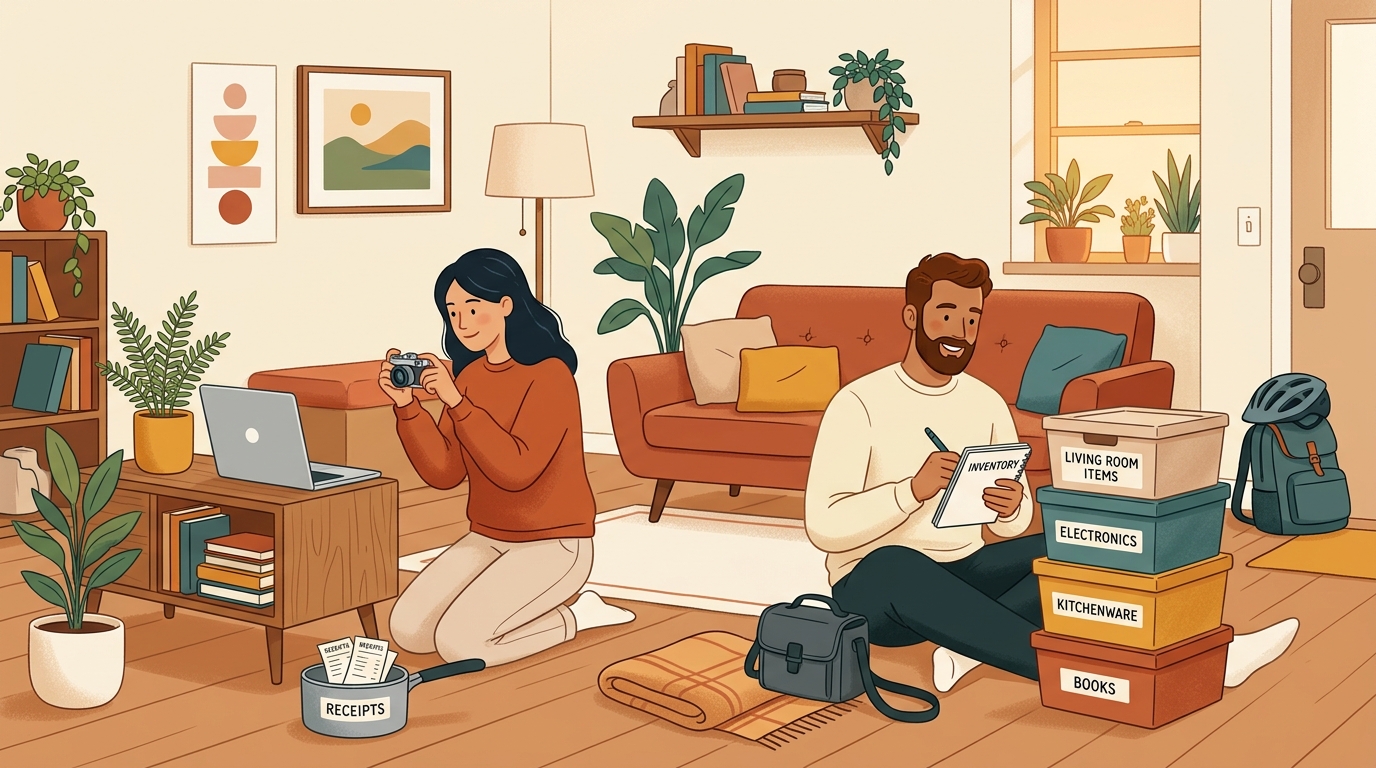
Home inventory renters insurance work is easy to ignore until a pipe bursts, a bike disappears, a kitchen fire spreads smoke through the apartment, or a move-out dispute turns into a receipt hunt. Renters insurance can protect the things you own, but the policy is only half the system. The other half is a clear record of what those things are, what they cost, where they live, and which documents prove they belong to you.
That matters because renters often underestimate the replacement cost of ordinary life. A laptop, mattress, sofa, headphones, winter coats, cookware, tools, books, sports gear, small appliances, and a closet of clothing can easily add up to more than the number you guessed while buying a policy. The Insurance Information Institute says renters insurance covers personal possessions, liability, and additional living expenses, and it recommends creating a detailed home inventory with estimated values to choose the right amount of personal property coverage and make claims faster.
This guide is built for renters who want practical protection without turning their apartment into a paperwork museum. You will learn what to record, how to document receipts and photos, how to handle roommates and shared items, what to update before renewal, and how to make your inventory useful if you ever need to file a claim.
If you own the place instead of renting — dwelling coverage versus the contents list — use the home inventory for homeowners insurance guide.
Why renters need a home inventory before buying coverage
Renters insurance is often sold as simple, inexpensive protection, and that is true compared with many other insurance products. The National Association of Insurance Commissioners says an average policy may cost about $15 to $30 a month, while covering belongings, liability, and sometimes living expenses if a covered loss makes the home unusable. Low monthly cost can make the decision feel casual, but the coverage amount should not be casual.
Your landlord's policy does not cover your belongings
The most important distinction is basic but often missed: the landlord insures the building, not your stuff. NAIC explains that personal belongings damaged or stolen from a rented apartment, house, or condo are not covered by the landlord or property manager's insurance policy. That leaves the renter responsible unless they have their own renters policy.
A home inventory turns that fact into a coverage number. Instead of asking, "How much coverage sounds normal?" you can ask, "What would it cost to replace my belongings if I had to start over?" That includes the visible items in the living room and the less glamorous items in closets, cabinets, drawers, storage lockers, laundry rooms, and cars.
Coverage limits depend on what you actually own
Personal property coverage is usually selected as a dollar limit. If your belongings would cost $35,000 to replace and you only buy $15,000 of coverage, the problem is not the insurance company being difficult. The problem is that the policy was sized around a guess.
Pew Research Center found that renters headed about 36% of U.S. households in 2019, and people under 35 were especially likely to rent. Many renters are building households in stages: hand-me-down furniture one year, a better mattress the next, work-from-home gear after that, then baby supplies, bikes, gaming equipment, or hobby tools. The coverage number that fit your first apartment may not fit your current one.
An inventory prevents the most expensive kind of memory problem
After a loss, memory gets worse exactly when you need it most. You may remember the television but not its size. You may remember the laptop but not the serial number. You may know there were kitchen tools, linens, cleaning supplies, and shoes, but not enough detail to rebuild the list confidently.
That is why a renters insurance inventory should exist before the claim. It gives you a calm record made under normal conditions, not a rushed list assembled after damage, theft, evacuation, or displacement. If you want the broader claim workflow, Vorby's home inventory for insurance claims guide goes deeper on adjusters, evidence, and claim-ready documentation.
What to include in a renters insurance inventory
A useful inventory is not a museum catalog. It is a working record that helps you estimate coverage, prove ownership, and find details quickly. Start with the categories most likely to drive replacement cost, then add the everyday items that become expensive in bulk.
Record the essentials for each important item
For high-value or claim-sensitive items, capture the facts an insurer, police report, warranty claim, or replacement search may need:
- Item name: Use a clear description, such as "Apple MacBook Air 13 inch" instead of "computer."
- Brand, model, and serial number: These matter for electronics, bikes, cameras, tools, appliances, musical instruments, and gaming systems.
- Purchase date and price: Exact is best, but approximate is better than blank.
- Current estimated replacement cost: Use what it would cost to buy a comparable item today, not what you hope the old one is worth.
- Receipt, invoice, or appraisal: Attach the proof when you have it.
- Photo or video: Show the item, condition, label, serial plate, accessories, and storage location.
- Location: Room, closet, bin, storage unit, bike room, garage space, or off-site location.
For lower-value items, grouping is fine. You do not need a separate record for every fork, paperback, towel, and sock. Group them by category and room, such as "kitchen utensils and cookware," "bed linens," "winter clothing," or "paperback books." The goal is credible replacement context, not inventory theater.
Do not skip ordinary categories
Renters often document electronics and forget everything else. Clothing is one of the biggest missed categories because each item feels ordinary, but replacing shoes, coats, jeans, formalwear, workout gear, and children's clothing at once is costly. The same is true for kitchenware, small appliances, tools, cleaning equipment, hobby supplies, and home office gear.
The Insurance Information Institute specifically calls out furniture, clothing, electronics, appliances, kitchen utensils, towels, and bedding when explaining how renters should decide how much insurance to buy. That list is useful because it sounds boring. Boring items are exactly what people forget when they estimate coverage from memory.
Mark items that may need special coverage
Renters insurance policies often include category limits for valuables. Jewelry, firearms, collectibles, fine art, musical instruments, cameras, bicycles, and certain electronics may have sublimits or may need an endorsement, floater, scheduled item, or separate policy. NAIC advises renters with expensive items, including art, computers, jewelry, or firearms, to ask their agent or insurer whether additional coverage is needed.
Your inventory should make those conversations easy. Tag items as "review with insurer" when the value is high, proof is weak, the item travels outside the home, or the category is commonly limited. Then ask specific questions before renewal, not after the loss.
How to document receipts, photos, and proof
An inventory without proof is better than no inventory, but proof is what turns a list into a claim-ready record. Receipts, photos, videos, serial numbers, appraisals, owner manuals, and repair records all add credibility. They also help you replace items accurately instead of searching vague product descriptions under stress.
Use photos for ownership and condition
The California Department of Insurance says photographs are especially helpful when an item is hard to describe on paper or when a purchase receipt cannot be obtained. It also recommends labeling each photograph with date stamps and additional useful information. For renters, that means every major item should have at least one clear photo, plus close-ups for serial numbers, labels, receipts, and accessories.
A simple room video also helps. Walk through each room slowly, open closets and drawers, narrate what is there, and capture storage areas that rarely appear in everyday photos. The California Department of Insurance specifically recommends walking around with a video camera, recording drawers, and sending the record offsite. A modern version can be a phone video saved to cloud storage and linked from your inventory.
Keep receipts where you can actually find them
Receipts are fragile. Paper fades, email receipts disappear under promotional mail, and online order histories may be tied to accounts you later close. Build a habit for every purchase above a threshold, such as $100 or $250: add the item, attach the receipt, photograph the serial number, and note the warranty date.
If you already have a scattered receipt problem, start with recent purchases and high-value categories. Vorby's guide on scanning receipts for tax deductions is tax-focused, but the same capture habit works for insurance: make the receipt readable, searchable, and connected to the item it proves.
Store the inventory away from the apartment
A printed binder on the bookshelf is useful until the bookshelf is damaged. Store the inventory somewhere you can access if the apartment is unavailable. Cloud storage, a trusted family member, a password manager note, or an exported backup can all work. California's insurance department recommends keeping a copy of the inventory and supporting documentation in a safe place, such as a safe-deposit box, work office, or relative's house.
Your inventory is not for the apartment you have on an ordinary Tuesday. It is for the morning when you need proof and cannot safely get back inside.
That does not mean everything must be public to your household. Sensitive documents, appraisals, and expensive item records should be shared carefully. The right system makes proof accessible in an emergency without turning private financial details into roommate gossip.
How renters should handle roommates and shared belongings
Shared living changes the inventory problem. Pew Research Center reported that nearly 79 million U.S. adults lived in a shared household in 2017, including relatives, adult children, siblings, and roommates. Many renters live with someone else, and shared homes blur ownership faster than people expect.
Separate personal property from household property
Most renters policies cover the named insured, and roommate coverage can vary by state, relationship, and insurer. The Insurance Information Institute says some insurers allow unmarried couples who live together to buy joint coverage, but a domestic partner is usually not automatically insured under the partner's policy unless specifically named. Roommates should not assume one person's renters policy covers everyone's belongings.
In the inventory, mark each item as personal, shared, borrowed, landlord-owned, or household-consumable. Personal items belong to one person. Shared items were bought together or intentionally owned together. Borrowed items belong to someone outside the apartment. Landlord-owned items are part of the rental. Household consumables are shared supplies that do not need claim-level tracking unless bought in bulk.
Document who paid for shared items
Shared items create two problems: insurance proof and household fairness. If a couch, espresso machine, rug, air conditioner, gaming console, or vacuum was split among roommates, record who paid, what share they paid, who keeps it at move-out, and how the household handles damage or replacement. The documentation does not need to be formal legal paperwork, but it should be clear enough that nobody has to reconstruct a Venmo history later.
Vorby's post on assigning ownership of shared items gives a full framework for shared homes. For insurance, the key is simpler: a claim should not become the first time anyone asks who owned the item.
Map shared storage before it becomes a junk drawer
Renters often store valuable items outside the room where they use them: bikes in a garage, holiday decor in a closet, tools in a shed, suitcases in a basement cage, or camping gear in a shared storage room. A storage location matters because a loss may affect only part of the property, and because roommates may move items without telling each other.
Use location labels that match real life: "hall closet upper shelf," "garage bike rack," "storage unit bin 3," or "under bed blue tote." If your apartment has shared closets or off-season bins, Vorby's shared storage organization tips can help turn those areas into visible zones instead of mystery piles.
How to estimate replacement value without overcomplicating it
Replacement value is where many renters get stuck. They do not know whether to use original price, current resale value, or the cost to buy something similar today. The answer depends on the policy type, but the inventory should capture enough detail to support either conversation.
Understand actual cash value vs replacement cost
The Insurance Information Institute and NAIC both explain the difference between actual cash value and replacement cost. Actual cash value pays to replace property minus depreciation, up to the policy limit. Replacement cost pays the cost to replace possessions without subtracting depreciation, also up to the limit. Triple-I says replacement cost coverage may cost about 10% more than actual cash value coverage, but can be worth the extra cost.
Your inventory should include original cost when known and current replacement cost when reasonable. If you bought a sofa on sale five years ago, the original receipt is still useful proof, but the current replacement cost may be different. If you bought a laptop used, the model and condition help the insurer evaluate comparable replacement or actual cash value.
Use categories to estimate the whole apartment
For a first pass, walk room by room and estimate replacement cost by category. Bedroom: mattress, bed frame, linens, clothing, shoes, nightstand, lamps, work bag. Living room: sofa, rug, media equipment, books, decor, games. Kitchen: cookware, dishes, small appliances, utensils, pantry equipment. Office: computer, monitor, chair, printer, software-related hardware, cables. Storage: luggage, seasonal items, tools, sports gear, hobby equipment.
Then compare the total to your policy. If your inventory lands near or above the limit, talk to your insurer before renewal. If a few categories dominate the value, ask whether any sublimits apply. That conversation is far better when you can point to the record instead of saying, "I think I have a lot of electronics."
Update values when life changes
A renters inventory should change after major purchases, moves, roommate changes, renovations, baby arrivals, new hobbies, remote-work upgrades, or inherited items. The California Department of Insurance recommends updating home inventories at least once per year and notifying the insurance company of new purchases so coverage remains adequate.
Annual updates also catch items you sold, donated, returned, replaced, or left with a former roommate. Removing old items matters because an inflated inventory can create confusion during a claim. Accuracy protects you in both directions: enough coverage for what you own, and a clean record that does not include things you no longer have.
A renter-friendly inventory workflow you can finish in a weekend
The best system is the one you will maintain. Do not start with the perfect spreadsheet, the perfect label maker, or a twelve-hour Saturday. Start with a workflow that captures the most useful proof quickly, then improves over time.
Start with the high-value sweep
Spend the first hour on the items most likely to matter: electronics, bikes, furniture, jewelry, musical instruments, cameras, tools, appliances, office equipment, hobby gear, and anything worth more than your deductible. Add photos, serial numbers, receipts, and replacement estimates where you can.
Next, do a room video. Open drawers and closets slowly. Narrate categories, not every object. Say, "top drawer, winter hats and gloves," or "closet shelf, two carry-on suitcases and camping pads." This gives you baseline visual proof while the detailed item records catch up.
Then build room and bin records
Once high-value items are captured, create room-level and storage-level records. Each room should have a short summary of major categories and estimated replacement ranges. Each bin or storage area should have a label, location, and contents summary. This is especially useful for seasonal storage, where items disappear for months and then suddenly matter.
If you use Vorby, this is where the inventory becomes easier to maintain. Create items for the possessions that need receipts, photos, serial numbers, ownership notes, and locations. Use categories for the lower-value groups. The system should mirror how you live, not force you into a filing cabinet's worldview.
Set a small maintenance rule
Maintenance is where inventory systems either survive or die. Use one rule: every meaningful purchase gets added before the packaging is thrown away. Photograph the item, serial number, and receipt. Add location and ownership. If it was shared, note who paid and what happens at move-out.
Then schedule one annual review near your renters insurance renewal. Walk the apartment, remove items you no longer own, update replacement values for major categories, and check whether high-value items need extra coverage. A twenty-minute renewal review can prevent a year of undercoverage.
What to do with your inventory after a loss
If something happens, the inventory helps you move from panic to sequence. You still need to follow your insurer's process, but you can do it with records instead of memory.
Protect safety, then document damage
Do not re-enter an unsafe apartment to rescue proof. Once it is safe, photograph or video damage before cleanup, keep damaged items until the adjuster tells you what to do, and save receipts for temporary expenses. The Insurance Information Institute advises renters to report crimes to police, contact the agent or company immediately, prepare a list of lost or damaged articles with copies of receipts, photograph or videotape damage, and keep receipts if relocation is needed.
Your pre-loss inventory becomes the starting list. Add a claim status to affected items: damaged, destroyed, stolen, repairable, pending review, replaced. Attach new photos and claim documents to the same item records so the timeline stays together.
Submit clear lists, not messy evidence dumps
An adjuster needs usable information. Group your claim by room or category, include descriptions, purchase dates, costs, photos, receipts, serial numbers, and replacement links when helpful. Do not send a chaotic folder of images and expect someone else to build the inventory for you.
If some proof is missing, be direct. A photo, warranty email, credit card statement, user manual, product registration, repair invoice, or app record can still support ownership. Your goal is to make each claimed item understandable and credible.
Track temporary living expenses separately
Renters insurance may include additional living expenses or loss-of-use coverage when a covered loss makes the home uninhabitable. Triple-I explains that ALE can cover hotel bills, temporary rentals, restaurant meals, and other extra expenses, usually reimbursing the difference between additional living expenses and normal living expenses.
Keep those receipts separate from personal property receipts. Use a simple claim folder with dated records: lodging, meals above normal cost, laundry, storage, transportation, pet boarding, and other insurer-approved expenses. Mixing ALE receipts with item receipts makes both harder to review.
FAQ: home inventory for renters insurance
Do I need a home inventory to buy renters insurance?
No. You can usually buy renters insurance without submitting an inventory. You still need one because it helps you choose the right personal property limit and makes claims easier if something is damaged, destroyed, or stolen.
How detailed should my renters insurance inventory be?
Document high-value items individually with photos, receipts, serial numbers, and replacement estimates. Group ordinary lower-value items by room or category, such as clothing, kitchenware, linens, books, or tools.
Does renters insurance cover my roommate's belongings?
Not automatically. Roommate coverage depends on the policy, state rules, relationship, and whether the other person is named on the policy, so each roommate should confirm coverage with their insurer.
Should I use replacement cost or original purchase price?
Record both when you can. Original price helps prove ownership and purchase history, while current replacement cost helps you estimate whether your personal property limit is high enough.
How often should renters update a home inventory?
Review it at least once a year, ideally before policy renewal. Also update it after major purchases, moves, roommate changes, inherited items, or any purchase that may need special coverage.
Turn renters insurance into a household system
Renters insurance protects the policyholder, but a home inventory protects the claim. It turns your belongings from a vague mental list into a record that can support coverage decisions, roommate clarity, replacement estimates, and recovery after a loss.
Make the first version simple: record the big items, scan the receipts you have, take photos, and add locations. Then keep it current with one purchase rule and one annual review. A clean inventory gives renters more control before the loss and a stronger starting point after it.
Protecting your apartment starts with knowing what is inside it. Build your renter-ready home inventory in Vorby and keep your belongings organized before you need the proof.


