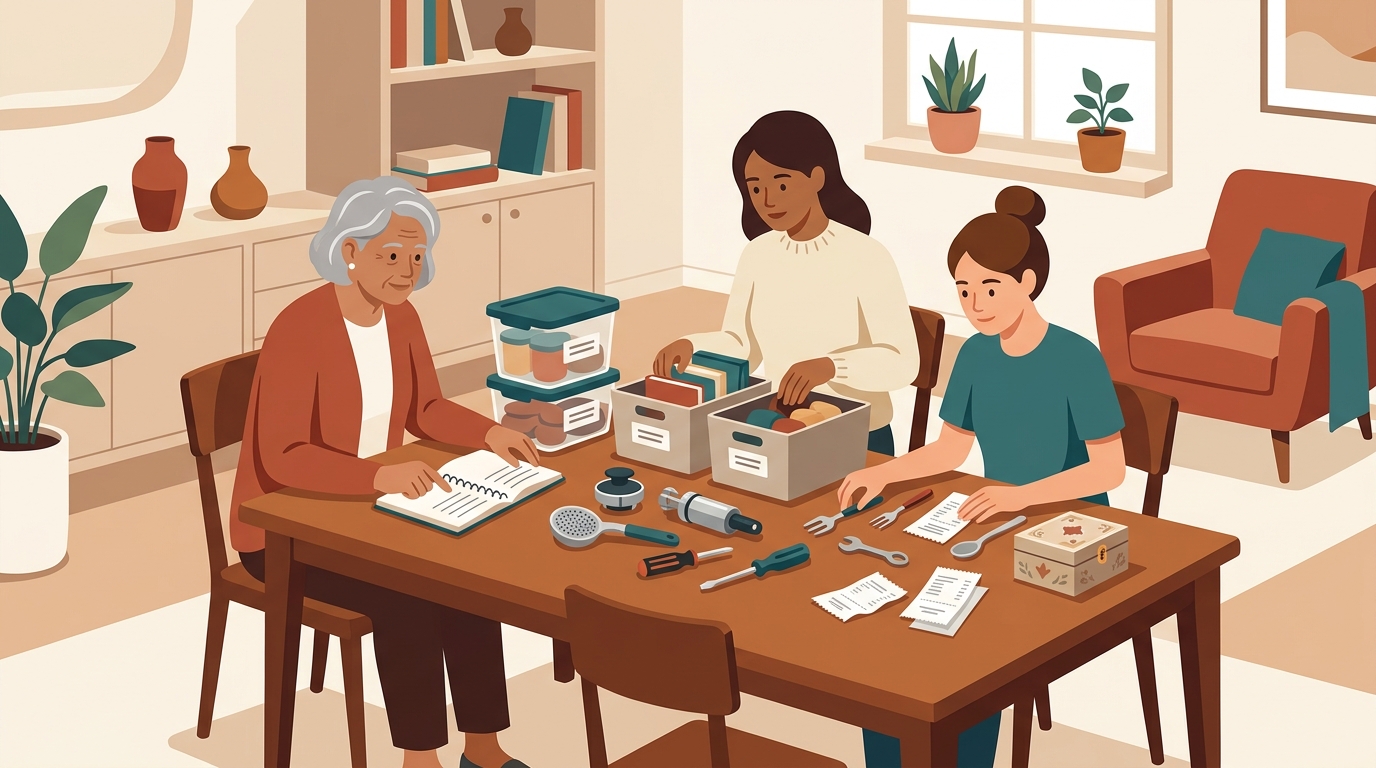
Assign ownership shared items before the first awkward argument, not after the moving truck is in the driveway. Shared homes work because people blend resources: one couch, one espresso machine, one set of patio furniture, one gaming console, one emergency kit, one set of tools, one pantry shelf that somehow belongs to everyone and no one. That generosity is useful until an item is damaged, sold, upgraded, moved out, or claimed by two people at once.
Ownership disputes are rarely about the object alone. They are about memory, money, assumptions, and fairness. A roommate thinks the air fryer was theirs because they bought it. A partner thinks the dining table is shared because both people chose it. A parent thinks the snow blower belongs to the household because everyone uses it. A sibling remembers paying half. Nobody can find the receipt. Everyone is a little right, which is exactly why the argument gets stuck.
The fix is a simple ownership system that lives with your household inventory. Decide how each shared item is owned, document the proof, assign maintenance responsibility, and agree what happens at move-out, breakup, sale, replacement, or damage. The process below works for roommates, couples, blended families, multigenerational households, and any home where belongings cross personal boundaries.
Why shared item ownership gets messy
Shared homes are common because housing, caregiving, family life, and practical economics often push people under the same roof. Pew Research Center reported that 59.7 million Americans lived in multigenerational households in 2021, about four times the number in 1971. Pew also found that financial issues were the top reason adults gave for living in a multigenerational home. The U.S. Census Bureau tracks households by relationship, nonrelatives, family structure, and living arrangements, which is a reminder that a home is often a network, not a single owner with perfect memory.
The problem is not generosity
Most shared-item problems begin with cooperation. One roommate buys a vacuum because the old one died. A couple splits a sofa because both people want the living room to work. A parent buys a lawn mower that adult children use. A family member stores inherited dishes at the house because everyone hosts holidays there. These decisions feel obvious in the moment, so nobody writes them down.
Later, the facts become fuzzy. Was the vacuum a gift to the apartment, or a personal purchase used by everyone? Was the sofa split evenly, or did one person pay more because the other covered utilities that month? Did the inherited dishes become family property, or are they still owned by the person who received them? Memory is not a reliable ownership ledger.
Big-ticket items raise the stakes
The National Association of Realtors says a home purchase is one of the largest financial transactions most buyers make. The items inside that home are smaller, but they still carry real value: appliances, furniture, electronics, tools, bikes, fitness gear, patio sets, generators, musical instruments, and specialty cookware can represent thousands of dollars. When people split costs casually, they also split risk casually.
The Insurance Information Institute recommends a home inventory with photos, descriptions, serial numbers, receipts, and appraisals when relevant. That guidance is usually framed around insurance claims, but it also solves a household problem: ownership is easier to respect when proof is attached to the item.
Move-outs expose every vague agreement
Move-outs compress decisions. People are tired, boxes are open, deposits are pending, and the person who was relaxed about shared ownership in March may feel very different in July. If a shared item has no written owner, no split percentage, and no agreed exit rule, the household is forced to negotiate under pressure. That is when small things become symbolic.
If you are setting up a shared home now, start with the same discipline you would use in a roommate move-in inventory checklist. The best time to decide ownership is while everyone still likes each other and nobody is carrying a couch down stairs.
Choose an ownership model for each item
Not every shared item needs the same arrangement. A $24 mop does not need the same record as a $1,200 couch. A wedding gift does not work like a roommate split purchase. A family heirloom should not be treated like an apartment toaster. Use the lightest ownership model that keeps the item fair and searchable.
Personal item, shared use
One person owns the item, but others are allowed to use it. This is the cleanest model for belongings that predate the shared home, items paid for by one person, sentimental belongings, work tools, hobby gear, family heirlooms, and anything someone would clearly take if they moved out.
- Record: Owner name, purchase date if known, receipt or proof, normal location, and use rules.
- Example: Jordan owns the stand mixer, but everyone can use it if they clean it and keep attachments in the drawer.
- Move-out rule: The owner takes the item. No buyout is needed unless the household later paid for a major upgrade.
This model prevents a common mistake: treating access as ownership. A shared item is not automatically jointly owned because several people use it. Write down the owner and the permission.
Joint item, percentage ownership
Two or more people own the item together, usually because they split the cost. Record percentages rather than vague phrases like split, shared, or ours. Equal shares are easy, but unequal shares are common when one person contributes cash and another uses gift cards, trade-in credit, or a larger household payment elsewhere.
- Record: Owners, percentages, total cost, each contribution, proof of payment, and what happens if one person leaves.
- Example: Maya owns 60 percent of the sectional, Sam owns 40 percent, based on the original purchase split.
- Move-out rule: One person buys out the other at an agreed value, or the item is sold and proceeds are split by percentage.
Percentages sound formal, but they are simply a kindness to your future selves. The record removes the need to reconstruct Venmo history while someone is patching nail holes.
Household item, no individual equity
Some things are truly household goods. Everyone benefits, nobody expects to take them, and the replacement cost is shared as part of running the home. Cleaning supplies, basic kitchen tools, inexpensive lamps, trash cans, storage bins, and shared emergency supplies often fall here.
- Record: Household-owned, replacement rule, normal location, and maintenance owner if needed.
- Example: The living room lamp is household property; if it breaks, replacement comes from the household fund.
- Move-out rule: The item stays with the home, is donated, or is divided by mutual agreement without reimbursement.
Use this category carefully. Expensive household items should still have named owners or percentages. Calling everything household-owned may feel relaxed at the start, but it can erase real contributions later.
Build a shared ownership inventory
An ownership inventory is not a legal contract by itself. It is a shared record of facts and expectations. The value comes from making the invisible visible: who paid, who owns, who maintains, where proof lives, and what everyone agreed would happen next.
Start with items most likely to cause disputes
Do not inventory every spoon on day one. Start with items that are valuable, sentimental, heavily used, easy to damage, hard to move, or likely to be claimed during a move-out. If you can imagine two people saying, wait, I thought that was mine, it belongs on the list.
- Furniture: couches, dining tables, desks, mattresses, patio sets, bookshelves, rugs.
- Electronics: TVs, speakers, game consoles, routers, monitors, cameras, tablets.
- Appliances: coffee makers, air fryers, vacuums, grills, tools, generators, small kitchen appliances.
- Outdoor and storage items: bikes, lawn equipment, camping gear, sports gear, coolers, storage shelving.
- Sentimental goods: inherited dishes, framed art, holiday decorations, keepsakes, family photos.
Couples who are merging households should be especially deliberate because duplicates and sentimental belongings collide fast. Vorby's guide to inventorying merged homes as a couple is a useful companion for deciding what stays, what goes, and what needs an owner before it disappears into the shared background.
Capture the ownership fields
For each item, record enough detail that a future person can understand the agreement without asking everyone to remember. A good record includes name, photo, location, owner or ownership percentages, purchase date, approximate value, receipt, serial number, condition, maintenance responsibility, and exit rule.
Use plain language. Instead of couch, write green Article sectional, bought May 2025, living room, Alex 50 percent and Priya 50 percent, receipt attached, buyout at mutually agreed used value or sell and split proceeds. That single entry can prevent five future arguments.
Attach proof immediately
Proof should live where the item lives digitally. Save the receipt, screenshot the payment split, photograph the serial number, and attach warranty or appraisal details. If the item was a gift, write who gave it, who received it, and whether it was intended for one person or the household.
This is where a household inventory app earns its keep. A spreadsheet can track ownership, but photos, receipts, notes, and locations are easier to maintain when they sit with the item record. If electronics are part of the shared home, the guide to documenting electronics for insurance explains why serial numbers and purchase proof matter long before a claim.
Use tags for people, rooms, and ownership status
Tags keep the record flexible. Add a person tag for each owner, a room tag for the current location, and an ownership tag such as personal shared-use, jointly owned, household-owned, borrowed, inherited, or undecided. Then you can filter the inventory before a move-out, holiday, repair weekend, or family meeting without reading every item one by one.
Undecided is a useful temporary status, not a permanent category. If nobody knows who owns an item, mark it undecided, add the known facts, and set a review date. That is better than pretending the answer is obvious and discovering later that each person had a different version of obvious.
Shared ownership works when the household can answer one question quickly: what did we agree this item was?
Write rules for damage, repair, replacement, and upgrades
Ownership is only half the system. Shared items also need operating rules because disputes often start when something breaks. The person who owns the item may not be the person who uses it most. The person who damaged it may not be the person who can afford to replace it immediately. Clear rules keep the conversation practical.
Separate normal wear from preventable damage
Normal wear is the cost of living with things. A couch cushion softens, a rug fades, a vacuum battery weakens, and a nonstick pan eventually loses its finish. Preventable damage is different: leaving a bike in the rain, using metal utensils on someone else's pan, dropping a speaker at a party, or letting a borrowed tool disappear.
Record the default rule. For normal wear on household items, the household shares replacement. For preventable damage, the person responsible repairs or replaces it. For personal items with shared use, the borrower follows the owner's rules and pays for damage beyond normal use.
Decide who handles maintenance
A shared item without a maintenance owner becomes everyone's job, which often means nobody's job. Assign a maintenance owner even when the item is jointly owned. That person is not financially responsible for everything; they are responsible for noticing, scheduling, updating the record, and raising decisions early.
- Vacuum: Riley cleans filters monthly and logs replacement parts.
- Grill: Chris handles propane, cover, cleaning, and winter storage.
- Router: Dana owns passwords, warranty details, and replacement planning.
- Shared bike rack: Morgan checks hardware before trips and records missing parts.
Maintenance ownership matters in families too. In a multigenerational home, the person who bought an item may not be the person who knows when it needs work. Vorby's multigenerational household inventory guide covers how shared records reduce invisible labor across generations.
Set upgrade rules before anyone shops
Upgrades create quiet ownership confusion. If one roommate pays to replace the old shared television, does the new TV belong to that roommate or the household? If a couple uses wedding money to upgrade a dining table, does ownership follow the gift, the marriage, the home, or the person who ordered it?
Use a simple rule: an upgrade creates a new ownership record. If the household pays, record household ownership or percentages. If one person pays, record personal ownership with shared use. If the old item had equity, decide whether that equity transfers, gets bought out, or ends when the item is sold or donated.
Plan fair move-outs and life changes
The most useful ownership rules are the ones written before anyone needs them. Move-outs, breakups, remodels, elder moves, college departures, and estate transitions all force belongings into motion. A calm exit plan lets people focus on logistics instead of relitigating the origin story of the toaster oven.
Create a move-out review list
Before a roommate leaves or a household changes, filter the inventory for shared items and personal items with shared use. Review each entry together. Mark take, stay, sell, donate, replace, buy out, or undecided. Do this before packing day.
For percentage-owned items, agree on valuation. You can use the original price minus depreciation, a current resale estimate, or a mutually agreed number. The exact method matters less than choosing it together and recording the decision.
Use buyouts when one person wants to keep the item
A buyout is the cleanest path for furniture, appliances, tools, and electronics that are hard to split physically. If two people own a $900 couch equally and agree it is now worth $500, the person keeping it pays the other $250. If ownership percentages are unequal, the buyout follows those percentages.
Keep buyouts boring. Put the amount, date, payment method, and final owner in the record. Once paid, update the item from joint ownership to personal ownership. That closes the loop.
Handle sentimental and family items differently
Sentimental items are not normal assets. Inherited dishes, handmade furniture, family photos, children's keepsakes, art, religious objects, and heirlooms should have named owners even if the whole household uses or displays them. If a family item is shared for hosting, record who legally or morally owns it and where it should go if the household changes.
Estate planning raises the stakes because household memory may outlive paperwork or conflict with it. If that is part of your situation, the Vorby guide to home inventory for estate planning can help separate sentimental value, replacement value, and ownership notes.
Use a simple meeting format that people will actually follow
The ownership system should feel like household management, not court. Short, recurring reviews beat one giant meeting that everyone avoids. The goal is to make decisions while items are visible and stakes are low.
Run a 45-minute shared item reset
Pick one room or category. Put the obvious shared items in view or open them in your inventory. For each item, ask four questions: who owns it, who uses it, what proof do we have, and what happens if someone moves out or it breaks?
Do not let the meeting become a debate over every low-value object. If an item is inexpensive and nobody cares, mark it household-owned and move on. Spend your attention on the items that would be painful to replace, emotionally loaded, or difficult to divide.
Write decisions in neutral language
Good ownership notes should not sound like blame. Use factual wording: Emma purchased this before move-in; household may use it; Emma takes it at move-out. Or: Shared purchase, 50 percent Noah and 50 percent Leo; if one person leaves, keep/sell decision due before move-out date.
Neutral notes reduce defensiveness. They also make the record easier to maintain because nobody wants to open an inventory app and read a tiny domestic prosecution.
Make changes visible
When someone buys, sells, donates, breaks, repairs, or moves a shared item, update the inventory the same day. Add a note if the ownership model changes. If a receipt is missing, write that too. A known gap is better than a pretend record.
For roommates, this habit pairs well with expense tracking. Payment apps show money movement, but they rarely explain what ownership agreement the payment created. Your inventory should translate the transaction into a household decision.
FAQ: assigning ownership of shared items
How do roommates decide who owns shared furniture?
Start with who paid, then record whether the item is personal with shared use, jointly owned by percentage, or household-owned with no individual equity. For expensive furniture, write the move-out rule when you buy it.
What if nobody has the receipt for a shared item?
Record the best available facts: who remembers paying, approximate purchase date, current photos, payment screenshots, and the ownership agreement everyone accepts now. Missing proof should be noted, not ignored.
Should couples track ownership of things they buy together?
Yes, especially before marriage, during a move-in, or when one person pays much more. A simple ownership note protects both people and makes future decisions calmer.
Who pays if a shared item is damaged?
Normal wear is usually shared by the owners or household. Preventable damage should be repaired or replaced by the person responsible, unless the household agreed otherwise.
Can a shared inventory prevent legal disputes?
It can reduce confusion and preserve evidence, but it is not a substitute for legal advice or formal agreements when valuable property, separation, estates, or business assets are involved.
Make shared ownership visible
Shared homes run better when belongings have clear owners, clear proof, and clear exit rules. Put the agreement next to the item, update it when life changes, and stop relying on memory for things that cost real money.
Vorby gives shared households one clear place to track what belongs to whom. Start with the items people borrow, split, damage, or argue about, then make the next move-out easier before it starts.