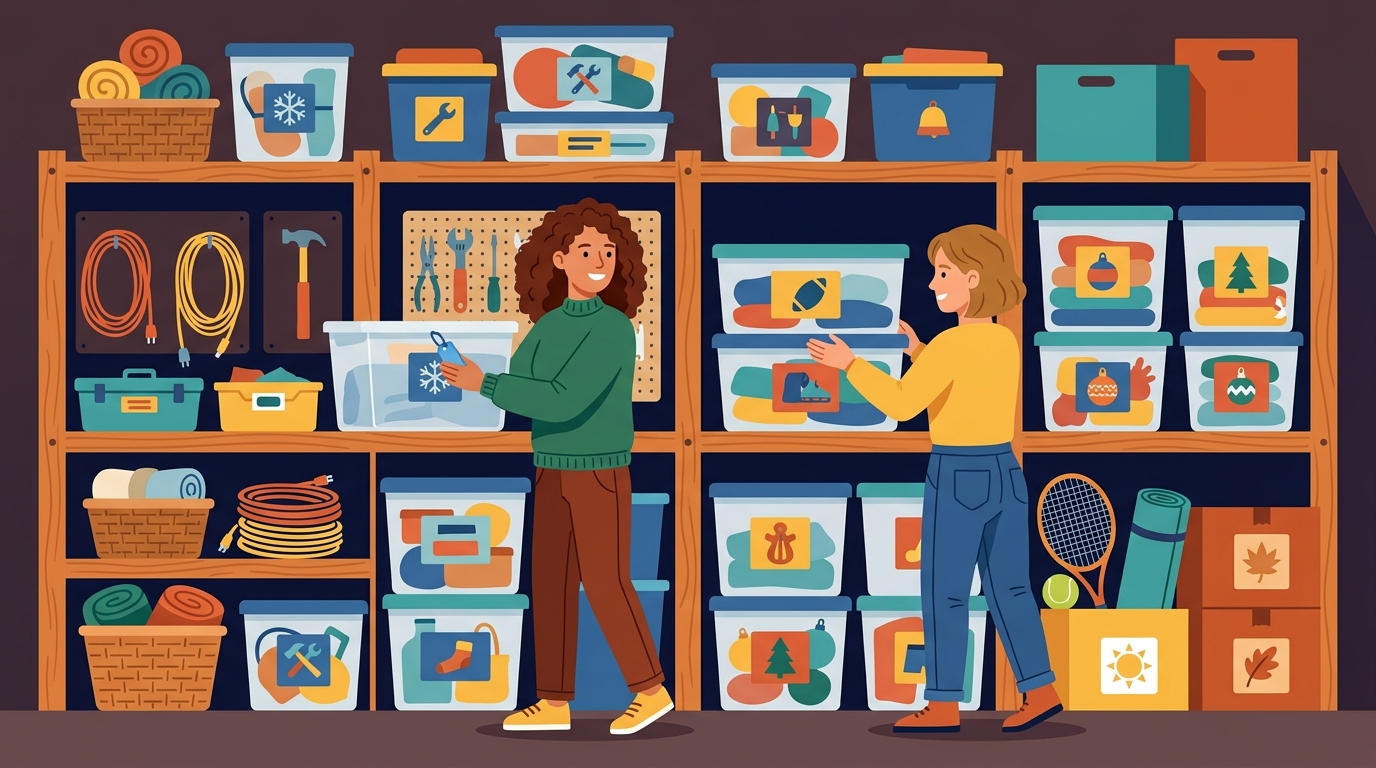
Organize shared storage before the garage, attic, basement, or hall closet becomes a neutral zone where everyone drops things and nobody knows what belongs to whom. Shared storage fails fast because it sits between private ownership and household convenience. Roommates stash moving boxes there, families rotate seasonal bins through it, adult children leave inherited furniture there, and nobody wants to be the person who opens every container on a Saturday just to find the air mattress pump.
The fix is not a prettier set of bins. Bins help, but only after the household agrees on zones, ownership, labels, records, and a reset rhythm. That matters more now because shared households are common and varied. Pew Research Center found that 18% of the U.S. population lived in multigenerational households in 2021, more than double the 1971 share. The U.S. Census Bureau also reports that family households remain the majority of U.S. households, while one-person households rose from 25% in 1990 to 28% in 2020. In other words, many homes are neither purely individual nor perfectly centralized. They are shared systems, and shared systems need visible rules.
These five tips are built for the storage areas where real households struggle: garages with bikes and tools, attics full of holiday bins, closets shared by roommates, basements packed with kids gear, and utility rooms where receipts, warranties, and spare parts vanish. Use them together and you turn storage from a pile into a map.
Why shared storage gets messy faster than private storage
Private storage has a single owner. Shared storage has overlapping claims, unclear responsibilities, and changing use cases. A bin might contain one roommate's camping stove, another roommate's spare bedding, and a household extension cord everyone uses. That kind of mixed ownership creates friction every time someone wants to clean, donate, repair, move, or replace something.
Shared spaces collect decisions people postpone
The garage and attic are attractive because they hide clutter without forcing a decision. If nobody knows whether the old blender works, it goes on a shelf. If nobody wants to decide who owns the folding table, it goes behind the camping chairs. If nobody can find the receipt for the dehumidifier, the manual gets tossed in a box with batteries and tape. The storage area becomes a waiting room for unfinished choices.
This is why a shared storage project should start with decision rules, not shopping. Decide what earns a spot, what gets labeled, who can move it, and when the household revisits it. Once those rules exist, containers and shelves become tools instead of decoration.
More people means more categories
Roommates usually share practical categories: cleaning supplies, kitchen overflow, tools, guest bedding, moving boxes, sports gear, and rarely used appliances. Families add kids gear, seasonal decorations, school projects, inherited items, home repair supplies, medical equipment, and emergency supplies. Multigenerational households add another layer because belongings may serve different ages and routines. Pew notes that financial issues are a major reason many adults live in multigenerational homes, which means storage often supports a broader household budget strategy, not just neatness.
The categories matter because each one needs a different standard. Holiday decor can live in labeled bins and get opened once a year. Tools need faster access and clearer return rules. Receipts and warranty documents need a digital record because the box they came in will not survive three storage resets.
Clutter is often an information problem
Most shared storage messes look physical, but the missing piece is information. Who bought the wet vac? Which bin has the soccer cleats? Is the spare router still under warranty? Can the old crib be donated, or is someone saving it? Without answers, people either avoid the space or duplicate purchases. A household inventory turns those invisible questions into searchable records.
Shared storage works when every item has three answers: where it lives, who decides its future, and what proof belongs with it.
Tip 1: Divide storage into zones before you buy containers
The first tip is simple: draw the map before you buy the bins. A shared garage or attic needs zones that match how the household lives, not just where shelves happen to fit. Zones stop the slow creep where camping gear swallows the paint shelf and holiday decorations bury the toolbox.
Start with household categories, not container sizes
Walk the storage space and write down the major categories already present. Common shared storage zones include seasonal decor, outdoor gear, tools and repair supplies, cleaning overflow, bulk household supplies, keepsakes, kids gear, sports equipment, guest bedding, luggage, appliance boxes, and documents. Do not start by measuring bins. Start by naming the work each area needs to do.
Then choose zones based on frequency and risk. High-use items should sit at shoulder height or near the entrance. Heavy items belong low. Fragile keepsakes need stable shelves. Emergency supplies should be reachable without moving ten boxes. Seasonal items can go higher or deeper because they have a predictable access window.
Create shared, private, and temporary zones
Most households need three zone types. Shared zones hold items anyone can use, such as tools, extension cords, guest bedding, coolers, or holiday supplies. Private zones hold one person's belongings in a clearly marked area. Temporary zones hold things with a deadline: returns, donations, borrowed items, moving boxes, or items waiting for repair.
The temporary zone is underrated. Without it, every undecided item becomes permanent clutter. Add a date label to anything temporary. If a donation bag sits for 30 days, it leaves. If a return misses the return window, the owner decides whether to keep, sell, or donate it. This turns vague storage into a queue with a finish line.
Use a simple floor plan
You do not need a professional diagram. A photo with arrows works. A note taped inside the garage door works. A shared digital note works. The important thing is that everyone can see the zone logic without asking the household organizer. For shared homes that already struggle with ownership questions, pair the map with a record of who owns shared items. Vorby's guide on how to assign ownership of shared items is a useful companion because zones work best when decision rights are clear.
Once the map is set, containers become easier to choose. You will know which zones need stackable clear bins, which need open shelves, which need hooks, and which need a locked or protected box.
Tip 2: Assign ownership and decision rights for shared items
Shared storage gets tense when an item is useful to everyone but owned by nobody. That is how duplicate ladders, mystery power tools, and abandoned furniture happen. Ownership does not have to mean one person controls everything. It means the household knows who can answer questions about the item.
Separate use from ownership
A shared item can be used by everyone while still having an owner or steward. The owner might be the person who bought it. The steward might be the person most likely to maintain it. For example, the household drill may belong to one roommate, but everyone can use it if they return the batteries to the charger. The family camping bin may be shared, but one adult manages the checklist before each trip.
Use three labels in your inventory: personal, shared, and borrowed. Personal items need permission before moving, donating, or lending. Shared items need return rules and a maintenance owner. Borrowed items need the lender's name and due date. This prevents a common shared-storage failure where an item is treated as communal until it breaks, then suddenly nobody remembers owning it.
Agree on donation and disposal rules
Storage does not stay organized unless things leave. Create a rule that covers abandoned, broken, duplicated, or outgrown items. A family might agree that kids gear gets reviewed at the end of each season. Roommates might agree that anything left in the temporary zone after move-out gets claimed within a specific window. Couples merging homes can use the same approach when they are deciding between duplicate appliances, tools, or decor.
Keep the rule kind and explicit. The goal is not to punish anyone for having stuff. The goal is to stop one person's forgotten item from becoming everyone's permanent obstacle. If the household has recurring disputes about move-outs, deposits, or shared purchases, the roommate move-in inventory checklist gives you a clean starting record before the first box lands in the closet.
Document expensive and high-friction items
Some items deserve extra detail because they trigger money or conflict: power tools, bikes, electronics, appliances, furniture, musical instruments, sports gear, emergency equipment, and anything bought together. Record the owner, approximate value, purchase date, serial number if relevant, condition, storage location, and receipt. The National Association of Insurance Commissioners says an accurate home inventory gives an insurance carrier the information needed to help settle claims, and the Insurance Information Institute says a home inventory can help you buy the right amount of insurance, settle claims faster, verify losses for income tax returns, and keep track of belongings accumulated over time.
That insurance logic applies to household management too. The more an item costs, the more likely it needs a record before there is a problem. If a shared pressure washer disappears, a bike is damaged, or a tool breaks, the conversation is easier when the household can see who bought it, where it lived, and what condition it was in.
Tip 3: Label bins so people can use the system without you
A label is not decoration. In shared storage, a label is a small agreement. It tells everyone what belongs there, what does not belong there, and how specific the category should be. The best labels are boring, readable, and consistent.
Use labels that describe retrieval, not just storage
Weak labels say things like miscellaneous, garage, or old stuff. Strong labels answer a future search: winter hats and gloves, extension cords and power strips, Quinn soccer gear, holiday lights, guest bedding, car cleaning supplies, camping kitchen, spare appliance parts, tax receipts 2026. The test is whether someone who did not pack the bin could find the item and return it correctly.
For shared homes, include the zone and owner when useful. A label like shared tools, garage wall, steward: Alex is more useful than tools. A label like Mia private keepsakes, attic shelf B is more useful than keepsakes. If the bin contains mixed ownership, say so and list the key items digitally.
Choose a label format the household will maintain
Do not build a system that requires perfect handwriting, specialty labels, and a label maker nobody can find. Blue painter's tape and a marker work for temporary labels. Printed labels work for permanent zones. QR codes can work well when a bin holds many small items, but only if the linked record is simple enough that people will actually update it.
Consistency matters more than polish. Pick a pattern like category, owner, location, review date. Use the same pattern across bins, shelves, and hooks. Vorby's shared storage bin labeling checklist goes deeper on label wording, color coding, and bin-level records if you want a more structured pass.
Pair visible labels with a searchable inventory
Labels help when you are standing in the garage. A searchable inventory helps when you are at the store, on a trip, filing a claim, or planning a move. Record each important bin and its contents. Take a photo of the bin, the shelf, and the items inside. Add tags for season, person, category, and room. The goal is not to catalog every paper clip. The goal is to prevent the household from opening six bins to find one charger.
This is where a product-aware system matters. A spreadsheet can work for a small apartment, but it usually breaks down when people need photos, receipts, shared access, and quick search from a phone. Vorby is designed around household inventory, so a shared storage bin can be connected to the items, receipts, photos, and locations that make it useful later.
Tip 4: Keep receipts, warranties, and manuals with the item record
Shared storage is not only about physical objects. It is also about proof. Receipts, warranties, manuals, serial numbers, model numbers, and repair notes decide whether an item can be returned, repaired, claimed, sold, or replaced. If those documents live in a junk drawer, they are not really part of the storage system.
Digitize proof at the moment it enters the home
When a shared item arrives, take three photos: the item, the receipt, and the model or serial number if it has one. Add the warranty length, store, purchase date, owner, and storage location. The Federal Trade Commission explains that written warranties should be available before purchase and that warranty details should be in writing. That is a practical reminder for households: if the warranty matters, the proof needs to be findable.
Receipts are especially important for shared items because payment and ownership can diverge. One person might buy the ladder and get reimbursed by the household. Two roommates might split a vacuum. A family member might buy a freezer for everyone to use. Keep the receipt with the item record so nobody has to reconstruct the purchase from bank statements later.
Create a document zone and a digital backup
Some paperwork still belongs in a physical folder: original appliance documents, home repair permits, insurance papers, moving paperwork, and sentimental documents. But the storage system should not depend on the folder being reachable during a crisis. Ready.gov says access to personal financial, insurance, medical, and other records is crucial for starting disaster recovery quickly and efficiently. A digital backup is not extra. It is what makes the physical folder useful when the folder is in a closet you cannot reach.
Set up one document zone for household records and connect the most important documents to item records. If the attic has a bin for appliance manuals, the freezer record should still include the model number, receipt photo, warranty information, and location of the manual. That way the household can search freezer and find the proof without climbing into storage.
Use receipts to reduce duplicate buying
Receipts are also a memory tool. They tell you what the household already bought, when it was bought, and whether it is worth replacing. If you know the air purifier filters were purchased three months ago, you do not need to buy another pack. If you know the storage bins are all the same model, you can buy matching lids instead of starting a new mismatched stack. If you know the shared snow shovel broke after two seasons, you can choose a better replacement.
For more detail on what household proof is worth keeping, read Vorby's guide to receipts to keep for taxes. Not every shared storage receipt is tax-related, but the same discipline helps: keep the documents that answer future money questions.
Tip 5: Build a reset rhythm that matches the storage category
The system only lasts if the household knows when to reset it. A one-time garage cleanout feels satisfying, then life resumes. People buy new gear, kids outgrow sports equipment, roommates move in and out, tools get borrowed, warranties expire, and seasonal bins rotate. Shared storage needs a rhythm, not a heroic annual rescue.
Use seasonal resets for seasonal items
Seasonal storage is the easiest place to start because the calendar gives you natural checkpoints. Review holiday decor after the holiday, not eleven months later. Review winter gear when spring starts. Review sports gear at the end of the season. Review beach, camping, and outdoor supplies before they move to the back of the garage.
A reset should be short and specific. Pull the bin, remove broken or unused items, update the inventory, add missing receipts or photos, relabel if needed, and set a review date. Vorby's seasonal storage inventory checklist can help households that want a structured routine without turning every season into a full cleanout.
Use move-in and move-out resets for roommate homes
Roommate storage changes when people arrive and leave. At move-in, give each person a private zone and create a shared zone list. At move-out, review any item with unclear ownership, borrowed status, or shared payment history. This protects friendships and deposits because the conversation happens from records, not memory.
For roommate houses, a reset can be tied to lease events. Do one 30-minute storage review when a new roommate signs, another two weeks before someone leaves, and a short shared-items check once a quarter. That is enough to catch orphaned items before they become household fossils.
Use quarterly resets for high-use shared zones
High-use areas need more frequent attention because they change quietly. Tool shelves, cleaning overflow, pantry overflow, sports gear, and kids gear accumulate small errors. A quarter is a good rhythm because it is frequent enough to catch drift and rare enough that people will tolerate it.
Make the reset visible and finite. Set a timer for 30 or 45 minutes. Put donations directly in the car. Throw away broken packaging. Update the inventory for anything expensive, shared, or hard to replace. If the household gets stuck, use a simple rule: if nobody will claim it, use it, repair it, or store it properly, it leaves.
How to set up a shared storage system this weekend
You do not need to finish the whole garage in one day. The fastest way to organize shared storage is to build the structure first, then fill it in. Use this weekend plan if the storage area already feels overwhelming.
Hour 1: Sort by zone and ownership.
Start with a rough sort. Create piles or areas for shared, private, temporary, donate, trash, and unknown. Do not open every memory box or debate every object. The goal is to reveal the shape of the storage space. Put obvious private items in the owner's area. Put obvious shared items in shared zones. Put decisions in the temporary zone with a date.
As you sort, take photos of crowded shelves before moving everything. Before photos help if someone later asks where an item used to be. They also make progress visible, which matters when a project feels messy halfway through.
Hour 2: Label the first 10 containers or shelves.
Pick the 10 most important containers, shelves, hooks, or zones. Label those first. Do not chase perfection across the entire space. If the household can find tools, guest bedding, cleaning supplies, sports gear, seasonal decor, and emergency supplies by the end of the first pass, you have already changed the daily experience.
Use temporary labels while categories are still moving. Once the system survives a few weeks, replace temporary labels with permanent ones. This avoids the classic mistake of making beautiful labels for categories you later realize are wrong.
Hour 3: Inventory the items that would be painful to lose.
Inventory the high-value and high-friction items first: electronics, tools, bikes, appliances, shared furniture, emergency gear, keepsakes, and anything with a receipt or warranty. Add photos, owner, location, condition, purchase date, and proof. Do not spend the first day cataloging cheap duplicates unless they are a recurring source of confusion.
This priority approach keeps the project useful even if life interrupts it. If you only finish one afternoon, the household still gains a map, visible labels, and records for the items most likely to cause money or conflict later.
FAQ: organizing shared storage
What is the best way to organize shared storage with roommates?
Give each roommate a private zone, create clearly labeled shared zones, and document shared purchases with owner, receipt, and location. Review storage at move-in, move-out, and once per quarter.
How do you label bins in a shared garage or attic?
Use labels that include category, owner or shared status, location, and review date. Avoid vague labels like miscellaneous because they make it hard for other people to return items correctly.
What should families keep in a shared storage inventory?
Families should track expensive items, seasonal bins, kids gear, tools, appliances, emergency supplies, keepsakes, receipts, warranties, and anything multiple people use. Photos and location notes matter as much as item names.
How often should shared storage be cleaned out?
Seasonal items should be reviewed after each season. High-use zones such as tools, cleaning supplies, sports gear, and kids gear usually need a short quarterly reset.
Should shared storage use an app or a spreadsheet?
A spreadsheet can work for a small, stable household. An app is better when the household needs photos, receipts, shared access, search, labels, and location records from a phone.
To organize shared storage, make the invisible parts visible: location, ownership, proof, and review dates. Once those answers are easy to find, garages, attics, closets, and basements stop being places where decisions disappear.
Shared homes run better when shared belongings are visible. Vorby gives roommates, families, and shared households one place to track what they own together. Start at vorby.com.