It’s that familiar, heart-sinking moment of panic. Your keys, wallet, or phone have vanished into thin air. Finding something you’ve lost often feels like a stroke of dumb luck, but it’s actually a skill, one you can learn and get better at. The trick is to replace frantic, chaotic searching with a calm, systematic process that works with your brain, not against it.
The Science of Finding What You've Lost
If you feel like you’re always searching for something, you're in good company. Misplacing personal belongings is an incredibly common human experience, happening far more often than most of us realize. The scale of this everyday problem is pretty staggering when you look at the numbers.
Recent research shows 60% of Americans have lost a personal item in the last year alone. Think about your own day; the average person misplaces up to nine items. This adds up, with Americans collectively spending about 2.5 days per year just searching for their stuff. That lost time and frustration costs a whopping $2.7 billion annually in replacement items. You can read more about these lost and found statistics and see just how big the impact is.
Shifting from Panic to a Plan
When something important goes missing, what’s your first instinct? For most of us, it’s to start tearing the room apart in a frenzy. But that chaotic approach almost never works. In fact, the stress it creates just clouds your memory, making it even harder to remember where you last saw the item.
The core principle of finding things is simple: a calm, methodical approach is your most powerful tool. By staying composed and following a logical sequence, you turn a frustrating hunt into a focused recovery mission.
This guide gives you a clear framework to find lost items efficiently. Instead of relying on random chance, you’ll learn a structured process that dramatically increases your odds of success. We’ll cover everything from quick, common-sense checks to deep, systematic searches.
Here's what you'll learn to master:
- The Cognitive Rewind: How to mentally retrace your steps to pinpoint the "last known location."
- Zone-Based Searching: A methodical way to divide and conquer any space so you don't miss a single spot.
- Psychological Triggers: Simple techniques to jog your memory and work with your brain's natural recall functions.
- Preventative Habits: How to make small changes and use smart tools to stop losing items in the first place.
By the end, you'll have a repeatable strategy not just to find what you've lost, but to keep track of your most important belongings for good.
Your First Five Minutes of Searching
The instant you realize something important is missing, your heart sinks. Keys. Wallet. Phone. That familiar jolt of panic hits, and the first instinct is to start tearing the room apart in a frantic search.
Stop. Resist that urge.
What you do in these first five minutes can mean the difference between finding the item in a moment of calm clarity and spending the next hour in a frustrating, chaotic hunt. The single most effective thing you can do is pause, take a breath, and think before you move.
Practice the Cognitive Rewind
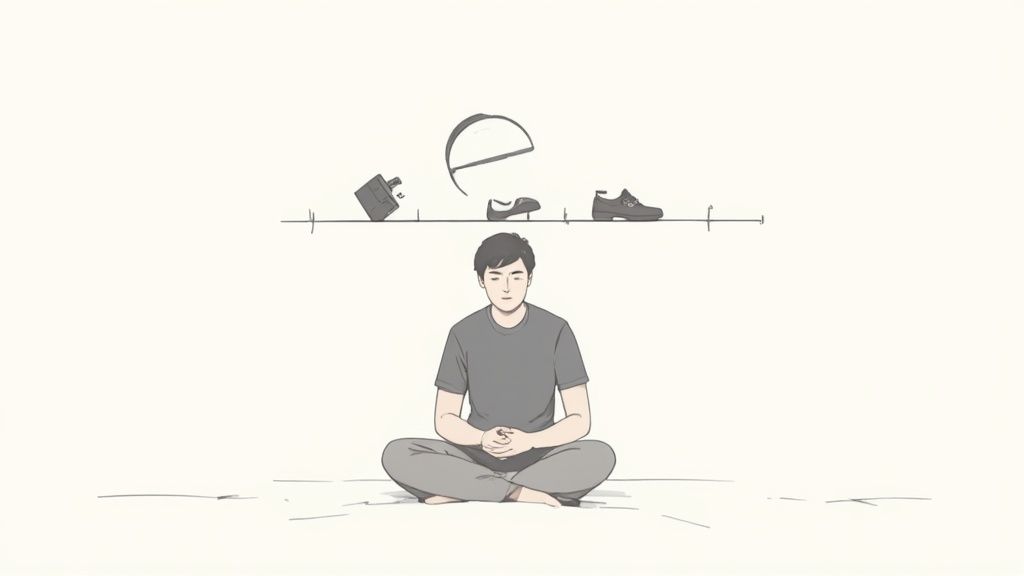
Instead of launching a physical search, start with a mental one. This technique, which I call a Cognitive Rewind, is all about mentally retracing your steps, actions, and even your thoughts from the last time you remember having the item. Panic clouds your short-term memory, but a focused rewind cuts through that fog.
Find a quiet spot and sit down for a minute. Close your eyes if it helps. Now, walk yourself through the last little while, but don't just focus on the big picture. The power is in the small, seemingly insignificant details.
Ask yourself pointed questions to jog your memory:
- What was I doing right before I noticed it was gone?
- Which room was I in the last time I remember seeing or using it?
- What else was in my hands at that moment? (This is a big one. Maybe you put your keys down on the counter to grab the mail.)
- What was on my mind? Was I listening to a podcast or thinking about dinner?
These tiny sensory details are like hooks for your memory. Recalling that you were listening to that true-crime podcast when you walked in the door can help you reconstruct the entire sequence of events, unlocking the door, dropping the mail on the hall table, and setting your wallet right next to it.
The goal isn't just to remember where the item is. It's to remember the last moment you knew where it was. That distinction is key because it narrows your search down to a specific time and place.
From Mental Map to Physical Search
Once your cognitive rewind gives you a probable "last seen" location, that's where you start looking. Not everywhere, just there. Search that immediate area methodically. Look under the sofa cushions, between the pages of the magazine on the coffee table, or inside the grocery bag you were carrying.
This targeted approach is so much more effective than a random, house-wide frenzy.
For those of us who seem to be constantly misplacing things in different spots, it might be time to give your brain a digital backup. Using organized location tracking for your belongings can stop these moments of panic before they even start. But for now, remember: stay calm and think before you act. You’re giving your mind a fighting chance to solve the puzzle.
A Systematic Search Method That Works
When your first frantic pass comes up empty, it's time to switch gears. Stop the hopeful glances around the room and start a real, structured plan. The single most effective way to find something that’s truly hiding is to stop searching randomly and start searching methodically. This is where a Zone-Based Search becomes your new best friend, turning a chaotic hunt into an organized recovery mission.
The idea is simple but powerful: instead of scanning the same areas over and over, you mentally divide the search space into small, manageable grids. Think of it like a detective's search pattern at a crime scene. You cover every single inch of one zone before moving to the next, which eliminates wasted effort and guarantees you won't miss a thing.
This whole process actually begins by pausing your physical search to start a mental one, a critical first step.
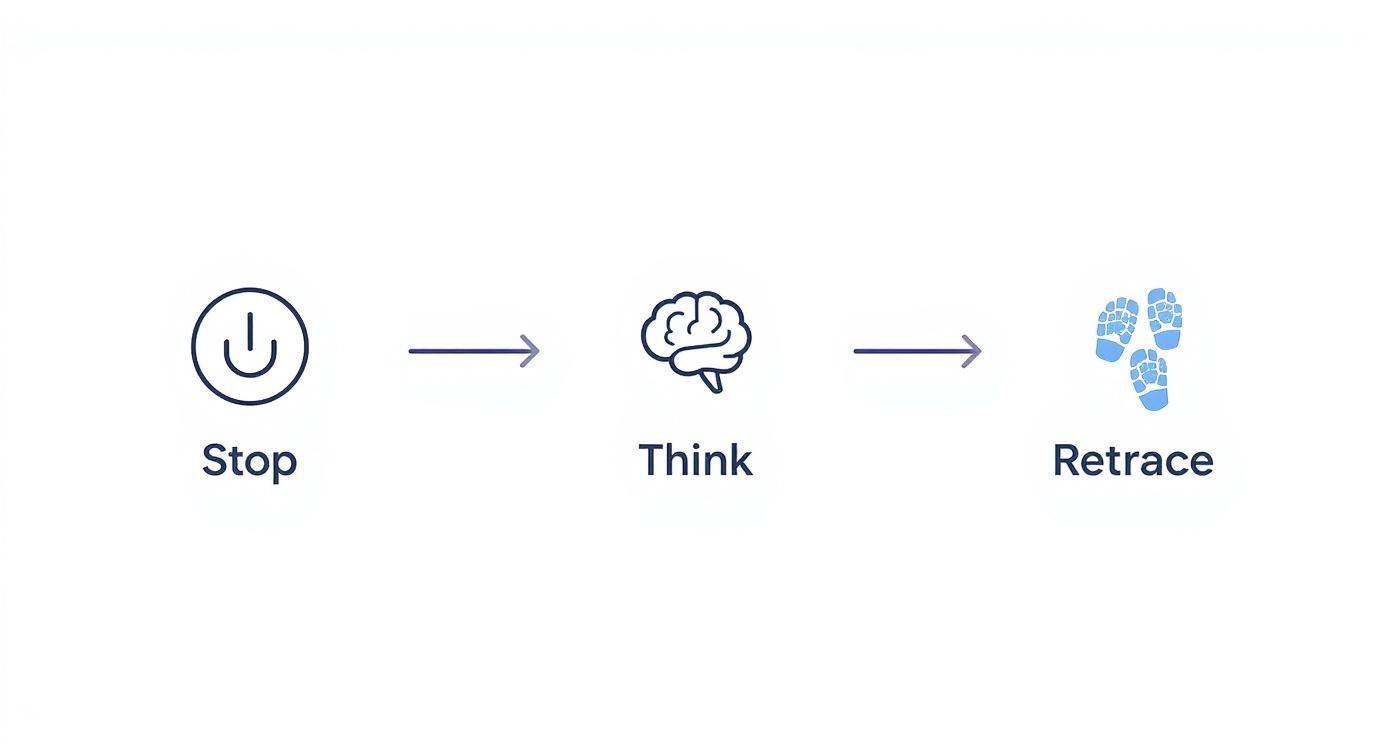
This diagram nails the sequence: stop the panic, think logically about where the item could possibly be, and only then retrace your steps before you even begin the physical search. This mental prep work keeps you from searching in a state of anxiety, which is almost always a waste of time.
Implementing a Zone-Based Search
Start in the room where you most likely last had the item. Don't look at it as one big space; break it down into smaller, bite-sized zones. For example, your living room isn't just a room, it's a collection of distinct areas:
- The couch and coffee table area
- The entertainment center and its shelves
- The desk hiding in the corner
- The entryway near the front door
Pick one zone to start with, let's say, the couch. Now, search it completely. I mean completely. Check under every single cushion, feel deep down in the crevices, get on your hands and knees to look underneath the entire piece of furniture, and shake out any nearby blankets or pillows.
Once you are 100% certain it's not in that zone, you can mentally check it off and move to the next one, like the coffee table. This disciplined, one-zone-at-a-time approach is what makes the whole system work.
Before you start tearing rooms apart, it helps to know where things usually end up. I've put together a quick cheat sheet for the most common culprits.
Common Hiding Spots for Frequently Lost Items
A quick reference guide to the most common places where everyday items are found, helping you prioritize your search.
| Item | Top 3 Places to Check First |
|---|---|
| Keys | In a coat pocket, near the front door, or still in the car ignition. |
| Phone | Between couch cushions, on the bathroom counter, or plugged into an outlet in another room. |
| Wallet | In a different pair of pants, on the kitchen counter, or in the car's center console. |
| TV Remote | Under a blanket, fallen between the couch and the wall, or on a nightstand. |
| Glasses | On top of your head, on the nightstand, or next to the bathroom sink. |
While this table covers the usual suspects, my next point is about what to do when an item isn't in any of these logical spots.
Thinking Beyond the Obvious Locations
A truly systematic search means you have to look in places that defy immediate logic. Our brains do some bizarre things on autopilot, like putting the remote in the fridge or accidentally dropping car keys into a grocery bag. These are often called "drop zones," places where we unintentionally leave things when our hands are full or our minds are somewhere else.
When you're searching, remember this simple rule: if you’ve already checked all the logical places, the item is almost certainly in an illogical one. Don’t dismiss any possibility, no matter how strange it seems.
This structured method definitely requires patience, but it's remarkably effective for anything that's been missing for more than a few minutes. By combining a logical grid system with an open mind about where things can end up, you create a powerful strategy. You stop relying on luck and start relying on a process that guarantees you will eventually uncover the exact spot where your lost item is waiting.
Using Psychology to Jog Your Memory
When you’ve turned the house upside down and the item is still nowhere to be found, it’s time to stop searching your physical space and start searching your mental one. More often than not, the thing you’re looking for isn’t in a clever hiding spot. It’s just trapped behind a gap in your memory. The trick is to stop trying to force the memory out and instead use a few psychological cues to gently coax it to the surface.
Our memories aren't stored like files in a cabinet. They’re a messy, beautiful web of associations, connecting sights, sounds, smells, and emotions. By tapping into those sensory and emotional details, you can often reactivate the exact neural pathway that leads to the moment you misplaced your keys.
Engage Your Senses and Emotions
Take a deep breath and think back to the last time you know for certain you had the object. Don't just picture where you were; try to reconstruct the entire scene in your mind. This isn’t just about visualization; it’s about creating a rich mental tapestry that can trigger that one missing piece of information.
To get there, ask yourself some specific questions:
- What was I hearing? Was music playing? Was the TV on in the background? The quiet hum of the dishwasher?
- What was I feeling? Were you relaxed after a long day, stressed about a deadline, or maybe excited about dinner plans? Emotions are powerful memory anchors.
- What was on my mind? Were you mentally running through your grocery list or replaying a conversation in your head?
Recalling that you were feeling anxious about a morning meeting while holding your wallet might suddenly make you remember shoving it into your coat pocket instead of leaving it in the usual spot by the door. If you want to get better at this kind of recall, it’s worth exploring some proven strategies to retain information better, which can help strengthen these memory pathways over time.
Embrace Strategic Distraction
It sounds completely backward, but one of the most effective ways to remember something is to stop trying so hard. When you're laser-focused on the problem, your brain can get stuck in a frustrating loop, revisiting the same dead-end thoughts over and over again. This is where a little strategic distraction works wonders.
Give your conscious mind a break. Shift your focus to a completely unrelated task, go for a walk, solve a puzzle, wash the dishes. This allows your subconscious to keep working on the problem in the background, free from the pressure.
This mental reset is often all it takes for that "Aha!" moment to strike. While you’re absorbed in something else, your brain makes new connections without you even realizing it. Suddenly, the memory of where you put down your glasses will pop into your head, seemingly out of nowhere.
For those of us who find these memory lapses happening a bit too frequently, it can be a huge relief to have technology act as a backup. Modern tools can serve as a kind of external memory, and you can learn more about how an AI home memory assistant can help fill in those frustrating gaps. By working with your brain's natural tendencies instead of against them, you can turn a frantic search into a simple, solvable puzzle.
Building Habits to Prevent Future Loss
After the stress of tearing your house apart for the third time this month, you realize something has to change. The best way to find lost items is to stop losing them in the first place. This isn't about some massive life overhaul; it's about shifting from frantic, reactive searching to building proactive, simple systems that keep your stuff where it belongs.
It really comes down to small, consistent changes that build a solid foundation, backed up by smart tools that act as your safety net.
Create a Designated Home for Everything
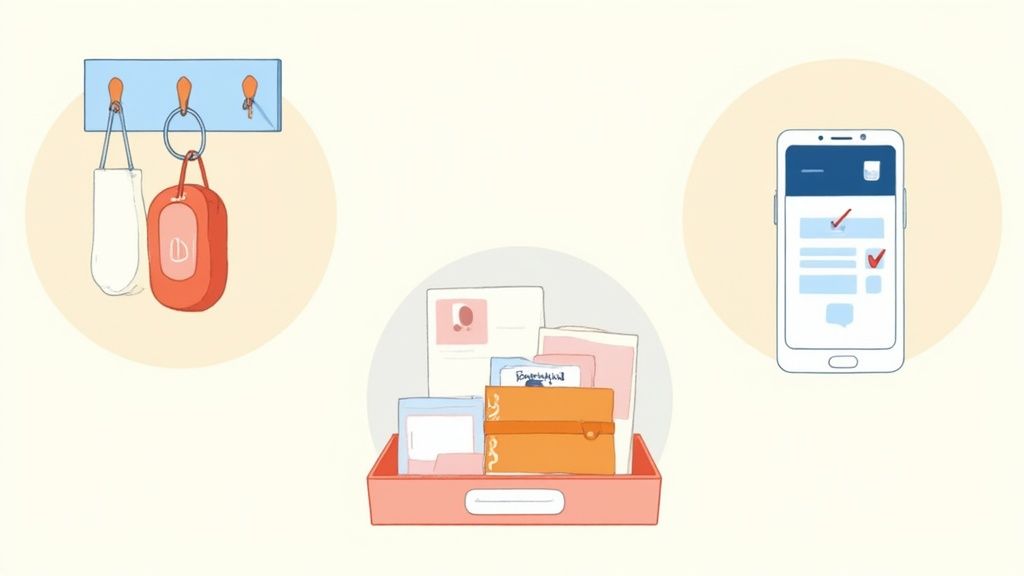
If you only do one thing, do this: give every important item a "designated home." Think about the usual suspects, keys, wallet, phone, glasses. These things need a permanent, non-negotiable spot where they live when you're not using them.
Your keys could have a dedicated hook right by the front door. The second you walk inside, they go on the hook. No exceptions. Your wallet might live in a specific tray on your dresser. Your phone has its charging station on the nightstand.
By making this a consistent ritual, you move the action from your conscious mind to your subconscious. You no longer have to think about where you put your keys; you just put them in their home on autopilot.
This one concept eliminates the vast majority of "where on earth did I leave it?" moments. It takes a little discipline to start, but the mental energy you get back is enormous. The goal is to make putting things away as automatic as locking the door behind you.
Build a Digital Inventory for Total Clarity
While good habits are your first line of defense, technology offers an incredible backup system. A digital home inventory tool like Vorby completely changes how you keep track of everything, from important documents to the holiday decorations stored in the attic. Instead of relying on a foggy memory, you’re creating a searchable, digital map of your entire home.
Imagine you're looking for your hiking boots, which you haven't seen since last summer. Instead of ripping through every closet, you could just ask your inventory app, "Where are my hiking boots?" and get an instant, precise answer: "In the blue storage bin, back-left corner of the garage."
Modern inventory apps make this incredibly easy with features that do the heavy lifting for you:
- Natural Language Search: Find things fast by asking questions in plain English, just like you’d ask a friend.
- Image Recognition: Snap a photo of an item, and the system can often identify and catalog it for you, saving you from tedious typing.
- QR Code and NFC Mapping: Stick a QR code or NFC tag on a box. A quick scan with your phone instantly shows you a complete list of everything inside, no more opening ten identical-looking bins.
If you're ready to get started, our guide on how to take an inventory of your home breaks down the process. For all your critical paperwork, adopting solid document archiving best practices is another game-changing habit.
Building these systems turns your home from a black hole where things disappear into an organized space where everything has its place, both physically and digitally. This combo of mindful habits and smart tech is the ultimate fix for the age-old problem of losing your stuff.
Common Questions About Finding Lost Items
Even with the best game plan, some situations just feel impossible. When you're in the thick of a search, you're bound to hit a wall with questions that don't fit the standard "look in the obvious places" advice. Here are some real-world answers to the dilemmas we all face when something important goes missing.
What If I Lost Something Outside My Home?
Losing something in public definitely ups the anxiety, but the core strategy is the same: retrace your steps. As soon as you can, physically walk the route you took. Did you stop at a coffee shop, a park, or a friend's house? Call every single place you visited, and do it quickly.
Don't forget the power of your community, either. Jump on local Facebook groups or neighborhood apps like Nextdoor. You'd be amazed at how often people post pictures of found keys, wallets, and even pets. If what you lost is valuable, think phone, wallet, or expensive sunglasses, it's worth filing a report with the local police. Good Samaritans often turn things in.
How Long Should I Search Before Giving Up?
This is a tough one, and it's less about a rule and more about protecting your own sanity. The "right" amount of time to search is a balance between the item's value (both monetary and sentimental) and your own peace of mind.
- For replaceable, low-cost items: Give it a solid, systematic search for a day or two. If a truly thorough sweep of all the logical (and illogical) spots comes up empty, it's probably time to let it go.
- For sentimental or irreplaceable items: The search can become more of an ongoing, low-level background task. After the first intense hunt, just keep an eye out for it during your regular cleaning or organizing sessions. Sometimes things show up months later in the most unexpected places.
Give yourself a mental deadline for the active search. The constant, nagging feeling of looking for something is emotionally draining. Giving yourself permission to stop is a healthy way to manage the stress of the loss.
Are Bluetooth Trackers Really Effective?
Absolutely, for the right kind of lost. Trackers like Apple AirTags or Tiles are fantastic for the things you tend to misplace in a limited area, like your home, car, or office. If you're the person who's always hunting for your keys, the remote, or your wallet somewhere in the house, they're a total game-changer.
They work by connecting to your phone via Bluetooth, showing you the item's last known location on a map. When you get close, you can make the tracker play a sound, guiding you right to it. They won't find the sunglasses you left on a park bench across the country, but for your everyday essentials, they act like a digital leash, keeping your most important belongings from getting truly lost in the first place.
Ready to stop searching and start finding? Vorby gives you a complete digital map of your home, so you always know exactly where everything is. Explore how Vorby can organize your life today.