
Filed November 2026 · valuation terms
Two sofas, one fire. Both policies respond. One check refurnishes the living room; the other buys a used sofa and a shrug. Nothing about the damage changed - only the settlement clause, and the paperwork behind it.
Actual cash value vs replacement cost is a question of arithmetic, not of which policy feels nicer to own. The same item, priced twice, produces two numbers. This page prices one claim both ways, item by item, then shows which documents move the lower figure up.
In short
Replacement cost vs actual cash value is one subtraction apart. Replacement cost coverage pays what it takes to buy the item again, of similar kind and quality, with no deduction for age. Actual cash value pays that same figure minus depreciation. On the four-item contents claim below, the replacement-cost policy settled at $2,950 and the actual cash value policy paid $126. The $2,824 gap closes only when replacement is proven. The home inventory guide for insurance claims covers the record that makes the proof possible.
What actual cash value means
Actual cash value is a replacement figure with age taken out of it. The Insurance Information Institute defines it as the amount needed to replace an item minus depreciation - the decrease in value due to age, wear and tear, and other factors. Massachusetts' Division of Insurance attaches an example: a refrigerator with a 20-year life expectancy that fails at 17 is valued as a refrigerator with three years of service left, not as a new one.
That definition makes ACV a two-question method. What does the item cost new today? How much of its service life was left when it was destroyed? An adjuster needs both answers before a number exists, and both answers are records problems before they are valuation problems. Under a typical homeowners policy, contents sit on an actual cash value basis unless a replacement cost endorsement is added. Knowing what a home inventory is and what it records is the first half of answering them.
What replacement cost means
Replacement cost coverage pays to replace damaged property with materials of similar kind and quality, without deducting for depreciation. The policy limit still caps the check, and "like kind and quality" is a floor as well as a ceiling: it buys the sofa you had, not the one you would upgrade to.
For contents, replacement cost has a condition attached. Insurers pay the replacement figure when the item is actually replaced; until then, the claim settles at cash value. The Insurance Information Institute puts it plainly - with replacement cost coverage on personal possessions, you normally need to replace the damaged items before the insurer pays, and you generally get several months from the date of the cash value payment to do it.
How depreciation turns replacement cost into ACV
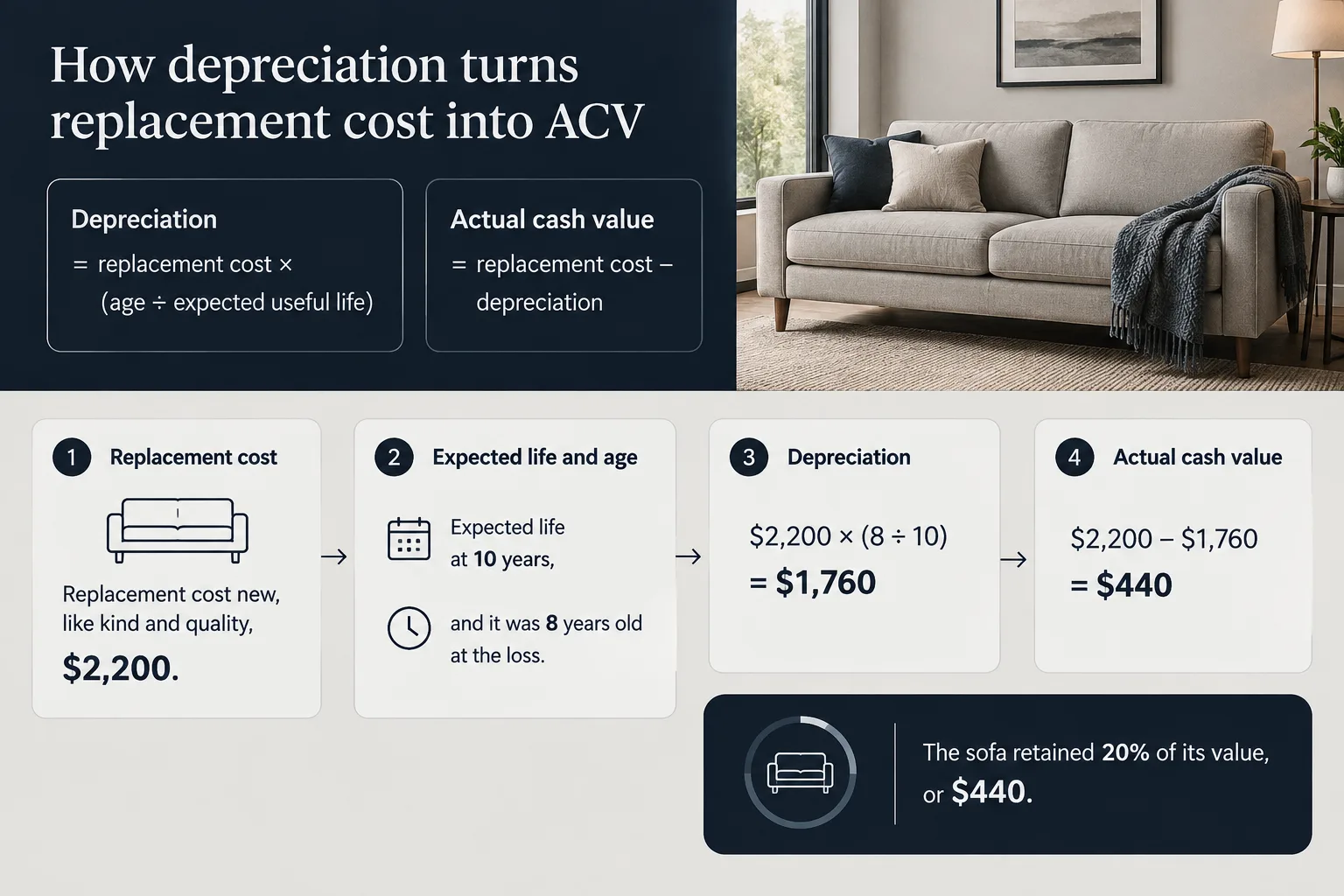
Depreciation is the whole distance between the two settlement methods. The formula an adjuster applies is short:
Depreciation = replacement cost × (age ÷ expected useful life)
Actual cash value = replacement cost − depreciation
Take one sofa. Replacement cost new, like kind and quality, $2,200. The adjuster's schedule puts its expected life at 10 years, and it was 8 years old at the loss.
Depreciation: $2,200 × (8 ÷ 10) = $1,760
Actual cash value: $2,200 − $1,760 = $440
The sofa retained 20% of its value, or $440. Age is not the only input - condition, wear and obsolescence count, and a well-kept item can argue its way to a higher figure. But the multiplication is mechanical, and it runs on two facts you either have or don't: the price when new, and the purchase date.
A separate calculation often gets confused with this one. For a federal casualty loss deduction, the IRS compares the property's adjusted basis with the decrease in fair market value and takes the smaller figure. That is a tax computation, not an insurance settlement, and it can land on a different number for the same sofa.
The same claim under both policies
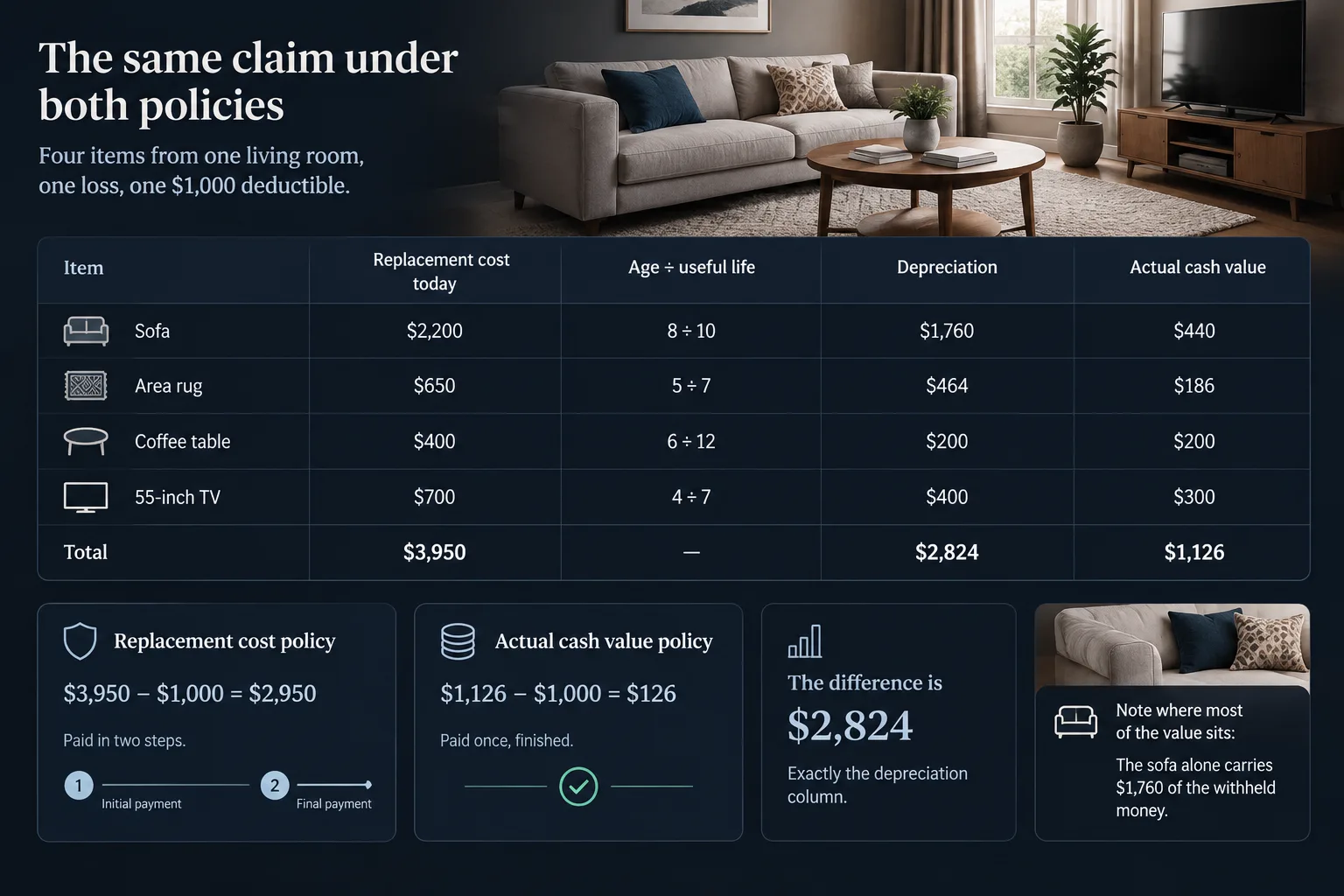
Four items from one living room, one loss, one $1,000 deductible. These are worked illustrations, not a claim file: what matters is the arithmetic, not the prices.
| Item | Replacement cost today | Age ÷ useful life | Depreciation | Actual cash value |
|---|---|---|---|---|
| Sofa | $2,200 | 8 ÷ 10 | $1,760 | $440 |
| Area rug | $650 | 5 ÷ 7 | $464 | $186 |
| Coffee table | $400 | 6 ÷ 12 | $200 | $200 |
| 55-inch TV | $700 | 4 ÷ 7 | $400 | $300 |
| Total | $3,950 | $2,824 | $1,126 |
The deductible applies once to the claim, not to each item.
Replacement cost policy: $3,950 − $1,000 = $2,950, paid in two steps.
Actual cash value policy: $1,126 − $1,000 = $126, paid once, finished.
The difference is $2,824 - exactly the depreciation column. On this claim the ACV policy pays less than a tenth of what the replacement-cost policy pays, and the deductible is not the reason. Note where most of the value sits: the sofa alone carries $1,760 of the withheld money. A personal property inventory is what tells you, before a loss, that one item is carrying that much of your contents coverage.
Recoverable depreciation: when the second payment arrives
Under a replacement cost policy, the withheld depreciation is not gone. It is held. The first check is the actual cash value figure less the deductible; the second is the depreciation, released when you show you replaced the item.
Using the claim above:
First payment: $1,126 − $1,000 = $126.
Held as recoverable depreciation: $2,824.
After receipts for the replacements are approved: $2,824, for a total of $2,950.
Replace only the sofa and the rug, and the second check covers only those two items: $1,760 + $464 = $2,224. Buy something cheaper than the scheduled replacement cost and the payment follows the receipt. Take the cash and replace nothing, and the depreciation stays with the insurer.
Three questions decide this stage, and all three belong to the adjuster. What amount on the estimate is marked recoverable? What proof is required? What is the deadline to submit it? Get the answers at the first payment, in writing, because the second check has an expiry the first one doesn't.
The evidence that changes the number
An adjuster can only allow what can be shown. Four records do most of the work.
A receipt or order confirmation fixes purchase date and price - the two inputs to age, and therefore to the whole depreciation subtraction.
A model or serial number pins the like-kind match, so the item is priced as what it was rather than as the nearest cheaper thing on a shelf.
A dated photo proves the item existed, sat in that room, and was in the condition claimed. This is the proof of ownership most households are missing when they need it.
A receipt for the replacement releases the recoverable depreciation.
State insurance departments say the same thing in fewer words. South Dakota's Division of Insurance recommends a room-by-room inventory "along with photos and proof of ownership" to make an accurate, detailed claim. The Insurance Information Institute asks for a description of each damaged item, its approximate purchase date, what it would cost to replace, and the brand names and model numbers - with receipts kept alongside the list and the whole record stored off the premises.
Vorby is built for that record. Photograph an item and it lands in a catalog with the room or storage spot where it lives, so "where is my passport" and "when did we buy the sofa" are the same search. At claim time the record leaves the app as a shareable link, a PDF, a CSV file or an Excel file: the link for the adjuster's first read, the spreadsheet for line-by-line review, the PDF for the file. Steward runs $7 a month; Curator carries the same features as a single annual subscription.
The home inventory checklist covers what to capture room by room. The photo inventory for insurance claims covers the shots that hold up under review.

Where claims go wrong
Most of the money lost in a contents claim is lost to the record, not to the fire.
Valuing from memory. The Insurance Information Institute allows it when records are gone - but it is the fallback, not the plan.
Discarding damaged items before the adjuster has seen them.
Accepting the first like-kind match with no model number to argue with.
Replacing items and then losing the receipts, which strands the recoverable depreciation.
Missing the deadline for the second payment because nobody asked for it.
Keeping the only copy of the inventory inside the house that burned.
The procedural side - proof of loss, what to send, when to send it - is set out in how to file a home inventory insurance claim.
What to do next
Photograph every room and every high-value item this week, and keep the date visible in the record.
Store each receipt and model number with the item it belongs to, not in a drawer.
Ask your adjuster, in writing, what is marked recoverable on the estimate and when that claim expires.
Questions people ask
Is actual cash value the same as replacement cost?
No. Replacement cost is what the item costs new, of similar kind and quality. Actual cash value is that figure minus depreciation for age and wear. The two numbers are identical on the day of purchase and diverge every month after it.
What is the 80% rule for home insurance?
Many insurers require a dwelling to be insured for at least 80% of its replacement cost, and some require 100%. Fall below the threshold and a penalty applies to partial losses. Massachusetts' Division of Insurance runs the arithmetic: a home that costs $200,000 to rebuild, insured for $160,000, pays a $40,000 loss in full; the same home insured for $120,000 pays $120,000 ÷ $160,000 = 75% × $40,000 = $30,000, leaving the owner $10,000 short. The rule governs the structure, not the settlement method for your contents.
Is it better to insure for market value or agreed value?
Neither, for a house. Market value includes the land and has no bearing on what a rebuild costs; insurance departments treat it as a separate number from the amount to insure. Agreed value is a stated-amount arrangement more common on vehicles and specialty policies. For a home, the choice that matters sits in the policy's loss settlement conditions: replacement cost or actual cash value, for the dwelling and, separately, for the contents.
Sources
Insurance Information Institute, Insurance for Your House and Personal Possessions - ACV and replacement cost definitions, contents limits, inventory practice.
Insurance Information Institute, Settling insurance claims after a disaster - claim documentation, replacement timing, two-part contents settlement.
Massachusetts Division of Insurance, Understanding Home Insurance - contents valuation, the 80% requirement and its worked example, market value.
South Dakota Division of Insurance, Home Inventory - room-by-room inventory, photos and proof of ownership.
Internal Revenue Service, Publication 547 (2025), Casualties, Disasters, and Thefts - the separate tax measure of a personal property loss.
All sources checked November 2026.


