Decluttering your home is so much more than a weekend cleaning binge. It's about consciously creating a space that actually supports you, instead of draining you. Once you understand how that mess is quietly sabotaging your life, you'll find the motivation you need to reclaim your environment, slash your stress, and sharpen your daily focus.
The True Cost of Clutter on Your Life
Ever had one of those frantic mornings, tearing the house apart looking for your keys, only to find them buried under a week's worth of mail? Or maybe you've dodged inviting friends over because you were just too embarrassed by the state of your living room.
These aren’t just small annoyances. They're symptoms of a bigger problem, one that silently chips away at your peace of mind.
Clutter is more than just a physical mess; it's a collection of postponed decisions. Every stack of papers, every overstuffed closet, every crowded countertop is a visual to-do list that never ends. It whispers to your brain that your work is never done, creating a low-grade, constant stress that saps your energy and makes it impossible to truly relax, even in your own home.
The Hidden Impact on Your Mental Health
The link between our space and our headspace is incredibly powerful. A disorganized home almost always leads to a disorganized mind, making it tough to focus, think clearly, or even make simple decisions. When your house is filled with too much stuff, all of it competes for your attention, creating a mental fog that can follow you all day.
And this mental burden is surprisingly common. It’s not just you. Statistics show that a staggering 80% of Americans report feeling stressed out by the clutter in their homes. It’s also estimated that all that chaos can tank our productivity by up to 40%, simply from the time we waste hunting for misplaced things. These numbers don't lie; they paint a clear picture of a widespread struggle with very real consequences. You can dig into more of the effects and see the full stats over on Zipdo.co.
Clutter is the physical manifestation of unmade decisions. By clearing it, you're not just tidying your space; you're also clearing your mind and making room for what truly matters.
Reclaiming Your Space and Well-Being
Getting a handle on these hidden costs is the real first step. This isn't about chasing some minimalist fantasy you saw online or having a "perfect" house. It's an act of self-care. It's about designing an environment that actively works for you.
When you start to tackle the clutter, you’re doing so much more than just tidying up. You are literally:
- Cutting down daily stress and anxiety: A clear space is a calm, predictable space.
- Saving time and money: You’ll stop wasting hours looking for things and quit buying duplicates of items you already have but can't find.
- Sharpening your focus: With fewer distractions fighting for your attention, your brain is free to concentrate on what's important.
- Boosting your social confidence: You’ll feel proud and ready to welcome people into your home, not hesitant.
When you frame it this way, decluttering stops being a dreaded chore and becomes a genuinely rewarding project. It’s a conscious choice to build a life with less stress and more intention, starting with the one space you control most: your home.
A Simple System for Sorting Your Belongings
Once you're fired up and ready to reclaim your space, you need a plan of attack. Just staring at a messy room is a recipe for overwhelm, and that feeling can stop you before you even start. The secret is replacing that paralysis with a dead-simple system that takes the guesswork out of every single decision.
Enter the Four-Box Method. It’s a super practical framework that turns the chaos of sorting into a structured, manageable process. Grab four boxes, or just mark out four distinct piles on the floor, and label them: Keep, Donate/Sell, Discard, and Relocate. This forces you to make a quick, concrete decision about every item you pick up. No maybes, no "I'll deal with it later."
Making Decisions Simple with Guiding Questions
The real power here is in its simplicity. Instead of getting bogged down thinking about an object’s history or some far-off potential future, you just ask a direct question and move on. This is how you build momentum and get through a room faster than you thought possible.
Here's how to break it down:
- Keep: Does this thing add genuine value to my life right now? Do I use it often, or does looking at it make me genuinely happy? Anything you keep should earn its spot with a clear purpose or a strong positive feeling.
- Donate/Sell: Is this in good shape but just doesn't serve me anymore? If someone else could get real use out of it, this is its new home.
- Discard: Is it broken, expired, or just too worn out for anyone to use? Be honest. It's okay to let go of things that have simply reached the end of their life.
- Relocate: Does this belong somewhere else entirely? This box is for the wanderers, the coffee mug that needs to go back to the kitchen or the book that belongs on the living room shelf. It's not clutter, it's just lost.
As you start sorting, it can be helpful to see how this fits into a bigger picture, especially if you have a major life event on the horizon. For example, a good ultimate moving house checklist that includes decluttering will show you how this process is a foundational step for a smoother move.
This quick table can be your cheat sheet as you go, keeping you from getting stuck.
The Four-Box Decluttering Decision Guide
| Category | Guiding Question | Action Item |
|---|---|---|
| Keep | "Do I use this regularly or absolutely love it?" | Find a permanent, logical home for it. |
| Donate/Sell | "Is it in good condition but no longer for me?" | Place it in the box and schedule a donation pickup or list it online this week. |
| Discard | "Is it broken, expired, or unusable?" | Put it straight into the trash or recycling bag. No second thoughts. |
| Relocate | "Is this a good item, just in the wrong room?" | Put it in the box to deliver to its proper home at the end of the session. |
Use these questions to make snap decisions and keep your momentum going.
Navigating Emotional Roadblocks
Let's be real: decluttering isn't just physical labor, it's emotional. Some items are way harder to part with than others. The two biggest hurdles I see people face are guilt over gifts and the dreaded "just in case" mentality.
When you feel that pang of guilt over letting a gift go, remember this: the kindness was in the act of giving, not in your lifelong obligation to store the item. You can appreciate the thought without keeping the object forever. If it helps, snap a quick photo to remember the gesture, then let the item go.
For all those "just in case" items, ask a more practical question: "Could I replace this for less than $20 in under 20 minutes if I really needed it?" You’ll be surprised how often the answer is a definite "yes." That little reality check makes it so much easier to release things you're holding onto out of a vague, unlikely fear.
Giving yourself permission to let go is the most critical step. Your home should be a sanctuary for your present and future life, not a storage unit for your past.
This decision-making flow chart is a great visual for the simple questions you can ask yourself.
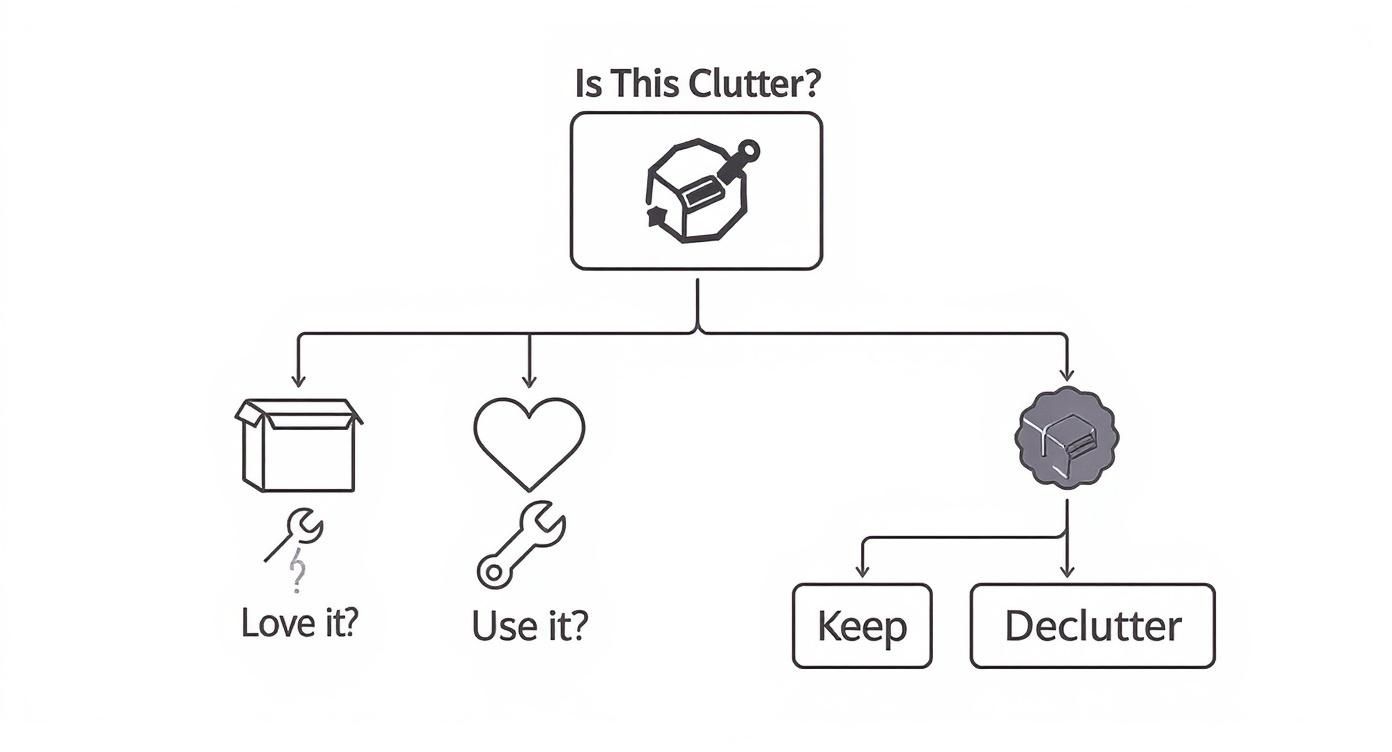
Ultimately, it all boils down to a core principle: an item’s value is defined by its current usefulness and how much you genuinely love it, not by what it cost years ago or some imaginary future purpose.
Your Room by Room Decluttering Strategy
Let's be honest: the idea of decluttering your entire home feels like trying to boil the ocean. It’s a massive task that can lead to instant burnout before you even fill a single donation box.
The real key to making lasting progress is to stop seeing it as one giant project. Instead, think of it as a series of small, manageable wins. By breaking the process down room by room, you create visible momentum that fuels you to keep going. You focus your energy, you finish a space, and you get that satisfying hit of accomplishment.
We’ll start where the clutter hits hardest: the kitchen, the closet, and the home office.
Conquering Kitchen Clutter
The kitchen is the heart of the home, but it can quickly become a chaotic mess of expired spices, duplicate gadgets, and a graveyard of mismatched Tupperware. The goal here is ruthless efficiency.
Don't try to tackle it all at once. Start with a single drawer or just the pantry. Set a timer for 20 minutes, a technique called time-boxing, and just go. It makes the task feel way less intimidating and stops you from pulling everything out onto the floor.
During that 20-minute sprint, go for these quick wins:
- Expired Foods: Go through your pantry, spice rack, and fridge. If it's past its prime, it's gone. No exceptions.
- Duplicate Utensils: How many vegetable peelers do you really need? Keep the best one and donate the rest.
- Unused Gadgets: That novelty banana slicer you used once three years ago? It’s time for it to find a new home.
- Mismatched Containers: Match every food container with its lid. Any orphan lids or bottoms get recycled. Immediately.
Once you’ve cleared the excess, you can prevent future clutter by creating a system. Keeping an inventory is a game-changer for avoiding duplicate purchases. Check out our guide on creating a household inventory list to see how you can digitally track what's in your pantry. It saves you money and space.
Mastering Your Closet and Wardrobe
Your closet should be a place of calm, not a stressful battleground every morning. The biggest challenge with clothes is sentimental attachment and the dreaded "someday" trap. We hang onto things we think we’ll fit into again, that might come back in style, or that we paid too much for to just give away.
To cut through that emotional noise, try the famous hanger trick. It's brilliantly simple.
- Turn all the hangers in your closet so the hooks face backward, away from you.
- After you wear something, put it back with the hanger facing the correct way.
- After six months (or a year, to cover all seasons), take a look. Any hangers still facing backward are holding clothes you haven't touched.
This gives you undeniable, visual proof of what you actually wear. It removes the guesswork and the emotion from the decision. For more ideas, this guide on how to declutter your bedroom has some great, simple steps that really work.
Don't let your closet become a museum of who you used to be. Curate a wardrobe that serves the person you are today.
Streamlining the Home Office
Paper is one of the most persistent and frustrating types of clutter. In a home office, stacks of mail, old bills, and random notes can quickly spiral out of control. The mission here is to digitize what you can and create a simple filing system for what you absolutely must keep.
Start by sorting every piece of paper into three piles:
- Action: Bills to pay, forms to sign, things that need a reply.
- File: Important documents like tax records, contracts, and medical papers.
- Recycle/Shred: Junk mail, old receipts for non-warranty items, and outdated info.
Once everything is sorted, tackle the "Action" pile immediately. Then, scan the documents in your "File" pile using a scanner or a smartphone app and store them in a secure cloud folder. This single act can eliminate 80% of your paper clutter.
The desire for organized living isn't just a passing trend; it's a major cultural shift. The professional decluttering services market, valued at around $8.2 billion in 2023, is expected to skyrocket to $12.9 billion by 2032. This boom shows a growing awareness of how much an organized environment can boost mental health and productivity. You can read more about this market growth in this industry analysis on OpenPR.com.
By tackling your home one room and one small task at a time, the whole process feels achievable. Each cleared drawer and organized shelf is a victory that builds your confidence and moves you closer to a truly peaceful and functional home.
Using Simple Tech to Organize What You Keep
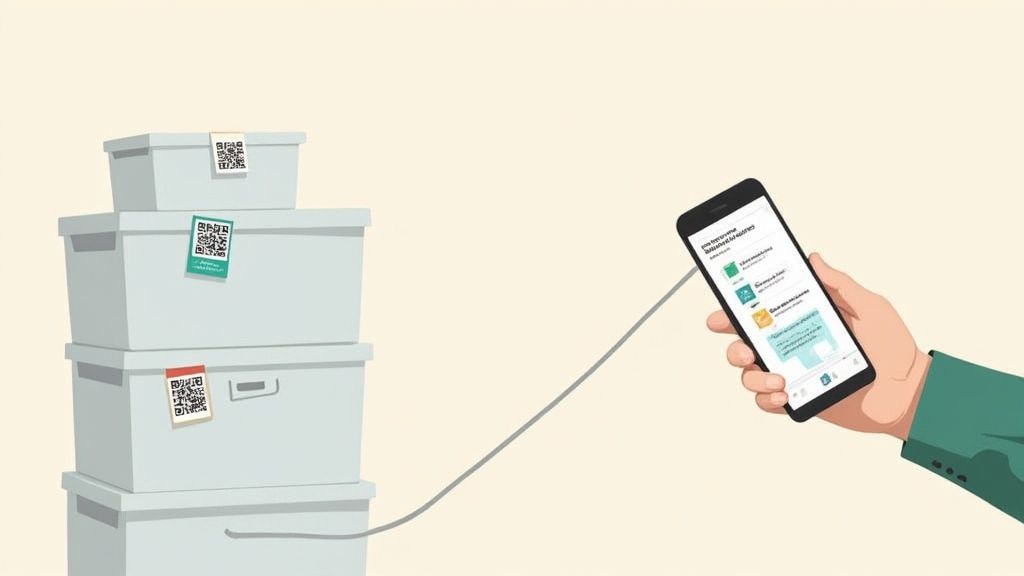
You’ve done the hard part. You’ve sorted, purged, and made the tough calls, leaving you with only the things that truly matter. But decluttering is only half the victory; smart organization is what makes it stick. This is where a little bit of simple tech can completely change the game, turning your neatly packed boxes into a searchable, stress-free system.
The goal here is simple: eliminate that sinking feeling of knowing you own something but having absolutely no idea where it is. We’ve all been there, tearing apart a perfectly tidy closet just to find one specific item. Modern home inventory tools are the antidote to this chaos, creating a digital map of your physical belongings.
From Piles to Pixels: A Smarter System
Picture your storage bins, each with a small QR code sticker on the side. Instead of ripping them open to see what’s inside, you just scan the code with your phone. Instantly, a complete list of everything in that box pops up on your screen, complete with photos. No more guesswork.
This completely transforms how you manage your stored items. Think about how this plays out in real life:
- Seasonal Decorations: Tag your holiday boxes. Next December, you can just search for "tree skirt," and your phone will tell you it's in the garage, inside the bin labeled "Holiday #2."
- Off-Season Clothing: Never again guess which bin holds your winter sweaters. A quick scan reveals the contents without you having to unfold a single thing.
- Important Documents: Keep track of essential paperwork in file boxes, knowing with certainty exactly where your birth certificate or car title is stashed.
This digital layer of organization is quickly becoming the new standard. In fact, the global home organization market is projected to hit $13.27 billion in 2025, largely driven by our growing desire to maximize living space and reduce daily friction at home. This isn't just about buying more plastic bins; it's a major shift toward smarter, more efficient storage.
Putting a Home Inventory into Practice
Let's walk through a common scenario. You’re planning a last-minute camping trip and need to find your headlamp. You vaguely remember packing it away with other outdoor gear, but now you’re staring at three identical-looking bins in the basement.
Instead of a 20-minute excavation project (and the mess that follows), you open your home inventory app. You type "headlamp" into the search bar. The app immediately tells you it’s in the "Camping Gear" bin on the bottom shelf. You go straight to the right box, grab what you need, and you’re done. No mess, no stress, no wasted time.
Implementing a system like this is surprisingly straightforward. Many apps walk you through the process step-by-step, helping you create a digital catalog of your possessions. To get a better idea of the nuts and bolts, check out our guide on creating a tagging system for inventory.
The ultimate goal of organization isn't just to have a tidy home. It's to reduce the mental energy you spend managing your stuff, freeing you up to focus on what actually matters.
By using simple tech tools, you create a home that is not just decluttered but also intelligently organized. It’s the final step that ensures all your hard work pays off for years, turning potential chaos into calm, searchable order.
Building Habits to Stay Clutter-Free for Good
You did it. You sorted through the piles, organized your rooms, and carved out a space that finally feels calm and functional. The big project is done, but let’s be honest: the real challenge is keeping it that way.
Decluttering is an event; staying organized is a lifestyle. It’s built on small, consistent habits that stop the slow creep of clutter from taking over again.
This final part is all about shifting your mindset from a temporary "purge" to a permanent rhythm. Without this shift, it's easy to fall into that frustrating cycle of decluttering every January only to find your home overflowing again by summer. The goal is to make tidiness a natural part of your daily life, not a massive chore you have to gear up for.
Slowing the Inflow of New Items
The single most effective way to keep your home clutter-free is to be more intentional about what you bring into it in the first place. Every item that crosses your threshold demands space, attention, and eventually, a decision about its departure. By becoming a more mindful consumer, you stop the problem at its source.
This isn't about deprivation or vowing to never buy anything new. It's about conscious decision-making. Before you click "buy" on that gadget or grab that sweater off the rack, just pause. Ask yourself a few critical questions:
- Do I truly need this? Or is this just a momentary want fueled by a sale or a slick ad?
- Where will it live in my home? If you can’t immediately picture a specific, permanent spot for it, you might be buying future clutter.
- Do I own something similar that already does the job? Be brutally honest about duplicates.
Here’s a great trick to break the impulse-buy habit: enforce a 24-hour waiting period for non-essential purchases. Let items sit in your online shopping cart overnight. You'll be surprised how often the initial urgency fades, and you realize you didn't really need it after all.
Adopting Powerful Maintenance Routines
Once you’ve curbed the influx, the next step is managing what you already own with simple, repeatable routines. These habits don’t require huge blocks of time; their power comes from sheer consistency. They are the small daily actions that prevent little messes from snowballing into overwhelming chaos.
Here are a few powerhouse habits to weave into your life:
- The 'One-In, One-Out' Rule: This is a non-negotiable principle for maintaining equilibrium. Every time you bring a new item into your home (like a pair of shoes or a book), a similar item must leave. This simple exchange prevents accumulation and forces you to regularly re-evaluate your belongings.
- The Daily 'Five-Minute Tidy': Before bed, set a timer for just five minutes. Do a quick sweep of the main living areas, put away the mail, fluff the couch cushions, and return stray items to their homes. This tiny investment resets your space for a fresh start tomorrow.
- The 'Pick Up 3 Things' Method: Another deceptively simple routine. The "Pick Up 3 Things" method is exactly what it sounds like: find and put away just three items that are out of place. You can learn more about how this small action makes a big impact in our article on the "Pick Up 3 Things" decluttering trick.
By transforming decluttering from a major project into a series of small, daily habits, you ensure your hard work lasts. It’s about maintaining order, not constantly recreating it.
These routines are about progress, not perfection. The idea is to build systems that streamline your daily life and make tidiness feel almost automatic.
Give Everything a Permanent Home
One of the biggest reasons clutter piles up is because items lack a designated spot. When you don't know where something belongs, it lands on the kitchen counter, the dining table, or the nearest flat surface.
And clutter is a magnet. One misplaced item soon attracts others, and before you know it, you have a pile.
Commit to assigning a logical, permanent home for everything you own. Your keys should have a hook by the door. Your bills should have a designated tray. Your remote controls should live in a specific spot on the coffee table.
When every item has a home, cleaning up becomes a simple matter of returning things to where they belong, not a complex game of finding a place for them. This single habit is foundational to keeping your home decluttered for the long term and maintaining that sense of peace you worked so hard to achieve.
You’ve Got Questions, We’ve Got Answers
Even with the best plan, you're going to hit a wall. It happens to everyone. Decluttering is as much an emotional workout as it is a physical one, and it’s totally normal to get stuck.
Think of this as your field guide for those moments. Whether you’re staring down a box of old photos or just can't find the energy to start, here are some real-world answers to the questions we hear most often.
How Do I Handle Sentimental Items?
This is the big one, isn't it? The box of your kid's kindergarten art, your grandmother's teacups, the t-shirts from every concert you attended in the '90s. These things feel impossible to let go of because they're tangled up with our memories.
The trick is to gently separate the physical object from the memory itself. Ask yourself a tough question: Does this item actually make me happy, or does it just make me feel obligated, or even a little sad? You don't have to keep things that weigh you down.
For the items you genuinely cherish, you don't have to let them go. You just have to manage them.
- Create a Digital Memory Box. Take a few really good photos of the item. Create an album on your phone or computer. Now you can revisit the memory anytime without sacrificing a closet shelf. The memory is safe, and your space is clear.
- Repurpose a Tiny Piece. Can you frame a small square from that worn-out quilt? Could a single teacup from your grandma's collection hold pens on your desk? This honors the item by giving it a new life, right out in the open.
- Pick a Few Ambassadors. You don't need all 20 of your child’s art projects from first grade. Choose one or two that truly capture that era and let the rest go. By choosing the best, you make them feel even more special.
The goal is to honor your memories, not to be buried by them. Your home should be a launchpad for your present and future, not just a storage unit for your past.
When you curate your sentimental items, you actually give them more power and visibility.
What If I Don't Have Much Time?
"I'll declutter when I have a free weekend." We've all said it, and we all know that mythical free weekend never arrives. Life is just too busy. The solution isn't to find more time; it's to use the little pockets of time you already have.
You would be absolutely shocked by what you can accomplish in just 10 to 15 minutes a day. This "micro-decluttering" approach is the secret to making real progress without burning out.
- Use the Timer Trick. Set a timer for 15 minutes. Pick one, tiny, self-contained area: a single kitchen drawer, the medicine cabinet, that leaning tower of mail on the counter. When the timer dings, you're done. That's it.
- Tackle Categories, Not Rooms. Instead of thinking "I have to clean the whole living room," just decide to gather up every old magazine in the house. This focused, single-task mission is quick, and the visible result feels fantastic.
Those small wins build momentum. It's not about achieving perfection overnight; it's about making steady, consistent progress.
Where Do I Start When I Feel Overwhelmed?
When you look around and every single surface is covered in chaos, the sheer scale of the problem can be paralyzing. This is the number one reason people put off decluttering forever. So, how do you fight that feeling?
You pick the smallest, easiest, most ridiculously simple task you can find. Do not, and I repeat, do not start with the garage or the attic. You need a quick, visible win to prove to your brain that this is possible.
- Clear Your "Landing Strip." Find one small, highly visible surface you can clear completely. This could be your kitchen counter, your nightstand, or the coffee table. Wiping that one surface clean creates an island of calm in the storm and gives you a focal point.
- Try the One-Bag Challenge. Grab one trash bag. Walk through your house with a single mission: fill it with obvious trash and stuff you know you can donate. Don't second-guess yourself. Just grab the junk.
Getting that first win under your belt makes it a thousand times easier to move on to the next small thing. The journey to a decluttered home begins with a single, clear counter.
Ready to create a smart, searchable map of your belongings? Vorby uses QR codes, NFC tags, and photo recognition to help you build a complete home inventory. Find what you need in seconds and keep your newly organized space in perfect order. Start your free trial today at Vorby.com.