Imagine trying to recall every single item you own after a fire, flood, or theft. It's a daunting, almost impossible task. A comprehensive household inventory list is more than just a catalog; it's your financial safeguard for insurance claims, a strategic tool for moving, and the ultimate key to a perfectly organized home. Many people underestimate the total value of their belongings, often by tens of thousands of dollars, making accurate documentation a critical financial tool.
Creating this list might seem like a massive project, but breaking it down into manageable categories makes it achievable. This guide provides a detailed, room-by-room approach, offering actionable steps, practical templates, and modern solutions to streamline the entire process. You will learn not just what to list, but how to document everything efficiently.
We will explore specific techniques for every category of your possessions, covering everything from furniture and electronics to collectibles and digital records. This article offers printable checklists, advanced tips for photographing your items, scanning receipts, and even using modern tools like QR codes and AI-powered apps like Vorby to speed up the creation and maintenance of your list.
This is your complete roadmap to building a detailed record of your assets. By following these steps, you can ensure you have the precise documentation you need, exactly when you need it most. Let's get started on creating a household inventory list that protects your property and simplifies your life.
1. Furniture and Large Appliances
The foundation of any comprehensive household inventory list begins with your most significant and valuable physical assets: furniture and large appliances. These items, such as your sofa, dining set, refrigerator, and washing machine, represent a substantial financial investment and are critical to document for insurance claims, estate planning, or moving. Because of their high replacement cost, insurers like State Farm and the National Association of Insurance Commissioners (NAIC) consistently emphasize cataloging these items first.

A detailed record of these big-ticket items provides undeniable proof of ownership and condition in the event of theft, fire, or natural disaster, streamlining the claims process and ensuring you receive fair compensation.
How to Document High-Value Items
For each piece of furniture and every major appliance, create a dedicated entry in your inventory system, whether it's a spreadsheet, a dedicated app, or a simple notebook. Your goal is to capture enough detail to uniquely identify the item and establish its value.
- Gather Key Data: Note the brand, model number, and serial number. These are usually found on a metal plate or sticker on the back or bottom of the item.
- Record Purchase Information: Log the purchase date and price. Scan or photograph the original receipt and attach the digital file to your inventory entry.
- Visual Documentation: Take clear photographs from multiple angles, including any existing damage or unique features. A short video documenting the item's condition can also be incredibly useful.
- Valuation: Keep your item's value current. For electronics, which depreciate quickly, it's helpful to periodically check their market value. For instance, you can see how much your phone is worth to understand its current replacement cost versus its original purchase price. This helps ensure your insurance coverage is adequate.
Pro-Tip: Store serial numbers and digital copies of receipts in a secure, cloud-based location separate from your home. This ensures you can access this critical information even if your physical records and devices are destroyed.
2. Electronics and Technology
Next to large furniture, your collection of electronics and technology represents some of the most valuable, frequently used, and theft-prone items in your home. This category includes everything from your work laptop and family television to gaming consoles and smart home devices. Due to their rapid depreciation and high desirability for thieves, insurance providers like Allstate and Consumer Reports strongly advise detailed documentation for these assets to ensure you are properly covered.
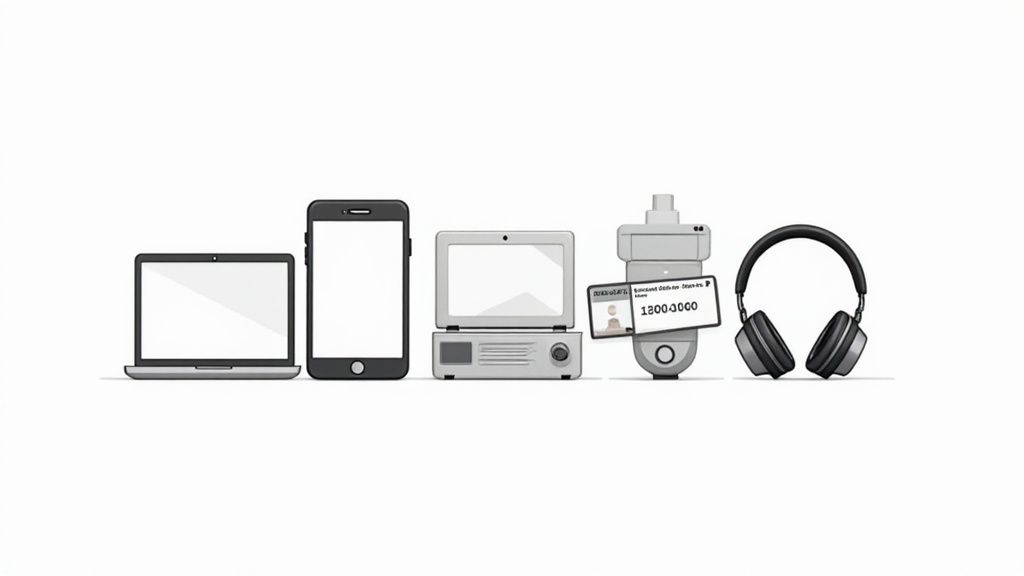
A thorough inventory of your electronics serves as crucial evidence for insurance claims, helping you prove ownership and establish the exact make and model for replacement. It also simplifies tracking warranties, software licenses, and upgrade cycles, which is essential in our fast-paced technological world.
How to Document Electronics and Technology
For each device, create a detailed entry in your household inventory list. The specificity is key, as a "55-inch TV" is far less useful for a claim than a "Samsung 55-inch QLED 4K Smart TV, Model QN55Q80A" with its serial number.
- Capture Critical Identifiers: Photograph or write down the brand, model name, and serial number. These are typically on a sticker on the back or bottom of the device.
- Document Purchase Details: Record the purchase date, price, and retailer. Scan the receipt and attach it to your inventory entry for proof of value.
- Take Detailed Photos: Photograph the device from all sides. Be sure to get a clear, readable shot of the serial number label and capture any custom upgrades or existing cosmetic damage.
- Log Associated Items: Note any accessories that go with the main device, such as chargers, controllers, or cases. Document software licenses and registration information, which can be crucial for recovery or reinstallation. A powerful way to manage this data is by using dedicated home inventory software that can link photos, receipts, and notes together.
Pro-Tip: Keep the original packaging for high-value electronics when possible. The box often contains the serial number and model information, and it can be useful for safe transport during a move or for increasing resale value.
3. Jewelry and Valuable Accessories
Beyond large furnishings, a household inventory list must account for smaller, high-value personal items like jewelry and luxury accessories. These items, including diamond rings, designer watches, gold necklaces, and even coin collections, often possess significant monetary and sentimental worth. Due to their small size and high value, they are frequent targets for theft and may require special riders or separate policies on your homeowners or renters insurance.

Properly documenting these valuables is crucial for substantiating insurance claims, as standard policies often have coverage limits for such items. Organizations like the Gemological Institute of America (GIA) and the American Gem Society (AGS) set the standards for professional appraisals, which are essential for proving an item's value. A detailed log ensures you can recover their true worth, not just a generic replacement cost.
How to Document Jewelry and Valuables
For each valuable accessory, create an inventory entry that captures its unique characteristics and establishes its value beyond a simple description. The goal is to provide irrefutable proof of ownership and quality for insurance purposes.
- Obtain Professional Appraisals: For any item worth over a certain threshold (typically $1,000-$1,500), get a formal appraisal from a certified gemologist or appraiser. Scan and digitally store this document with the item's entry.
- Detailed Photography: Take clear, close-up photos of each piece from several angles. Capture any identifying marks, such as hallmarks, maker's marks, or inscriptions. A ruler in the shot can help show scale.
- Record Specifics: Note the type of metal (e.g., 18k gold, platinum), the type and size of gemstones (e.g., 1.5-carat diamond, VVS1 clarity), and any other unique identifiers. Log the purchase date, price, and store original receipts.
- Use Unique Identifiers: For added security and organization, consider using small, discreet tags for storage boxes. You can explore a variety of options, as seen in this guide explaining what asset tags are and how they can help manage valuable collections.
Pro-Tip: Review your insurance policy's coverage limits for jewelry and consider adding a "scheduled personal property" rider for high-value pieces. Update appraisals every three to five years, as market values for precious metals and gems can fluctuate significantly.
4. Clothing and Personal Items
While the value of a single t-shirt or pair of jeans may seem minor, the collective worth of your entire wardrobe is often surprisingly substantial. Clothing, footwear, and personal accessories represent a significant, yet frequently underestimated, category in a household inventory list. Documenting these items is crucial for insurance purposes, especially after an event like a fire or flood where soft goods are often a total loss. Insurance companies require proof of your belongings, and having a detailed list can prevent a major financial setback when you need to replace an entire family's wardrobe.
Documenting every single sock would be impractical, so a category-based approach is most effective for this part of your household inventory. This method provides a comprehensive overview without demanding an exhaustive item-by-item log, making the process manageable while still delivering the necessary detail for a potential insurance claim.
How to Document Clothing and Accessories
For clothing and personal items, your goal is to capture the quantity and average value of different categories rather than detailing every individual piece. High-value designer items, however, should be cataloged separately with the same level of detail as furniture or electronics.
- Group by Category: Organize your inventory into logical groups like "men's casual shirts," "women's formal dresses," "children's outerwear," or "athletic footwear." For each category, estimate the total number of items you own.
- Estimate and Document Value: Research the average replacement cost for items in each category and note it in your list. For example, you might list "15 pairs of men's jeans at an average value of $70 each." Scan and attach receipts for any recent or high-value purchases.
- Use Visual Evidence: Broad visual documentation is key. Take clear photos of entire closets, open dresser drawers, and shoe racks. A slow video walkthrough of your closet spaces, narrating the contents as you go, provides dynamic and compelling proof of your belongings.
- Detail High-Value Pieces: Create separate, detailed entries for any designer handbags, luxury watches, custom suits, or expensive coats. For these, include the brand, purchase date, price, photos, and a copy of the receipt, just as you would for a major appliance.
Pro-Tip: Don't forget to include seasonal items stored away in basements, attics, or storage units. Capture photos of these bins and create a general list of their contents (e.g., "Box of winter coats and ski gear") to ensure they are part of your complete inventory.
5. Books, Media, and Collections
Beyond functional items, a complete household inventory list must account for personal collections like books, media, and other valuable collectibles. These items, such as a personal library, vinyl record collection, or sports memorabilia, often hold significant sentimental and financial value. Documenting them is crucial because their specialized replacement costs can be high and are often underestimated in standard insurance policies.
A thorough record of these collections ensures you can accurately account for their value during an insurance claim, preventing potential disputes over their worth. This is especially important for items whose value has appreciated over time, like first-edition books or rare art prints, which may require a special rider on your policy.
How to Document Collections
For each collection, you can group similar items but should detail any individual pieces that are particularly valuable. The goal is to create a clear record that establishes both ownership and the collective or individual worth of the items.
- Create a Detailed Log: Use a spreadsheet or inventory app to list items with key details like title, artist, author, and quantity. For specific pieces, note edition numbers, first printings, or any unique identifiers.
- Photograph Everything: Take wide shots of the entire collection on its shelf or display area. Then, capture close-up photos of individual high-value items, including any signatures, edition markings, or existing damage.
- Establish Value: Research current market values for collectible items, as their worth can fluctuate. Note the condition (e.g., mint, good, fair) for each piece, as this significantly impacts its valuation.
- Get Professional Appraisals: For rare or exceptionally valuable collections, such as fine art, antiques, or signed memorabilia, obtain a professional appraisal. Attach a digital copy of the appraisal report to your inventory entry for indisputable proof of value.
Pro-Tip: For large media collections like DVDs or video games, consider using a dedicated cataloging app. Many of these apps can scan barcodes to automatically pull in titles, release dates, and even current market prices, saving you immense time.
6. Kitchen Items and Dishes
While individual kitchen items like a single plate or fork may seem insignificant, the collective value of your cookware, dishes, small appliances, and utensils represents a substantial investment. These items, from your full set of dinnerware and glassware to your coffee maker, blender, and specialty cooking tools, can quickly add up to thousands of dollars in replacement costs. A detailed kitchen section in your household inventory list is crucial for ensuring you can fully replace these everyday necessities after an insured event.
Documenting these items proves ownership and helps you accurately estimate the funds needed to restock your kitchen from scratch. This level of detail prevents underestimation during an insurance claim, ensuring your settlement is sufficient to cover the full replacement cost.
How to Document Kitchen Items
Because of the sheer quantity of items in a kitchen, a category-based approach is often most efficient. Your goal is to balance detail with practicality, focusing on higher-value items while grouping common ones.
- Group and Count: Instead of listing every fork, group items into categories. For example, create entries like "Dinnerware Set (12 place settings)," "Silverware (8 place settings)," or "Drinking Glasses (16 count)." Note the brand and quality level (e.g., budget, mid-range, high-end).
- Photograph in Batches: Open cabinets and drawers and take clear, well-lit photos of their contents. These visuals provide powerful proof of quantity and condition. A quick video walkthrough of your pantry, cabinets, and drawers is also highly effective.
- Detail Small Appliances: For small appliances like your stand mixer, toaster, or air fryer, record the brand, model, and approximate purchase date. Scan and attach receipts for newer or more expensive appliances.
- Estimate Replacement Value: For grouped items, research the current retail cost to replace the entire set, not what you originally paid. This ensures your household inventory list reflects today's prices, which is what your insurance claim will be based on.
Pro-Tip: Don't forget specialty items. Document things like your knife block set, high-end cookware (like Le Creuset or All-Clad), specialty baking pans, and unique serving dishes separately, as their individual replacement costs can be significant.
7. Linens and Textiles
While often overlooked, the collective value of your household linens and textiles can be surprisingly high. This category includes everything from bed linens and towels to curtains, area rugs, and tablecloths. Individually, these items may seem inexpensive, but the cost to replace them all at once after a disaster like a fire or flood can add up to thousands of dollars. Creating an inventory of these goods is a crucial step for a complete and accurate household inventory list.
Documenting these items ensures you don't absorb this significant replacement cost out of pocket. An accurate count provides your insurance adjuster with clear proof of the quantity and quality of your soft goods, helping you receive a fair settlement for items that are often completely destroyed in an incident.
How to Document Linens and Textiles
Cataloging textiles is less about individual serial numbers and more about capturing quantity and quality. The goal is to create a general but comprehensive record that establishes the scope of your collection and its approximate replacement value.
- Categorize and Count: Group items by room and type (e.g., "Master Bedroom Bedding," "Guest Bathroom Towels"). Count the number of each item within a category, such as 12 bath towels, 2 sheet sets, and 4 throw blankets.
- Visual Documentation: Open your linen closets, drawers, and storage bins. Take clear, well-lit photographs or a short video panning across the contents. This visual evidence is powerful for demonstrating volume.
- Note High-Value Items: If you own premium or designer textiles, such as Egyptian cotton sheets, a hand-knotted rug, or custom-made drapes, document these separately. Photograph their labels and keep receipts if possible.
- Estimate Replacement Cost: For each category, note the general quality (e.g., basic, mid-range, luxury) and estimate an average replacement cost per item. For instance, you might list "10 Mid-Range Bath Towels at ~$15/each."
Pro-Tip: Remember to include seasonal items stored away, like flannel sheets, holiday tablecloths, or heavy comforters. A quick photo of their storage bin with a general description of the contents is often sufficient.
8. Tools, Sporting Equipment, and Hobby Items
Often overlooked and spread across garages, basements, and closets, your tools, sporting equipment, and hobby-related items can represent a significant cumulative value. From power tools and gardening supplies to bicycles and camping gear, these assets are frequently targeted in thefts and susceptible to damage. Properly documenting them in your household inventory list is essential for ensuring your insurance policy provides adequate coverage for their replacement.
A detailed inventory of these items provides clear proof of what you own, which is crucial when filing a claim. Without documentation, it can be difficult to recall every single tool or piece of recreational gear, potentially leading to an incomplete and undervalued insurance settlement.
How to Document These Varied Items
Given the diverse nature of these belongings, a systematic approach is key. Grouping similar items together for documentation can make the process more efficient. Whether you have a collection of power tools, extensive fishing gear, or expensive art supplies, your goal is to capture specific details to establish ownership and value.
- Group and Categorize: Start by organizing items into logical groups like "Hand Tools," "Power Tools," "Camping Gear," or "Woodworking Supplies." Photograph each collection as a group and then take individual shots of more valuable items.
- Capture Identifying Details: For power tools and expensive equipment like a high-end bicycle or a treadmill, record the brand, model, and serial number. This information is invaluable for both insurance claims and police reports if the items are stolen.
- Document Purchase History: Note the purchase date and price for significant items. Scan receipts for things like a new table saw or a set of golf clubs and link them to your inventory entry.
- Assess Condition and Value: Take clear photos or videos that show the condition of your equipment. For specialized gear, it's wise to periodically research current retail prices to ensure your replacement cost estimates are accurate and your insurance coverage remains sufficient.
Pro-Tip: For large collections of smaller, lower-value items (like a set of wrenches or artist paintbrushes), lay them out on a neutral background and take a single, high-resolution photo. You can then add a general description and an estimated total replacement value for the entire set.
9. Vehicles and Automotive Equipment
While often covered by separate auto insurance policies, your vehicles are significant assets that belong in a comprehensive household inventory list. Documenting cars, trucks, motorcycles, and recreational vehicles provides a complete financial picture for net worth calculations, estate planning, and potential legal scenarios. A thorough record can also be invaluable if you need to prove ownership or condition, especially for high-value custom accessories not always covered by standard auto policies.
This centralized documentation creates a single point of reference for all your major assets. It simplifies the process of assessing your total property value and ensures that nothing, from your family sedan to an expensive roof rack, gets overlooked.
How to Document Vehicles and Equipment
For each vehicle, including cars, RVs, ATVs, or even boats, create a detailed entry that goes beyond basic insurance information. The goal is to capture its unique identity, condition, and value at a specific point in time.
- Gather Key Data: The most crucial piece of information is the Vehicle Identification Number (VIN). Also, note the make, model, year, and current mileage with the date of the reading.
- Record Purchase and Legal Information: Log the purchase date and price. Keep digital copies of the title, registration, and bill of sale.
- Visual Documentation: Take comprehensive photos of the vehicle's exterior from all angles and detailed shots of the interior. Be sure to document any existing damage, modifications, or unique features.
- Valuation and Accessories: Use resources like Kelley Blue Book or NADA Guides to get a current market value estimate. Separately list and photograph expensive accessories like custom wheels, cargo carriers, or audio system upgrades, as these contribute to its total value.
Pro-Tip: Compiling an inventory of your vehicles also highlights their vulnerability. It's wise to review your security measures. You can learn more about how to protect your assets with a modern guide to prevent car theft to ensure your valuable property is secure.
10. Photographs, Documents, and Digital Records
Beyond physical possessions, a complete household inventory list must account for your most irreplaceable assets: important documents, digital records, and sentimental items like family photographs. While many of these items have little direct monetary value, their loss can be devastating and create significant logistical challenges. Cataloging them is a critical step in disaster preparedness, as emphasized by organizations like FEMA, because it ensures you can recover vital information and preserve precious memories.
A well-organized record of these items provides peace of mind, knowing that you have a plan to access critical data, from birth certificates and deeds to digital account credentials, even if the originals are lost or destroyed. This part of your inventory serves as a personal and administrative recovery kit.
How to Document Irreplaceable Records
The goal for this category is preservation and accessibility, not just valuation. You'll want to create secure digital copies and a clear roadmap for locating both physical and digital originals. This process is essential for everything from recovering from an emergency to streamlining estate management.
- Digitize and Scan: Use a high-quality scanner or a mobile scanning app to create clear digital copies of all crucial documents. This includes birth certificates, passports, social security cards, deeds, titles, wills, and insurance policies.
- Log Digital Assets: Create a secure list of your digital accounts, including email, social media, online banking, and subscription services. Note usernames but use a password manager to handle sensitive login credentials securely.
- Preserve Personal Media: Digitize old family photos, home videos, and journals. Organize these files logically and ensure they are backed up in multiple locations to prevent permanent loss.
- Create an 'In Case of Emergency' Binder: Compile a physical binder with copies of the most critical documents and a guide to your digital inventory. Store this binder in a fireproof safe or an easily accessible grab-and-go bag. You can find more details on how to get started in our home inventory checklist guide.
Pro-Tip: Implement the "3-2-1 backup" rule for your most critical digital files. Keep three total copies of your data, store two of them on different local media (like an external hard drive and your computer), and keep one copy off-site in a secure cloud storage service.
10-Category Household Inventory Comparison
| Item | 🔄 Implementation Complexity | ⚡ Resource Requirements | 📊 Expected Outcomes | 💡 Ideal Use Cases | ⭐ Key Advantages |
|---|---|---|---|---|---|
| Furniture and Large Appliances | Moderate to High, requiring item-by-item measurements, serials, and occasional pro handling | High, with space planning, photos, receipts, and possible professional removal or installation | Reliable replacement estimates and insurance documentation | Home insurance claims, moving, estate inventories | High-value clarity; serial numbers and established depreciation |
| Electronics and Technology | Moderate, with many small items, rapid turnover, and serial tracking | Moderate, needing photos, serials, receipts, and data backups | Accurate theft or replacement claims; quick recovery potential | Theft-prone assets, warranty claims, tech audits | Easy identification; serials and resale or value data available |
| Jewelry and Valuable Accessories | High, requiring professional appraisal and periodic updates | Moderate, with appraisals, secure storage, receipts, and a possible safe-deposit box | Precise insured values; eligibility for scheduled coverage | High-value or sentimental items needing rider coverage | Compact high value; appraisals enable formal insurance and recovery |
| Clothing and Personal Items | Low to Moderate, best done by category, not itemized individually | Low, with photos, category counts, and estimated values; time-intensive | Broad category totals adequate for total-loss claims | Household contents valuation, routine inventory updates | Easy to categorize; predictable depreciation and bulk documentation |
| Books, Media, and Collections | Moderate, with organized listing and specialist appraisal for rare items | Moderate, using catalogs, market research, and occasional appraisals | Variable, since some items appreciate while others are costly to replace | Collectibles insurance, personal libraries, specialty collections | Often well-organized; online pricing or databases assist valuation |
| Kitchen Items and Dishes | Low, since category counts and photos work well | Low, needing cabinet photos, counts, and receipts for high-value items | Practical retail replacement estimates | Kitchen replacement after loss, renter inventories | Easy categorization; predictable replacement options |
| Linens and Textiles | Low, using a room-by-room category inventory | Low, with closet photos, counts, and average per-item values | Category totals for modest replacement costs | Routine household inventories, seasonal updates | Standardized pricing; simple bulk documentation |
| Tools, Sporting Equipment, Hobby Items | Moderate, with varied values, dispersed storage, and some serials | Moderate, needing photos, serials for power tools, receipts, and secure storage | Mixed, since there are many low-cost items but some high-value ones need proof | Garage or workshop inventories, theft-prone equipment tracking | Many items have serials; online pricing aids replacement |
| Vehicles and Automotive Equipment | High, with VINs, titles, mileage, and separate policies required | High, requiring a title or registration, maintenance records, and appraisals | Precise market valuation; separate insurance handling | Vehicle insurance, comprehensive household asset records | Definitive identification (VIN), Blue Book or NADA valuations |
| Photographs, Documents, Digital Records | High, with organization, sensitive data handling, and format migration | Moderate to High, requiring scanning, encrypted backups, and cloud or off-site copies | Preservation of irreplaceable records; faster post-loss recovery | Disaster preparedness, legal or financial recordkeeping | Digital backups enable restoration and remote access; strong security options |
From Checklist to Action: Modernizing Your Inventory Process
You have navigated the comprehensive journey of creating a detailed household inventory list, moving room by room and category by category. From cataloging your living room furniture and documenting your kitchen gadgets to itemizing your valuable collections and securing digital records, you now possess the blueprint for a truly organized home. This endeavor is far more than a simple organizational exercise; it is a foundational step toward financial security, streamlined living, and profound peace of mind.
A complete inventory is your best defense in an emergency. It transforms the chaotic and stressful process of an insurance claim into a structured, manageable task. Instead of struggling to recall every lost or damaged item from memory, you will have a definitive, documented record, complete with photos, receipts, and serial numbers. This preparation can dramatically expedite your claim and ensure you receive the fair compensation you deserve.
Key Takeaways: From Static List to Dynamic Tool
The true power of a modern household inventory list lies in its evolution from a static document into a dynamic, living system. While spreadsheets and printable checklists are a fantastic starting point, embracing new technologies can unlock a new level of efficiency and utility.
- Technology is Your Ally: Leverage tools that automate the tedious aspects of inventory creation. AI-powered apps can recognize items from a photo, extract data from receipts in your email, and help you build a comprehensive database in a fraction of the time.
- Consistency is Crucial: An outdated inventory is nearly as unhelpful as no inventory at all. The key to long-term success is integrating the updating process into your routine. Set a calendar reminder for a biannual review or, even better, adopt a "one in, one out" policy where you document new purchases as they arrive.
- Think Beyond Insurance: While disaster preparedness is a primary motivator, your inventory serves countless other purposes. It can help you plan a move, prevent you from buying duplicate items, assist with estate planning, and even help you locate misplaced belongings with a quick search. Imagine knowing exactly which box contains your seasonal decorations or where you stored your camping gear.
Actionable Next Steps for an Organized Future
Completing this article is the first step; now it is time to translate knowledge into action. Do not let the scale of the project overwhelm you. The most effective approach is to start small and build momentum.
- Choose Your Method: Decide whether you will use a digital app, a detailed spreadsheet, or a physical binder. Consider your lifestyle and technical comfort level. The best system is the one you will actually use.
- Start with One Room: Pick a single, manageable space, like a small bathroom or home office. Completing one area provides a tangible sense of accomplishment and builds the motivation needed to tackle larger rooms.
- Gather Your Tools: Before you begin, assemble everything you need: your smartphone for photos, a tape measure for dimensions, and a notebook or your chosen app for data entry.
- Schedule the Time: Block out a few hours on your calendar dedicated solely to your inventory. Treat it like any other important appointment.
Ultimately, creating and maintaining a household inventory list is an act of self-care and responsibility. It is an investment in your future self, protecting your assets and simplifying your life in ways you may not yet anticipate. You are not just listing items; you are creating a comprehensive record of your home and your life, providing a safety net that allows you to face the future with greater confidence and control. The effort you invest today will pay dividends for years to come.
Ready to ditch the spreadsheet and build a smart inventory in minutes? Vorby uses AI to automatically identify items from photos and parse receipts from your email, making the entire process faster and more efficient. Create a powerful, searchable household inventory list and find anything in your home with ease. Get started for free at Vorby.