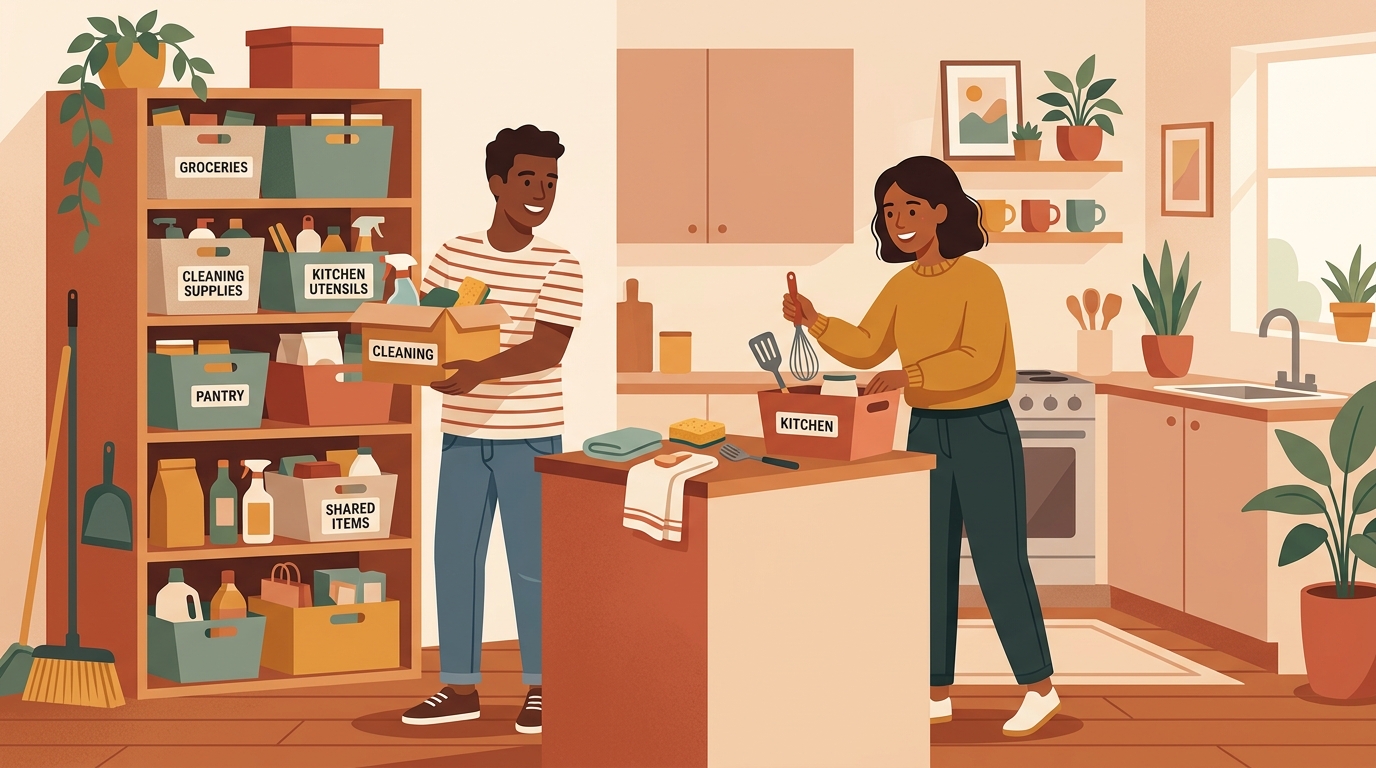
Prevent roommate ownership disputes inventory is not a fancy phrase for labeling every spoon in the drawer. It is a practical habit for shared homes where people buy furniture together, bring personal belongings into common rooms, split replacement costs, borrow each other's gear, and eventually move out at different times. When no one knows who paid for the air fryer, whether the couch was a gift, or which roommate gets the storage bins after the lease ends, a normal household decision can turn into a relationship problem.
Shared living is common because housing is expensive, life is mobile, and people delay buying homes longer than past generations. Pew Research Center reported that nearly 79 million U.S. adults lived in shared households in 2017, defining that as a household with an extra adult such as a roommate, sibling, or adult child. The U.S. Census Bureau reported 42.4 million renter-occupied homes that paid cash rent in its 2019-2023 American Community Survey estimates. The National Association of Realtors reported in its 2025 Profile of Home Buyers and Sellers that first-time buyers fell to 21% of buyers, with a median first-time buyer age of 40. Translation: roommate life is not a short, unserious phase for many adults. It is a real household system, and household systems need records.
The good news is that ownership disputes are usually preventable. A simple inventory gives roommates a shared memory before stress, moving boxes, or a security deposit deadline gets involved. It turns vague claims into clear facts, and it lets the home stay friendly because the important details are already written down.
Why roommate ownership disputes happen
Most roommate disputes over belongings do not start with bad intentions. They start with informal decisions that seemed obvious at the time. Someone picked up a lamp on the way home. Someone bought a coffee table because the living room needed one. Someone's parents donated a microwave, then everyone used it for two years. Months later, the context disappears, and the item is just part of the apartment.
Memory fades faster than a lease
A one-year lease is long enough for dozens of small purchases to blur together. If three roommates Venmo each other for groceries, toilet paper, cleaning supplies, small appliances, and utilities, the original purpose of a payment can get hard to reconstruct. The payment app may show a number, but it may not show whether $62 was for a blender, a bulk grocery run, or a shared cleaning restock.
That gap matters most when the item has resale value or when one person feels they contributed more than everyone else. A roommate who paid for a vacuum may feel taken advantage of when another person assumes it belongs to the household. Another roommate may remember splitting it, but have no receipt, no note, and no way to prove the split.
Shared use feels like shared ownership
Common-area items create emotional confusion. If everyone has used the sofa, the TV stand, the cast-iron pan, and the patio chairs for a year, those things can feel collectively owned even when one person bought them alone. The reverse can also happen: a person may forget that something was explicitly purchased with shared money because it lives in one roommate's preferred space.
This is why a home inventory should separate use from ownership. Everyone may use the router, but one person may own it. Everyone may sit on the sectional, but it may be jointly owned. Everyone may store food in the freezer, but the freezer may belong to the landlord. Clear labels keep those categories from drifting.
Moving out puts pressure on fuzzy agreements
Disputes often surface during move-out because the household is already under pressure. People are packing, scheduling cleaners, chasing deposit details, and deciding who can take what. A casual understanding that worked during the lease may not survive the moment when two people want the same bookshelf or one person expects reimbursement for a shared mattress topper no one wants anymore.
If your household already uses a checklist for move-out, connect it to inventory. Vorby's roommate move-out checklist for deposit recovery is a natural companion because ownership, condition, and deposit deductions often collide in the same final week.
The best time to decide who owns the couch is when everyone still likes each other, not when the moving truck is double-parked outside.
What belongs in a roommate inventory
A roommate inventory should be useful, not theatrical. You do not need museum-grade cataloging for every mug. You need a reliable list of the things that cause confusion, cost real money, or matter during move-in, move-out, insurance, replacement, and resale.
Common-area furniture and appliances
Start with the items everyone can see and everyone uses. Sofas, coffee tables, rugs, bar stools, dining chairs, TV stands, lamps, shelves, air purifiers, vacuums, microwaves, pressure cookers, air fryers, blenders, speakers, routers, and storage furniture belong on the list. These items are most likely to trigger disputes because they sit in shared rooms and become part of the home's identity.
For each item, record the owner, purchase date if known, original price if known, condition, and where the proof lives. Proof can be a receipt, a screenshot, a payment note, a photo from move-in, or a simple household note signed off by the people involved. If the item was a gift, write that down too. Gifted items are especially easy to misread because no roommate payment exists.
Shared purchases and split-cost items
Any item purchased with more than one person's money needs an ownership rule. Splitting the cost evenly does not automatically answer what happens later. Will one roommate buy out the others at move-out? Will the item be sold and the proceeds split? Will it stay with the roommate who remains on the lease? Will everyone agree that the purchase was a consumed household expense, like trash bags, even if it is durable?
Write the rule at the time of purchase. That one minute of clarity prevents the classic argument where one person says, "We all bought that," and another says, "Yes, but it was for the apartment, so whoever stays should keep it." If your home has a pattern of buying duplicates because nobody knows what already exists, pair this process with Vorby's guide to stopping duplicate purchases in shared apartments.
Receipts, photos, serial numbers, and warranties
The Insurance Information Institute recommends creating a home inventory for renters and homeowners, including photos, receipts, recent purchases, and details that help support a claim. That advice applies even more cleanly in a roommate household because documentation has two jobs: it helps with insurance, and it helps roommates remember who bought what.
Record serial numbers for electronics, purchase photos for high-value items, warranty details for appliances, and condition photos for things that could be damaged. The National Association of Insurance Commissioners also advises consumers that an accurate home inventory gives an insurer the information needed to help settle claims. For roommates, that same inventory can help separate personal property from shared property before anyone has to file a claim.
How to set up the inventory in one evening
The fastest roommate inventory is a structured walkthrough. Do it once, keep it light, and update it as new purchases happen. The goal is not to create a perfect archive. The goal is to remove ambiguity from the items most likely to create tension.
Walk room by room
Start in the living room, then move through the kitchen, dining area, bathrooms, closets, storage spaces, patio, garage, and entryway. Skip private bedrooms unless a roommate wants to record personal items for insurance. In each shared space, identify items above a threshold your household agrees on, such as $25, $50, or $100. A threshold keeps the project from turning into an inventory of forks and half-used candles.
For each item, add a name that everyone recognizes. "Black IKEA bookshelf near TV" is better than "bookcase." "Ninja air fryer on kitchen cart" is better than "appliance." Roommates should be able to glance at the list and know exactly what object it means.
Use ownership categories
Every item should have one of four ownership categories: owned by one roommate, jointly owned by named roommates, landlord-owned, or unclear pending review. The last category is useful because it keeps the inventory moving. If nobody remembers who bought the hallway table, mark it as unclear and resolve it later instead of derailing the walkthrough.
For jointly owned items, add the split. Equal shares are simple, but not always accurate. One roommate may have paid 70% for a sofa while another paid 30%. One person may have contributed a used item while others paid for delivery. The split matters when the item is sold, bought out, or assigned to someone at move-out.
Attach proof while the details are fresh
The easiest time to attach proof is during setup. Take a photo of the item in place. Upload the receipt if someone has it. Add a screenshot of the payment note if the purchase was split. If there is no proof, write a short note that everyone can agree to now. "Taylor brought this dining table from their previous apartment, no shared reimbursement" is enough to prevent a future misunderstanding.
Statista tracks annual U.S. expenditure on household furnishings and equipment, and the Bureau of Labor Statistics reported household furnishings and equipment as a continuing consumer spending category in its 2024 Consumer Expenditures report. The exact amount your apartment spends may be modest, but shared homes accumulate value quietly. A few small appliances, one sofa, a rug, a desk, and some storage pieces can represent hundreds or thousands of dollars.
Rules that prevent disputes before they start
An inventory works best when it is paired with simple household rules. The list tells everyone what exists. The rules tell everyone what happens when something is bought, borrowed, broken, replaced, sold, or left behind.
Create a purchase rule
Before anyone buys a shared item, decide whether it is personal, shared, or reimbursable. Personal means the buyer owns it and may take it at move-out. Shared means named roommates own it according to a written split. Reimbursable means one person bought it for the household and should be paid back by a certain date.
This rule is especially useful for kitchen gear because it is easy for one person to become the unofficial supplier. If your home is building out a common kitchen, Vorby's shared kitchen gadgets inventory checklist can help roommates decide what belongs in the household, what belongs to one person, and what does not need to be purchased at all.
Create a damage rule
Damage disputes get emotional because they mix money with blame. Decide ahead of time how the household handles damage to personal items in shared spaces and jointly owned items. A fair rule might say that accidental damage caused by one person is paid by that person, normal wear is shared by owners, and unclear damage is discussed within 48 hours of discovery.
Condition photos make this rule easier to apply. If the rug already had a stain at move-in, nobody needs to argue later. If the coffee table was photographed without a crack last month, the conversation can focus on what happened and how to fix it.
Create a move-out rule
Move-out rules should answer three questions: who can take jointly owned items, how buyouts are calculated, and what happens to items no one wants. Keep the math simple. Some roommates use current resale value, some use a fixed depreciation rule, and some agree that low-cost items transfer to the person staying. The important part is that the rule exists before anyone is tired, rushed, and surrounded by boxes.
At move-in, add these rules to your household agreement. Vorby's roommate move-in guide for a shared apartment covers the broader setup work, including expectations that are much easier to settle before daily routines take over.
Using inventory for insurance, deposits, and accountability
Ownership records are not only for roommate harmony. They also support practical financial tasks. A shared home may involve renters insurance, landlord deposit claims, warranty claims, police reports after theft, and reimbursement conversations after accidental damage.
Renters insurance is personal, even in a shared home
Roommates often assume that one renters insurance policy covers everyone in the apartment. That is usually not how it works. The Insurance Information Institute explains that renters insurance covers a renter's personal possessions, liability, and additional living expenses, while the building is the landlord's responsibility. Roommates should check their own policies and avoid assuming that another roommate's policy protects their belongings.
An inventory helps each person understand what they own and what value they may need to insure. It also helps identify jointly owned items that might require a conversation with an insurer. Vorby's home inventory for renters insurance guide goes deeper on what to document before a claim.
Deposits and belongings are separate issues
Security deposits usually relate to the condition of the rental, not who owns the sofa. Still, the two issues overlap during move-out. If a roommate leaves a bulky item behind, the landlord may charge disposal fees. If a shared shelf scratches the floor, everyone may argue about whether the owners of the shelf should pay or the whole household should share the deduction.
Inventory helps by showing which items are leaving, which are staying, and which are being discarded. Pair that with condition photos of the apartment, and your final week becomes less about blame and more about completing a checklist.
Accountability stays calmer when records are neutral
A neutral record is kinder than a memory contest. When the inventory says that Jordan owns the projector, the projector goes with Jordan unless Jordan sells it or gifts it. When the inventory says that Maya and Chris split the patio set 50/50, a buyout or resale split follows that record. Nobody has to argue from vibes.
This is the real relationship benefit. Documentation can feel formal at first, but it reduces the number of personal conversations that have to happen under stress. The inventory does not replace trust. It protects trust from avoidable confusion.
What to look for in a roommate inventory app
A spreadsheet can work for a small apartment, but it breaks down when the household needs photos, receipts, shared access, search, labels, and easy updates from a phone. If you choose an app, focus on features that reduce friction. The best system is the one roommates will actually use after the first setup night.
Shared access and clear ownership fields
Look for a tool that lets the household record who owns an item, whether it is jointly owned, and where it lives. Shared access matters because one roommate should not become the only keeper of the truth. Everyone who contributes to shared purchases should be able to see the same record.
- Owner field: Name the person or people who own the item.
- Location field: Tie each item to a room, closet, bin, or storage area.
- Purchase details: Store price, date, warranty, and merchant when available.
- Condition notes: Record current condition and any existing damage.
Photos, receipts, and search
Photos are the fastest way to make an inventory understandable. Receipts and payment screenshots are the fastest way to make it credible. Search is what makes the system useful later, when someone asks who owns the folding table or whether the house already has a spare monitor.
Vorby is built around this kind of household memory: items, photos, receipts, organization, and quick lookup in one place. For roommates, that means the common-room record can live somewhere more durable than a group chat thread.
Labels for bins, closets, and shared storage
Inventory becomes more powerful when physical storage matches the digital record. Label bins for tools, kitchen overflow, seasonal decor, cables, documents, cleaning supplies, and move-out supplies. Then list the bin itself and the important items inside it. This prevents the familiar roommate question: "Did someone take the extension cord, or is it buried in the hall closet?"
Labels also reduce accidental possession. If a bin says "Avery's camping gear" or "Shared kitchen extras," nobody has to guess whether an item is free to borrow, shared by the household, or personal property stored in a common area.
FAQ: roommate inventory and shared ownership
How do roommates prove who owns what?
Use a shared inventory with owner names, photos, receipts, payment screenshots, and short notes for gifts or items brought from a previous home. The proof does not have to be complicated; it has to be easy to find when the question comes up.
Should roommates split furniture purchases?
Split furniture only when everyone agrees on the move-out rule before buying. If nobody wants to handle buyouts or resale later, it may be cleaner for one person to buy the item and own it outright.
What happens to jointly owned items when one roommate moves out?
The cleanest options are a buyout, a resale split, or assigning the item to the roommate who stays based on a written agreement. Decide the method when the item is purchased, not during move-out week.
Do roommates need separate renters insurance?
Usually, yes. Renters insurance is commonly tied to the named insured person's belongings and liability, so each roommate should confirm coverage with their own insurer instead of assuming another roommate's policy applies.
Is a spreadsheet enough for roommate inventory?
A spreadsheet can work for a few items, but it becomes harder to maintain when you need photos, receipts, labels, and quick mobile updates. A dedicated inventory app is better for households that buy, store, and share many items.
Roommate relationships work better when shared belongings are visible, documented, and easy to discuss. Vorby gives shared households one calm place to track what belongs where and who owns it. Start the inventory before the next disagreement has a chance to form.