Stop duplicate purchases shared apartments should not require a tense house meeting every time someone wants batteries, dish soap, a lamp, or a new can opener. The real problem is simpler: roommates buy what they cannot see. If the apartment has no shared record of what it owns, where each item lives, who bought it, and whether it is fair game for everyone, every shopping trip becomes a guess.
Shared apartments are built from overlapping lives. One roommate brings cookware from an old place. Another brings cleaning supplies. Someone owns the router, someone bought shelves, and someone has a vacuum in the trunk of a car because nobody was sure whether the apartment already had one. The apartment may have enough stuff, but the household cannot act on what it cannot find.
This guide gives roommates a practical system for preventing repeat buys without turning the home into a tiny office. It covers what to track, how to run a quick audit, which buying rules actually work, and how to use photos, receipts, and ownership notes so shared life stays cheaper and calmer.
Why duplicate purchases happen in shared apartments
Duplicate purchases usually look like a spending problem, but they are an information problem. A roommate standing in a store aisle needs to know three things: whether the item exists, whether it works, and whether it is available for shared use. If any answer is unclear, buying another one feels safer than going home empty-handed.
Roommates inherit partial households
Most shared apartments are assembled, not designed. People arrive with pieces of previous homes: pans, lamps, tools, cables, bedding, cleaning products, small appliances, bins, and half-used packs of light bulbs. Those items land in cabinets, closets, bedrooms, and under-bed storage before anyone has a complete picture.
Shared living is common enough to deserve better systems. Pew Research Center reported that nearly 79 million U.S. adults lived in shared households in 2017, including adults living with relatives, housemates, or roommates. The U.S. Census Bureau also uses roommates living together as a clear example of shared households. This is not an odd edge case. It is a normal housing arrangement with real coordination costs.
Small purchases slip past everyone
Roommates rarely duplicate the rent check. They duplicate the items that feel too small for process: paper towels, mops, extension cords, dish towels, shower liners, storage bins, batteries, cleaning sprays, measuring cups, extra chargers, screwdrivers, and replacement filters. One item may be cheap. A year of repeat buying is not.
Statista's consumer spending data shows why these everyday goods matter. Its 2024 U.S. household furnishings and equipment series put average annual spending at about $2,414 per consumer unit. Roommates will never eliminate household spending, and they should not try. They can stop paying for the same solution twice because nobody checked the hall closet.
Shared space hides useful things
A small apartment can still hide a lot. Items migrate into the most convenient empty space: a tool kit in a bedroom closet, spare bulbs in a kitchen drawer, the air mattress under a bed, printer paper in a desk, cleaning refills behind the toilet paper, the spare HDMI cable in a moving box that never fully unpacked. The household owns the item, but the purchasing roommate cannot see it at the moment of need.
Duplicate purchases are what happen when the apartment owns something, but no one owns the knowledge of where it is.
Build one shared record before the next shopping trip
The fix is not a bigger group chat. Group chats are good for quick decisions, but terrible as permanent memory. A shared apartment needs one household record that answers buying questions fast enough to use in real life.
Track the fields that prevent repeat buying
Do not start by cataloging every fork and mug. Start with the items most likely to be bought twice, fought over, misplaced, reimbursed, or removed at move-out. For each item, capture a short set of fields:
- Item name: Use plain language like vacuum, router, mop bucket, can opener, spare sheets, or tool kit.
- Category: Kitchen, cleaning, bathroom, furniture, storage, tech, tools, linens, seasonal, or outdoor.
- Location: The exact spot, not just the room. Write hall closet top shelf, under sink left bin, or living room media cabinet.
- Owner: Name the roommate, landlord, shared household, or unknown.
- Shared status: Shared, personal, ask first, do not use, borrowed, or undecided.
- Condition: Working, missing part, low supply, broken, needs cleaning, or due for replacement.
- Receipt or proof: Attach a receipt photo when price, warranty, reimbursement, or ownership could matter later.
That is enough to stop most duplicate buying. A roommate can check whether the apartment has a stepladder, see that it lives behind the coats, and avoid buying another one during a hardware store run.
Use photos because descriptions are weak
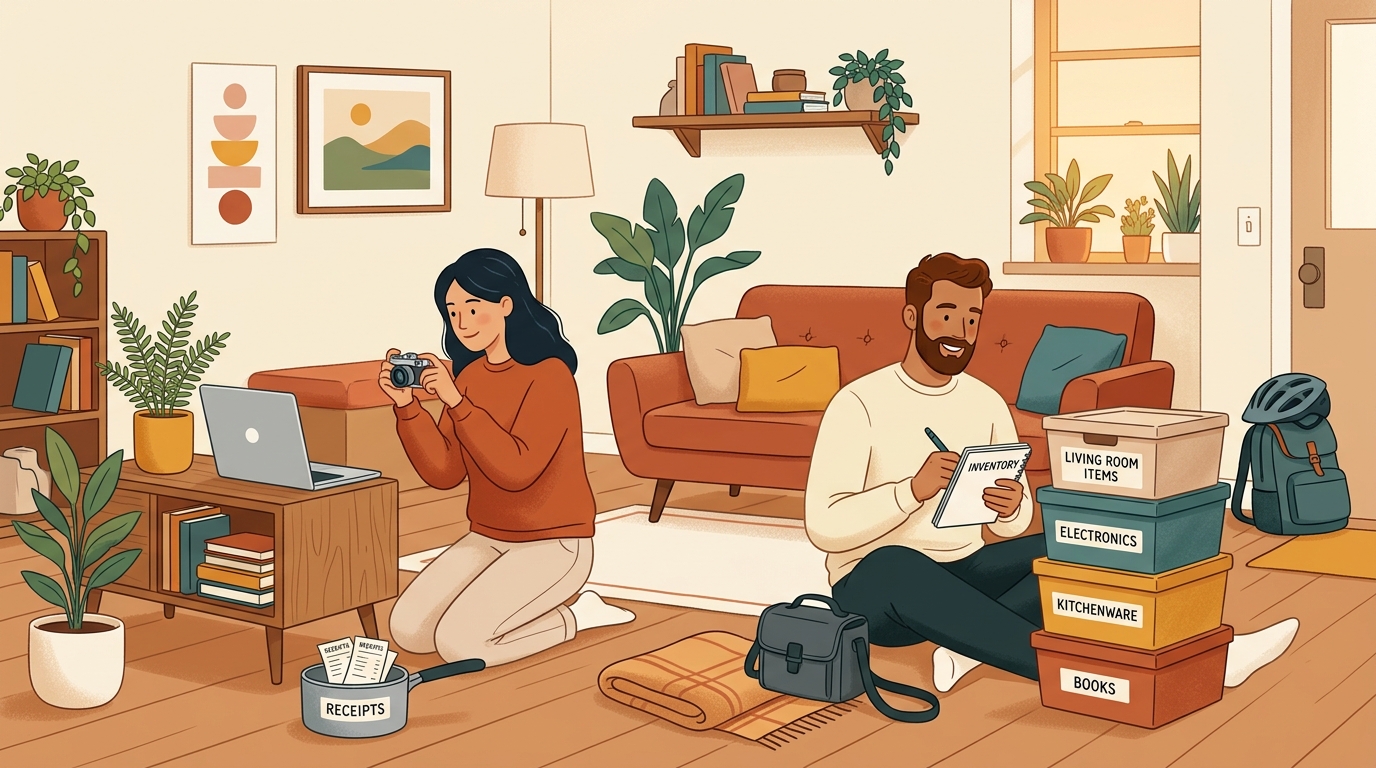
Names are often vague in shared homes. A photo of the black toolbox, the exact vacuum filter, or the bin labeled party supplies is more useful than a perfect written description. Photos also reduce the emotional load of asking, "Is this yours?" or "Can I use this?" The record already shows the answer.
The Insurance Information Institute recommends photos, receipts, model details, serial numbers, and proof of value for home inventories. That advice is usually framed around claims, but it works for roommates too. If photos and receipts help after a loss, they also help before a roommate spends money on a replacement the apartment did not need.
Pick a tool roommates will actually open
A shared spreadsheet can work for two organized roommates with a small list. It gets weaker when people need quick phone photos, receipts, locations, labels, and search. A household inventory app is better when the apartment has many shared categories and everyone needs access from the store, the closet, or move-out day.
Vorby fits this job because it is built around belongings, not generic notes. Roommates can record photos, receipts, owners, storage locations, and item details in one searchable place. If your group is debating format, read Vorby's guide to spreadsheet vs app for shared kitchen inventory, then choose the lowest-friction system everyone will use before buying.
Run a 60-minute duplicate audit
The first audit should be fast and physical. You are not trying to create a museum record. You are trying to reveal what the apartment already owns before the next Target run, Amazon order, or late-night group text.
Start with duplicate-prone zones
Walk the apartment by zone, not by person. Start with the areas most likely to produce duplicate purchases: kitchen drawers, under-sink storage, bathroom cabinets, hall closets, the laundry area, media cabinets, shared desks, tool boxes, and any overflow shelf that has become a graveyard for mystery items.
For each zone, pull visible items into categories or photograph them in place. In the kitchen, look for small appliances, measuring tools, openers, food storage containers, pans, specialty gadgets, cleaning refills, and shared pantry basics. Vorby's shared kitchen gadgets checklist for roommates is a useful companion if the kitchen is where your duplicates keep breeding like tiny stainless-steel rabbits.
Use keep, extra, missing, and undecided
Do not spend the audit debating every object. Give each duplicate-prone item one of four labels. Keep means the apartment needs it and knows where it lives. Extra means the household has more than it needs right now. Missing means the apartment should buy or borrow one. Undecided means ownership, usefulness, or condition needs a short follow-up.
Extra is not automatically bad. Two cutting boards can make sense. Three bottles of glass cleaner probably do not. A spare lamp may be useful for the next roommate, while a third toaster turns cabinet space into rent you pay for an appliance nobody requested. The point is to name the overlap before someone adds to it.
Resolve the mystery items last
Mystery items slow the audit down because they invite stories. Who bought the humidifier? Is the old router still needed? Does the landlord own the microwave? Did the last roommate leave the folding table by accident? Put uncertain items in a review category and keep moving.
After the walkthrough, spend 15 minutes resolving the important mysteries. Text a former roommate if needed. Check old receipts. Ask the landlord about furnished items. If ownership still cannot be determined, mark the item as shared household with an exit rule, or set a review date. A vague item is better than an invisible item, but a resolved item is what prevents future purchases.
Create buying rules roommates can follow
An inventory tells roommates what the apartment has. Buying rules tell them what to do before spending money. Keep the rules short, because a rule nobody remembers will not survive the first busy week.
Set a check-before-buying rule
The core rule is simple: before buying anything for the shared apartment, check the household record and the likely storage spot. If the item is missing, broken, or not shared, buy it according to the household's price rule. Then add the new item, receipt, owner, and location the same day.
This habit matters most for purchases made away from the apartment. The person in the store can search for "batteries," "mop," "router," "sheet set," or "can opener" and make a decision without turning the group chat into a scavenger hunt. The rule turns the inventory from a nice list into a spending control.
Use price thresholds, not constant permission
Roommates do not need a vote on every sponge. They do need a fair process for items that cost real money, take up storage, or will belong to the group. Set price thresholds before anyone buys. For example, under $15 can be handled by the assigned category owner, $15 to $50 needs a group message, and over $50 needs clear agreement from everyone who will pay or store the item.
The exact numbers should match the apartment's budget. Housing costs have already put pressure on shared living decisions. The National Association of REALTORS has noted that some young adults live with family because of high rent and tight affordability. Roommates share apartments for many reasons, but nobody moves in hoping to waste cash on duplicate supplies.
Assign categories instead of blaming personalities
Do not make one roommate the household parent by default. Assign categories. One person can track cleaning supplies. Another can track kitchen tools. Another can track shared tech, batteries, and cords. Another can manage bathroom and laundry items. The category owner does not necessarily pay for everything. They keep the record current and start the purchase conversation when something is missing or low.
Consumables deserve their own rhythm because they disappear differently than durable goods. For paper towels, trash bags, dish soap, laundry detergent, toilet paper, and similar goods, connect the inventory to a restocking habit. Vorby's roommate guide to shared household supplies goes deeper on fair restocking without making every grocery receipt a trial.
Attach receipts, ownership notes, and exit rules
Duplicate purchases are not only annoying while people live together. They can create disputes when someone moves out. A shared record should explain who paid, who owns, who can use, and what happens later.
Record who owns shared-looking items
Shared-looking does not always mean shared-owned. A couch may belong to one roommate. A router may be leased, borrowed, or split three ways. A microwave may belong to the landlord. A lamp may be personal but available for common use. Write this down while everyone is calm.
Use plain ownership labels: personal, personal but shared, jointly owned, household supply, landlord-provided, borrowed, and unknown. If the apartment needs a deeper system for furniture, appliances, and higher-value shared purchases, Vorby's guide on how to assign ownership of shared items with roommates covers the move-in and move-out logic in more detail.
Keep proof with the item record
Receipts answer questions that memory turns into arguments. Who bought the vacuum? Was the router reimbursed? Is the shelving unit still returnable? Which model of filter does the air purifier need? The Insurance Information Institute says a home inventory should include basic details, proof of value, and updates while details are fresh. Roommates can use the same habit for ordinary household coordination.
This also helps renters think beyond today's shopping list. A record of electronics, furniture, tools, and appliances supports insurance documentation if something is stolen or damaged. Vorby's home inventory for renters insurance guide explains how photos and receipts make a claim-ready record more useful.
Write the exit rule at purchase time
Move-out turns vague ownership into immediate friction. If two roommates split a couch, who keeps it? If one person bought a vacuum and everyone used it, can they take it? If the apartment bought a new router with shared money, does the remaining roommate reimburse the person leaving?
Write a short exit rule when the item is added. Personal items leave with the owner. Jointly owned items are sold, bought out, or left behind by agreement. Household supplies stay with the apartment unless someone was clearly reimbursed for unused bulk purchases. The rule does not need legal language. It needs to be visible before boxes appear.
Make storage match the shared record
An inventory only works if it matches the apartment. If the record says the tape measure is in the tool box but it actually lives in a bedroom, roommates will stop trusting the system and start buying backups again.
Create obvious zones
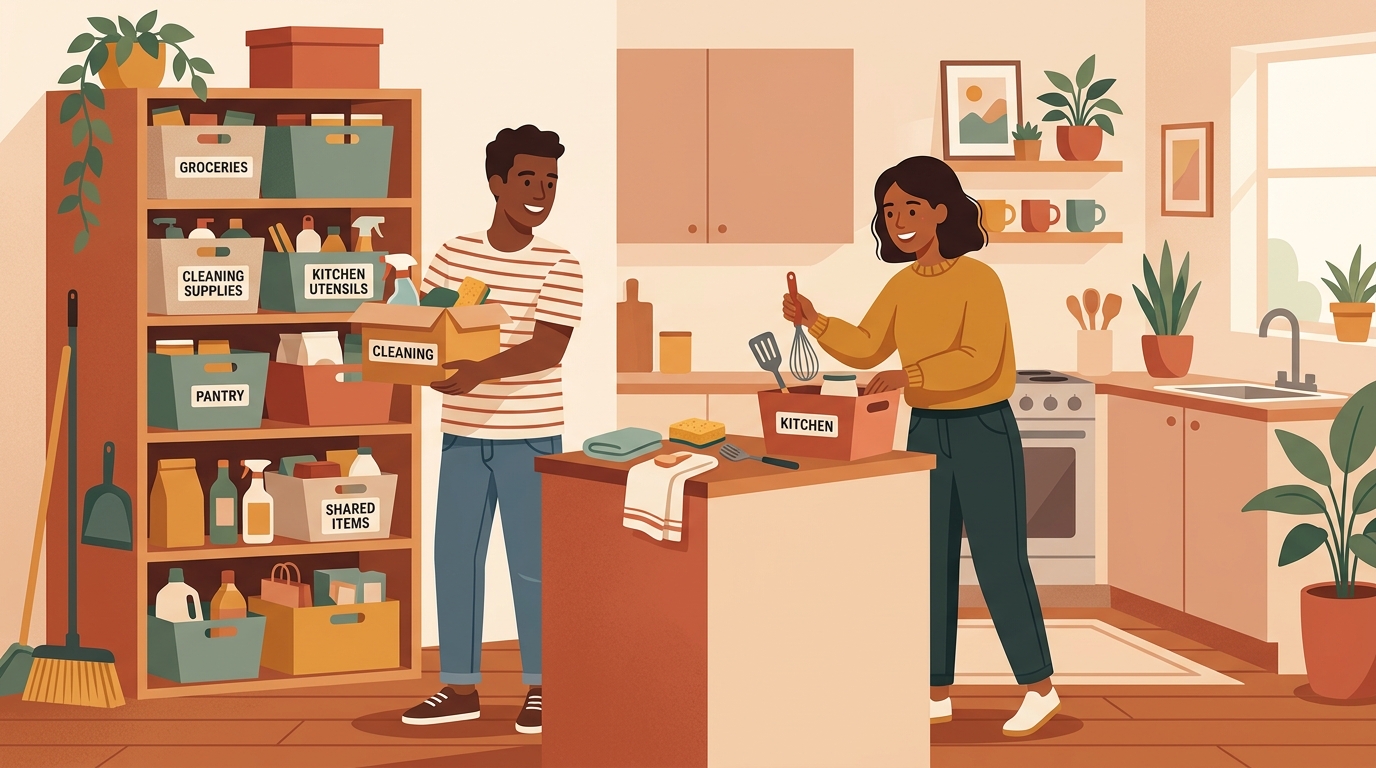
Give every shared category a default home. Cleaning products go under the sink or on one labeled shelf. Tools and hardware go in one box. Batteries, bulbs, and small utility items live together. Guest linens have one bin. Cords and chargers are sorted by type. Kitchen gadgets live by function, not by the person who last used them.
Good zones reduce the need for negotiation. A roommate can put the flashlight back with batteries, return the screwdriver to the tool kit, or check the refill bin before buying dish soap. The record reinforces the storage, and the storage reinforces the record.
Label for the least-informed roommate
A label is successful when the person who did not organize the closet can still use it. Avoid vague labels like misc, overflow, or apartment stuff. Use literal labels: cleaning refills, batteries and bulbs, hand tools, guest bedding, shared kitchen extras, cables to test, donate or return.
Labels also reduce the social cost of shared living. Nobody has to ask where everything goes after every chore. Nobody has to confess that they bought another shower liner because the backup liners were hidden in an unmarked bin. The apartment becomes easier to maintain because the right answer is visible.
Review duplicates before buying more bins
Storage products can become their own duplicate-purchase category. The apartment feels cluttered, someone buys more bins, and suddenly the home has organized clutter instead of less clutter. Review what the apartment owns before buying containers to hide it.
If you need bins, buy them after the audit. Choose sizes that fit the actual categories, label them immediately, and add the bin location to the record. A bin is useful when it helps roommates find existing items. A bin full of unknown duplicates is just a prettier version of the old problem.
Keep the system alive with a small maintenance rhythm
The best roommate inventory is not perfect. It is current enough that people trust it before they shop. Maintenance should take minutes, not weekends.
Add new purchases the same day
When someone buys a shared or duplicate-prone item, add it immediately. Take a photo, attach the receipt, record the owner, note the storage location, and mark whether it is shared. If reimbursement is expected, write that too. The details are easiest while the item is still in the bag.
Same-day entry prevents decay. If a roommate waits a week, the receipt is gone, the item has moved, and the group has already forgotten whether it was bought as personal or shared. A 45-second update can prevent the next repeat purchase and the next repayment question.
Do a monthly ten-item check
Once a month, review the ten categories most likely to drift: cleaning supplies, paper goods, kitchen gadgets, batteries, bulbs, tools, cords, bathroom supplies, guest linens, and shared tech. Delete items that left, update anything broken, and flag anything low or missing.
This should not become a formal meeting unless the apartment needs one. One roommate can do the quick pass, then post a short note: "We have trash bags, need dishwasher pods, extra extension cord is in the hall closet, do not buy more storage bins." That note is useful because it is backed by a record, not one person's shaky memory.
Run a pre-move-out review
Two weeks before a roommate leaves, filter the record by owner and shared status. Personal items can be packed. Jointly owned items need a decision. Borrowed and landlord-provided items should stay. Unknown items should be resolved before the final cleaning day.
This protects the departing roommate and the people staying. Nobody has to discover on move-out morning that the departing roommate owns the only router, broom, or kitchen table. Vorby's roommate move-out checklist for deposit recovery can help pair the inventory review with cleaning, damage documentation, and key handoff.
FAQ: stopping duplicate purchases in shared apartments
What is the easiest way for roommates to stop buying duplicates?
Create one shared inventory for duplicate-prone items, then require a quick inventory check before buying anything for the apartment. Include location, owner, shared status, condition, and a photo.
Should roommates use an app or spreadsheet for shared apartment inventory?
A spreadsheet works for simple households with few shared items. An app is better when roommates need photos, receipts, search, ownership notes, and updates from their phones.
What items should roommates track first?
Start with kitchen tools, cleaning supplies, bathroom supplies, batteries, bulbs, tools, cords, shared tech, guest linens, storage bins, and furniture. Skip ordinary low-value items nobody would dispute.
How do roommates decide who pays for shared items?
Set price thresholds before purchases happen. Small restocks can rotate by category, mid-price items can require a group message, and expensive or bulky items should require agreement from everyone who pays or stores them.
How often should a shared apartment inventory be updated?
Update it whenever something is bought, moved, broken, donated, reimbursed, or taken by a roommate. Do a quick monthly check of the categories most likely to drift.
Make the apartment searchable before you shop
Roommates do not need more friction before every purchase. They need shared visibility. When the household can see what exists, where it lives, who owns it, and what needs replacing, duplicate buying becomes the exception instead of the default.
Shared apartments run better when shared belongings are visible. Vorby gives roommates one place to track what the household owns before anyone buys it again. Start the record today.