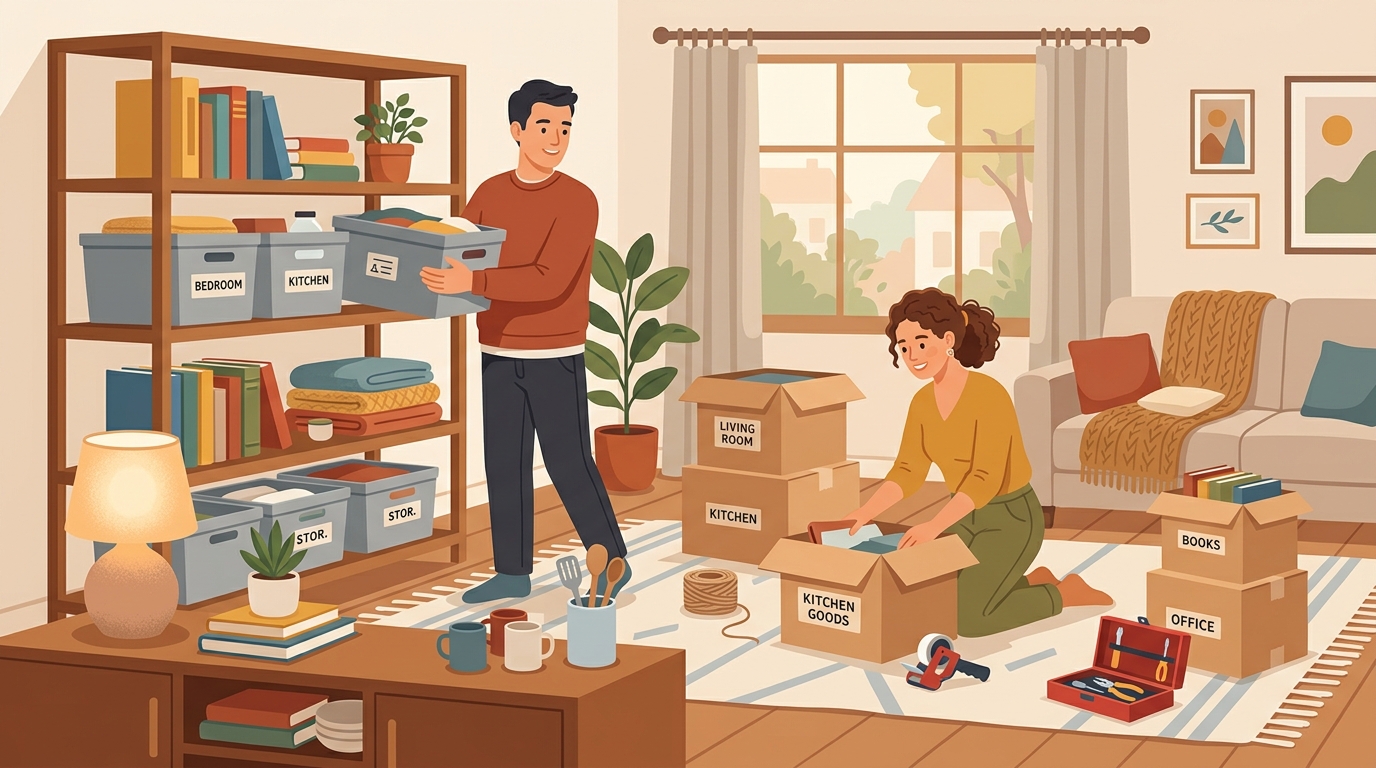
Shared kitchen gadgets checklist sounds practical because it is, but it also solves a surprisingly personal roommate problem: the drawer full of tools no one can explain. One person brought the citrus press, someone else bought a second can opener because the first one vanished, and the slow cooker might belong to the former roommate whose name still appears on the internet bill. A shared kitchen works best when the people using it can see what exists, who owns it, where it lives, and when it should be replaced.
This matters because shared homes are normal, not niche. Pew Research Center reported that nearly 79 million U.S. adults lived in a shared household in 2017, including arrangements with extra adults, adult relatives, roommates, and boarders. The U.S. Census Bureau also uses examples like roommates living together when explaining shared households. When more adults share square footage, the kitchen becomes a test of the household system. If the system is only memory, group chat, and a junk drawer, duplicate purchases are almost guaranteed.
The goal is not to turn your apartment into a restaurant supply room. The goal is to build a short, usable inventory that helps roommates stop buying the same gadgets twice, settle ownership questions before move-out week, and keep cabinets from becoming a museum of forgotten peelers.
Why shared kitchens collect duplicate gadgets
Kitchen clutter usually looks like a storage problem, but in a roommate house it is often an information problem. People buy duplicates because they do not know what the household already owns, cannot find the item when they need it, or do not know whether an item is shared or personal. That is how one drawer ends up with four wine keys, three vegetable peelers, two garlic presses, and no working thermometer.
Everyone shops from their own memory
Roommates usually arrive with separate histories. One person moved from a studio, another from a family home, and another from a furnished sublet. Each person brings a partial kitchen, then fills gaps as they notice them. The problem is that the gaps are visible at different times. Someone baking on Sunday buys measuring cups. Someone cooking dinner on Tuesday buys measuring cups again because the first set is buried behind the mixing bowls.
The National Association of REALTORS has written about young adults using shared or family housing as a way to navigate affordability pressure. That pressure makes shared kitchens more common, but it also makes wasted purchases more annoying. A $12 duplicate zester is not a crisis. Ten small duplicate purchases across a semester or lease term become real money and real cabinet space.
Ownership gets blurry fast
Gadgets are especially tricky because many are inexpensive enough to feel casual and specific enough to feel personal. A chef's knife is obviously owned by someone. A toaster might be shared. A silicone spatula could be either. When the ownership status is unclear, roommates hesitate to discard broken items, replace missing parts, or take items when moving out.
That confusion tends to show up at the worst time. It appears when a roommate is packing, when a new roommate moves in, or when someone asks the group chat, "Who bought the air fryer?" and nobody answers. A kitchen inventory gives the household a shared record before emotions and cardboard boxes enter the picture.
Clutter creates household friction
IKEA's 2026 Store & Organize Report found that kitchen countertops were the top clutter hotspot cited by respondents and a major source of arguments. That tracks with roommate life. The counter is where bulky gadgets go when cabinets are full, and the counter is also where everyone notices what is not working.
A shared kitchen does not need more rules first. It needs a visible list of what already belongs there.
Once the list exists, the rules get easier. Roommates can decide what is shared, what is personal, what should be stored elsewhere, and what nobody actually wants.
The core shared kitchen gadgets checklist
Start with the items most likely to cause duplicates, disputes, or cabinet overload. You do not need to catalog every fork on the first pass. Focus on gadgets, tools, and small appliances that are shared, expensive, easy to misplace, or likely to be taken by mistake at move-out.
Small appliances and countertop tools
These items take the most space and usually cost enough that ownership should be clear. Add each item to the inventory with the owner, shared status, storage location, condition, and any accessories.
- Toaster or toaster oven: Note whether it is shared, who cleans the crumb tray, and whether it stays on the counter.
- Air fryer: Record basket, rack, insert, manual, and any silicone liners that belong with it.
- Blender: Include pitcher size, lid, tamper, personal cups, blade base, and warranty or receipt if available.
- Food processor: List the bowl, lid, pusher, blades, slicing discs, and storage case.
- Stand mixer or hand mixer: Record attachments, bowls, beaters, dough hook, whisk, and owner.
- Slow cooker, rice cooker, or pressure cooker: Note inserts, lids, cords, gasket condition, and whether parts are dishwasher safe.
- Coffee gear: Include grinder, kettle, scale, brewer, filters, carafe, and any roommate-owned specialty items.
If your shared kitchen has more appliances than outlets or counter zones, mark some as cabinet-only. Appliances that live permanently on the counter should earn that space through frequent use.
Drawer gadgets and prep tools
This is where the checklist earns its keep. Drawer gadgets are cheap enough to multiply and small enough to hide. Group them by function instead of listing them randomly.
- Openers: Can opener, bottle opener, wine key, jar opener, and church key.
- Cutting and peeling: Vegetable peelers, kitchen shears, mandoline, microplane, box grater, pizza cutter, and bench scraper.
- Measuring: Measuring cups, measuring spoons, kitchen scale, liquid measuring cup, instant-read thermometer, and timer.
- Mixing and serving: Whisks, spatulas, wooden spoons, tongs, ladles, serving spoons, potato masher, and pastry brush.
- Specialty tools: Garlic press, citrus juicer, cherry pitter, avocado tool, spiralizer, egg slicer, and any gadget bought for one recipe.
For duplicates, use a keep number. Two spatulas might make sense in a house where several people cook at once. Four garlic presses almost never do. The checklist should capture the household decision, not just the count.
Pots, pans, bakeware, and shared accessories
Pots and pans are not gadgets, but they interact with gadgets. A roommate may buy a new nonstick pan because the shared one is scratched, or buy another baking sheet because nobody knows which pan is safe for broiling.
- Cookware: Saucepan, skillet, Dutch oven, stockpot, wok, steamer basket, lids, and handles.
- Bakeware: Sheet pans, muffin tins, loaf pans, cake pans, cooling racks, pie plates, and casserole dishes.
- Food storage: Containers, lids, reusable bags, labels, clips, and jars.
- Safety and cleaning: Oven mitts, trivets, splatter screen, fire extinguisher, brush heads, and appliance cleaning tools.
Do not obsess over brand names for every pan unless the item is valuable. Record enough detail that a roommate can identify it, care for it correctly, and return it to the right spot.
How to audit the kitchen without starting a roommate war
The audit should feel like a reset, not an inspection. Pick a time when at least two roommates can participate, set a timer, and work by zone. If you try to catalog the entire kitchen while one person is cooking dinner, the project will turn into a traffic jam with measuring spoons.
Step 1: Empty one zone at a time
Start with the highest-friction zone: the gadget drawer, small appliance cabinet, or counter. Empty only that zone. Wipe it down, sort items into visible groups, and put obvious trash aside. Broken tools, mystery lids, duplicate takeout chopsticks, and dead batteries do not need a household summit.
For each real item, ask four questions: What is it? Who owns it? Where should it live? Do we need this many? If nobody can answer what a gadget does, put it in a temporary review bin instead of returning it to the drawer. A review bin gives the household one lease-friendly step before donating or discarding.
Step 2: Sort by shared, personal, and uncertain
Use three categories. Shared items belong to the household for common use. Personal items belong to one roommate and should either live in that person's cabinet space or be clearly labeled. Uncertain items need a decision, especially before someone moves out.
This is also the right moment to connect the kitchen reset with broader roommate planning. If your household is new, pair the inventory with a move-in conversation. Vorby's roommate move-in guide for a shared apartment covers the bigger setup decisions that make shared spaces smoother from day one.
Step 3: Decide the duplicate rule
Duplicates are not automatically bad. Two cutting boards are useful. Two vegetable peelers may be useful if roommates cook together. Two bulky blenders are usually a cabinet tax. The rule should be based on frequency, simultaneous use, storage cost, and replacement cost.
- Keep duplicates when multiple people use the item at the same time or the item is cheap, compact, and used daily.
- Consolidate duplicates when the item is bulky, rarely used, expensive, or hard to store cleanly.
- Label duplicates when one is shared and one is personal, especially for knives, specialty pans, coffee gear, and baking tools.
Write the decision down. A duplicate rule that lives only in someone's head will disappear by the next grocery run.
What to record for each shared gadget
A useful inventory is short enough to maintain and detailed enough to prevent arguments. The mistake is trying to make it perfect. Roommates need a practical record, not a museum catalog.
The minimum fields
For most shared kitchen gadgets, record these fields:
- Item name: Use plain names like "air fryer," "box grater," or "red handled can opener."
- Owner: Name the roommate, landlord, prior tenant, or "shared household."
- Shared status: Shared, personal, ask first, or do not use.
- Location: Drawer, cabinet, shelf, counter zone, pantry bin, or roommate cabinet.
- Condition: New, good, worn, missing part, needs cleaning, broken, or review.
- Accessories: Lids, blades, baskets, cords, manuals, filters, and attachments.
- Replacement note: Who replaces it if it breaks through normal use, misuse, or age.
Those fields answer the questions that actually cause tension. If the blender leaks, roommates can see whether it is shared, who bought it, and whether the gasket is missing. If someone wants to buy a waffle maker, they can check whether the household already has one in the upper cabinet.
Receipts, photos, and proof of ownership
Receipts matter more than most roommates think. The Insurance Information Institute recommends keeping receipts and appraisals with a home inventory, and the National Association of Insurance Commissioners says an inventory should include details such as brand, price, date of purchase, model, serial number, receipts, and photos. That advice is usually framed around insurance, but it is just as useful for shared housing.
For kitchen gadgets, receipts help with warranty claims, replacement decisions, and move-out disputes. Photos help roommates identify which item the inventory means. If two roommates own similar black nonstick pans, a photo settles the question faster than a paragraph.
What not to track
Do not inventory every spoon, chipped mug, rubber band, or takeout sauce packet. The checklist should not become another chore that everyone avoids. Skip ordinary consumables, pantry food, disposable foil pans, and anything nobody would dispute.
Track low-cost items only when they are frequent sources of duplication or mess. Measuring spoons deserve a line because they vanish and multiply. Individual forks usually do not. This keeps the system usable for roommates who want a calmer kitchen, not an administrative hobby.
Ownership rules for purchases, replacement, and move-out
The checklist is only half the system. The other half is deciding what happens when someone buys, breaks, upgrades, or takes a gadget. A few simple ownership rules prevent the awkward end-of-lease scavenger hunt where everyone suddenly remembers buying the same toaster.
Before anyone buys a new gadget
Use a 60-second buying rule. Before buying a kitchen gadget for the shared space, check the inventory, check the likely storage spot, and message the group if the item costs more than the household threshold. The threshold can be $20, $40, or whatever fits your roommate budget.
This pairs naturally with shared expense habits. If roommates already split utilities, cleaning supplies, and rent-adjacent costs, kitchen gadgets should not be a special mystery category. If your household is still figuring that out, Vorby's guide to inventory apps versus spreadsheets for couples is useful for thinking through when a living arrangement needs a searchable shared record instead of another tab in a spreadsheet.
Who pays when something breaks
Set a fair default. Normal wear on a shared item is a household cost. Damage from misuse is the user's cost. Personal items are replaced by the owner unless the household agreed to share and replace them together.
Be specific with high-friction items. Nonstick pans should not be used with metal utensils. Blender parts should be washed and dried before reassembly. A shared knife should not go through the dishwasher if the owner says hand wash only. Care rules are not fussy when they protect someone else's property.
Move-out rules
Move-out is where the inventory pays for itself. Before a roommate packs the kitchen, filter the list by owner. Personal items go with the owner. Shared household items stay unless the group agrees otherwise. Uncertain items get resolved before the final cleaning day.
For a bigger departure plan, link the kitchen list to a full move-out checklist. Vorby's roommate move-out checklist for deposit recovery covers cleaning, documentation, and handoff decisions that keep the security deposit conversation from turning chaotic.
Storage rules that make the checklist visible
A checklist helps people decide what belongs in the kitchen. Storage rules help them keep it that way. The best shared kitchen storage is boring, visible, and easy to reset after dinner.
Create zones instead of territories
A shared kitchen needs zones, not random ownership claims. Put prep tools near the prep surface, cooking tools near the stove, coffee gear near the kettle or machine, baking tools together, and small appliance accessories next to the appliance. If an accessory cannot live with the appliance, label its location in the inventory.
Zones also make it easier for new roommates to join the system. They do not need a 20-minute tour. They can open the prep drawer and find prep tools. They can open the appliance bin and find the pressure cooker gasket. The checklist then becomes backup, not the only way to navigate the kitchen.
Use labels where memory fails
Labels do not need to look precious. A strip of painter's tape on a bin can save a lot of group chat archaeology. Label shared bins by function: baking, coffee, appliance parts, food storage lids, measuring, sharp tools, and review. Label personal items only when confusion is likely.
For drawers, use dividers or small boxes by function. The goal is to stop the rummage cycle. When someone can find the can opener in three seconds, they are less likely to buy another one during the next grocery run.
Keep counters for daily-use items
Counter space should be earned. Daily coffee gear, a frequently used toaster, or a fruit bowl may deserve permanent counter space. A spiralizer, holiday waffle maker, and backup blender do not. If a gadget sits on the counter because it has no assigned home, that is an inventory problem and a storage problem.
The countertop rule is simple: if everyone sees it every day, everyone should agree it belongs there. If only one roommate uses it, it should usually live in that roommate's space unless the group has extra room.
Maintenance schedule for a shared kitchen inventory
A shared kitchen checklist should be easy to update because kitchens change constantly. People buy things, break things, host friends, replace appliances, and move. The maintenance rhythm matters more than the original audit.
The two-minute receipt habit
When someone buys a shared gadget, add it before the receipt disappears. Take one photo of the item, one photo of the receipt, and record the owner, price, date, and storage spot. If the item was split, note who paid and whether it belongs to the household or to one roommate who was reimbursed.
This is where an app like Vorby fits naturally. Instead of a messy group chat thread, roommates can keep item photos, receipts, locations, and ownership notes in one searchable place. That matters later when someone needs the model number for a replacement basket or wants to confirm whether a purchase was shared.
The quarterly drawer reset
Set a recurring kitchen reset every three months, or once per semester for student houses. Open the gadget drawer, appliance cabinet, food storage shelf, and review bin. Remove broken items, reunite accessories with appliances, check duplicate counts, and decide whether anything should be donated.
Quarterly is often enough because the goal is prevention, not perfection. If the reset takes more than 30 minutes, the checklist is probably tracking too much or the kitchen has too many undecided items.
The pre-move check
Two weeks before anyone moves, review the inventory by owner. Personal items can be packed early if the household has alternatives. Shared items should stay available until the end unless roommates agree otherwise. Items with unclear ownership should be resolved before the final weekend.
This pre-move check is also a good time to consider insurance and documentation. If someone owned a higher-value appliance or kitchen tool, a receipt and photo can support a warranty claim, renters insurance record, or simple proof that the item existed and belonged to them.
FAQ: shared kitchen gadgets checklist
What should roommates include in a shared kitchen gadgets checklist?
Include small appliances, drawer gadgets, measuring tools, specialty prep tools, cookware accessories, and anything expensive, easy to duplicate, or likely to cause ownership confusion. Skip ordinary consumables and low-value items that nobody would dispute.
How do roommates decide what kitchen gadgets are shared?
Shared gadgets should be items the household uses regularly and agrees to store in common space. Personal gadgets should be labeled or stored in the owner's space, especially if they are valuable, fragile, or have special care rules.
Should roommates split the cost of new kitchen gadgets?
Split costs only when the item is truly shared and everyone agrees before purchase. If one person wants a specialty gadget that others rarely use, that person should usually buy it and mark it as personal.
How often should a shared kitchen inventory be updated?
Update the inventory whenever a shared gadget is bought, replaced, broken, donated, or taken by a roommate. Do a drawer and cabinet reset every three months so the list stays close to reality.
What is the easiest way to prevent duplicate kitchen purchases?
Make the inventory searchable, include storage locations, and require a quick check before buying anything for the shared kitchen. Most duplicate purchases happen because the existing item is hidden, unlabeled, or forgotten.
Turn the checklist into a household habit
A shared kitchen gets calmer when roommates can see what they own together and what belongs to each person. Start with the drawer that causes the most frustration, record the gadgets that matter, and make the list part of every purchase and move-out conversation.
Vorby gives shared households one place to track belongings, receipts, ownership, and storage locations. Build your kitchen inventory at vorby.com.