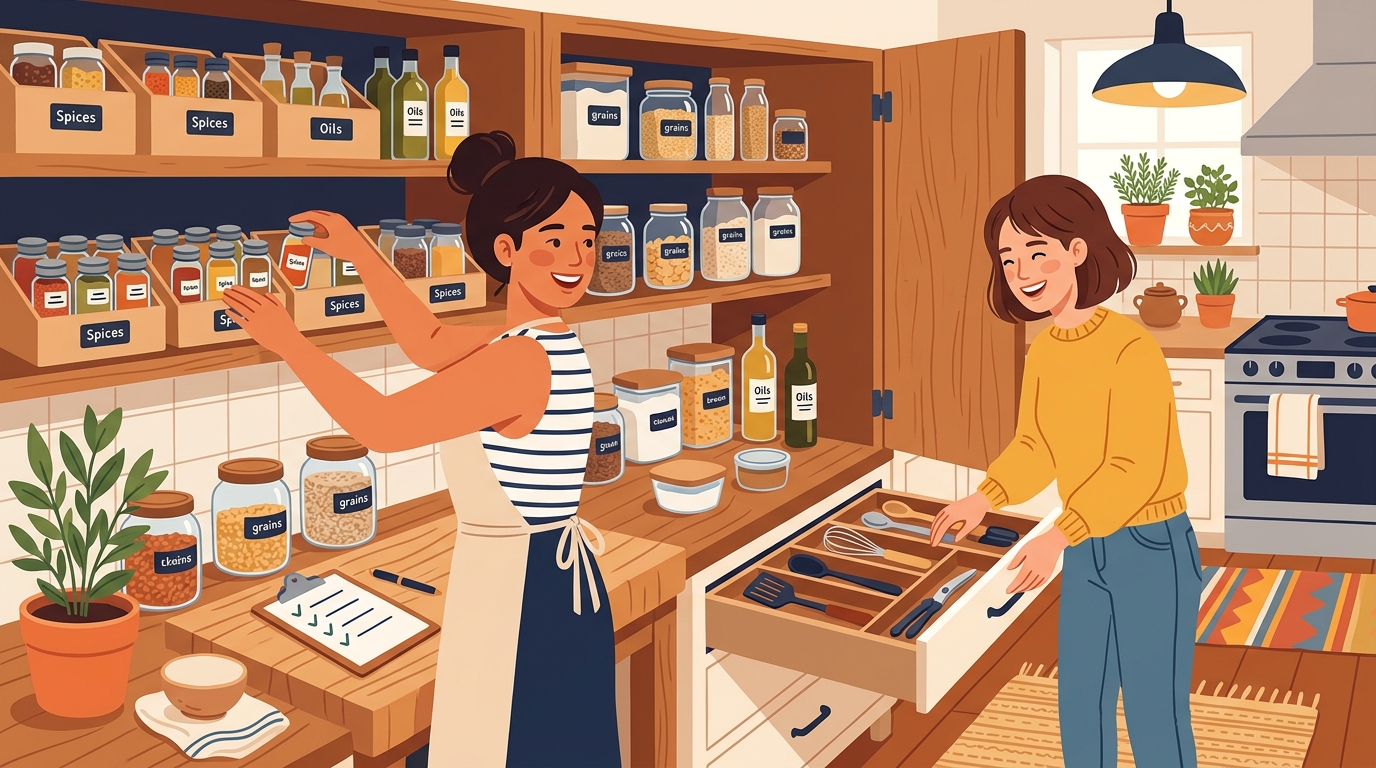
Spreadsheet vs app kitchen inventory is not really a software debate. For roommates, it is a question of whether the system can stop the same arguments from returning every week: who used the last olive oil, whether the house already owns cumin, why there are three peelers, and who is allowed to take the cast iron skillet when the lease ends.
A shared kitchen looks simple because the items are familiar. Spices, oils, baking sheets, utensils, pantry staples, coffee filters, food storage containers, and small appliances all seem too ordinary to deserve a system. That is exactly why they cause friction. Nobody wants a house meeting about paprika, so the kitchen runs on memory until memory fails.
Shared living is common enough that these small systems matter. Pew Research Center reported that nearly 79 million U.S. adults lived in shared households in 2017, and its later work on multigenerational homes found 59.7 million people living with multiple generations in 2021. The National Association of Home Builders, using Census Bureau ACS microdata, reported a record 6.8 million households sharing housing with unrelated housemates, roommates, or boarders in 2023. More people are sharing kitchens, bills, storage, and buying decisions.
This comparison is for roommates managing a real shared kitchen, not a fantasy pantry with matching jars and unlimited patience. A spreadsheet can be good enough for a small, stable apartment. An app can be worth it when items move, people shop separately, receipts matter, or the household wants one trusted record instead of a shared tab nobody opens.
Why shared kitchen inventory gets messy fast
The kitchen is the most collaborative room in a roommate home. It is also the room where personal, shared, and borrowed belongings blur together. One person brings a knife set. Another buys the baking sheets. Someone else subscribes to a warehouse club and arrives with a gallon of avocado oil, twelve rolls of parchment, and a heroic amount of chili crisp.
Small items create big uncertainty
Roommates usually remember the expensive things. The espresso machine, air fryer, Dutch oven, and stand mixer have stories attached to them. The trouble lives in the middle: spices, oils, vinegars, baking supplies, prep tools, storage containers, serving pieces, measuring cups, thermometers, peelers, strainers, cutting boards, and specialty pans.
Those items are inexpensive enough to buy without asking, but not so cheap when the household buys them repeatedly. A $6 jar of cumin, a $14 bottle of sesame oil, and a $9 pack of freezer bags do not feel like household infrastructure. Multiply that by a year of separate shopping trips and the kitchen quietly taxes everyone.
Vorby already covers this pattern in its guide to duplicate purchases around the home. The kitchen is where that behavior happens fastest because people shop under time pressure, often while hungry, and usually away from the cabinet they need to check.
Ownership and permission are different questions
A shared kitchen item has at least three facts attached to it: who owns it, where it lives, and whether others can use it. A roommate may own the wok but let everyone use it. The apartment may collectively own the plates because everyone split the receipt. One roommate may own the good chef knife and prefer that nobody else touches it, which is fair if the record is clear.
Without a system, people confuse access with ownership. If a tool sits in a shared drawer for six months, someone assumes it belongs to the house. If the owner later moves out and takes it, the kitchen suddenly feels incomplete and the remaining roommates feel surprised, even when nobody acted badly.
Food waste and duplicate buying are related
Shared kitchen inventory is not only about utensils. Pantry overlap matters too. USDA estimates that 30 to 40 percent of the U.S. food supply is wasted, including retail and consumer-level waste. Roommate kitchens contribute in miniature when nobody knows there is already rice behind the cereal, three open oils in different cabinets, or an unopened bag of flour bought for one recipe.
A system does not need to track every onion. It should make durable, shared, or recurring items visible enough that the household uses what it has before buying more.
The best kitchen inventory system is the one that answers the question at the moment someone is about to buy, use, borrow, replace, or move out.
Where a spreadsheet works well
A spreadsheet is the default answer for a reason. It is free, flexible, familiar, and easy to share. For a two-person apartment with a modest kitchen and a roommate rhythm that rarely changes, a spreadsheet can solve the core problem without adding another app to anyone's phone.
Spreadsheets are great for stable lists
The best spreadsheet use case is a stable list of shared kitchen infrastructure. Think appliances, cookware, serving pieces, bulk supplies, and house-owned staples. The household can create columns for item name, category, location, owner, shared status, replacement rule, purchase date, receipt link, and notes.
This works especially well during move-in. Roommates can sit at the table, list what each person brought, flag duplicates, and decide what belongs in shared cabinets. If your kitchen setup overlaps with larger shared-home organization, pair the spreadsheet with Vorby's roommate guide to shared household supplies so the kitchen does not become the only room with rules.
A spreadsheet also helps create neutral language. Instead of debating whether something is yours or ours, the row can say: owner, Maya; shared use, yes; move-out plan, Maya keeps it; replacement if broken, house vote. That is not romantic, but neither is arguing over a scratched pan at midnight.
Spreadsheets make rules visible
The spreadsheet advantage is not automation. It is shared visibility. A simple tab can capture house agreements that otherwise live in group chat fragments:
- Use freely: Everyday utensils, basic pans, plates, mixing bowls, and common spices.
- Ask first: Expensive knives, cast iron, specialty baking tools, party serving pieces, and anything personally sentimental.
- Replace if finished: Olive oil, coffee filters, trash bags, dish soap, parchment, foil, flour, sugar, and communal condiments.
- Do not share: Personal supplements, specialty ingredients for a specific recipe, meal-prep containers, and clearly labeled private shelves.
That list can prevent more friction than a beautifully formatted pantry database. Roommates do not need perfect information. They need enough agreement to behave fairly without asking permission for every spoon.
Spreadsheets are easy to export and leave behind
Spreadsheets also travel well. If one roommate moves out, the file can be copied, filtered, printed, or archived. If the house changes platforms later, the data is not trapped. For households that are wary of new tools, starting in a spreadsheet can be a low-conflict first step.
The limit is that a spreadsheet depends on everyone remembering to open it. That is fine for planned reviews. It is weaker for aisle decisions, receipt capture, photos, and fast updates after a Costco run.
Where a spreadsheet starts to break
Spreadsheets fail when the kitchen changes faster than people update rows. A roommate buys replacement oil on the way home. Someone borrows the roasting pan for Thanksgiving. A blender breaks. A receipt stays in a coat pocket. The spreadsheet remains technically correct for a few days, then becomes a museum of good intentions.
The update burden is too easy to dodge
A shared spreadsheet asks people to do clerical work after the useful moment has passed. After unloading groceries, nobody wants to type item names, adjust quantities, upload receipts, and fix categories. If the house relies on one organized roommate to update everything, the spreadsheet becomes a chore assigned by personality.
This is where kitchen inventory differs from rent splitting. Rent has a deadline. Utilities have due dates. Spices and utensils drift. There is no dramatic reminder that the spreadsheet is stale until someone buys the third bottle of sesame oil or cannot find the can opener.
Mobile use is usually worse than the idea
Spreadsheets look reasonable on a laptop and annoying on a phone. Filtering a cabinet list in a grocery aisle, adding a receipt photo, or scanning through tiny rows while standing in the kitchen is friction. Roommates may have access, but access is not the same as use.
This matters because the key inventory moments are mobile. You are at the store. You are unpacking groceries. You are looking in a drawer. You are checking whether the pressure cooker belongs to the house or to the roommate who is leaving in June. If the system is awkward in those moments, people fall back to memory.
Receipts and photos become scattered
The Insurance Information Institute recommends keeping proof of value, receipts, purchase contracts, photos, model details, and serial numbers as part of a useful home inventory. That advice is insurance-focused, but it applies neatly to shared kitchen items that cost enough to argue about or replace.
A spreadsheet can link to receipt images and photos, but the files often live elsewhere: text threads, email, camera rolls, cloud folders, or payment apps. Once evidence is separated from the item record, the household can see that a Vitamix exists but not who paid, what it cost, whether the warranty is active, or whether the cracked lid is covered.
Where an app earns its place
An app is worth considering when the kitchen needs more than a list. The strongest case for an app is not that it feels modern. It is that the record can live closer to the real behavior: photos while standing at the cabinet, quick updates on a phone, ownership notes attached to items, and receipt details connected to the thing purchased.
An app reduces the distance between seeing and recording
Kitchen inventory improves when adding an item feels like taking a quick note, not maintaining a database. A roommate can photograph the spice drawer, add a label, assign the item to a shelf, or record that the house owns the new stockpot while the receipt is still fresh.
This is the product-aware difference Vorby is built around. The point is not to turn roommates into warehouse managers. It is to give the household a careful record of shared belongings, ownership, location, photos, receipts, and context, so a simple question has a simple answer.
For appliances and higher-value tools, this connects directly to Vorby's guide to tracking shared household appliances. The toaster oven, blender, kettle, rice cooker, mixer, and coffee grinder are kitchen items, but they also behave like shared assets. They have purchase dates, warranties, parts, and eventual move-out consequences.
Apps handle mixed ownership better
Roommate kitchens need nuance. A binary shared or personal label is too crude. Useful records should support house-owned, privately owned but shared, privately owned and not shared, borrowed, split purchase, replacement owed, and move-out decision pending.
A good app can make those distinctions easier to see without adding columns forever. That matters because ownership problems rarely appear when everyone is happy. They appear when someone moves, breaks something, hosts a dinner, or wants reimbursement.
If ownership is the heart of the problem, read Vorby's guide on how to assign ownership of shared items. The kitchen is a perfect test case because it contains nearly every category: personal tools, communal purchases, consumables, gifts, inherited items, and things nobody remembers buying.
Apps are stronger for receipts and evidence
Statista's reporting on food-related digital behavior shows that Americans are already experimenting with technology for meal planning, grocery shopping, and food decisions. Roommates do not need every AI feature in the grocery aisle, but they do benefit when a purchase record can be captured before it disappears.
Receipts matter for three reasons. First, they prove who paid. Second, they help roommates split or reimburse accurately. Third, they help with warranties, returns, insurance documentation, and replacement cost. For shared kitchen items, the receipt is often the difference between a calm answer and a fuzzy memory.
Spreadsheet vs app kitchen inventory: the practical comparison
The right choice depends on household complexity, not personal taste. A spreadsheet can beat a bloated app if the house only needs a simple cabinet list. An app can beat a perfect spreadsheet if nobody updates the spreadsheet where life actually happens.
Choose a spreadsheet when the household is simple
A spreadsheet is the better starting point when:
- You have two roommates: Fewer people means fewer ownership paths and fewer separate shopping trips.
- The kitchen is small: One pantry, one utensil drawer, and a few shared appliances are manageable in rows.
- Items rarely move: If everything stays in the same cabinet, location data does not need much updating.
- You mostly need rules: Use, replace, ask first, do not share, and move-out plan may be enough.
- Everyone already uses the same workspace: A shared Google Sheet works better if people already check it.
For this household, keep the spreadsheet intentionally boring. One tab for shared kitchen items, one tab for consumable replacement rules, one tab for move-out ownership. Do not create fifteen columns because you can. The system should be easy enough that the least organized roommate still participates.
Choose an app when the kitchen has moving parts
An app is the better choice when:
- Three or more people share the kitchen: More roommates means more duplicate buying, more ambiguity, and more coordination costs.
- People shop separately: The system needs to answer questions away from home.
- Receipts matter: Split purchases, warranties, returns, and proof of value should sit near the item record.
- Storage is spread out: Pantry, fridge, freezer, cabinets, hall closet, garage shelves, and labeled bins are harder to remember.
- Move-outs happen often: Students, rotating leases, and sublets need ownership records that survive turnover.
This is also where the broader spreadsheet vs app roommate inventory question becomes useful. The kitchen may be the pain point, but the same decision applies to shared storage, furniture, appliances, cleaning supplies, and move-in records.
Use a hybrid if that gets adoption
Some households should not choose one tool for everything. Use a spreadsheet for house rules and move-out agreements. Use an app for item records, receipts, photos, and locations. The spreadsheet explains how the household works; the app shows what the household owns.
The hybrid approach is especially useful for roommates who distrust overcomplicated systems. Start with one kitchen category, such as appliances and shared cookware. Once the house sees fewer duplicate purchases and fewer ownership arguments, expand to spices, oils, specialty tools, and pantry staples.
How to set up a shared kitchen inventory roommates will actually use
The tool matters less than the rollout. A spreadsheet introduced as homework will fail. An app introduced as surveillance will fail faster. The goal is to create a shared record that makes daily life easier, not a policing system for who finished the peanut butter.
Start with the argument-prone categories
Do not inventory every tea bag. Begin with the categories most likely to cause duplicate purchases, breakage, reimbursement questions, or move-out tension:
- Shared appliances: Toaster, kettle, blender, rice cooker, food processor, mixer, air fryer, coffee grinder, microwave accessories.
- Cookware and bakeware: Skillets, saucepans, sheet pans, Dutch oven, muffin tins, roasting pan, specialty pans.
- Utensils and prep tools: Knives, peelers, graters, measuring cups, thermometers, scales, strainers, can opener, tongs.
- Reusable storage: Food containers, jars, freezer bags, labels, lunch containers, canisters.
- Shared staples: Oils, vinegars, spices, flour, sugar, rice, coffee filters, foil, parchment, dish soap, trash bags.
For each category, decide the minimum useful record. Appliances need owner, location, receipt, purchase date, warranty, and move-out plan. Spices may only need shared status, location, and replace-if-finished rule. Utensils may need owner and ask-first note if they are expensive.
Make replacement rules explicit
Roommate conflict often comes from mismatched expectations, not bad intentions. One person thinks finishing communal olive oil means the next shopper replaces it. Another thinks the person who used the last splash replaces it. A third thinks bulk staples come out of a monthly household fund.
Write the rule before the bottle is empty. For shared consumables, choose one of these patterns:
- Last-use replaces: The person who finishes it adds it to the shopping list or buys the next one.
- Rotating buyer: Each roommate handles household staples on a schedule.
- Shared fund: Everyone contributes monthly, and one person shops from the fund.
- Receipt split: Whoever buys uploads the receipt and gets reimbursed.
Whatever you choose, attach the rule to the inventory record or house spreadsheet. Group chat is fine for discussion, but it is terrible as an archive.
Review the kitchen at predictable moments
Inventory systems decay unless the household gives them a rhythm. Review the kitchen at move-in, before major shared shopping trips, before hosting holidays, at lease renewal, and two weeks before anyone moves out. These moments already create decisions, so the inventory has a natural job.
During review, ask four questions: What do we already own? What is missing or broken? What should be private, shared, or ask-first? What leaves with whom if someone moves? If the system answers those questions quickly, it is working.
FAQ: spreadsheet vs app for shared kitchen inventory
Is a spreadsheet enough for roommate kitchen inventory?
Yes, if the kitchen is small, the roommates are stable, and the main need is a visible list of shared items and rules. Keep it simple, mobile-friendly, and limited to the items people actually argue about or duplicate.
What should roommates track in a shared kitchen app?
Track shared appliances, cookware, utensils, specialty tools, reusable storage, recurring staples, receipts, ownership, location, and move-out decisions. Do not try to track every perishable item unless the household truly wants that level of detail.
How do roommates avoid buying duplicate spices and oils?
Put spices, oils, vinegars, and baking staples in one visible record with location and replacement rules. Review the list before grocery runs, and make one person responsible for updating new shared purchases immediately after unpacking.
How should roommates handle personal kitchen tools?
Label personal tools clearly in the inventory as private, ask-first, or shared-use. The important part is separating ownership from permission, because a privately owned item can still be available for shared use if the owner agrees.
What is better for move-out, a spreadsheet or an app?
An app is usually better if photos, receipts, and ownership notes matter. A spreadsheet can work if it clearly lists who owns each item, what the house bought together, and what happens to shared purchases when the lease ends.
The bottom line for shared kitchen inventory
A spreadsheet is best when roommates need a simple agreement. An app is best when the kitchen needs a living record with photos, receipts, locations, ownership, and quick updates from a phone. The right system is the one that reduces repeat purchases and makes shared items easier to trust.
Shared kitchens run better when shared belongings are visible. Vorby gives roommates one place to keep the record clear before the next grocery run, dinner party, or move-out. Start your shared household inventory at Vorby.


