Imagine a digital twin of your home, one that always knows exactly what you have and where everything is. That’s the big idea behind real time inventory software. It’s less like a static spreadsheet and more like a live, interactive map of your stuff that updates itself instantly.
What Exactly Is Real Time Inventory Software?
At its core, real time inventory software is a living, breathing record of your possessions. Instead of manually checking things off a paper list or punching updates into a spreadsheet, the technology does the heavy lifting for you.
Think of it as a smart shopping list that already knows you have three cans of tomato soup, stopping you from buying a fourth you don’t need.
This isn't some brand-new concept; businesses have relied on it for years to keep shelves stocked and warehouses running smoothly. If you want a deeper dive into the business side of things, understanding inventory management systems used in commercial settings provides great context. The same core principles that power massive supply chains are now simple and accessible enough to manage your own home.
From Business Tool to Home Essential
While big retailers have depended on these systems for ages, the tech has finally become a perfect fit for personal use. The goal is simple: give you instant, accurate answers about your belongings without all the tedious manual work.
It’s designed to solve those classic household headaches, like:
- Finally finding that specific holiday decoration you packed away in a storage bin.
- Knowing exactly how many AA batteries you have before a storm hits.
- Keeping a detailed record of your electronics and valuables for insurance claims.
- Managing shared groceries and supplies with roommates so no one buys duplicate milk.
The business world has poured billions into perfecting this technology. The global market for inventory management software was estimated between USD 2.3–3.9 billion in the mid-2020s, and it's still growing fast. That massive investment has made these tools incredibly powerful, affordable, and easy for anyone to use.
The Big Leap Beyond Manual Lists
The key difference is right there in the name: "real time." A manual list is frozen in time; it’s only as accurate as the last time you sat down to update it.
Real time software, on the other hand, syncs across all your devices and updates the moment an item is added, used, or moved. It closes the gap between what you think you have and what you actually have.
To show just how big that leap is, let's compare the old way with the new.
Key Differences Between Manual Lists and Real Time Software
| Feature | Manual List (e.g., Spreadsheet) | Real Time Inventory Software |
|---|---|---|
| Updates | Manual; requires you to remember and record changes. | Automatic; syncs instantly across devices. |
| Accuracy | Prone to errors and quickly becomes outdated. | Always current, reflecting the true state of your inventory. |
| Accessibility | Limited to the device or notebook where it's stored. | Available anytime, anywhere, on any connected device. |
| Searchability | Basic text search; difficult to find items quickly. | Advanced search with filters, photos, and categories. |
| Effort | High; a constant chore to maintain. | Low; automated features do the work for you. |
This table makes it clear: we're moving from a passive, high-effort chore to an active, automated system that works for you in the background.
The real power of real time inventory software is its ability to create a single source of truth for your belongings, accessible anytime, anywhere. It turns inventory from a dreaded task into a simple, automated background process.
This shift is fundamental. By adopting a more dynamic approach, you gain a level of clarity and control over your personal items that just wasn't possible before. To see how this works in a home setting, check out our complete guide to home inventory software. Ultimately, it’s about making your life at home simpler, more efficient, and a lot less stressful.
How the Core Technology Actually Works for You
The "magic" behind real-time inventory software isn't some complex, futuristic concept. It's actually a bundle of smart tools, many of which you already use every day on your phone, all working together to make your life simpler. Let's pull back the curtain and see how this technology turns a mind-numbing chore into a surprisingly easy process.
At the very heart of it all is real-time syncing. Think of it as the invisible engine that keeps your inventory perfectly updated across all your devices. It works just like a shared family calendar: when your partner adds a dentist appointment on their phone, it instantly pops up on yours. When you add a new item on your tablet at home, it's immediately there on your phone when you're at the store. This creates a single, reliable source of truth for everything you own.
This simple diagram shows how the software acts as a central hub, giving you a complete, live picture of your inventory, including what you have, where it is, and when it was last touched.
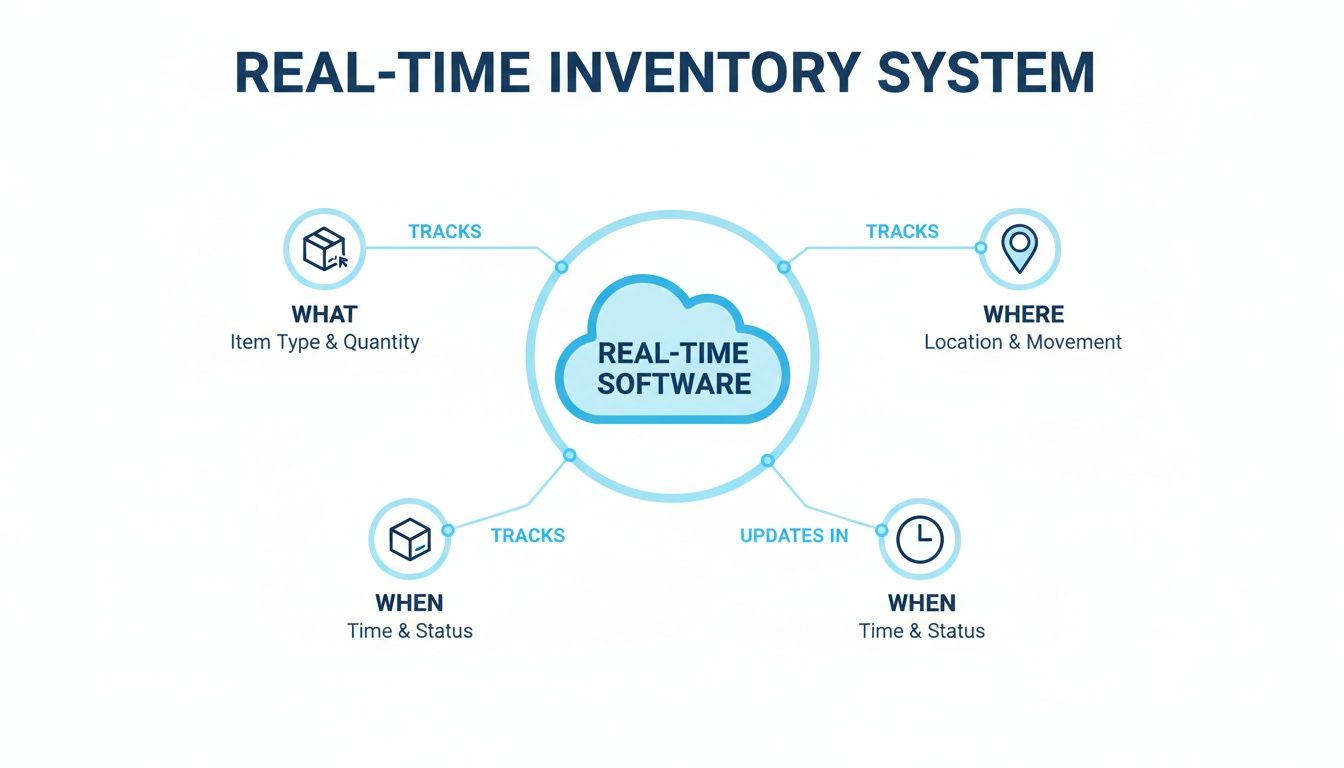
It connects all the essential data points for every single item you own into one clear, easy-to-read system.
The Brains Behind the Operation: AI and Automation
Another piece of the puzzle is AI-powered image recognition. If you’ve ever searched your phone’s photo gallery for "beach" and had it instantly pull up the right pictures, you've used this tech. With an inventory app, you just snap a photo of that new board game or kitchen gadget. The AI gets to work, identifying the item and often auto-filling the name, brand, and other details. This one feature eliminates hours of tedious typing.
Then there's receipt parsing. Instead of manually entering every single thing from that massive hardware store receipt, you just take a picture of it. The software uses something called optical character recognition (OCR) to "read" the text, instantly turning a crinkled piece of paper into a neat digital list. From there, it adds everything right into your inventory.
The whole point of this tech isn't to add another complicated system to your life; it's to remove one. By automating the most painful parts of cataloging your stuff, real-time inventory software frees you up to focus on literally anything else.
Making Your Physical Stuff Digital
So, how do you connect a physical object to its digital entry? Simple: with digital labels like QR codes, barcodes, and even NFC tags.
Here’s what that looks like in the real world:
- QR Codes for Storage Bins: Generate a unique QR code for each storage tote in the attic. The next time you need the holiday decorations, just scan the code on the box with your phone. A complete list of what's inside pops up instantly. No more tearing open five identical boxes just to find the string lights.
- Barcodes for Products: Nearly everything you buy already has a barcode. The app's built-in scanner can read that code to instantly identify the item and add it to your list with all the details pre-filled. It's incredibly fast.
- NFC Tags for Quick Access: For things you use all the time, you can stick on a small NFC tag (the same tech used for tap-to-pay). A quick tap of your phone on a tag stuck to a pantry shelf can pull up its contents or let you log that you've used the last of the olive oil.
These tools are designed to be dead simple. Knowing exactly where everything lives is a huge part of feeling organized, and you can learn more about how powerful detailed location tracking in home inventory systems can be. When you put it all together, these technologies create a system that’s not just powerful, but genuinely easy to weave into your daily life.
The Practical Benefits for Your Home
Let's be honest, the true value of any tech isn't its flashy features, but how it solves real, everyday problems. Real-time inventory software takes its smarts and turns them into tangible wins that pad your wallet, cut down on stress, and give you back your precious time. It’s all about turning household chaos into calm, predictable order.

This isn’t just about knowing what you have. It's about what that knowledge empowers you to do. From saving a surprising amount of cash to simplifying life's unexpected emergencies, the benefits are both practical and profound.
Save Money and Reduce Waste
One of the first things you'll notice is the impact on your budget. When you have a live view of your household supplies, you can finally put an end to those wasteful spending habits that quietly add up.
Sound familiar?
- No More Duplicate Purchases: How many times have you bought batteries, lightbulbs, or cleaning supplies, only to get home and find a full stock hidden in a closet? A quick search in your app stops these redundant buys cold, keeping that money right in your pocket.
- Slash Food Waste: You grab fresh cilantro for a recipe, forget about it, and find it wilted in the back of the fridge a week later. With an inventory system, you can track expiration dates and get alerts, nudging you to use things before they spoil.
- Smarter Grocery Shopping: Instead of wandering the aisles guessing what you need, you can check your pantry's status right from aisle four. This means you buy exactly what’s required, so no more overspending or last-minute trips for a single forgotten ingredient.
These small, consistent savings accumulate fast, making a real difference in your monthly household expenses. It's a simple, effective way to be more mindful about your resources.
Boost Your Peace of Mind
Beyond the financial perks, there’s a significant sense of security and control that comes from having a detailed record of your belongings. This becomes especially critical when facing unexpected events where documentation is everything.
A well-maintained digital inventory is your ultimate safety net. In the unfortunate event of a fire, flood, or theft, filing an insurance claim is an overwhelming task. Instead of trying to recall every lost item from memory, you have a comprehensive, photo-documented list ready to go.
This list can include serial numbers, purchase dates, and receipts, which can dramatically speed up the claims process. More importantly, this detailed record serves as undeniable proof of ownership, highlighting the power of real-time evidence in insurance claims and potentially leading to a faster, more accurate payout.
By turning abstract knowledge into a concrete, accessible record, real-time inventory software gives you the confidence that you are prepared for anything.
This preparedness isn't just for emergencies. It’s also about the daily peace of mind that comes from knowing exactly what you own and where to find it, eliminating that low-grade stress of a disorganized home.
Streamline Organization and Daily Life
Finally, the organizational benefits make daily routines smoother and less frustrating for everyone under your roof. Think of a centralized inventory system as a shared brain for your home.
If you live with roommates or family, a shared digital pantry list, updated in real time, ends the constant confusion over who needs to buy milk or paper towels. Everyone is on the same page, which reduces friction and simplifies running the household. For those looking to take it a step further, our guide on automated inventory management offers deeper insights.
This organizational power is backed by data from the business world. Companies using real-time tracking have seen inventory accuracy jump by 15–20 percentage points. While your home isn't a warehouse, that same principle applies. Better accuracy means less time wasted searching and more time for what matters. Finding seasonal decorations or that specific screwdriver becomes a matter of a quick search, not a frantic hunt through dusty boxes.
Getting Started with Your Home Inventory System
Staring down the barrel of a full-home inventory can feel like a massive project, but modern real time inventory software is built to make it a simple, step-by-step process you can knock out at your own pace. The secret? Forget about doing everything at once. Just start small and let the momentum build.
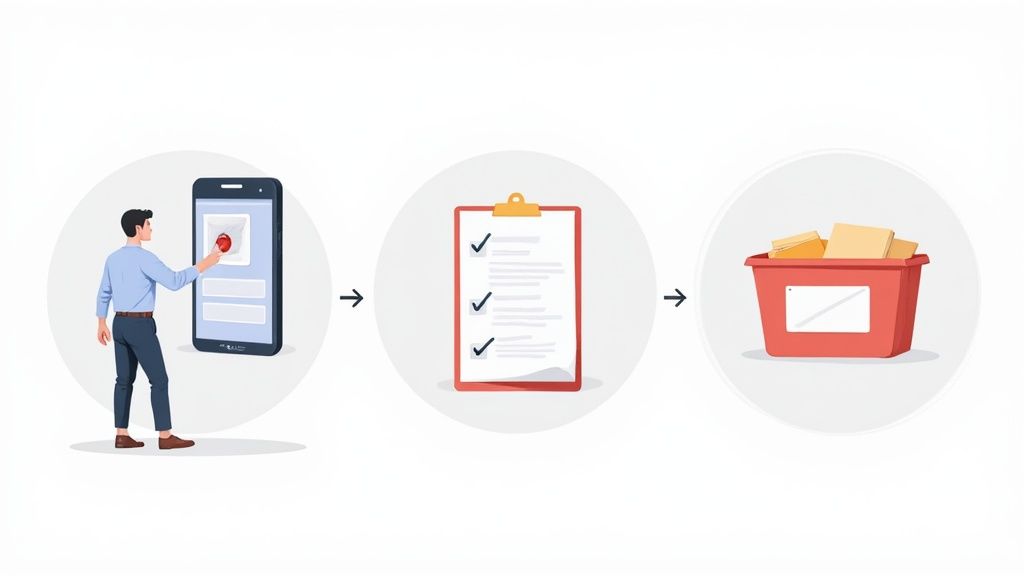
This approach transforms a huge, intimidating task into a string of small, satisfying wins. By zeroing in on one manageable area at a time, you’ll see the benefits almost immediately and feel genuinely motivated to keep going.
Step 1: Choose Your Starting Point
The first, and most critical, step is to pick one specific area to catalog. Don't even think about the whole house. Just choose a single zone that feels totally achievable. This strategy helps you learn the software's features in a low-pressure way and gives you a quick victory to fuel the rest of the project.
Not sure where to begin? Consider one of these popular spots:
- The Kitchen Pantry: This is a perfect first mission. You can add items in minutes, track expiration dates, and see the payoff right away when you build your next grocery list.
- A Specific Collection: If you collect books, vinyl records, or video games, inventorying them is actually a fun way to reconnect with what you own and appreciate your hobby.
- Your Garage or Workshop: Cataloging tools, holiday decorations, or sports gear makes it infinitely easier to find exactly what you need, the moment you need it. No more frantic searching.
- The Medicine Cabinet: Tracking medications and first-aid supplies is crucial for household safety. It ensures you know what you have, what's expired, and what needs to be restocked.
Step 2: Begin Adding Items Effortlessly
Once you’ve picked your zone, it’s time to start adding things. This is where the power of modern software really shines, wiping out the tedious manual data entry that made old-school inventory methods so painful.
Most apps give you several dead-simple ways to add your belongings:
- Snap a Photo: Often, the easiest method is just taking a picture. AI-powered image recognition can frequently identify the item, automatically filling in the name, brand, and category for you.
- Scan a Barcode: For packaged goods, electronics, or books, scanning the barcode is the fastest way to add an item with perfect accuracy. The software pulls all the product details from a global database in a split second.
- Upload a Receipt: Just get back from the hardware store? Snap a photo of the receipt. The app can read the text and create individual entries for everything you bought, saving you from typing a single word.
Your goal isn't perfection on day one. It's progress. Adding just five or ten items using these simple methods is a huge win that builds the foundation for a fully organized home.
Step 3: Create Simple and Logical Categories
As you add items, the software will prompt you to organize them. This is your chance to build a system that makes sense for you. Don't overthink it; the best organizational systems are always simple and intuitive.
Start with broad categories, then use tags to nail down the specifics.
- Category: Electronics
- Tags:
Gaming,Audio,Kitchen,Office
- Tags:
- Category: Tools
- Tags:
Gardening,Power Tools,Automotive
- Tags:
- Category: Documents
- Tags:
Warranty,Manual,Receipt,Certificate
- Tags:
This mix of categories and tags creates a powerful, searchable database of everything you own. Six months from now, you won't have to remember if you filed the lawnmower manual under "Garage," "Outdoor," or "Manuals." You can just search for "lawnmower manual" and find it instantly. The software does all the hard work of remembering for you.
How Vorby Brings This Tech into Your Home
The kind of powerful real-time inventory software used by massive companies is finally available for your home, and Vorby is designed to be that bridge. We took the core ideas from big-league systems, like instant syncing and smart automation, and rebuilt them from the ground up for the real-world needs of homeowners, collectors, and families. Vorby isn't some clunky business tool; it's a simple, intuitive way to bring clarity and order to your personal space.
Our whole focus is on making this technology feel effortless. Take Vorby’s AI-driven item recognition. It works just like your phone’s photo app, identifying items from a quick snapshot so you don't have to do a bunch of tedious typing. The setup is designed to be just as easy. You can start by organizing a single drawer and build momentum from there.
Built for How We Actually Live
Vorby translates powerful inventory concepts into practical, everyday features. One of the best examples is our collaborative spaces, which let family members or roommates manage a shared inventory. Everyone can add to the grocery list or see who used the last of the paper towels, all synced in real time across every device. It keeps the entire household on the same page, turning potential chaos into simple cooperation.
The platform also gives you a visual, searchable inventory of everything you own. Instead of digging through boxes in the attic, you can just search for "holiday lights" and know instantly which bin they're in and where that bin is. We believe finding your own belongings should be as easy as a web search, and Vorby makes that happen.
The goal is to put enterprise-grade organizational power directly into your hands, without the enterprise-grade complexity. Vorby makes advanced inventory management feel as simple as making a shopping list.
Making Advanced Technology Approachable
There's a huge trend right now toward user-friendly software, even in the business world. More and more companies prefer subscription-based tools because they make powerful tech accessible to smaller teams. In much the same way, Vorby makes advanced real-time inventory software accessible for your personal life. The market for this kind of technology is booming, with one report estimating the software component alone to be worth nearly $3.97 billion by 2025 as developers embed more AI and analytics. You can dive deeper into the growth of the inventory optimization market to see just how fast this tech is evolving.
By focusing on an easy setup and practical uses, Vorby delivers a tool that solves common household frustrations without a steep learning curve. It’s all about giving you a smarter, more organized home.
Your Stuff, Your Data: A Hard Look at Privacy and Security
Let’s be honest. The idea of creating a digital catalog of everything you own, from your grandmother’s wedding ring to that expensive new TV, brings up some big questions about privacy. Who sees this data? How is it protected? These aren't just details; they're deal-breakers.
When you're documenting your life's possessions, you need absolute certainty that your information is locked down tight. Any worthwhile real-time inventory software is built with this in mind from day one. Security isn't an add-on; it's the foundation.
The Digital Forcefield: End-to-End Encryption
The single most important security feature you should look for is end-to-end data encryption. Think of it as an unbreakable digital shield around your information, making it completely unreadable to anyone who isn’t you.
This shield has to work in two places to be effective:
- Data in Transit: When you snap a picture of a new purchase on your phone, that data has to travel over the internet to the app's servers. Encryption scrambles it into gibberish during that trip. Even if someone could intercept it, all they’d see is a meaningless jumble of code.
- Data at Rest: Once your inventory data arrives and is stored on a server (in "the cloud"), it can't just sit there unprotected. Strong encryption keeps it locked down and private while it's being stored, safe from any outside threats.
This two-stage protection is the gold standard. It ensures your information is shielded whether it’s on the move or sitting still.
You Are the Gatekeeper of Your Information
Beyond the technical stuff, there's a simple philosophy a trustworthy service must follow: you own your data, period. This shouldn't be buried in legal jargon; it should be front and center in their privacy policy.
When you're checking out a service, find their privacy policy. Is it written in plain English? A good one will state clearly that they will never sell your personal inventory data to advertisers or other third parties. It puts you in complete control, ensuring your private information stays that way.
Your home inventory is a personal digital asset. A secure platform will treat it that way, giving you full ownership and control over who sees your data and how it’s used.
Making the Right Choice for Your Peace of Mind
Picking the right software isn't just about cool features; it’s about finding a company you can trust with your personal life. A provider that’s serious about security will be transparent about their practices and make it easy to understand how you’re protected.
By prioritizing services that offer robust encryption and a clear, user-first privacy policy, you can get all the benefits of an organized home without ever having to worry about your data. It’s about gaining control of your space without sacrificing an ounce of privacy.
Got Questions? We've Got Answers
Diving into the world of real-time inventory software for your home usually brings up a few practical questions. Let's tackle some of the most common ones to help you see how this kind of tool can actually fit into your life without being a huge chore.
How Much Time Does It Really Take to Set Up a Home Inventory?
Getting started is way faster than you’d think. The secret is to ditch the idea of cataloging your entire house in one go. Nobody has time for that.
Instead, start small. Pick one manageable project, like your kitchen pantry or that one overflowing bookshelf. You can easily knock that out in under an hour. With modern tools that let you scan items with your phone's camera or parse receipts, you're not stuck with mind-numbing manual typing. The whole point is to build your inventory over time, turning a monster task into a series of small, satisfying wins.
Can I Share My Inventory with My Family or Roommates?
Absolutely. In fact, that's one of the best parts. The top apps are designed for collaboration from the ground up. You can easily invite family members or roommates, giving everyone access to view and update shared lists right from their own phones.
This is a game-changer for managing all the stuff you share:
- Groceries: Everyone can see what's in the fridge or pantry before heading to the store. No more coming home with a third jar of mustard.
- Household Supplies: Finally, an end to buying duplicate cleaning supplies or running out of toilet paper.
- Shared Collections: Perfect for couples or families who co-manage collections of books, movies, or video games.
- Emergency Kits: In a crisis, everyone knows exactly where the first-aid kit, flashlights, and other essentials are.
When everyone's on the same page, you cut down on the "Hey, where's the...?" texts and make daily life a lot smoother.
Is My Personal Inventory Data Safe?
Look, when you're creating a detailed record of everything you own, you need to know that information is private and secure. Your privacy should be non-negotiable.
Any reputable real-time inventory software uses serious, multi-layered security to protect your data. You want to see features like robust encryption, which basically scrambles your information so no unauthorized person can read it. It's also critical to read the privacy policy, which should state in plain English that you own and control your data, period.
The single most important step is choosing a developer who is transparent about their security practices. Your personal data should never be sold or shared without your explicit consent.
By picking a service with a proven commitment to privacy, you can get all the organizational benefits without sacrificing your security. That's how you achieve true peace of mind.
Ready to get your home organized with the power of real-time inventory? Vorby makes it simple to catalog your belongings, find anything fast, and collaborate with your family. Start your free 14-day trial today and see how easy it is to bring order to your home.