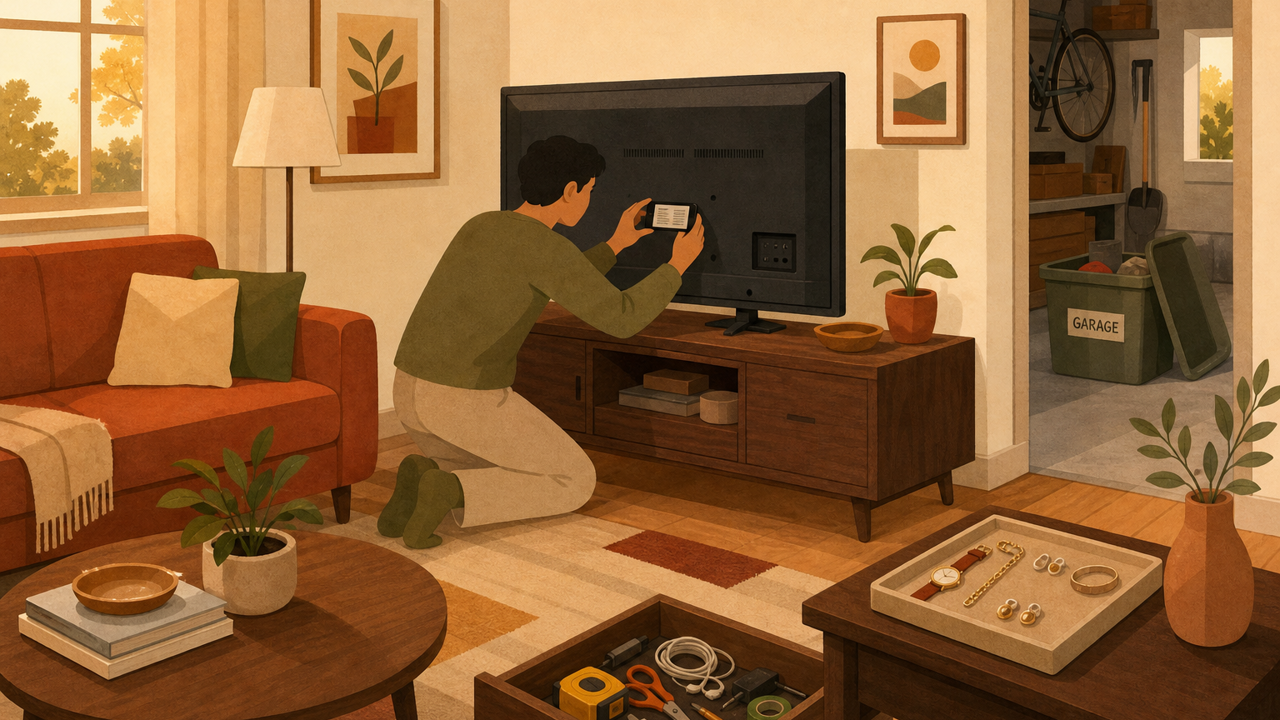
Quick answer. Wide from the corners, medium with drawers open, close on the plate. Serials, receipts, originals with their timestamps. Photograph while it is safe and boring — not while a room is still hazardous. A living-room panorama is not a claim file.
A living-room panorama looks like proof. To an adjuster, it is a blurry couch and a TV you cannot name. This is not another full home-inventory guide. It is the camera-roll version: which shots actually help a claim, which ones waste a Saturday, and the order that keeps you from photographing the sofa six times and the serial number never.
What can an adjuster actually use?
Adjusters are not collecting interior-design mood boards. They need three answers: did you own it, what exact thing was it, and what would it cost to replace. A pretty wide shot answers none of those by itself.
The Insurance Information Institute tells people to photograph or videotape belongings, and to record serial numbers on major appliances and electronics. Keep receipts and appraisals with the list, and store a copy somewhere the house cannot destroy. In a dispute, a serial number and a photo taken in your house carry more weight than a written description, because they are harder to invent after the fact. A stock image of the same TV model does not prove yours was on that stand. A phone photo of that TV, with your wall behind it and the original file kept, does.
Think in threes.
- Wide. One shot from each corner of the room. Furniture, rugs, the vacuum in the corner, the Dutch oven on the stove. You are proving the contents of the room, not making art.
- Medium. Open the thing. Shelves, cabinets, closets, the junk drawer, the garage bin with the lid off. A closed cabinet is a rumor. An open cabinet is a list.
- Close-up. The expensive item, then the plate. Brand, model, serial number. The sticker under the TV. The label inside the laptop. The stamp on the tool. If you cannot read it in the photo, it does not count.
Tidy and findable are different. A staged, empty-looking room photographs nicely and documents almost nothing. Leave the tape measure on the workbench. Photograph the mess you actually live with.
Why is the serial number the whole point?
A line that says "TV" is not a claim. A line that says 65-inch LG, serial number photographed, sitting on the walnut console in last year's holiday photos, is a claim.
Serial numbers hide on purpose. Under the TV. Bottom of the laptop. Inside the dishwasher door. Back of the soundbar. Underside of the mower. Inside the battery door of the camera. On a sticker the size of a fingernail, already peeling.
Do this while you can still tilt the thing. After a loss, you may not have the object, the light, or the patience. Photograph the plate, then take one step back and photograph the whole item in the room so the plate and the object are obviously the same thing.
If the item came in a box, the box often has a cleaner copy of the same numbers. Keep the box for a while on anything you would be sad to replace. Photograph that label too.
What about originals, timestamps, and metadata?
Keep the original files. Do not "enhance," crop hard, and save over the only copy. Your phone already stamps when the photo was taken. That timestamp is part of the story: this was here on a normal Tuesday, not invented after the loss. If you export or sync, prefer a path that keeps the original (or a faithful copy), not a heavily recompressed social-media upload as your only archive.
A screenshot of a product page is not a substitute for a photo in your house. A receipt photo that is all glare is not a receipt. Flat, readable, attached to the item later if you use an inventory app — or filed next to the room photos if you do not.
What shots do people skip?
The living room gets photographed. The jewelry tray does not. That is backwards.
The III notes that jewelry, art, and collectibles may need coverage separate from a standard homeowners policy — check with your agent before a loss. That is not a reason to skip the tray. It is a reason to look at it. If the tray holds more than your policy's jewelry limit, you have a coverage problem you can fix on a calm Tuesday. Photograph each piece on a plain surface, both sides, with any hallmark or inscription. One group shot of a glittery pile is jewelry as decoration. Individual shots are jewelry as property.
Then the places you do not "see" because you live here:
- The garage. Treat each shelf like a room. Power tools, bikes, the generator, seasonal gear. A closed bin is a mystery. Open it.
- Drawers. Kitchen gadgets, the camera bag in the bedroom, chargers that only work with one device. Photograph down into them. Close-up anything with a brand you would have to re-buy.
- Closets and under-bed boxes. Luggage, the extra monitor, the unlabeled box. If you cannot name what is in it, that is the photo to take.
- Outside. Grill, patio furniture, mower, kids' gear that lives on the porch. Contents coverage is not only the rooms with throw pillows.
A video walkthrough is useful as a backup. It is not the system. Walkthroughs miss serial numbers, skip closed doors, and go dark in the garage. Use video after the stills, not instead of them.
What about safety?
Photograph on a boring day, while the house is intact. After a fire, flood, or collapse, do not walk a damaged structure to "finish the photo set" if it is unsafe. Ready.gov on home fires puts safety ahead of paperwork. After a loss, the III's claims guidance still asks for an inventory of damaged or destroyed items, receipt copies, and photos or video of the damage — when you can take them safely. If you cannot enter, use the pre-loss set you stored offsite. That is the point of shooting before anything happens.
What should you skip?
You do not need a museum catalog of every sock.
Skip the sixth angle of the sofa once you have a wide shot and a close-up of the tag. Skip photos so dark you cannot tell a drill from a hair dryer. Skip screenshots of product pages. Skip a receipt shot so glary the total is a white blob. And skip the heroic Saturday where you try to do the whole house, get tired in the hallway, and never open a drawer. One room, done properly, beats a whole-house blur.
What is a Saturday order of operations?
Start with the room you would least want to rebuild from memory. For most people that is the living room (TV, speakers, furniture) or the office (laptop, monitors, the chair that actually cost money).
- Stand in each corner. Wide shot. Lights on. If you cannot read the brand in the photo, retake it.
- Open cabinets, closets, drawers. Medium shots of what is actually in them.
- Pull the expensive things far enough to see the plate. Close-up of the serial, then a step-back of the item in place.
- Move to the garage, the jewelry, the drawers you have been avoiding. Same three distances.
- When you buy the next vacuum, photograph it the day it comes in the door, before the box goes to recycling.
You are not making a fear project. You are leaving your future self a camera roll that can answer a specific question: what was in this house, exactly. Pair this with a home inventory built for insurance lines, not just a folder of images.
When are the photos done?
Put them somewhere the house cannot destroy. A folder that never leaves the phone is the same mistake as a binder in the hall closet. Off-site or in the cloud, with one other person who knows where it lives.
If you want those photos to turn into a list without typing, that is what vorby.com is for. Snap the room. Get items, rooms, and a record you can actually hand over. The pictures still have to be the right pictures. The app does not invent a serial number you never shot.
FAQ
Do phone photos count for an insurance claim?
Yes. Insurers do not need a photographer. They need a picture you can read. Lights on. The item fills the frame. If you cannot name the thing from the photo, retake it. Keep the original file.
Do the photos need timestamps?
Your phone already stamps the file. Leave it. A date on a photo taken in your house is part of the proof: this was here on a normal Tuesday, not invented after the loss. Prefer exports that keep that metadata.
How many photos should I take?
Enough that an adjuster can answer three questions: did you own it, what exact thing was it, and what would it cost to replace. One wide from each corner, open drawers, close-up of the expensive items and the serial plate. One room done that way beats a hundred blurry living-room shots.
Can a video walkthrough replace still photos?
No. Use video as a backup. Walkthroughs miss serial numbers, skip closed doors, and go dark in the garage. Stills first. Video after.
Should I photograph serial numbers?
If it has a plate and you would be sad to replace it, yes. The sticker under the TV. The label inside the laptop. The stamp on the tool. Then one step back so the plate and the object are obviously the same thing.
Should I photograph receipts?
For the expensive things, yes. Flat, no glare, total readable. A white blob does not help. You do not need a receipt photo for every mug.
Where should I keep the photos?
Somewhere the house cannot destroy. Cloud or off-site, and one other person who knows where they live. A folder that never leaves the phone is the same mistake as a binder in the hall closet.
Is it safe to photograph after a fire or flood?
Only if the structure is safe to enter. Otherwise use the pre-loss set you stored offsite, and photograph damage later when officials or your carrier say it is safe. Safety first; paperwork second.

