Let's be honest, moving feels like trying to solve a puzzle while the room is spinning. But there's one tool that can bring everything into sharp focus: a solid inventory list. Think of a moving inventory list template as your personal command center for every single thing you're packing up. It's the only way to guarantee nothing gets lost, broken, or mysteriously left behind.
Furniture is a different job than boxes. Measure the couch and the dresser before anything is packed: inventory the furniture before you move.
This isn't just about making a list; it's about creating the blueprint for an organized, accountable, and surprisingly calm relocation.

Why a Moving Inventory Is Non-Negotiable
A detailed moving inventory turns a mountain of a task into a series of manageable steps. It’s so much more than a simple checklist of your stuff. It becomes the single source of truth that guides you from taping up that first box in your old place to unpacking the last coffee mug in your new home.
Without one, you’re basically moving blind. You’ll waste time tearing open boxes looking for the coffee maker or find yourself wondering if that little scratch on the bookshelf was there before the movers touched it. An inventory completely eliminates the guesswork.
The Hidden Perks of a Good List
The real value of a thorough inventory goes way beyond just knowing where things are. It offers some seriously practical benefits that save you time, money, and a whole lot of stress during one of life's most chaotic moments.
Here's where it really pays off:
- Financial Protection: It's your number one piece of evidence if you need to file an insurance claim for something that got damaged or went missing. A detailed list with item conditions and values makes that whole process a thousand times smoother.
- Mover Accountability: When you hand your life's possessions over to a moving company, your inventory is the mutual scorecard. You can check off every box and piece of furniture as it’s loaded and unloaded, holding everyone accountable.
- A Smarter Way to Unpack: Knowing exactly what’s in each numbered box lets you unpack strategically. You can find essentials like bedding, towels, and kitchen gear right away instead of having to open twenty boxes to find a fork.
A well-kept inventory is your best defense against the classic moving nightmare of a lost box or a dispute over a damaged antique. You have a clear, agreed-upon record of everything, period.
Anatomy of an Effective Moving Inventory
Here's a quick look at the essential fields your moving inventory list template needs to be truly effective.
| Field | What It Does | Example Entry |
|---|---|---|
| Box ID | A unique number for each box to prevent mix-ups. | 001, 002, KITCHEN-01 |
| Origin Room | Where the box was packed. | Living Room, Master Bedroom |
| Destination Room | Where the box should go in the new house. | Den, Guest Bedroom |
| Contents | A high-level summary of what's inside. | Cookbooks, mixing bowls, small appliances |
| Condition | Note the pre-move condition of valuable items. | Bookshelf: Minor scratch on left side |
| Est. Value | Crucial for insurance purposes. | $150 |
| Photo | A quick snapshot for visual reference and proof. | IMG_5021.JPG |
| Notes | Any special handling instructions. | FRAGILE, This Side Up, Heavy |
Having these details on hand is what transforms a simple list into a powerful moving tool.
Slash Errors, Boost Efficiency
The idea of using a template to track things isn't some new fad. In the business world, structured inventory templates are proven to cut down on manual errors by up to 80%. The same principle of precision applies directly to your household move.
Ultimately, taking the time to build out a detailed inventory is one of the smartest moving organization tips you'll ever get. For even more ways to make your transition smoother from start to finish, check out these additional tips on how to make moving less stressful.
How to Build Your Inventory Before You Pack
Here's where most people go wrong: they pack first and try to list what's in the boxes later. Trust me, that's a recipe for disaster. The smart move, the one that will save your sanity, is to create your inventory before a single item gets packed.
Think of it as a pre-move audit. This approach turns the chaos of moving into a calm, controlled project. Tackling this room by room ensures your moving inventory list template is dead-on accurate from the very beginning, and it keeps that overwhelming "where do I even start?" feeling at bay.
A Practical Room-by-Room Strategy
Don't even think about inventorying your entire house in one go. That's a surefire way to burn out. Instead, break your home down into manageable zones. A great way to start is with a less-cluttered space, like a guest room or home office. This lets you get your system down and build some momentum before you dive into the really dense areas like the kitchen.
As you move through each room, stick to a consistent pattern:
- Start big: Log your furniture and large electronics first. These are usually your highest-value items and need the most detailed descriptions for insurance purposes.
- Work your way down: Once the big stuff is logged, move on to wall art, lamps, and other medium-sized pieces. Then, you can tackle the contents of closets and drawers.
- Group the small stuff: You don't need to list every single spoon. For low-value, similar items, group them logically. Think "Kitchen Drawer - Silverware" or "Desk Drawer - Writing Utensils."
Tackling one room at a time transforms the massive job of creating an inventory into a series of small, achievable wins. This approach keeps you focused and guarantees nothing gets overlooked.
The Art of a Useful Description
A vague description like "TV" is almost as useless as no description at all. Your goal is to be specific enough to uniquely identify an item and, crucially, to document its condition. This is your lifeline if you need to file an insurance claim later.
For your valuable possessions, get specific enough that there's no room for argument. Instead of "TV," your entry should look something like this: "Samsung 65-inch 4K Smart TV, Model QN65Q80B, small scratch on top left bezel." That level of detail is your best defense. For furniture, note the material and any existing damage, like "Oak Dining Table - Good condition, minor scuff on east leg."
Assign an ID Before You Box
This is the final, critical step before the packing tape comes out: assign a unique identifier to everything. It doesn't need to be complicated; a simple numbering system is perfect. You can assign an ID to a large item that won't be boxed (like your sofa) or to the future contents of a box.
For instance, as you're listing the books from a shelf, you can group them all under a future box number, like Box 014, long before they're actually packed. This simple step connects your physical items to your digital list right from the start, making the packing and labeling process a thousand times smoother when the time comes.
A Smart System for Labeling and Packing
An impeccable inventory list is only half the battle. Its real power comes when you create a direct, foolproof link between that list and your actual, physical boxes. This is where your detailed moving inventory list template transforms from a simple spreadsheet into a dynamic command center for your entire move.
You don’t need a complicated system, just a consistent one. The goal is simple: make every single box instantly identifiable so it gets to the right room without you (or your movers) having to play a guessing game. A unified approach is what saves you from chaos and wasted hours on moving day.
The whole process really breaks down into three simple stages: first you categorize your items, then you describe them, and finally, you assign each box a unique ID.
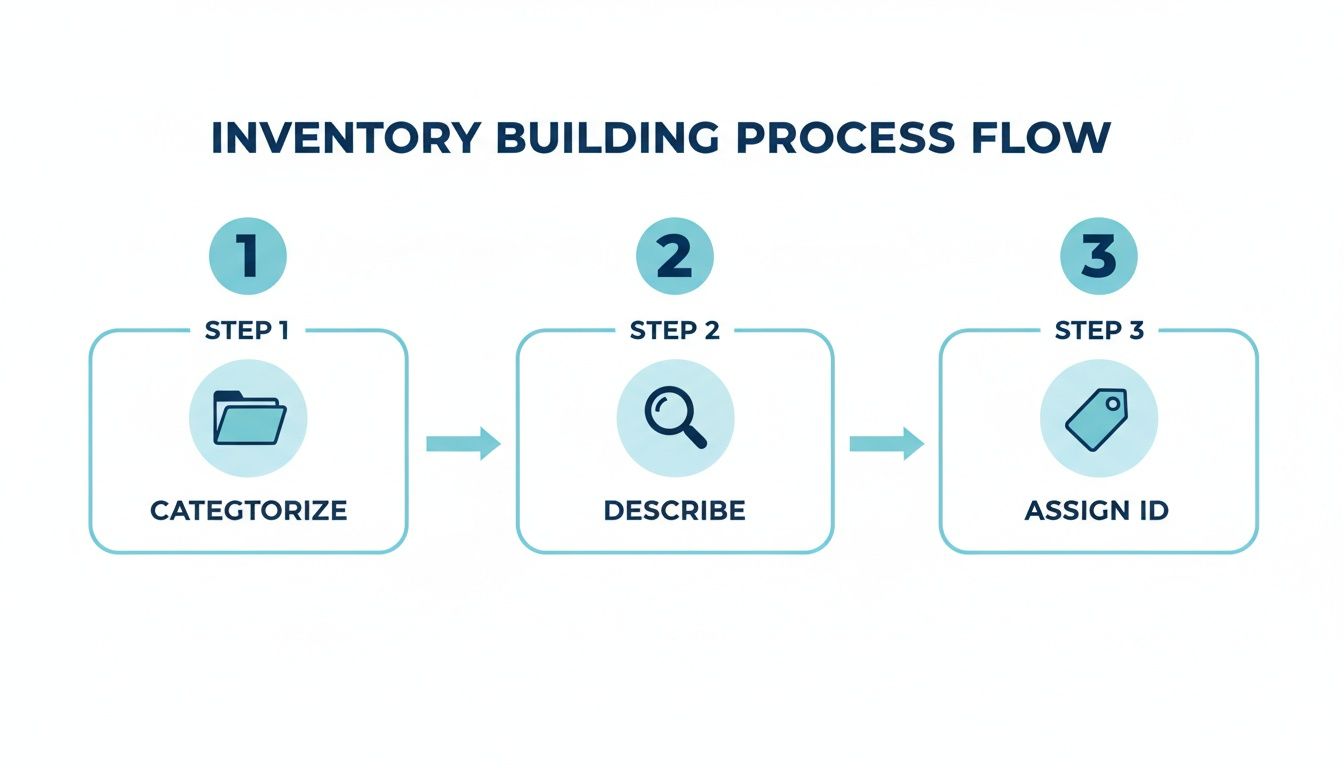
As you can see, a successful inventory isn't just one action but a sequence of organized steps. Each one builds on the last to create a flawless result.
From Simple to High-Tech Labeling
The most basic, and honestly, one of the most effective methods is to give each box a unique number that matches an entry on your inventory sheet. Grab a thick permanent marker and write that number boldly on at least two sides of the box. Trust me, you'll thank yourself later when they're stacked.
Beyond the box number, every label should have three key pieces of information:
- Destination Room: Write where the box needs to end up (e.g., "Kitchen," "Master Bedroom"). This lets movers work on autopilot without asking you for directions every five minutes.
- Content Summary: A quick, high-level list of what’s inside (e.g., "Pots & Pans," "Office Files") helps you find specific things without tearing open every box in a room.
- Handling Instructions: Don't skip the obvious warnings like FRAGILE, HEAVY, or THIS SIDE UP. Never assume movers will know a box needs special care.
If you want to get a bit more advanced, you can generate QR codes. Each code can link directly to a specific row in your digital spreadsheet. This means you can just scan a box with your phone and see a detailed list of its contents pop up.
No matter which method you choose, consistency is everything. Every box should be labeled in the same format and in the same spot (like the top-right corner). It makes scanning them visually so much faster.
Packing That Syncs with Your Inventory
Your packing strategy should directly support your inventory system. The smartest way to do this is to pack room by room, keeping similar items together. This is how you avoid that dreaded "mystery box" filled with a random assortment of stuff from the kitchen, bathroom, and office.
Here's the critical part: as you fill and seal each box, update your inventory spreadsheet with its assigned number immediately. Don't fall into the trap of telling yourself you'll do it later. That’s how items get lost in the shuffle.
By sealing a box and logging it in real-time, you create a secure, one-to-one link between the physical container and your digital record.
This disciplined approach ensures that by the time the last box is taped shut, your inventory is 100% complete and accurate. It's ready to be your most valuable tool on moving day. These principles are just as effective for long-term storage, too. For a deeper dive, check out our guide on the best way to label storage bins for organization that lasts.
Using Simple Tech to Your Advantage
A paper checklist is a classic, but let's be honest, it's pretty one-dimensional. With tech you already own, you can turn that static list into a powerful, dynamic tool that does way more than just track boxes. Think of it as making your inventory smarter, more accessible, and genuinely useful long after the truck pulls away.
The simplest first step? Move your list to a cloud-based spreadsheet. Seriously, tools like Google Sheets or Microsoft Excel Online are a total game-changer for a move.
This one switch means you can add an item from your phone while standing in the garage, at the same time your partner is checking off a box from their laptop upstairs. No more duplicate work, and everyone is always looking at the most current version of the plan.
Creating a Bulletproof Digital Record
Here's where a digital inventory really shines: you can bake photos and receipts right into your list. This is non-negotiable for high-value items, like electronics, antiques, or that custom piece of furniture. A quick snapshot is undeniable proof of its condition before the movers ever touched it.
Just snap a photo, pop it into a cloud folder, and paste the share link into a "Photo" column on your spreadsheet. You can do the exact same thing with digital receipts. Now you have an ironclad record for any potential insurance claim if something gets lost or, worse, damaged.
A digital inventory isn't just about convenience; it's about creating a verifiable, shareable record that protects your assets and holds your moving company accountable.
Making Your Inventory Searchable
Picture this: You’re standing in your new home, surrounded by a mountain of identical brown boxes. All you want is the coffee maker. Instead of tearing into boxes at random, you just pull out your phone.
With a digital list, a quick "Ctrl+F" search for "coffee maker" instantly tells you it’s in Box #12. That simple search just saved you a massive amount of time and a boatload of frustration.
This idea of making simple data searchable has huge implications. Businesses use inventory data to analyze sales trends and forecast future demand with up to 92% accuracy. While you’re not forecasting sales, you are using the same principle to turn a simple list into an organized, predictive tool for your own household.
Advanced Tech for Ultimate Organization
Feeling ambitious? QR codes are your next step. You can generate a unique QR code for each box that links directly to its entry in your spreadsheet. A quick scan with your phone’s camera reveals the box's entire contents without ever needing to slice the tape. If you've never made one, this practical guide on how to make a QR code will walk you through the surprisingly simple process.
For those who want to integrate this kind of smart tracking into their daily lives, it’s worth exploring how barcode scanning for inventory management can streamline organization long after the move is over.
By embracing these simple tech solutions, you turn a basic checklist into a sophisticated system that ensures a smooth, organized, and accountable move.
Putting Your Inventory to Work on Moving Day
All that meticulous work creating your moving inventory list is about to pay off. Big time. This is the moment your spreadsheet or app stops being a planning tool and becomes the master checklist for the entire operation. As the controlled chaos of moving day begins, your list is what brings order and accountability.

Your first job is to play gatekeeper. As boxes and furniture head for the truck, stand near the exit with your tablet or phone and check off each item. This simple act ensures nothing gets left behind and forces a cross-check with the movers' official paperwork (usually called a bill of lading).
The Unloading Check-In: Your Most Critical Role
The real test, however, happens at your new home. As the truck door rolls up and movers start unloading, your role is just as critical. Check off each box and item the moment it comes off the truck. This is your single best opportunity to spot problems right away.
This isn't just about counting boxes; it's a quick condition check. If a box labeled "FRAGILE" is rattling or another looks like it was used for target practice, make a note directly on your inventory immediately.
Your inventory is the ultimate scorecard for the move. Checking items off as they're loaded and unloaded provides a real-time audit of your belongings, making it easy to catch any issues the second they happen.
Handling Damage and Discrepancies on the Spot
So, what happens when box #42 is nowhere to be found, or your favorite armchair has a brand-new scratch? Don't panic. Your detailed inventory is your best friend. The second you spot an issue, here's what you do:
- Flag the Foreman: Politely but immediately point out the problem to the lead mover. Show them the entry on your inventory list and, if you have one, the "before" photo you took.
- Document Everything: Make a detailed note on your personal inventory and the mover’s official paperwork before you sign a single thing. Be specific. Don't write "table damaged"; write "Dining table has a new 3-inch scratch on the surface."
- Take New Photos: Snap clear pictures of any damage from multiple angles. This new evidence, combined with your original photos, builds an undeniable case for any potential claim.
This documentation is the absolute key to getting any insurance claim approved without a fight.
Your Unpacking Roadmap
Once the movers are gone and the dust settles, your inventory list takes on its final, most glorious role: it's your guide to unpacking. Instead of staring down a mountain of anonymous brown boxes, you have a clear plan of attack.
Desperate for coffee first thing in the morning? A quick search of your spreadsheet tells you the coffee maker is in Box #17, which you already made sure was placed in the kitchen. It’s a systematic approach that saves you from ripping open a dozen boxes just to find the mugs.
This kind of efficiency isn't just for moving. In the business world, automated inventory lists can boost a company's inventory turnover rate by an average of 27%. You can dig deeper into these inventory management insights on NetSuite.com. By using your list to unpack strategically, you’re applying the same principles of efficiency to reclaim your home and settle in faster.
Even with the best moving inventory template, you're going to hit a few snags. It's just part of the process. But getting tripped up by the small details now can lead to some major headaches later. Let's tackle the most common questions head-on so you can build a list that’s not just complete, but actually useful when the chaos of moving day hits.
Think of this as the expert advice you'd get from a seasoned mover, practical, no-nonsense answers to get the job done right.
How Detailed Do I Really Need to Be?
This is the big one, and the answer is surprisingly simple: for anything with real monetary or sentimental value, you can't be too specific. A vague entry like "Lamp" or "Chair" is next to useless if you have to file an insurance claim.
A good rule of thumb is to give each valuable item a unique fingerprint. Instead of just "TV," your entry should look more like this: "Sony 65-inch Bravia OLED TV, Model A80K." That level of detail leaves no room for debate about what you owned or its condition. The more specific you are, the stronger your proof becomes.
Your inventory isn't just a list; it's your personal insurance policy. The details you log for your high-value items are what will turn a potential claims nightmare into a straightforward process.
What's the Best Way to Handle Small Items?
Relax, you absolutely do not need to list every single fork, spoon, and paperclip. That's a one-way ticket to insanity and a list so long it becomes unusable. For all the small, low-value stuff, the trick is to group it logically.
- Group by function: Think "Kitchen Drawer - Silverware & Utensils" or "Desk Drawer - Writing Supplies."
- Group by container: Try "Bathroom Cabinet - Toiletries" or "Pantry Shelf - Canned Goods."
On your moving inventory list template, you'll just list the entire box as a single entry. For instance, "Box #21 – Kitchen – Pots & Pans." This keeps your inventory manageable while still giving you a solid idea of what's inside each box.
Should I Use a Digital or Paper List?
A paper list can feel tangible and reliable, but a digital spreadsheet (like Google Sheets or Excel) is almost always the smarter move. A digital list can’t get lost under a pile of boxes, you can update it from your phone in the middle of packing a room, and you can share it instantly with your partner or moving coordinator.
The real game-changer, though, is the ability to embed photos and links directly into a digital inventory. This creates an unshakeable visual record of your items' pre-move condition, which is priceless. If you still love the feeling of a physical copy, you can always print one out right before moving day to have on hand for quick check-offs.
Ready to transform your move from chaotic to controlled? The Vorby app takes the idea of a moving inventory and makes it intelligent. With AI-powered item recognition, instantly searchable lists, and seamless QR code integration, you can build a smarter inventory in a fraction of the time. Stop guessing where things are and start organizing with precision. Explore how Vorby can simplify your next move.