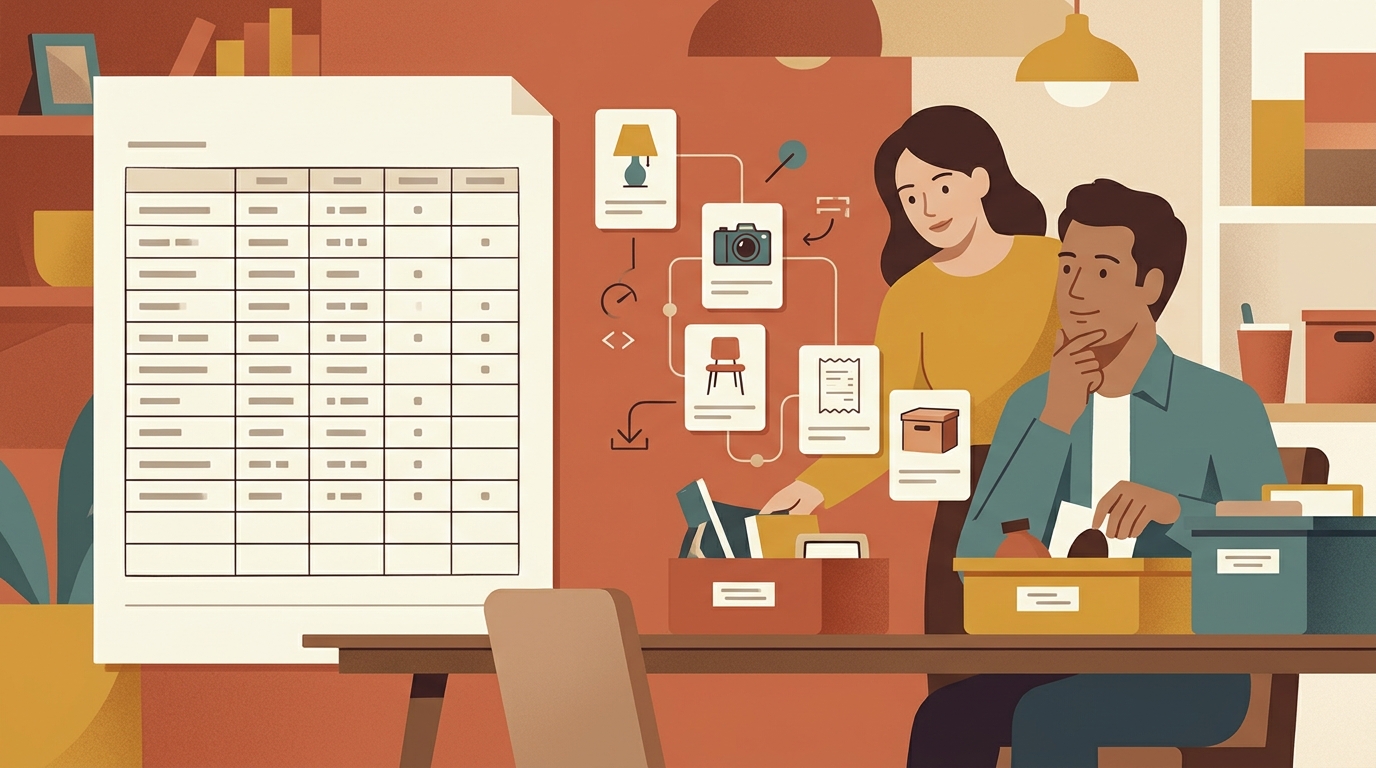
A multigenerational household inventory needs to answer a question that ordinary decluttering advice often skips: who owns what? When grandparents, parents, adult children, and younger kids share one address, the house can hold decades of possessions, several purchasing histories, inherited items, medical equipment, shared appliances, and belongings that are only there temporarily. Without a clear record, family members buy duplicates, lose receipts, overlook warranties, and argue about ownership when someone moves, downsizes, or settles an estate.
The challenge is not that the family owns too much. The challenge is that one physical home contains several personal inventories plus a shared household inventory. A good system respects both. It makes communal belongings easy to find while preserving each person's control over private, valuable, or sentimental property.
This guide shows how to build that system without turning the home into a warehouse or assigning one relative a permanent unpaid job as family archivist. You will define ownership, catalog the right level of detail, organize shared spaces, preserve purchase records, and create a maintenance routine that works across ages and technology comfort levels.
Why Multigenerational Homes Need a Different Inventory System
More households are combining generations
Multigenerational living is a major part of American housing, not an edge case. Pew Research Center found that 59.7 million Americans, or 18 percent of the population, lived in multigenerational households in 2021. That was more than four times the 1971 total. Pew uses a broad definition that includes two or more adult generations or a skipped-generation household.
The U.S. Census Bureau uses a narrower three-or-more-generation measure in its 2020 household brief. Under that definition, about 6 million households were multigenerational, representing 4.7 percent of all households and 7.2 percent of family households. The numbers are different because the definitions are different, but both sources show that millions of homes contain overlapping generations and overlapping property. Statista's historical series, based on Pew data, also shows the long rise in the share of Americans living in multigenerational households through 2016.
Housing decisions continue to reflect the trend. The National Association of Realtors reported that 14 percent of recent buyers purchased a multigenerational home in its 2025 Profile of Home Buyers and Sellers. Adult children moving back was the primary reason for 27 percent of those buyers. A move that begins as a practical family decision can quickly bring another apartment's worth of furniture, cookware, tools, electronics, and records through the door.
The ownership problem hides inside ordinary clutter
A crowded shelf can look like a storage problem when it is actually an information problem. Three slow cookers might belong to three different people. The power drill in the garage might be a shared purchase, a loan from an uncle, or a grandparent's tool that nobody should donate. The china in a kitchen cabinet may look unused, yet carry a family history that makes it irreplaceable.
That ambiguity raises the cost of everyday decisions. Nobody knows whether an item can be moved, borrowed, discarded, insured, replaced, or claimed. Family members delay decisions because they do not want to offend anyone. The result is accumulation without stewardship.
In a multigenerational home, clutter is often ownership information that never got written down.
The system must serve different abilities and priorities
One person may happily scan barcodes and upload receipts. Another may prefer a printed list. A child needs simple labels and consistent storage spots. An older adult may need larger text, fewer steps, and a trusted family member who can help without taking over. A useful household system accommodates these differences rather than demanding that everyone become equally enthusiastic about inventory management.
Start with one shared source of truth, then allow several ways to interact with it. A digital inventory can coexist with printed emergency summaries, labeled bins, and a folder for original documents. What matters is that all of those pieces use the same ownership terms, room names, and item categories.
Define Ownership Before You Start Organizing
Use four ownership categories
Every recorded item should fit one of four categories. Keeping the categories simple makes them usable during a fast room-by-room pass.
- Personal: Owned and controlled by one household member, even if others sometimes use it.
- Shared: Purchased, inherited, or explicitly designated for household use, with no single person expected to take it automatically.
- Loaned: Physically in the home but owned by someone outside it, or temporarily provided by one resident to another.
- Undecided: Ownership is unclear and requires a family conversation, receipt search, or estate document review.
Do not force a decision just to finish the list. An honest "undecided" label is safer than a confident mistake. Create a short review queue and resolve those items separately, especially when inheritance, divorce, trusts, or other legal interests may be involved. An inventory records family understanding; it does not replace a will, trust, title, or legal agreement.
Assign a responsible contact without changing ownership
Ownership and responsibility are not the same. Grandma may own the sewing machine while an adult grandchild maintains it. The household may own the refrigerator while one person keeps the warranty and schedules repairs. Add a responsible contact for items that require maintenance, subscription renewal, storage decisions, or specialized knowledge.
This distinction prevents a familiar failure: the person who enters an item into the system gradually becomes treated as its owner, cleaner, repair coordinator, and decision-maker. Record those roles explicitly. For a shared generator, for example, the household might be the owner, one adult the maintenance contact, and another the person who knows where the fuel and manual are stored.
Agree on privacy boundaries
A shared home does not require a fully shared catalog. Decide which details everyone can see, which are limited to selected adults, and which stay private. General records for furniture, tools, appliances, and shared supplies can usually be household-visible. Jewelry values, financial documents, medication records, collectible appraisals, and personal keepsakes may need restricted access.
Keep the inventory focused on belongings. Do not attach sensitive identity documents, account passwords, complete payment card information, or medical records to a general household catalog. The system should help relatives find the locked document box, not expose every document inside it. If a family member needs emergency access, document the access process separately and tell the appropriate people where it is kept.
Build the Inventory Room by Room
Begin with a fast visual capture
Do not start by typing a perfect description of every fork. Walk through the home one room at a time and create a visual baseline. Take wide photos of each wall, open important cabinets and closets, and capture storage areas such as the garage, attic, basement, shed, and off-site storage unit. Narrated video can be useful for a quick first pass, and this home inventory video guide explains how to film rooms and important details systematically.
Give every room one stable name. "Mom's room," "guest room," and "back bedroom" may all refer to the same place, which makes search and maintenance confusing. Pick one label, such as "first-floor bedroom," then use it on digital records, boxes, shelves, and printed lists.
Visual capture creates momentum and preserves context, but it should not be the final product. A video can show that a television existed, yet fail to reveal its model, serial number, owner, purchase price, or receipt. Use the footage as the map for a more selective itemized inventory.
Itemize what is valuable, disputed, or easy to confuse
Create individual records for belongings that are expensive, sentimental, covered by warranties, frequently borrowed, similar to another person's property, or likely to matter during a move or insurance claim. Useful fields include:
- Item name and category: Use plain language the family would actually search.
- Owner and responsible contact: Choose from the agreed categories and household members.
- Location: Record the room plus a specific cabinet, shelf, bin, or zone when helpful.
- Photo: Include the full item and identifying marks.
- Make, model, and serial number: Especially for appliances, electronics, tools, mobility equipment, and bicycles.
- Purchase or acquisition details: Date, retailer, price, giver, or inherited-from note.
- Documents: Receipt, warranty, appraisal, manual, or repair history.
- Status: In use, stored, loaned out, needs repair, donate, sell, or undecided.
Group ordinary low-value items where individual records would add work but little clarity. "Twelve everyday dinner plates, shared, kitchen cabinet 3" is usually enough. The Insurance Information Institute similarly recommends counting clothing by general category while making special note of valuable pieces.
Use a tool the household can maintain
A spreadsheet is inexpensive and excellent for sorting, filtering, and exports. A flexible database can add linked pages and custom views. A dedicated home inventory tool can make photo capture, room organization, and search easier. The practical tradeoffs are covered in Notion versus a spreadsheet for household inventory.
For a large family, ease of contribution matters as much as database power. Test the system with three actions: add a purchase, find a borrowed item, and update a room after something moves. If those actions require a tutorial every time, the system is too complicated.
Give one or two people administrative responsibility, but let other adults contribute records and corrections. Children can help photograph books, games, or sports equipment, while an adult confirms ownership and values. That turns inventory work into a shared household practice instead of a secret project maintained by one person.
Organize Shared Spaces Around Access and Ownership
Create physical zones that match the inventory
The digital record and the physical home should describe the same system. Divide busy shared spaces into zones based on use, not on whoever happened to fill the shelf first. A garage might have zones for household tools, garden equipment, car care, seasonal decorations, and each adult's personal storage. A kitchen might separate everyday shared cookware from special-occasion pieces and medically necessary supplies.
Use labels that answer two questions at a glance: what is here, and who controls it? "Shared baking," "David personal tools," and "Family keepsakes, ask Carol" are more useful than "miscellaneous." Avoid labels based only on age, such as "old stuff," which can feel dismissive and say nothing about ownership.
Keep frequently used shared items in the easiest-to-reach positions. Personal collections and archival belongings can occupy defined lower-frequency zones. Safety takes priority over perfect space efficiency, particularly when children, older adults, or people with limited mobility share the home. Store medication, chemicals, firearms, sharp tools, and heavy objects according to appropriate safety guidance, not merely where they fit.
Label containers with durable identifiers
A bin label should remain useful when the contents change. Numbered or QR-coded containers can link a physical box to a current digital list, while the visible text tells people the category and owner. For example, "B-014, holiday decorations, shared" works better than a long handwritten list that becomes wrong after one season.
Photograph the open container before closing it, record its storage location, and list only the notable contents. Nobody needs to catalog every ornament, but the family should know which bin contains the heirloom tree topper, who owns it, and whether it needs special handling.
When someone removes an item from deep storage, update the record or use a simple checkout location such as "with Maya" or "loaned to neighbor." The goal is not surveillance. It is eliminating the household scavenger hunt that begins when several people remember seeing an object but nobody remembers where it went.
Prevent duplicates without policing purchases
Before buying a household item, search the shared inventory and check the relevant zone. This small habit is especially valuable for tools, serving dishes, cables, seasonal gear, cleaning machines, and bulk supplies. The record should make a purchase easier, not create a permission process for every family member.
Track quantity and reorder thresholds only for products where duplication creates waste or shortage causes trouble. Toilet paper, filters, batteries, light bulbs, mobility-device supplies, and emergency goods may deserve counts. Ordinary groceries are usually better handled by a shopping list. Inventory management works when it focuses attention on durable belongings and consequential supplies, not every object that passes through the front door.
Connect Receipts, Warranties, Insurance, and Family History
Preserve proof of ownership and value
An inventory becomes far more useful when it connects an item to evidence. The Insurance Information Institute, also known as Triple-I, recommends recording basic item details, purchase information, make and model, serial numbers, photos, receipts, contracts, and appraisals. It also recommends keeping backups somewhere safe and accessible after a fire, theft, or other destructive event.
Photograph or scan receipts before thermal paper fades. Name the file with the item, date, and retailer, then attach it to the inventory record or store a link. Keep original appraisals, titles, and documents with legal significance in appropriate secure storage. For a step-by-step insurance-focused workflow, use this guide to creating a digital home inventory.
Insurance coverage can become complicated when several adults under one roof own valuable property. Policies, insured people, exclusions, and limits vary. Use the inventory to calculate what each person and the household own, then ask a licensed insurance professional how the applicable homeowners or renters policies treat residents, relatives, business property, collections, and items stored away from home.
Track warranties and maintenance by item
Shared appliances often have shared use but invisible paperwork. Record the warranty period, receipt, model, serial number, installation date, maintenance schedule, and service history. Assign one responsible contact and add reminders for filters, inspections, registrations, or warranty deadlines.
This record helps when two relatives remember the purchase differently. Instead of searching email inboxes and kitchen drawers while the freezer warms up, the family can open the item record and find the retailer, date, protection plan, and repair notes. It also keeps a new resident from discarding a part or manual that belongs to equipment already installed in the home.
Record stories without confusing them with value
Some possessions matter because of provenance, not replacement cost. Add a short note explaining who made, used, or passed down an heirloom. Include names, approximate dates, relationships, and handling wishes. A two-sentence story can stop a meaningful item from being donated because nobody recognized it.
Do not assume sentimental history establishes legal ownership. If a family expects conflict or an item has substantial financial value, encourage the owner to address it through appropriate estate planning documents. The inventory can preserve the photograph, story, location, and stated preference, while the legal document governs the transfer.
Historical context also makes downsizing more thoughtful. Relatives can distinguish objects that carry a specific family story from objects kept only because nobody felt authorized to decide. That creates room for respectful conversations while the people who know the stories can still participate.
Keep the System Current Through Household Changes
Use small triggers instead of giant annual projects
The easiest inventory to maintain is one updated at moments that already demand attention. Add or revise a record when someone buys a major item, receives a valuable gift, moves into the home, moves out, borrows something long term, completes a repair, changes rooms, or puts a box into storage. Capture the details while the receipt and context are available.
Set a short quarterly review for shared property and one deeper annual check. The quarterly pass can clear the undecided queue, confirm loaned items, and update recent purchases. The annual review can verify insurance totals, photograph changed rooms, test emergency equipment, and identify items ready for repair, sale, donation, or family distribution.
Keep the meeting focused on the system, not on judging anyone's possessions. Review missing information and shared-space decisions first. Personal decluttering should remain voluntary unless an item creates a safety, sanitation, access, or agreed space problem.
Create move-in and move-out snapshots
When an adult child returns, a parent moves in, or another relative joins the home, document what arrives before it disappears into closets. Record personal furniture, electronics, boxes, vehicles, equipment, and valuables, plus any existing damage. The same method used in a roommate move-in inventory adapts well to relatives because it separates ownership from memory.
At move-out, filter the inventory by owner and review shared purchases separately. Decide whether jointly acquired items stay, travel, get bought out, or are sold. Mark transferred records with a date rather than simply deleting them. A history is helpful if a receipt, warranty, tax question, or family disagreement surfaces later.
Plan for emergencies and incapacity
A system is only useful if the right people can reach it. Keep a backup outside the home or in secure online storage, as Triple-I advises. Document who can access the account, where printed emergency summaries are kept, and how a trusted person can obtain information if the usual administrator is unavailable.
Create a concise emergency view for critical household assets and supplies. It might include shutoff tools, fire extinguishers, backup power equipment, mobility devices, insurance contacts, pet carriers, and the location of important document storage. Do not put passwords or sensitive medical details on an openly posted sheet.
Choose at least one backup administrator from a different generation. Teach that person how to export the inventory and locate attached records. This protects the household from a system that works beautifully until the only person who understands it is traveling, hospitalized, or no longer able to manage it.
Frequently Asked Questions
What should be included in a multigenerational household inventory?
Include valuable, sentimental, warrantied, frequently borrowed, easily confused, and shared items. Record the owner, location, photo, identifying details, purchase evidence, responsible contact, and current status.
How do we inventory belongings when ownership is unclear?
Mark the item as undecided, photograph it, record what each person remembers, and resolve it in a separate family review. Do not guess, discard the item, or treat an inventory entry as a substitute for legal ownership documents.
Should every family member have access to the entire inventory?
No. Give household members access to shared records while restricting sensitive values, documents, and private collections to the people who need them. Make emergency access deliberate rather than making everything public.
Is a spreadsheet enough for a large family inventory?
Yes, if family members can add, find, filter, back up, and export records reliably. Move to a dedicated system when photos, permissions, mobile capture, reminders, or container labels become difficult to manage.
How often should a multigenerational home inventory be updated?
Update it whenever major belongings enter, leave, move, or receive repairs. Add a short quarterly review and a deeper annual check for shared property, insurance evidence, backups, and unresolved ownership.
Shared homes run better when every generation can find what belongs to them and understand what belongs to everyone. Build your family's searchable household record with Vorby, then keep it current one item and one room at a time.