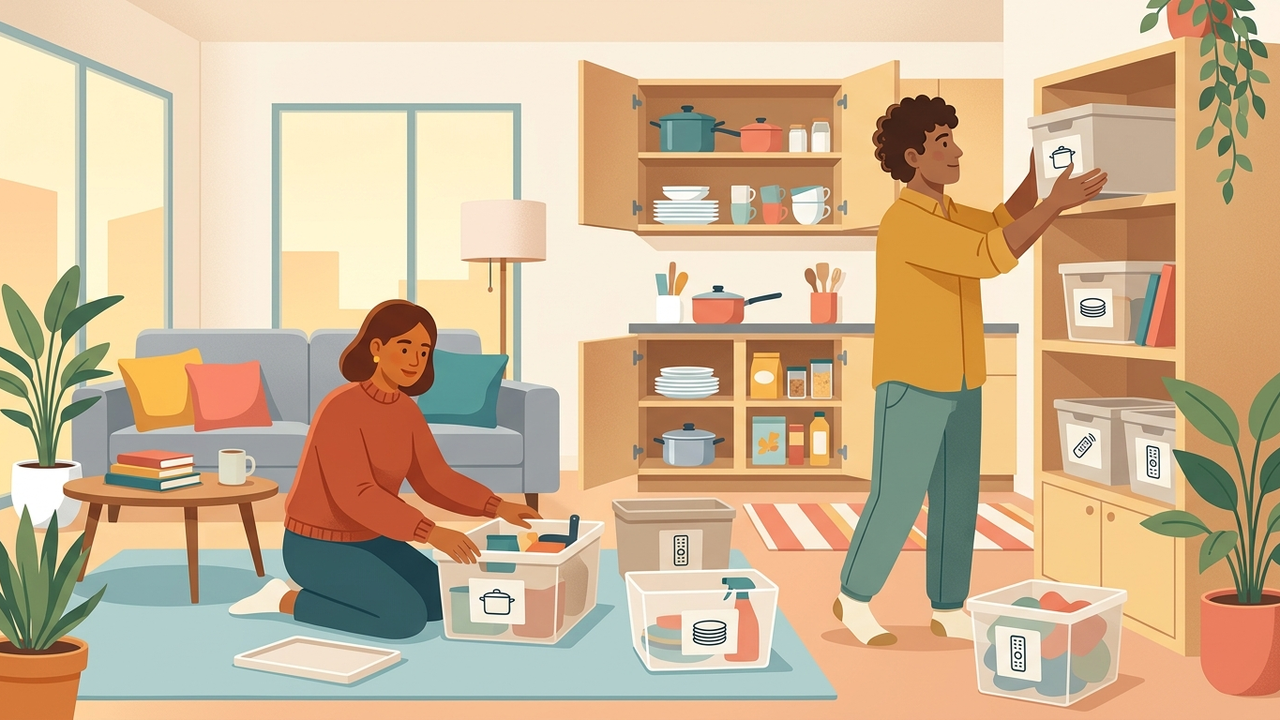
A roommate move-in inventory is a shared record of what each person brought into the home, what the household owns together, and what condition the rental and its included fixtures were in on day one. It prevents a familiar argument months later: “I bought that,” “No, we split it,” or “That scratch was already here.” The best time to settle those facts is before routines blur memories and receipts disappear.
This is not about labeling every fork or treating your roommates like opposing attorneys. It is about creating enough clarity that ordinary transitions, including a replacement roommate, a breakup, a move, an insurance claim, or a security deposit discussion, do not turn into a forensic investigation. A useful inventory takes a focused afternoon to start and a few minutes to maintain.
Why a Roommate Move-In Inventory Matters
Shared homes create more ownership gray areas
Roommates often combine three kinds of property under one roof. There are personal belongings, such as a bedroom television or a set of cookware one person already owned. There are individually purchased items used by everyone, such as a sofa that belongs to one roommate but sits in the living room. Then there are genuinely shared purchases, such as a dining table bought with equal contributions. All three can look communal after a year of daily use.
Shared living is not a fringe arrangement. The U.S. Census Bureau reported that there were 25.5 million shared households in 2019, representing 19.8 percent of U.S. households, and 81.2 million adults lived in them. The Census definition includes homes with an additional adult beyond the householder and their spouse or partner, including roommates. The Census Bureau’s shared-household analysis also found that 38.4 percent of adults ages 25 to 34 lived in a shared household that year.
Pew Research Center similarly found that 79 million adults, or 31.9 percent of the adult population, lived in a shared household in 2017. Pew’s research on shared living explicitly identifies roommates as one form of the arrangement. When millions of adults pool space and resources, ownership clarity becomes basic household infrastructure.
Memory is weak evidence after months of shared use
At move-in, everyone remembers that Maya brought the floor lamp, Chris supplied the microwave, and Sam paid for the vacuum. Sixteen months later, the lamp has moved rooms, the microwave has been replaced, and somebody reimbursed somebody for part of the vacuum. Memory now contains a mixture of facts, assumptions, and old payment notifications.
A dated photo and a short ownership note are stronger than competing recollections. The inventory does not need to prove every fact to a courtroom standard. Its first job is to help reasonable people reconstruct what happened without escalating a practical disagreement into a personal conflict.
Possessions and property condition are separate records
A roommate inventory tracks who owns the movable things inside the home. A move-in condition report tracks the state of the rental itself, including walls, floors, doors, appliances, fixtures, and existing damage. You need both. Combining them into one organized move-in process is efficient, but keep the categories distinct so nobody mistakes a landlord-owned refrigerator for a roommate-owned appliance.
HUD’s sample guidance says a move-in inspection should document the status of the unit, appliances, and fixtures, along with unfinished work and the signatures of the inspector and resident. HUD’s move-in inspection guidance is designed for housing management, but the principle transfers well: record conditions while everyone can see and agree on them.
The inventory is not a prediction that roommates will fight. It is an agreement that nobody should have to rely on memory if they do.
What to Record on Move-In Day
Start with high-value and high-confusion items
Do not begin by counting teaspoons. Start with belongings that are expensive, shared frequently, easy to confuse, or likely to stay in a common area. Furniture, electronics, kitchen appliances, tools, sporting equipment, decor, musical instruments, gaming systems, and cleaning equipment deserve attention first.
For each item, record:
- Item name: Use a description specific enough to identify it, such as “walnut six-drawer dresser” rather than “dresser.”
- Owner: Name the individual owner, all co-owners, or the household if everyone has explicitly agreed that it is communal.
- Location: Note the starting room and update it if the item moves permanently.
- Acquisition details: Add the purchase date, retailer, approximate price, and who paid.
- Identifiers: Include brand, model, serial number, color, size, or another distinguishing detail.
- Evidence: Attach a clear photo and, when available, a receipt, order confirmation, warranty, or payment record.
- Condition: Note visible wear, missing parts, stains, chips, scratches, or damage.
- Exit plan: For shared purchases, state what happens when someone moves out.
The National Association of Insurance Commissioners recommends recording brand, price, purchase date, model, serial number, receipts, and photographs in a home inventory. NAIC’s consumer guidance is written for insurance readiness, yet those same details are exactly what distinguish one roommate’s television, bicycle, or stand mixer from another person’s property.
Separate private, shared-use, and jointly owned property
Use ownership labels that describe the arrangement rather than the room. “In the living room” does not mean “owned by the household.” A simple three-part system works well:
- Personal: One roommate owns the item and can take it when leaving, even if everyone uses it.
- Shared-use: One roommate owns the item and has agreed that others may use it under normal household rules.
- Jointly owned: Two or more roommates contributed money or explicitly accepted co-ownership.
This distinction solves the most common misunderstanding in shared apartments. Access is not ownership. If Jordan puts a personal blender in the kitchen for everyone to use, generous access does not transfer title to the household. Recording it as “Jordan, personal, shared use permitted” preserves both the practical arrangement and the ownership fact.
Include the unglamorous household items
Disputes are not limited to expensive objects. A departing roommate may have supplied the shower curtain, entry rug, router, surge protectors, trash cans, shelving, extension cords, basic tool kit, vacuum, mop, storage bins, and half the kitchen utensils. Removing all of them at once can leave the remaining household scrambling.
Record these items in sensible groups when individual detail adds little value. “Kitchen utensils, approximately 25 pieces, owned by Priya” is useful. Twenty-five separate entries are not. If you want a broader structure for capturing belongings without turning the process into a spreadsheet marathon, use the room-by-room method in Vorby’s guide to creating a digital home inventory.
How to Build the Inventory Without Derailing Move-In
Schedule one walkthrough before the home gets crowded
The ideal window is after the major belongings arrive but before boxes are fully unpacked and mixed together. Set aside 45 to 90 minutes, open the same shared record on everyone’s phone, and walk through the home in a fixed order. Start at the entrance, move clockwise through common areas, then cover private rooms only with each occupant’s permission.
One person can photograph while another enters details. Say the item and owner aloud before taking each photo. That creates a quick verbal check and helps prevent mistakes. If someone is absent, mark questionable entries as pending rather than assigning ownership by guesswork.
For the rental condition record, take wide photos of every room and close-ups of existing damage. Capture floors, walls, ceilings, doors, windows, counters, sinks, tubs, toilets, built-in appliances, smoke detectors, and supplied furniture. Include a photo that shows the meter reading if utilities require one. Send required condition notes to the landlord or property manager through the method specified in the lease.
Use a minimum viable record, then improve it
A complete inventory is helpful, but an unfinished inventory that covers the expensive and disputed items is more useful than a perfect system nobody launches. Triple-I, the Insurance Information Institute, makes the same practical point in its home inventory guidance: start with a contained area, recent purchases, or another easy category, and keep going even if the first version is incomplete.
Use this priority order:
- First: High-value personal property and everything jointly purchased.
- Second: Items in common rooms that belong to one person.
- Third: Landlord-owned appliances, fixtures, keys, and existing damage.
- Fourth: Grouped everyday belongings and low-cost household supplies.
If move-in day is chaotic, photograph each room and record the major items. Schedule a 20-minute follow-up within the first week to add receipts, serial numbers, and shared-purchase terms. Put that follow-up on the household calendar before everyone scatters into normal life.
Get acknowledgment without making it awkward
The record becomes much stronger when every roommate can review it. Send a shared link and ask each person to confirm their own property, the household’s joint purchases, and any notes that mention them. A simple written message such as “I reviewed the move-in inventory and the ownership notes look accurate” creates a dated acknowledgment.
Do not hide the inventory in one roommate’s private account. Everyone should have practical access to the shared portion and a way to export or retain a copy. Keep sensitive documents, including full financial account numbers, identity records, and unrelated private receipts, out of a household-wide record.
If you want a purpose-built structure rather than a generic document, review Vorby’s comparison of the best home inventory apps for roommates. The deciding factor should be whether every roommate can understand the record and retrieve it later, not how many decorative templates the tool offers.
How to Handle Shared Purchases and Reimbursements
Record contributions at the moment of purchase
Joint ownership needs more than a photo of the item. Record the total price, each person’s contribution, purchase date, receipt, warranty holder, and agreed ownership shares. Equal payment can mean equal ownership, but do not assume that it always does. One roommate might contribute less because another person intends to keep the item after the lease ends.
A clean entry might read: “Living room sofa, $900 total. Lee paid $600 and Morgan paid $300. Lee owns the sofa. Morgan’s $300 is a nonrefundable household contribution in exchange for use through the current lease.” Another might read: “Dining table, $480 total. Four roommates paid $120 each and own equal 25 percent shares.” Both are valid because the agreement is explicit.
Save the receipt with the entry, then note reimbursements when they clear. A payment request is not proof that payment happened. If one person fronts the purchase, leave the contribution status pending until the other transfers arrive.
Choose an exit rule before anyone leaves
Every jointly owned durable item needs a separation rule. Pick one of these before the purchase becomes emotionally or financially complicated:
- Designated owner: One person keeps the item and others contribute for use rather than ownership.
- Buyout: One roommate may buy the others’ shares using a stated valuation method.
- Sale and split: The household sells the item and divides net proceeds according to ownership shares.
- Rotation or choice order: Roommates take turns selecting jointly owned items when the household separates, with value balancing if needed.
- Household transfer: The item stays with the apartment or continuing household, and the departing owner receives an agreed payment.
For a buyout, decide whether value means original price, current resale value, or a simple depreciation schedule. Current local resale value is often the fairest for ordinary furniture and electronics because it reflects what the group could realistically recover by selling. Whatever method you choose, write it down while everyone still expects the arrangement to work.
Keep consumables out of the ownership ledger
Toilet paper, dish soap, trash bags, pantry staples, and cleaning products usually do not belong in a possession inventory. Track them through a shared-expense or restocking system instead. Mixing consumables with durable property creates clutter and makes the important ownership records harder to find.
There are exceptions. Bulk supplies purchased for a specific event, an unopened case of expensive specialty products, or a large prepaid fuel delivery may warrant a note. Use common sense: if the item will be used up during ordinary household life, treat it as an expense; if it retains meaningful value and can leave with someone, treat it as property.
Build Evidence That Works Beyond Roommate Disputes
Photograph context, details, and condition
One photograph rarely answers every question. Take a wide shot that establishes where the item was at move-in, a closer shot that clearly identifies it, and a detail shot for the serial number or existing damage. Keep original files when possible because their metadata may preserve dates, although you should not rely on metadata alone.
For grouped property, photograph the full group. Open cabinets and closets where appropriate. For valuable items, add multiple angles and any certificates, appraisals, or distinctive marks. Triple-I advises recording serial numbers, retaining proof of value, and backing up the inventory away from the home. That last step matters because an inventory stored only on a device inside the apartment can disappear in the same theft, fire, or water loss as the belongings it documents.
Connect receipts without exposing private information
Receipts and order confirmations establish purchase date, seller, model, and price. Before sharing them, crop or redact unrelated purchases, loyalty account identifiers, partial card information, home addresses from prior residences, and other details roommates do not need. Preserve an unredacted private copy for insurance or warranty use.
The Insurance Information Institute says an up-to-date inventory can make an insurance claim easier and help determine the amount of coverage needed. Its 2023 consumer survey found that only 47 percent of homeowners said they had prepared an inventory to document losses. Triple-I’s homeowners and renters insurance statistics show how many households still lack this basic record.
Roommates should also understand that one person’s renters insurance policy may not protect every unrelated roommate’s possessions. Coverage depends on the policy and who is insured. Each person should review their own policy or ask their insurer directly. Vorby’s renters guide to home inventory protection explains how a possession record supports insurance preparation without confusing the inventory itself with insurance coverage.
Document the rental separately for deposit protection
Your landlord condition report should include every preexisting defect you can reasonably observe: nail holes, scuffs, stains, cracked tiles, loose handles, damaged blinds, appliance issues, worn carpet, chipped counters, mold concerns, and missing fixtures. Use neutral descriptions. “Two-inch scratch on living room floor beside balcony door” is stronger than “floor looks bad.”
Follow the lease and local rules for submitting the report. Some properties provide a form or deadline. Keep proof of delivery and the landlord’s response. At move-out, repeat the same camera path and angles. Matching before-and-after evidence makes it easier to separate new damage from ordinary wear or a condition that already existed.
This rental record is not a substitute for learning the law where you live. Security deposit requirements differ by state and city. The practical principle remains consistent: timely, dated, specific documentation is easier to use than a folder of random pictures taken after a disagreement begins.
Maintain the Record Through Move-Out
Update after purchases, damage, and roommate changes
An inventory becomes stale when new items arrive and old ones leave without a note. Use a lightweight update rule: add any durable shared purchase immediately, review the common areas every three months, and conduct a formal review whenever a roommate joins or leaves.
Record repairs and replacements too. If the jointly owned television fails and one roommate buys the replacement alone, the ownership arrangement has changed. Archive the old entry, attach the disposal or sale note, and create a new record. If a roommate damages another person’s item and pays for repair, attach the invoice and mark the issue resolved rather than deleting the history.
Keep household logistics connected. An inventory tells you who owns the vacuum; a cleaning plan tells you who uses it and when. Vorby’s roommate cleaning schedule template offers a practical companion system for dividing recurring work without confusing chores with ownership.
Run a checkout review before the moving truck arrives
Schedule the roommate checkout one or two weeks before move-out, not while friends are carrying boxes down the stairs. Filter the inventory by owner and jointly owned status. Confirm which items the departing roommate will take, sell, donate, leave, or transfer. Resolve shared-item buyouts in writing and complete payments before handing over property when possible.
Walk through common rooms together. Check storage areas, garages, balconies, basements, and utility closets, where forgotten tools and seasonal items often live. Photograph any transfer of a valuable item and update the record with the date. Return keys, access cards, parking permits, and landlord-owned equipment through a separate checkout list.
Archive the final record
Once everyone agrees that move-out is complete, export a dated copy that cannot be quietly rewritten. Each former roommate should retain the parts relevant to their property, shared transactions, and rental condition. Keep receipts and insurance-supporting records for as long as they remain useful for coverage, warranty, tax, or claim purposes.
Do not use the archive as a permanent collection of everyone’s personal data. Remove expired access links and limit continuing access to what former roommates reasonably need. A clean archive closes the arrangement with the same clarity that started it.
Roommate Move-In Inventory FAQ
What should be included in a roommate move-in inventory?
Include high-value belongings, items kept in common areas, jointly purchased property, landlord-owned furnishings, receipts, photos, ownership labels, condition notes, and exit terms for shared purchases. Group low-cost items when separate entries would add little value.
Should every roommate sign the inventory?
A formal signature is helpful but not always necessary for a practical household record. At minimum, give every roommate access and ask each person to confirm in writing that the ownership and condition notes are accurate.
Is a roommate inventory legally binding?
Its legal effect depends on the facts and the law where you live. Treat it as clear contemporaneous evidence of the household’s agreement, and consult a qualified local attorney if a valuable dispute requires legal advice.
How do roommates divide jointly owned furniture at move-out?
Follow the exit rule recorded when the furniture was purchased. Common options are a buyout at current resale value, a sale with proceeds divided by ownership share, or an agreed transfer to the continuing household.
What is the difference between a roommate inventory and a move-in inspection?
A roommate inventory records possessions and ownership. A move-in inspection records the rental’s condition and included fixtures for the tenant and landlord; complete both during the same walkthrough, but keep their purposes clear.
Shared homes run better when ownership is visible from the beginning. Use Vorby to create a clear household inventory, then keep it current whenever belongings or roommates change.