Think about your home for a second. It’s not just a building; it’s a personal warehouse full of stuff you own. Some of it is valuable, like your laptop or that antique dresser from your grandmother. Some of it is everyday stuff you burn through, like coffee, batteries, and paper towels.
Asset and inventory management is simply the practice of keeping track of both categories: your valuable items (assets) and your everyday consumables (inventory). It's about creating a clear, simple record of what you own so you can manage your belongings for financial planning, insurance claims, and just day-to-day sanity.
What Is Household Asset and Inventory Management?

Imagine your home as a small business, specifically your business. Like any company, you have things that hold long-term value and other things you use up and have to restock. Getting a handle on the difference between the two is the first step. This isn't just about tidying up; it's about creating a smart system that brings real financial and organizational benefits.
Here’s a simple way to think about it: the 65-inch TV you bought last year is an asset. The batteries for its remote? That's inventory. One is a long-term possession you'd want to track for insurance or to calculate your net worth. The other is a consumable you need to monitor so you don't find yourself frantically searching for AAs in the middle of movie night.
This basic distinction is the key to managing your household stuff effectively.
Assets vs. Inventory: What's the Difference?
The heart of this whole concept is splitting your belongings into two buckets. Figuring out which items go where helps you prioritize what to track and why.
- Assets are the durable, high-value things you own. You don’t replace them often, and they usually have significant financial or sentimental worth. Think electronics, furniture, jewelry, major appliances, and valuable collectibles.
- Inventory covers all the consumable or disposable stuff you use regularly. These are the items on your recurring shopping list, like pantry staples, cleaning supplies, toiletries, and light bulbs.
By keeping a clear record of both, you gain total control over everything you own. This big-picture view is a game-changer for insurance claims, budgeting, and just making daily life a little less chaotic. While we're talking about home use here, many of the same principles of inventory management for small businesses apply, proving just how valuable a systematic approach can be.
A well-organized home inventory isn't just about knowing where your keys are. It's about understanding what you have, what it’s worth, and how it all fits into your financial life. This single record can save you thousands in a disaster and streamline countless household headaches.
Moving Beyond Simple Decluttering
Decluttering is great; it creates physical space and feels therapeutic. But asset and inventory management is the next level. It builds financial and organizational clarity.
It’s not a one-and-done weekend project; it’s an active, ongoing process. The goal isn't just to get rid of stuff, but to create a living document of your possessions that grows and changes right along with your life.
This system gives you a snapshot of your household’s value at any given moment. That knowledge empowers you to make smarter decisions, whether you're setting a budget, getting ready for a big move, or (worst-case scenario) filing an insurance claim after a fire or flood. It’s the foundation for managing your personal property like a pro.
Why Managing Home Assets Is a Financial Game Changer
Think of your home not just as a place to live, but as a financial command center. Setting up a system for your asset and inventory management is less about tidying up and more about gaining a powerful financial advantage. It's a safety net, an efficiency booster, and a clear path toward your goals. That initial effort pays off big time, completely changing how you handle everything from unexpected disasters to long-term planning.
This proactive approach gives you four huge advantages that can seriously impact your financial well-being. By knowing exactly what you own, you take control of your personal balance sheet, making you more resilient and ready for whatever life throws at you. Let's break down how this is a true financial game changer.
Maximize Your Insurance Claims
Imagine the worst happens: a fire, a flood, a theft. Amid the chaos, your insurance company will ask for a "proof of loss," a detailed list of every single item lost or damaged, complete with its value. Trying to pull that list from memory during such a stressful time is nearly impossible. It almost always leads to forgotten items and, ultimately, a smaller payout.
A well-kept home inventory flips this script entirely. Instead of struggling to recall every book, gadget, and piece of furniture, you simply provide a comprehensive report packed with photos, receipts, and serial numbers. This solid documentation makes the claims process faster, smoother, and far more likely to end in a fair settlement that actually covers what you lost. You can learn more about how a home inventory for insurance can protect you financially.
A detailed asset list is your most powerful tool in an insurance negotiation. It shifts the burden of proof, turning a frustrating ordeal into a straightforward process of reimbursement and recovery.
Achieve True Financial Clarity
Do you really know your net worth? For most of us, the answer is a fuzzy estimate that completely overlooks the massive value tied up in our physical possessions. An asset management system gives you a precise, real-time snapshot of what all your stuff is actually worth, a critical piece of the puzzle for any effective financial planning.
This clarity helps in a few key ways:
- Smarter Budgeting: When you understand the full value of your assets, you make better-informed decisions about spending and saving.
- Simpler Estate Planning: It creates a clear, organized list for your heirs, making the distribution of assets smoother and reducing potential conflicts.
- Better Goal Setting: Knowing your complete net worth allows you to set more realistic and achievable long-term financial goals.
This isn't just a strategy for big corporations. The global asset management industry recently hit a record $128 trillion under management, a 12% jump driven by strong market performance. Applying those same core principles to your personal assets brings professional-grade financial insight right into your home. You can dig into this trend and how market volatility is reinventing growth on bcg.com.
Boost Household Efficiency and Savings
Beyond the big financial moments, a home inventory system streamlines daily life and plugs the leaks in your budget. How many times have you bought batteries or a specific spice, only to find you already had it buried in a drawer? It's a common problem, and those duplicate purchases really add up.
An organized inventory shows you exactly what you have and where it is, saving you both time and money. You’ll spend less time hunting for that misplaced tool and more time actually using it. This efficiency also extends to managing warranties, finding user manuals, and even planning meals based on what's already in the pantry, cutting down on food waste.
Gain Invaluable Peace of Mind
Honestly, the greatest benefit might just be the peace of mind. The mental load of trying to keep track of everything you own is a low-grade source of stress for so many people. A documented system simply lifts that burden.
Whether you're planning a move, downsizing, or helping manage a loved one's estate, having a complete inventory makes these major life transitions infinitely less stressful. It gives you a sense of control and preparedness. You know your important belongings are accounted for and their value is documented, safe, and secure.
How to Create Your Home Inventory System
Starting a home inventory can feel like a huge undertaking. I get it. The idea of cataloging every single thing you own is daunting, but breaking it down into a simple, step-by-step process makes it not just manageable, but actually pretty straightforward. The goal isn’t to create a perfect list in one go; it's to build a living system you can actually keep up with over time.
Think of it as a four-phase project: the initial sweep, the detail work, getting organized, and finally, keeping it fresh. Following this workflow will help you build a comprehensive inventory without wanting to pull your hair out.
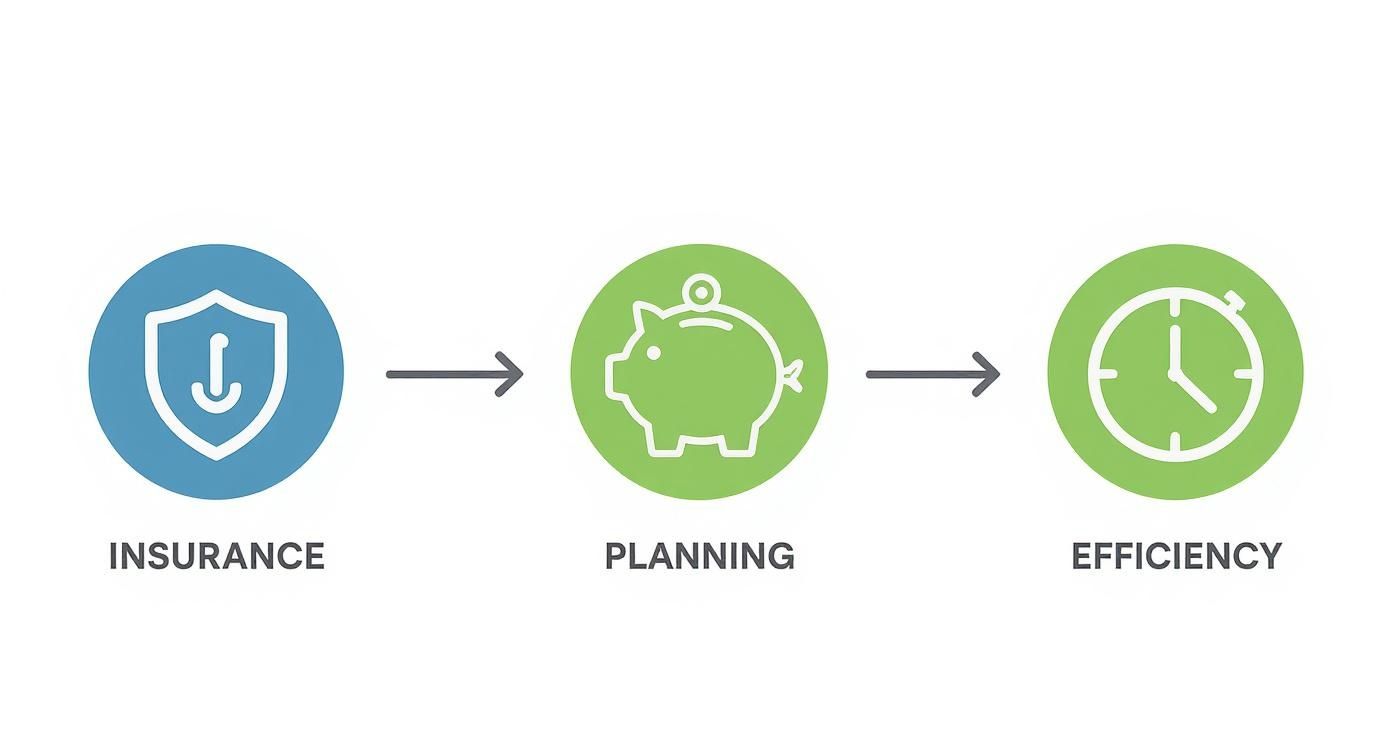
This process unlocks the real-world benefits of knowing what you own: smoother insurance claims, smarter financial planning, and a more efficient household. It all starts with capturing the right information.
Phase 1: The Initial Audit
First things first, you need to do a systematic sweep of your home. The key here is to be methodical. Pick a system and stick with it to avoid missing things or (even worse) counting them twice. Going room by room is usually the easiest way to tackle it.
Start in one room, say, the home office or living room. Begin at the door and move clockwise, documenting every single significant item. Your smartphone is your best friend here. Take clear photos or even a slow-panning video of each item. Be sure to capture any identifying marks, like brand names or unique features.
- Take multiple shots: Get the item from a few different angles. For anything electronic, make sure you get a crystal-clear photo of the serial and model numbers.
- Video is your friend: A slow video of a room or closet is a fantastic shortcut for documenting a bunch of items at once. You can always go back and grab still frames later if you need to.
- Don't skip the hidden spots: Attics, basements, closets, and garages are often where the most valuable (and forgotten) items live. Open every door and drawer.
This first pass is all about collecting the raw visual proof. Don't get lost in the weeds trying to write down details just yet. Focus on creating a complete visual record.
Phase 2: Detailed Data Capture
Alright, with your photos and videos in hand, it's time to add the critical details for each asset. This is where you build a truly robust asset and inventory management system. Good data is what transforms a simple list into a powerful tool for insurance claims and financial tracking.
You'll want to log a few key pieces of information for every item. Trust me, having this data ready is absolutely essential when you're preparing for a Proof of Loss form after an incident, as it can make the difference of thousands of dollars.
To make sure your inventory is complete for both insurance and financial planning, you'll need to capture the essential data for each valuable item you own. Here’s a checklist of what information to record.
Key Information to Record for Each Asset
| Data Point | Why It's Important | Example |
|---|---|---|
| Item Description | A clear name helps you identify the item quickly. | "Sony 65-inch 4K Smart TV" |
| Brand & Model | Crucial for valuation and replacement. | Brand: Sony, Model: X90J |
| Serial Number | The ultimate proof of ownership for electronics and appliances. | S01-1234567-A |
| Purchase Date | Helps determine the item's age and depreciation. | 11/25/2023 |
| Purchase Price | The baseline for insurance claims and calculating net worth. | $1,299.99 |
| Current Condition | Affects the item's actual cash value. | "Like New" or "Good, minor scratches" |
| Receipt/Proof | Digital proof of purchase simplifies claims. | Photo of Best Buy receipt |
| Replacement Cost | What it would cost to buy a new, similar item today. | $1,400.00 |
If you're looking for a shortcut, a good home inventory list template can give you a pre-built structure with all the fields you'll need.
Phase 3: Logical Organization
Now that you've got all this great data, you need to organize it so it actually makes sense. A messy, disorganized list is almost as useless as having no list at all. The entire point is to be able to find what you need, right when you need it.
One of the simplest and most effective ways to do this is by organizing everything by room, then breaking it down by category within each room. For instance, your "Living Room" inventory could have sub-folders for "Electronics," "Furniture," and "Art & Decor."
Your inventory system should reflect your life. Whether you organize by room, by category (like "All Electronics"), or by owner in a shared household, choose a structure that feels intuitive to you. The best system is the one you’ll actually use.
This kind of logical structure means you can quickly review a specific part of your home or a certain type of asset without having to scroll through hundreds of unrelated items.
Phase 4: Regular Maintenance
Here’s the thing about a home inventory: it's not a one-and-done project. It’s a living document that needs a little attention to stay accurate and useful. You buy new things, you get rid of old ones, and items move around.
Set up a simple schedule to keep your inventory from getting stale.
- Add new purchases on the spot: When you bring home a new laptop or TV, add it to your inventory right away. Snap a picture of the item and the receipt before you even throw the box away. It takes 30 seconds.
- Do quarterly check-ins: Every few months, take 15 minutes to do a quick scan of your inventory. Did you sell that old bike? Donate those clothes? Delete them from the list.
- Schedule an annual review: Once a year, block out an hour to do a more thorough walk-through of your home. Compare what you see to what's in your inventory and make any necessary updates.
Choosing the Right Tools for Home Inventory
Picking the right tool for your home inventory is the moment that decides whether this project becomes a reliable asset or a forgotten chore. Let's be honest, the days of a spiral notebook and a pen are over. Modern tools can make tracking your belongings easier, more accurate, and a whole lot less painful than you might think.
Your best choice really boils down to your specific needs, your budget, and how much time you're willing to sink into it. If you only have a handful of high-value items to track, a simple spreadsheet might be all you need. But for a growing family, a serious collector, or anyone who just wants a system that works, you’ll need something a bit more powerful.
Let’s walk through the options, from the old-school to the cutting-edge, to find your perfect fit.
Manual Methods: Spreadsheets
Spreadsheets, like Microsoft Excel or Google Sheets, are the classic digital starting point. People gravitate to them because they're often free and you can customize them endlessly. You can create whatever columns you want and organize your data in a way that makes perfect sense to you.
But that total freedom is also their biggest weakness. Spreadsheets are completely manual. Every single piece of information has to be typed in by hand. Trying to add photos is clunky at best, and forget about helpful features like barcode scanning or quick reports. This makes them a ton of work to set up and even harder to keep accurate over time.
General-Purpose Apps
Next up are tools like Notion, Airtable, or Evernote. These apps are a definite step up from a basic spreadsheet, offering more dynamic features like slick image integration, useful templates, and the ability to link records together. They hit a nice middle ground for folks who want more function without jumping into a dedicated inventory tool.
The catch? You have to build your system from the ground up. These apps aren't designed specifically for inventory, so you'll spend a good amount of time creating the structure, fields, and views you need. They're powerful, no doubt, but can feel overly complex if you just want a straightforward solution that’s ready to go.
The best tool is one that actually fits into your life. If a system is too complicated to update, it will become outdated and useless fast. Always prioritize ease of use to make sure your inventory stays a reliable, living document.
Specialized Inventory Apps
For the most seamless experience, nothing beats an app built from the ground up for asset and inventory management. These tools come loaded with features tailored specifically for cataloging your stuff. You can see a full breakdown of the top options in our guide to home inventory management software.
They're designed to solve the biggest headaches of inventory tracking.
Key features often include:
- Barcode Scanning: Instantly add an item just by pointing your phone's camera at the UPC code.
- Photo Integration: Snap and upload multiple photos for each item right inside the app.
- Automated Reporting: Generate a report for an insurance claim or financial planning with a single click.
- Cloud Sync: Your data is kept safe, secure, and available on any device, anytime.
These apps slash the time spent on manual data entry and make the whole process feel less like a chore. While many have a subscription fee, the time you save and the peace of mind they provide often make it a worthy investment.
The Rise of AI-Powered Tools
The newest evolution in home inventory is the arrival of artificial intelligence. AI-powered tools are completely changing the game by automating the most tedious part of the process: identifying your items and entering their details.
With an app like Vorby, you can just take a photo of something, and the AI often recognizes the product, finds its details online, and automatically fills in the brand, model, and even tracks down a user manual. This massively cuts down the effort it takes to build your inventory and, more importantly, to keep it current.
This shift toward automation in our homes mirrors what's happening in the wider financial world. For instance, private markets are reshaping how people invest, with revenues expected to hit $432.2 billion by 2030. This growth is being driven by new tech that makes digital assets more accessible to everyone. You can read the full PWC research about this global asset management shift. Just as technology is making complex financial markets simpler, AI is finally making sophisticated asset management something every household can do.
Asset Management in Real Life Scenarios

Theory is one thing, but seeing asset and inventory management solve real problems is where it all clicks. The abstract idea of "tracking your stuff" suddenly becomes a concrete solution for the messy, stressful situations we all face. The real magic isn't in just having a list; it's in how that list brings order to chaos during major life events.
To show you what I mean, let's walk through a few common scenarios where a detailed record of your belongings isn't just helpful, it's a game-changer. These stories turn potential nightmares into manageable projects, saving you time, money, and a whole lot of stress.
The Cross-Country Movers
First, meet the Jacksons. They're gearing up for a big move from Chicago to Austin. The excitement for their new life is real, but so is the logistical headache. Boxes are piling up, the moving truck is booked, and that nagging fear of something valuable getting lost or broken is starting to creep in.
Instead of relying on scribbled notes and wishful thinking, the Jacksons use their home inventory system. Every single item, from their big-screen TV down to the last coffee mug, is logged with photos, serial numbers, and its pre-move condition. They even generate QR codes for each box that link to a complete manifest of what's inside.
This simple setup gives them some serious superpowers during the move:
- Total Accountability: As boxes come off the truck in Austin, a quick scan of each QR code confirms it arrived safely. They realize a box of rare books is missing and can instantly provide the moving company with a precise list and photos of its contents. No arguments, just facts.
- Frictionless Damage Claims: They unwrap their antique dining table and discover a fresh scratch. Ugh. But instead of a frustrating back-and-forth, they pull up the dated "before" photos, file a claim, and get a fast, fair resolution.
- Smarter Unpacking: The first morning in a new home can be rough. Instead of tearing through a dozen boxes labeled "Kitchen," they scan the QR codes to find the one with the coffee maker. That first cup of coffee tastes a lot better without the frantic search.
The Growing Family
Now, let's check in with the Chens, who just welcomed their second child. Their home is suddenly overflowing with a crib, a smart baby monitor, a fancy stroller, and a tidal wave of toys and hand-me-downs. It's a lot to keep track of.
Their asset management system has become the family's command center. Every time they buy a big-ticket baby item, they immediately add it to the inventory, uploading the receipt and warranty info right then and there. This five-minute task saves them from the future nightmare of digging through junk drawers for a proof of purchase when that baby monitor inevitably glitches out.
A shared family inventory is more than a list; it's a collaborative tool for managing the household. It ensures everyone knows what warranties are active, where important items are stored, and what needs replacing, reducing redundant spending and family friction.
They also use the system to track valuable hand-me-downs, noting which items are stored in the attic for their younger child. When a friend asks to borrow a travel crib, they can instantly check its location and condition. For the Chens, their inventory system brings a sense of calm to the beautiful chaos of raising a family.
The Passionate Collector
Finally, there’s Maria, an avid art collector. Her collection isn't just her passion; it's a major financial investment. For her, a simple spreadsheet won't cut it. She needs a professional-grade asset and inventory management solution to protect her assets.
Her digital inventory serves several critical roles. Each piece of art has its own detailed profile, complete with the artist's name, purchase price, professional appraisals, and certificates of authenticity. This detailed record is absolutely essential for securing the right insurance coverage, especially as the value of her collection changes over time. If she ever decides to sell a piece, she has its entire history (its provenance) ready for potential buyers.
This level of meticulous tracking isn't so different from what happens in the high-stakes world of finance. For instance, private equity has become a dominant force in asset management, with firms tracking trillions in investments. In fact, private equity made up about 54% of all alternative asset fundraising over the past five years, managing a staggering $6.8 trillion in assets. As you can learn more about asset management industry trends from Morningstar, the core principle is the same: meticulous tracking protects value. For Maria, this system protects both her passion and her portfolio.
Your Home Inventory Questions, Answered
Starting any new system, especially one for your home, naturally brings up a few questions. When it comes to something as important as a home inventory, a handful of common concerns can make the project feel bigger than it really is.
Good news: the answers are usually pretty simple. Getting clear on a few key points upfront will help you sidestep common mistakes and build a system that’s actually easy to keep up with.
Let’s tackle the most common questions we hear about creating and maintaining a home inventory.
How Often Should I Update My Home Inventory?
Forget marathon organizing sessions. The key to an accurate inventory is consistency, not intensity. A good rhythm is to do one major review a year, but the real magic happens with small, ongoing updates.
The best habit you can build? Add any significant new purchase, like a TV, a new laptop, or that fancy air fryer, into your system the moment you get it. It’s easiest while you still have the receipt and packaging right there.
For smaller things or stuff you use up, a quick check-in every few months is usually plenty to keep your records straight.
The most effective approach is "little and often." Adding a new laptop to your inventory takes less than a minute when you first unbox it. Trying to remember its details six months later is a whole different story.
Using a dedicated app makes these real-time updates painless. It usually just takes a moment to snap a photo, add a quick note, and upload a digital copy of the receipt. That’s how your inventory stays a living, accurate document instead of a project you dread.
What Is the Best Way to Prove an Item's Value?
When you need to prove what something is worth, especially for an insurance claim, documentation is your best friend. The undisputed champion is the original purchase receipt.
Make it a habit to take a clear photo of every important receipt and attach it directly to that item’s entry in your digital inventory. This creates an undeniable record of exactly what you paid.
But what if you don't have a receipt for an older item or a gift? You've still got options:
- Find a Look-Alike: Do some quick online research for the same or a very similar product. Finding listings for items in comparable condition helps establish a current market value.
- Check Your Statements: Credit card or bank statements can often serve as proof of purchase, showing the date, the retailer, and how much you paid.
- Call in a Pro: For high-value assets like fine art, jewelry, or rare collectibles, a professional appraisal is non-negotiable. This document gives you an expert, defensible valuation that insurance companies take seriously.
Whatever you use, always save a digital copy of the appraisal or screenshot of the comparable item with its entry in your inventory.
Where Is the Safest Place to Store My Inventory?
Think about when you'd need your inventory the most: after a disaster like a fire or flood. That’s exactly why storing your list only on a local computer hard drive is such a huge risk. If your computer gets destroyed, your inventory disappears with it.
The best practice is to use a secure, cloud-based service. Most dedicated inventory apps, like Vorby, handle this for you automatically, syncing your data across devices and keeping it safe on remote servers. If you’re going the spreadsheet route, make sure you save it to a trusted cloud provider like Google Drive, Dropbox, or iCloud.
Want an extra layer of security? Good thinking.
- Share Access: Grant "view-only" permissions to a trusted family member or friend who lives somewhere else.
- Make an Offline Copy: Once or twice a year, export your entire inventory to a USB drive.
- Store It Offsite: Keep that USB drive somewhere safe outside your home, like a fireproof safe, a safe deposit box, or even at your parents' house.
Can I Use an Inventory System If I Am a Renter?
Absolutely. In fact, for renters, a detailed inventory can be a financial lifesaver.
Renter's insurance works just like homeowner's insurance: you have to provide proof of what you owned to file a claim. Without a documented list, you risk getting a settlement that’s a fraction of what you’re actually owed.
Beyond insurance, an inventory is also your proof of what you brought into the rental and what condition it was in. This can be your best defense against unfair claims on your security deposit when you move out. And in a shared house with roommates? A simple inventory clearly defines who owns what, heading off potential arguments before they ever start.
Ready to transform how you manage your household? With Vorby, you can use AI to automatically catalog your belongings, track warranties, and find anything in seconds with a simple search. Stop guessing and start organizing. Begin your free trial and gain complete control over your home inventory today.