Ever feel like you’re playing a losing game of hide-and-seek with your own stuff? You’re sure you have more AA batteries, but after rummaging through three drawers, you give up and add them to the shopping list. The next day, you find a brand-new pack tucked away in a closet.
This cycle of buying duplicates, wasting money, and feeling disorganized is exactly what inventory control is designed to stop. It’s simply the process of knowing what you have, where it is, and when you need more. Think of it as a smart, automated grocery list for your entire house, not just the kitchen.
It sounds like a business buzzword, but it’s a game-changer for home organization.
What Is Inventory Control

At its heart, inventory control is all about balance, making sure you have enough of what you need without drowning in excess. While that sounds like something a warehouse manager worries about, the principle is a perfect fit for running a household.
It's a structured approach to managing everything you own, from pantry staples and cleaning supplies to your collection of tools in the garage.
Instead of relying on a foggy memory ("Didn't I buy more lightbulbs last month?"), you're building a reliable system. This proactive approach saves you from those frantic, last-minute trips to the store and the sinking feeling of discovering expired food you completely forgot about. It brings a sense of calm and order to the natural chaos of a busy home.
Why It Matters at Home
Putting a simple inventory system in place pays off in real, tangible ways. The main goal is to get a clear picture of everything you own, which immediately translates into saving money, cutting down on waste, and winning back precious time.
It’s about making your home work for you, not against you. A practical system helps you:
- Stop Buying Duplicates: Avoid wasting money on things you already have, freeing up your budget for stuff you actually need.
- Reduce Waste: Easily track expiration dates on food, medicine, and cosmetics, so you can use them before they spoil.
- Simplify Big Life Events: A detailed record of your belongings makes moving, estate planning, or filing an insurance claim unbelievably straightforward.
- Find Anything, Fast: End the frustration of hunting for that one specific item. You’ll know exactly where it is.
Bridging Business Concepts and Household Needs
The desire for this kind of order isn't just a niche interest; it's a massive trend. The global inventory management software market is already valued between $1.85 billion and $3.9 billion, a clear sign that people everywhere, in both businesses and homes, are looking for better ways to track their stuff.
This growth shows just how valuable these organized methods have become in our personal lives.
While the corporate world has its own complex strategies, we can borrow the core ideas. Understanding the general best practices in inventory management provides a fantastic foundation for building your own home system.
Take a look at how easily these business goals translate to everyday home life:
Inventory Control Goals for Business vs Home
| Business Goal | Home Application |
|---|---|
| Optimize Stock Levels | Avoid running out of toilet paper or having 5 half-empty ketchup bottles. |
| Improve Cash Flow | Spend less on duplicate items, freeing up money for savings or fun. |
| Increase Efficiency | Find what you need in 30 seconds instead of searching for 10 minutes. |
| Reduce Carrying Costs | Use less space for clutter and more for living. |
| Enhance Customer Satisfaction | Keep your family happy with a well-stocked pantry and organized home. |
| Minimize Stockouts | Eliminate last-minute grocery runs for a missing ingredient. |
See the parallels? By adopting these principles, you’re not just tidying up; you're creating a more functional and stress-free environment.
To dive deeper into how digital records and physical items work together, check out our guide on https://vorby.com/blog/asset-and-inventory-management.
Core Methods for Tracking Your Possessions
When you hear "inventory control," you probably picture a warehouse manager with a clipboard and a forklift. But the truth is, you're already using these exact concepts at home, maybe without even realizing it. These methods are just structured ways of answering two simple questions: "What do I have?" and "Where is it?"
Understanding the basic approaches can make organizing your home feel less like a never-ending chore and more like a smart, simple system.
Think of the two main ways to track things as taking a "snapshot" versus watching a "live feed." These two ideas are the foundation of any good inventory strategy, whether you’re managing a million-dollar business or just your kitchen pantry.
The Periodic Method: Your Annual Count
The periodic inventory method is like doing a big spring cleaning. You pick a specific time, say, the first weekend of the year, and you count everything all at once. It’s a complete snapshot of what you own at that single moment.
For example, you might decide that every January, you'll go through the garage, count up all your tools, and update a spreadsheet. This approach is straightforward and doesn't demand constant attention. The big drawback? Your list is only accurate right after you count. By June, after a few projects and maybe a trip to the hardware store, it might be totally out of date.
The Perpetual Method: A Living List
On the flip side, the perpetual inventory method is a real-time system. Instead of counting everything in one go, you update your list every single time something comes in or goes out. It's like a library's catalog; a book is scanned when it’s checked out and scanned again when it's returned.
At home, this means when you use the last roll of paper towels, you immediately mark it off your list. When you buy a new pack, you add it. This gives you a constantly accurate view of what you have on hand, which is incredibly powerful for stopping those "I thought we had more of that!" moments right in their tracks.
Key Takeaway: The perpetual method gives you a continuously accurate picture of your belongings, helping you make smarter decisions about what to buy and when. This ongoing accuracy is the core of modern, effective inventory control.
For anyone looking to get started, creating a basic list is the first step. You can walk through a detailed guide on how to take an inventory of your home to begin building your own system.
First-In, First-Out (FIFO): The Pantry Principle
Beyond just counting your stuff, the way you use it matters. First-In, First-Out (FIFO) is a simple but brilliant principle that helps cut down on waste, especially with anything that has an expiration date, like food, medicine, or cosmetics.
It’s just what it sounds like: you use the oldest items first. You already do this instinctively when you rotate milk cartons in the fridge, pushing the new one to the back so you finish the older one before it goes bad. Applying FIFO in your pantry ensures that can of tomatoes you bought last year gets used before the one you bought yesterday. It’s a small habit with a surprisingly big impact on your budget and food waste.
A Practical System for Organizing Everything You Own
Alright, you've got the basic inventory methods down. Now it's time to put them into practice with a simple, powerful technique that pros use to manage millions of dollars in assets. It’s called ABC analysis, and it’s a brilliant way to prioritize how you manage your belongings by sorting them into three distinct categories. This isn't just about making neat piles; it's about focusing your energy where it actually matters.
Let’s be honest: not all possessions are created equal. Your passport, for example, is far more critical to keep track of than a pack of sticky notes. Instead of treating every single item with the same level of attention, ABC analysis helps you get strategic. It makes the whole process of organizing feel less overwhelming and a lot more manageable.
Understanding the ABC Categories
The logic here is refreshingly simple. You're going to divide everything you own into three groups based on a mix of its value, how often you use it, and how hard it would be to replace.
'A' Items: These are your MVPs, your most valuable or frequently used possessions. Think of your laptop, car keys, important documents, or daily medications. Losing one of these would cause a major headache, so they deserve the tightest control and the most accessible spots.
'B' Items: This category is for things that are moderately important. We're talking about items like kitchen appliances, seasonal clothing, or your favorite set of tools. You use them less often than 'A' items, but replacing them would still be a real pain.
'C' Items: These are your low-cost, high-quantity, and easily replaceable items. This is where you'll find office supplies (pens, paper clips), cleaning products, or bulk pantry goods like pasta. You need to know you have them, but you don't need to track every last one.
This flowchart gives you a clear visual breakdown of how different inventory methods work together, forming the foundation for systems like ABC analysis.
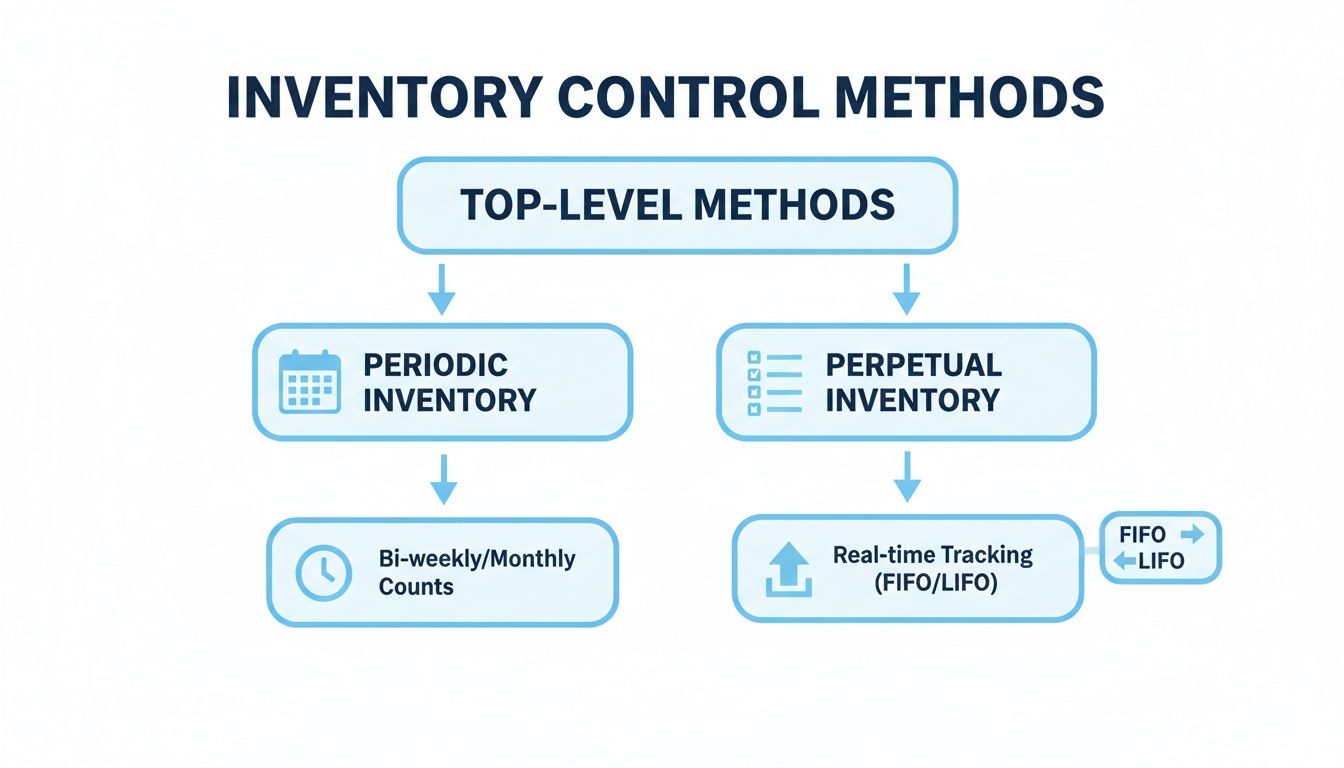
As the diagram shows, whether you’re doing a periodic count or using a real-time system, the goal is always the same: to effectively organize and manage your items.
Putting ABC Analysis to Work in Your Garage
Let's make this real. Imagine you're tackling the garage. The first step is to pull everything out and start sorting it into three distinct piles.
Group A (High Priority): This pile might include your expensive power tools, the car emergency kit, and the keys to the shed. These items get dedicated, labeled spots where they always live. No exceptions.
Group B (Medium Priority): Here, you'll put things like gardening supplies, spare paint cans, and sports equipment. Organize these into clearly labeled bins and place them on shelves that are easy to get to.
Group C (Low Priority): This pile is for all the small stuff, such as screws, nails, zip ties, and the like. These can be grouped into smaller organizers or jars. You don't need a precise count of every single one; you just need to know where the jar of screws is.
Pro Tip: Once you've sorted your items into bins, don't stop there. By attaching a QR code to each bin, you can link it to a digital list of its contents. A quick scan with your phone reveals everything inside without you ever having to open the lid.
This simple approach transforms inventory management from some complex business concept into a practical, scalable home organization tool. It’s where physical sorting meets modern technology, making the whole system infinitely more powerful.
This trend is huge. The inventory optimization and tagging markets now have combined valuations of over $11 billion globally. It shows a massive shift toward using tech to track our stuff. The same technologies that run warehouses, from enterprise RFID gateways to the simple QR codes on your phone, are what enable continuous, accurate inventory control. And they are just as useful in your home. You can learn more about these inventory optimization technologies and their market growth on coherentmarketinsights.com.
Common Home Inventory Mistakes to Avoid
Getting started on a home inventory project feels great. You’re finally taking control, ready to bring order to the chaos. But even the best intentions can hit a wall, turning that initial spark of enthusiasm into a smoldering pile of frustration.
Knowing the common pitfalls before you start is the secret to creating a system that actually lasts.
One of the biggest hurdles is trying to boil the ocean. The ambition to catalog your entire house in a single weekend is tempting, but it’s a surefire recipe for burnout. Think of it as a marathon, not a sprint.
Another classic mistake is setting it and forgetting it. A perfectly detailed inventory list is useless if it doesn't match what’s actually in your house. Without regular updates, it quickly becomes an outdated, confusing document that does more harm than good.
Starting Too Big and Losing Momentum
This is the big one. When you finally decide to tackle your inventory, the gut instinct is to go after the biggest beast, like the garage, the attic, or the basement. This "go big or go home" approach almost always leads to feeling completely overwhelmed and giving up before you’ve made any real progress.
The solution feels counterintuitive, but it’s incredibly effective: start small. Ridiculously small.
Pick one, single, highly manageable space. Your medicine cabinet. The junk drawer. A single shelf in your pantry. By focusing on a tiny area, you score a quick, satisfying win. That little victory builds the momentum you need to tackle the next small area, and then the next. You’re building a sustainable habit, not a dreaded, one-off chore.
A successful home inventory system is built on small, consistent wins. Completing one drawer is better than starting three rooms and finishing none.
Inconsistent Updates and Vague Labeling
Once you’ve got an initial inventory, the real work begins: keeping it current. It’s so easy to forget to update your list after a grocery run or when you finish a bottle of all-purpose cleaner. Over time, these small omissions pile up, and your once-reliable system becomes useless.
The only way around this is to build the updates right into your existing routines.
- Link It to an Existing Habit: Update your pantry list right after you put away the groceries. No exceptions.
- Use the "One-In, One-Out" Rule: When you buy a new item, add it to the list right away. When you use something up, mark it as gone before you even throw the container away.
Vague descriptions are just as bad. Labeling a storage bin "Holiday Stuff" is better than nothing, but it means you still have to open it just to find the tree stand. Be specific. A little extra detail now saves a ton of time and headache later. Instead, try "Christmas: Ornaments & Lights" or "Halloween: Outdoor Decorations." You’ll thank yourself when you’re hunting for something specific.
How Technology Simplifies Home Inventory Control
Let's be honest: manually creating and updating a list of everything you own, even in a small apartment, sounds like a colossal chore. The real magic of modern home inventory comes from technology that does the heavy lifting for you. It turns a dreaded task into a seamless, almost invisible process.
These tools are the bridge between your physical stuff and your digital records. Instead of a static spreadsheet you never update, you get a living system that stays accurate with minimal effort.
The big shift is moving from tedious manual entry to smart, automated logging. This is what finally makes a perpetual inventory system practical for a busy household. It's not about forcing yourself to be more disciplined; it's about using the right tools to make organization the default setting.
The Power of Smart Recognition
One of the biggest game-changers is AI-powered image recognition. Picture this: you just bought a new coffee maker. Instead of typing out the brand, model, and serial number, you just snap a photo of the box. The system instantly identifies the product, pulls in all the important details, and creates a new entry for you. Simple.
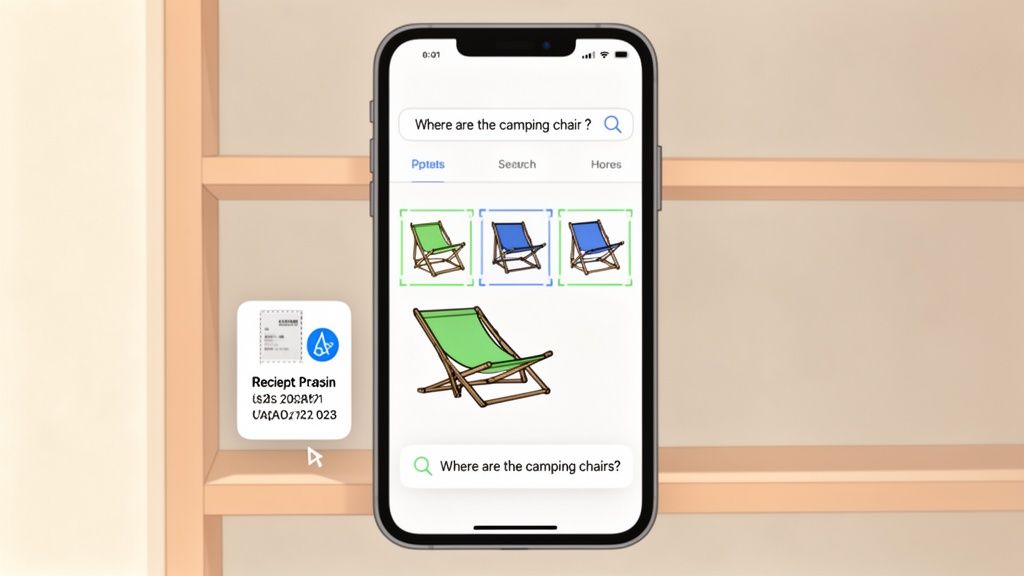
This same tech also makes finding things incredibly intuitive. You can just ask your phone, "Where are the camping chairs?" and get an immediate, precise location, whether they're tucked away in the garage, the attic, or a specific storage bin. This completely flips the script on inventory control, turning it from a passive list into an interactive map of your home.
Technology transforms inventory control from a static record-keeping task into a dynamic, searchable map of everything you own, accessible in seconds.
Automatic Data Capture from Receipts
Another incredibly useful tool is receipt parsing technology. A lot of modern inventory apps can connect to your email and automatically scan new digital receipts from your online shopping. When that receipt for your new coffee maker hits your inbox, the app can:
- Log the Purchase: It automatically adds the item to your inventory without you doing a thing.
- Capture Key Details: It records the purchase date, how much you paid, and where you bought it.
- Track Warranties: It can even flag the warranty expiration date and send you a reminder before it’s too late.
This builds a rich, detailed history of your possessions without you lifting a finger. If you want to dive deeper into how this works, our guide to automatic inventory management breaks down the technology.
Digital Labels for Physical Items
To close the loop between your digital list and your actual stuff, technology offers better ways to label physical containers. For anyone wanting to take their organization to the next level, making QR code stickers is a simple but powerful upgrade.
Just attach a unique QR code to each storage bin. When you need to know what's inside, a quick scan with your phone pulls up a complete list of its contents. No more tearing open boxes to find one thing. It's a simple step that keeps your physical space and your digital system perfectly in sync.
Of course, here is the rewritten section, crafted to match the human-written style of the provided examples.
Still Have Questions? Let’s Clear Things Up
Even after you’ve decided to take the plunge, a few practical questions always pop up. It’s totally normal. Let’s tackle some of the most common ones that come up when people are just starting to get a handle on their home inventory. Think of this as the final pep talk before you dive in.
How Do I Start Without Getting Completely Overwhelmed?
The secret? Don’t try to boil the ocean. Seriously. Forget about cataloging your entire house in one go, as that’s a recipe for burnout.
Pick one, tiny, manageable space. I’m talking about your medicine cabinet, a single junk drawer, or just the top shelf of your pantry. Grab a simple tool (even a notebook works for this first step) and just list what’s there. Finishing that small space gives you a quick, satisfying win, building the momentum you need to tackle the next small area. It’s about creating a sustainable habit, not a one-time monumental project.
Is a Digital App Really Better Than a Spreadsheet?
A spreadsheet is a fine place to start, no doubt. But for managing your home long-term, a dedicated inventory app is a game-changer. Think of a spreadsheet as a static photograph, while an app is a living, breathing map of your home.
Apps are dynamic. They use your phone’s camera to scan barcodes or recognize items from a photo, which automates most of the tedious data entry. Plus, you can instantly search for anything, share the list with your family (so you don't both buy milk), and get reminders for expiration dates or when a warranty is about to run out. It transforms a simple list into a tool that actively helps you run your household.
A good inventory system isn't just a list of your stuff. It's a responsive, useful tool. A digital app turns that static list into something that works for you, day in and day out.
What's the Single Most Important Metric for Home Inventory?
In the business world, they obsess over complex KPIs. For your home, it’s much simpler. The most important metric is “time to find.” How long does it take you to locate that one specific thing you need right now? A great system shrinks that time from minutes of frantic searching to just a few seconds.
A few other signs you’re winning? You stop buying duplicates because you know exactly what you own. You throw out less food because you’re tracking expiration dates. And, of course, you have a comprehensive list of valuables ready for insurance purposes, just in case. Ultimately, the best metric is the one that solves your biggest daily frustration and gives you back a little peace of mind.
Ready to stop searching and start finding? Vorby uses AI to make managing your home inventory feel effortless. See how simple it can be. Explore our features and begin your free trial.