Good kids gear organization shared household starts with a painfully familiar scene: one child needs soccer cleats in ten minutes, another child borrowed the shin guards, the backpack with the field-trip form is under a pile of sweatshirts, and a trumpet case has somehow become a hallway obstacle. Soccer cleats, shin guards, backpacks, and musical instruments migrate around the house like they are auditioning for a magic trick. The fix is not a prettier mudroom photo. The fix is a household system that makes shared gear visible, assignable, easy to return, and easy to audit before the next practice, rehearsal, school day, or weekend trip.
Families are running more like small operations than ever, even when nobody wants home to feel like an office. The U.S. Census Bureau reported that family households still made up the majority of U.S. households in 2020, while many family structures shifted over the decade. Pew Research Center has also documented the rise of multigenerational living, which means more people, more shared rooms, and more overlapping stuff under one roof. Add sports, school, music, camps, clubs, hand-me-downs, and seasonal clothes, and ordinary household storage becomes a coordination problem.
This guide gives you a practical system for organizing shared kids' gear at home without turning every parent into a full-time equipment manager. It covers zones, labels, ownership rules, inventory, receipts, photos, weekly resets, and the small habits that stop everyday gear from disappearing into closets, cars, garages, and sibling bedrooms.
Why shared kids' gear gets out of control so quickly
Kids' gear is harder to manage than adult belongings because it moves constantly, changes size constantly, and often belongs to more than one person emotionally, even when only one person can use it at a time. A jacket can be a hand-me-down, a backup, a school item, a sports-layer item, and a lost-and-found candidate all in the same month. A ball pump can belong to everyone, which often means nobody feels responsible for putting it back.
Shared gear has no natural owner
Most homes handle personal items better than shared items. A child may know where their favorite hoodie lives, but the shared soccer ball, extra water bottle, pencil sharpener, music stand, or charger drifts because it does not have a clear owner. Shared gear needs two kinds of ownership: a home location and a person responsible for returning it after use.
This is why family organization systems fail when they focus only on containers. A bin labeled sports is better than a floor pile, but it does not answer the real questions: who used the spare shin guards, which child gets the next-size cleats, which bag contains the rain jacket, and where does the mouthguard go after practice? Organization that stops at storage still leaves the household guessing.
Activities create duplicate versions of the same item
Families with multiple children rarely have one clean category called sports gear. They have indoor cleats, outdoor cleats, last season's cleats that almost fit a younger sibling, practice jerseys, game jerseys, backup socks, team jackets, water bottles, cones, braces, tape, and the single pair of shin guards that somehow fits everyone badly. School gear has the same problem: backpacks, lunch boxes, library bags, art folders, headphones, calculators, instrument books, chargers, and permission-slip folders.
Project Play, the Aspen Institute initiative focused on youth sports, frames youth sports as part of children's physical, mental, and social development. That is the good news. The household-management side is that every healthy activity brings objects with it. The goal is not to reduce kids' interests to whatever fits neatly in one cubby. The goal is to build a gear system that can keep up with active children.
Clutter becomes a search problem, not a neatness problem
When a family says the house is cluttered, the daily pain is usually not visual clutter. It is search time. Missing cleats before practice. Missing library books before school. Missing headphones before online homework. Missing recital shoes the night before the recital. Search time turns into stress because it arrives exactly when the family has the least flexibility.
That is why this process borrows from home inventory thinking as much as home organization. The Insurance Information Institute recommends creating a home inventory with photos, receipts, and regular updates because memory is unreliable after a loss. The same principle works for everyday family gear: when the household can see what it owns and where each item belongs, last-minute searches get shorter.
Start with a gear map before buying more bins
Buying containers before mapping gear is the classic organizing mistake. It feels productive, but it usually creates prettier hiding places. A gear map is a simple list of what your family owns, who uses it, where it should live, and when it leaves the house. You can do it on paper, in a spreadsheet, or in a household inventory app. The important thing is to define the categories before you design the storage.
Sort by activity, not by child first
Start with activities because activities reveal the real workflows. Make a list of the recurring gear categories in your home:
- Soccer and field sports: cleats, shin guards, socks, balls, pumps, jerseys, warm layers, goalkeeper gloves, braces, tape, water bottles.
- School: backpacks, lunch boxes, folders, library books, art supplies, headphones, calculators, chargers, uniforms, field-trip items.
- Music and performance: instruments, cases, stands, books, reeds, rosin, valve oil, concert clothes, recital shoes.
- Outdoor and seasonal: rain gear, snow gear, helmets, gloves, goggles, sandals, camping gear, beach towels.
- Shared play: board games, building sets, craft supplies, scooters, balls, costumes, batteries, controllers.
After that, add the child or children connected to each category. This order matters. If you sort by child first, shared items get copied mentally into multiple places. If you sort by activity first, you can see which items should be shared, which should be assigned, and which should be duplicated because sharing causes more chaos than it saves.
Mark the three states of every important item
Every piece of kids' gear is usually in one of three states: ready, in use, or outgrown. A ready item is clean enough, correctly sized, and stored where it belongs. An in-use item is in a backpack, car, locker, practice bag, instrument case, or bedroom because it is actively part of the week. An outgrown item is too small, no longer assigned, or waiting for a younger sibling, donation, resale, or disposal.
Most household mess comes from mixing these states. Outgrown cleats sit next to current cleats. A spare backpack hides the school backpack. A winter glove from last year lives in the same drawer as the matching current pair. Create separate locations for ready, in-use, and outgrown gear. If you already use storage bins, Brian's existing Vorby guide to a shared storage bin labeling checklist is a useful companion because the label only works when the bin's purpose is narrow enough.
Give each category a launch point
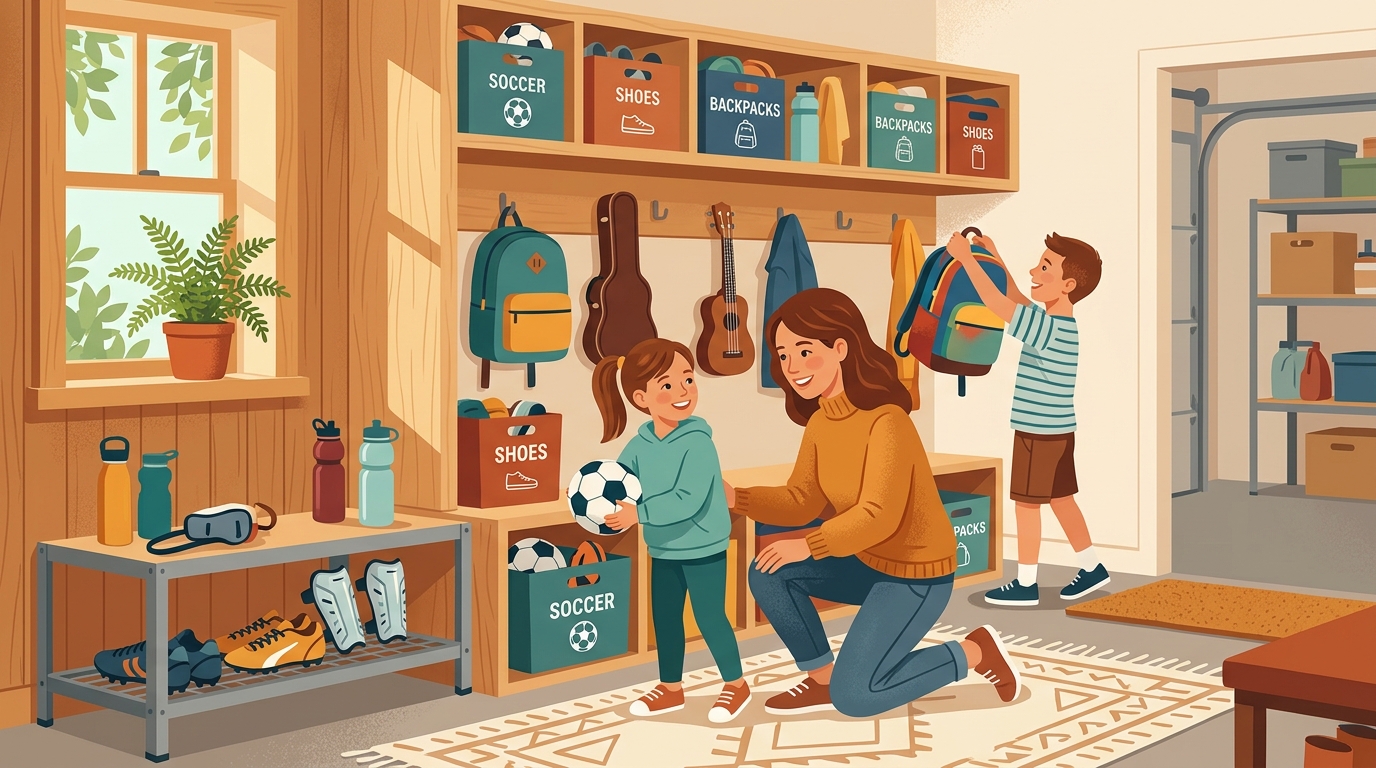
A launch point is the place gear passes through before leaving the house. For many families, that is the mudroom, garage entry, laundry room, hallway, or a bench near the door. The launch point should hold only what is needed in the next few days, not every item the family owns. Current soccer bag, current backpacks, current instrument cases, current seasonal outerwear, and today's forms belong there. Extra gear belongs in deeper storage.
This one distinction reduces a lot of friction. Deep storage can be less convenient because it is used less often. Launch storage must be fast because it is used while the family is already moving. A labeled garage bin can hold next-size cleats; it should not be the place a child has to dig through at 7:15 a.m.
Create zones that match how kids actually move
A family gear system works when it follows the path items already travel. If children enter through the garage, the system should not require them to walk upstairs, put cleats in a bedroom closet, return a water bottle to the kitchen, and place a music folder in an office. That may look logical to an adult, but it has too many steps for a tired kid after practice.
Use a mudroom zone for daily departures
The daily departure zone should be boring, visible, and easy to reset. Hooks beat hangers for jackets and bags. Open bins beat lidded bins for gear that must be dropped quickly. A shelf above kid height can hold parent-managed items such as tournament packets, expensive electronics, backup medicine, and forms that should not disappear into backpacks too early.
Give each child a small personal landing space, then keep shared items in a separate shared section. That separation matters. If the spare shin guards live in one child's cubby, they become that child's problem. If they live in the shared sports section, the household understands that anyone can use them and anyone who uses them must return them.
Use deeper storage for backups and hand-me-downs
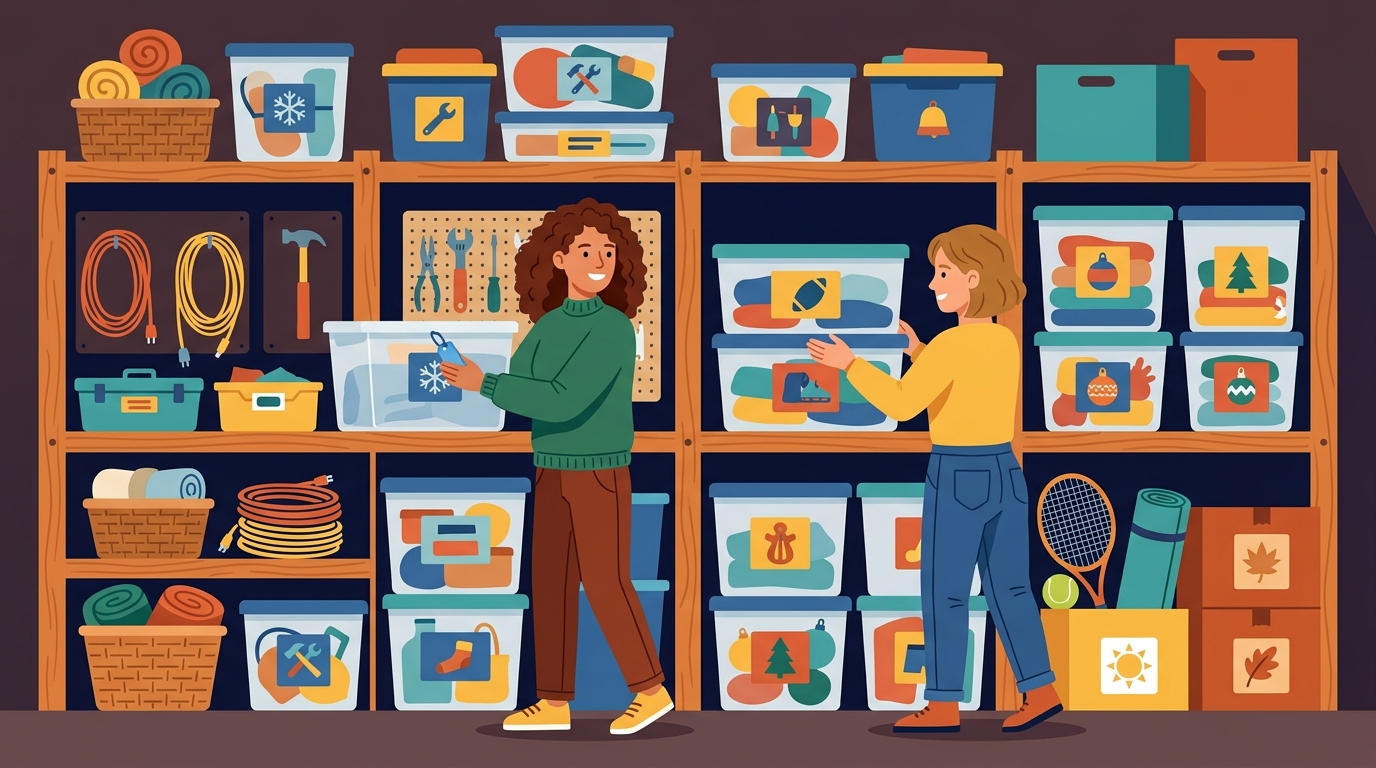
Backups do not belong in the daily zone. Put outgrown but useful gear in labeled bins by size, season, and category: soccer cleats size 5, winter gloves youth medium, school uniform shirts, extra backpacks, beginner music books. The more children you have, the more valuable this becomes. Hand-me-downs save money only if you can find them when the next child reaches that size.
The National Association of Realtors has repeatedly noted that multigenerational and larger household choices often involve practical needs such as cost savings and family support. Even when your household is not multigenerational, shared family gear has the same economic logic. The best storage system preserves value by keeping useful items visible enough to reuse instead of repurchasing them in a panic.
Use the car as a transit zone, not a storage unit
The car is where kids' gear goes to become temporarily invisible. It is easy to leave cleats, water bottles, library books, jackets, sheet music, and snack containers in the back seat because the next activity is always coming. Treat the car as a transit zone with a simple rule: anything that came home in the car leaves the car the same day, unless it is intentionally assigned as car gear.
For car gear, choose a small permanent kit: wipes, sunscreen, a first-aid pouch, an emergency snack, a backup hair tie, maybe one extra water bottle. Do not keep full duplicate sets of sports and school gear in the car unless your schedule truly requires it. If the car becomes the second house, the first house cannot stay organized.
The best family gear system is not the one that looks most organized on Sunday night. It is the one a tired kid can follow on Thursday after practice.
Label shared gear so the right person can return it
Labels are not just for bins. In a shared household, labels answer questions before they become arguments. Is this backpack current or spare? Are these cleats Quinn's, Kelsey's, or waiting for the next kid? Does this trumpet book stay with the instrument or the music stand? Good labels make the return path obvious.
Use names, categories, and dates together
A name alone is not always enough. Kids grow, siblings inherit, and shared gear changes hands. For valuable or frequently confused items, use a label format like Kelsey, soccer, fall 2026 or shared, outdoor balls, garage shelf. For hand-me-down bins, use size and season: cleats size 6, next season or winter gear, youth large.
Date labels prevent stale storage. A bin marked school supplies can sit for years. A bin marked school supplies, checked July 2026 tells you when it last made sense. That is especially useful for markers, glue sticks, batteries, mouthguards, sunscreen, and anything that dries out, expires, or becomes gross in the uniquely creative ways kids' belongings specialize in.
Separate shared, assigned, and floating items
Not every item should be managed the same way. Use three simple statuses:
- Shared: anyone can use it, and the item returns to a shared location.
- Assigned: one child uses it now, even if it may become a hand-me-down later.
- Floating: the item moves as needed, but an adult or older child is responsible for checking it weekly.
This is where many families accidentally create conflict. A sibling borrows the good scissors, the spare cleats, the black binder, or the only working charger, then nobody knows who should return it. Floating items need a named reset person. That person is not blamed for every disappearance; they simply check the item during the family reset.
Photograph weird items before they disappear
Photos are useful for the unglamorous items that are hard to describe later: a specific calculator model, a team warmup jacket, a rented violin case, a costume accessory, a charger with a particular connector, a pair of prescription sports goggles. The Insurance Information Institute recommends taking photos and labeling them with details such as what the item is, where it came from, and information that could matter for replacement. Families can use the same habit for everyday gear.
If you use a home inventory tool, add photos of expensive, rented, borrowed, or school-owned gear. If not, create a shared album or folder. The point is not to document every pencil. The point is to make high-friction replacement items easy to identify when time is short.
Track value, receipts, and replacement details
Shared kids' gear can represent a surprising amount of money. Cleats, instruments, backpacks, electronics, calculators, helmets, sports braces, uniforms, winter gear, and camp equipment add up quickly. When families lose track of what they already own, they often repurchase items that were sitting in a bin, a trunk, a locker, or a sibling's closet.
Keep receipts for high-cost and reimbursable items
Receipt tracking is not only for taxes or insurance claims. It helps families answer practical questions: when did we buy these cleats, are the headphones still under warranty, can the school reimburse that supply purchase, did we buy the correct size last season, and what model is the replacement mouthpiece? A basic receipt record can save real money.
For household paperwork and proof-of-purchase habits, Vorby's guide on organizing household paperwork without losing anything pairs well with a kids' gear system. Keep the original receipt where your family already stores financial records, then attach a photo or note to the inventory item if the gear is valuable, rented, insured, or likely to be replaced.
Make a replacement profile for important gear
A replacement profile is a short note that tells future-you how to buy the item again. For kids' gear, include brand, size, color, team requirement, school requirement, purchase date, and where it is normally stored. This is especially useful for cleats, uniforms, backpacks, lunch boxes, instrument accessories, headphones, calculators, helmets, and seasonal gear.
Do not make this more complicated than it needs to be. A useful note can be one line: Quinn soccer cleats, Adidas Copa, size 6, black, bought Aug 2026, current pair in blue sports bag, next-size pair in garage bin. That is enough to prevent a lot of duplicate buying and last-minute guessing.
Use inventory only where it lowers friction
Some parents hear inventory and imagine scanning every sock. Do not do that. Track the categories that cause actual household pain: expensive items, shared items, borrowed items, school-owned items, activity-critical items, and easy-to-lose small items. If losing it would make tomorrow harder, track it. If replacing it would be expensive or annoying, track it. If nobody argues about it and it costs two dollars, leave it alone.
Vorby's guide to stopping the loss of small household items is useful here because many family gear problems start with small missing pieces. Cleats are obvious. The missing pump needle, mouthguard case, violin rosin, calculator charger, or single shin guard is what derails the afternoon.
Build a weekly reset that kids can actually do
The system works only if it resets. Without a reset, every storage zone slowly turns into an archaeological dig. The reset does not need to be long. In fact, it should be short enough that the household can do it on a weeknight without needing inspirational music and a second cup of coffee.
Pick one reset time tied to the family calendar
Choose a predictable reset time: Sunday evening, Friday after school, Wednesday before trash day, or the night before the busiest practice day. Tie the reset to a calendar rhythm rather than a mood. If everyone waits until the house feels chaotic, the reset has already become too big.
The reset should answer five questions: what leaves the house tomorrow, what needs washing, what needs replacing, what belongs to someone else, and what has become outgrown or unused? Younger children can return gear to labeled zones. Older children can check their own activity bags against a short list. Adults can handle receipts, repairs, forms, and purchases.
Use checklists for bags, not lectures
Kids do better with visible checklists than repeated verbal reminders. Put a small checklist inside each activity bag or near the launch zone. A soccer checklist might include cleats, shin guards, socks, water bottle, jersey, warm layer, and ball if needed. A music checklist might include instrument, book, pencil, stand, folder, and concert clothes on performance days.
Keep checklists short. The goal is not to create a binder that nobody reads. The goal is to reduce the number of things a child must remember while the household is moving. When the same item goes missing twice, add it to the checklist. If an item never goes missing, do not clutter the list with it.
Make outgrown gear leave the active system
Outgrown gear is sneaky because it still looks useful. It also creates search noise. During the weekly or monthly reset, pull items that no longer fit or no longer match a current activity. Move them into one of four places: next sibling, sell, donate, or discard. If an item is waiting for a sibling, label the size and likely season.
This is where families can borrow from shared-household routines. In Vorby's guide to apps for multigenerational households, the larger lesson is that visibility matters when several people rely on the same home. Kids' gear is the same coordination problem at a smaller scale. The household needs to know what exists, where it lives, and whether it still belongs in daily circulation.
How Vorby fits into a family gear system
Vorby is useful when your family needs more than bins and labels. Physical organization tells people where items should go. A household inventory gives the family a searchable record of what exists, where it belongs, who uses it, and what details matter when something needs to be found, repaired, replaced, handed down, or claimed.
Track the items that cause the most stress
Start with the items that create the loudest last-minute searches. Add current cleats, shin guards, team bags, school backpacks, headphones, calculators, instruments, rented equipment, seasonal gear, and shared chargers. Add photos for items that are easy to confuse. Add notes for size, assigned child, storage location, and replacement details.
This makes Vorby especially useful for families with multiple children because the app does not require every person to remember every location. If the soccer bag is supposed to live by the garage door and the next-size cleats are in a labeled storage bin, the record can say that. If a younger sibling will inherit an item, the note can say that too.
Use rooms and storage areas as real-life locations
Set up locations the way your family actually thinks: garage shelf, mudroom bench, hallway closet, music corner, school cabinet, car kit, attic bin, donation box. Avoid vague locations such as storage unless the home has only one storage area. Specific locations reduce arguments because the family is not searching the whole house, only the place where that item should logically live.
For shared kids' gear, the best records combine digital visibility with physical simplicity. A label on the bin helps the person standing in front of it. A Vorby item record helps the person who is trying to remember whether the item exists at all.
Use QR labels for bins and high-turnover categories
QR labels are most useful on bins that change over time: outgrown cleats, seasonal gear, art supplies, school extras, sports backups, and hand-me-down clothing. Scan the bin, update the contents, and keep moving. This keeps the system from becoming stale, which is the silent failure mode of every neat-looking storage setup.
Do not put QR labels on everything. Put them where the label unlocks a decision: keep, borrow, return, donate, replace, or hand down. The right level of tracking should make the house easier to run, not turn family life into warehouse receiving.
FAQ: organizing shared kids' gear at home
What is the best way to organize sports gear for multiple kids?
Sort sports gear by activity first, then assign current items by child. Keep daily-use gear near the exit, store backups and next-size items separately, and label shared items with a return location.
How do I stop siblings from losing each other's gear?
Create separate statuses for shared, assigned, and floating items. If a child borrows assigned gear, the return location and reset person should be clear before the item leaves its normal zone.
Should every child have their own gear bin?
Each child should have a small personal landing space, but shared gear should not live inside one child's bin. Keep shared items in a neutral shared zone so responsibility does not accidentally fall on one sibling.
How often should we clean out kids' gear?
Do a short weekly reset for current bags and launch zones, then a deeper seasonal cleanout for sizes, sports seasons, school transitions, and weather changes. Outgrown gear should leave the active system quickly.
What kids' gear should I track in a home inventory app?
Track expensive, shared, borrowed, rented, school-owned, activity-critical, and easy-to-lose items. Photos, storage locations, sizes, purchase dates, and replacement notes are usually enough.
Turn shared kids' gear into a household system. Shared kids' gear stays organized when every important item has a place, a status, and a return path. Map the gear, separate daily launch zones from deep storage, label shared items clearly, track the details that prevent duplicate buying, and reset the system before the week gets away from you.
Shared homes run better when shared belongings are visible. Vorby gives families one place to track the gear their kids use, share, outgrow, and need again tomorrow.