It's a familiar story: you know you own something, but you have no idea where it is. Maybe it’s the spare HDMI cable, a sentimental heirloom, or just that extra set of batteries you bought last month. The frustration of searching for misplaced items wastes time, creates unnecessary stress, and can even cost money when you repurchase things you already have. But what if you could apply proven business strategies to your own household?
Professional inventory control methods are not just for warehouses; they are powerful frameworks for bringing order, efficiency, and peace of mind to your home. This guide translates eight distinct strategies from corporate jargon into practical, actionable steps for managing everything from your pantry to your storage unit.
You will learn not just what each method is, but exactly how to implement it to fit your unique lifestyle. We provide clear examples whether you are a busy parent tracking school supplies, a passionate collector cataloging valuables, or someone preparing for a big move. Let's transform your home into a perfectly organized space where everything has its place, and you can find it in seconds. We'll explore systems like Just-In-Time (JIT) for consumables, ABC analysis for prioritizing your most valuable items, and perpetual tracking to create a living, breathing catalog of your belongings.
1. Just-In-Time (JIT) Inventory
The Just-In-Time (JIT) inventory method is a lean management strategy where items are acquired only right before they are needed. Originating in manufacturing to boost efficiency, JIT has powerful applications for home inventory management. The goal is to minimize waste, reduce storage costs, and prevent the accumulation of items that expire or become obsolete.
For households, this means shifting from bulk-buying to purchasing goods on an as-needed basis. This approach is ideal for those with limited space, such as college students or digital nomads, and for families wanting to cut down on food waste and unnecessary spending. It’s one of the most effective inventory control methods for maintaining a minimalist and highly efficient home.
Practical Application at Home
Consider a busy family that used to buy groceries in bulk, only to find produce spoiling and pantry items expiring. By adopting JIT, they now plan weekly meals and purchase only the necessary ingredients. This not only saves money but also ensures fresher meals and a clutter-free kitchen.
Another example is a frequent mover who needs to keep possessions to a minimum. Instead of stocking up on toiletries or cleaning supplies, they purchase them only when their current supply is nearly depleted, making packing and moving significantly easier.
How to Implement JIT with Vorby
- Check Before You Shop: Use Vorby’s natural language search ("Do we have AA batteries?") to instantly check your inventory before heading to the store, preventing duplicate purchases.
- Identify Reorder Points: Create categories like "Pantry" or "Cleaning Supplies" in Vorby. Track consumption to see how quickly you use items, helping you pinpoint the perfect time to restock.
- Coordinate Purchases: Create a shared household inventory. When a family member uses the last of the olive oil, they can update its status in Vorby, alerting everyone that it’s time to buy more.
- Automate Tracking: Leverage Vorby’s email receipt parsing to automatically log new purchases. This provides a clear, real-time view of what has recently entered your home.
2. First-In-First-Out (FIFO)
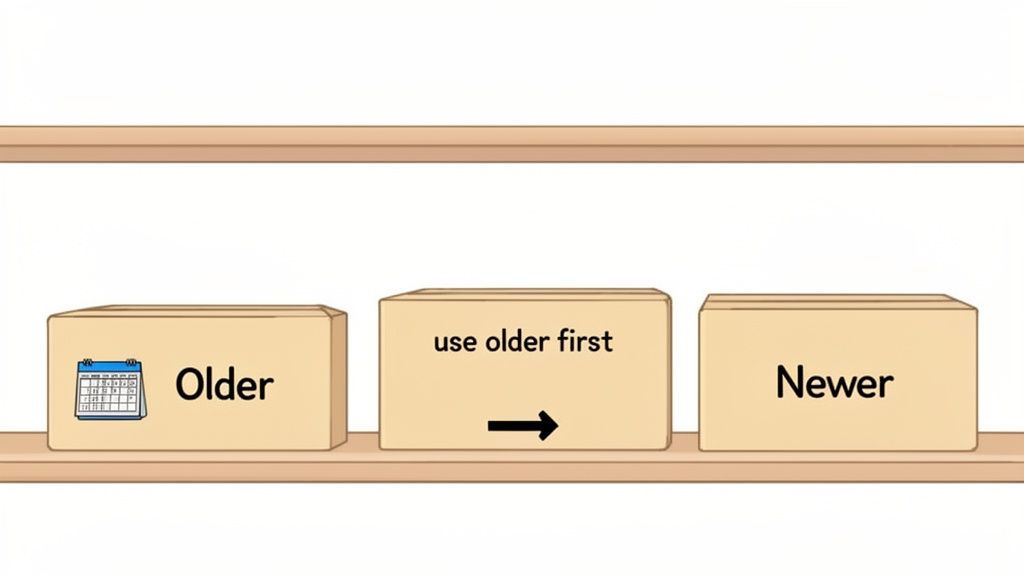
The First-In-First-Out (FIFO) inventory method is a simple yet powerful system for managing items with a limited shelf life. The principle is straightforward: the oldest items, those that came in first, should be the ones used first. This chronological approach is one of the most essential inventory control methods for preventing waste, especially with perishables, medications, or products with expiration dates.
By ensuring older stock is rotated to the front and consumed before newer purchases, households can dramatically reduce spoilage and ensure everything is used at its optimal quality. FIFO is perfect for anyone managing a pantry, medicine cabinet, or even a collection of cosmetics, where freshness and efficacy are crucial.
Practical Application at Home
Imagine a family stocking their pantry. Without FIFO, new groceries get pushed in front of older ones, leading to expired cans of soup and stale crackers being discovered months later. With FIFO, they place new items at the back of the shelf, forcing everyone to grab the older items first. This simple habit minimizes food waste and saves money.
Another example is a skincare enthusiast. By arranging products with the nearest expiration dates at the front of their cabinet, they ensure every cream and serum is used while it's still effective. This same logic applies to managing a wine collection, where vintages must be consumed in a specific order to be enjoyed at their peak.
How to Implement FIFO with Vorby
- Log Expiration Dates: Use Vorby's image recognition to snap a photo of a new item and its expiration date. The app can log this information, making it easy to sort your inventory chronologically.
- Set Automated Reminders: When you add items with expiration dates, like medications or pantry goods, set reminders in Vorby to alert you before they expire, ensuring you use them in time.
- Use Location Tags: Apply QR codes to pantry shelves or refrigerator bins. A quick scan with Vorby can show you what’s in that location and which items are the oldest, reinforcing the FIFO process.
- Coordinate with the Household: A shared Vorby inventory allows everyone to see which milk carton or yogurt to use first. When someone adds new groceries, they can update the inventory so the whole family stays on the same page.
3. ABC Analysis (Pareto Analysis)
ABC Analysis is a prioritization technique that categorizes inventory based on its value and importance. Rooted in the Pareto Principle, which suggests that roughly 80% of effects come from 20% of causes, this method divides items into three distinct groups. Applying this as one of your inventory control methods allows you to focus your attention where it matters most.
This approach is perfect for households managing a wide variety of items with different values, from expensive electronics to everyday consumables. Group A includes high-value, critical items; Group B contains moderately important items; and Group C consists of low-value, less critical goods. By prioritizing management efforts, you ensure your most significant assets are well-protected and tracked.
Practical Application at Home
Consider a collector of vintage toys. Their rare, mint-condition figures would be "A" items, requiring detailed records, secure storage, and insurance documentation. Moderately valuable toys in their original packaging might be "B" items, while common, loose figures would be "C" items. This tiered system ensures the most prized possessions get premium attention without overcomplicating the management of the entire collection.
Another example is a family organizing their garage. High-value power tools and seasonal equipment are "A" items, tracked closely. Hand tools and gardening supplies are "B" items, checked periodically. Nuts, bolts, and old paint cans are "C" items, managed with minimal effort.
How to Implement ABC Analysis with Vorby
- Tag Your Tiers: Use Vorby’s custom tagging feature to label items as "A-Tier," "B-Tier," or "C-Tier" based on their financial or sentimental value. This makes it easy to filter and review your most important assets.
- Enhance 'A' Item Tracking: For your "A" items like electronics or jewelry, attach warranty documents, purchase receipts, and photos directly to their entries in Vorby for a complete digital record.
- Use QR Codes Strategically: Assign QR codes to storage bins containing "A" and "B" items for quick, precise identification. "C" items, which are less critical, can be managed with broader category-level tracking.
- Prioritize with Categories: Create dedicated categories in Vorby like "High-Value Electronics (A)" or "Everyday Consumables (C)" to align your digital inventory with your physical organization strategy.
4. Physical Cycle Counting
Physical cycle counting is a systematic inventory control method where a small portion of your inventory is counted on a regular, rotating schedule. Instead of a single, overwhelming annual inventory count, this approach breaks the task into manageable chunks. By periodically counting specific rooms, categories, or storage bins, you can maintain high accuracy without major disruptions.
This method is perfect for households with large or distributed inventories, such as collections spread across multiple rooms or supplies stored in a garage, basement, and pantry. It helps identify discrepancies like misplaced or missing items in near real-time, preventing small issues from becoming big problems. For families and collectors, it transforms a dreaded annual chore into a simple, routine habit.
Practical Application at Home
Imagine a family with extensive holiday decorations stored in the attic. Instead of a chaotic search each December, they use cycle counting. In October, they count and verify the "Halloween" bin. In November, they count the "Thanksgiving" bin, and so on. This ensures everything is accounted for and in good condition right before it’s needed.
Another example is a comic book collector with thousands of issues. Rather than counting their entire collection at once, they audit one long box or one specific series each month. This makes the task less daunting and helps them quickly spot if a valuable issue is misplaced or needs better storage.
How to Implement Physical Cycle Counting with Vorby
- Schedule Your Counts: Designate a specific time for counting, like "Pantry Check Sunday." Create a recurring task in your calendar and link it to your Vorby inventory. This makes it a consistent, easy-to-follow routine. For more tips on getting started, you can take an inventory with a structured approach.
- Systematize with Tags: Place QR codes or NFC tags on storage bins, shelves, or room entrances. During your count, simply scan the tag with the Vorby app to pull up the list of items that should be in that location, making verification fast and accurate.
- Assign Responsibilities: In a shared household, use Vorby’s shared inventory feature to assign different counting tasks. One person can be responsible for the kitchen supplies this week, while another handles the bathroom toiletries next week.
- Document and Reconcile: As you count, update quantities directly in Vorby. If you find a discrepancy, use the "Notes" field to record why an item is missing or where it was moved, helping you maintain a precise and trustworthy inventory.
5. Barcode and QR Code Tracking
Barcode and QR code tracking is an inventory control method that uses scannable codes to instantly identify and log items. While traditional barcodes are common in retail, QR codes (a type of 2D barcode) are exceptionally well-suited for home inventory. By linking a physical item or location to a digital record, this method eliminates manual entry, reduces errors, and provides immediate access to detailed information with a simple scan.
This technique transforms static storage into a dynamic, interactive system. It's perfect for anyone with extensive storage, such as homeowners with attics or garages, collectors managing valuable items, or families organizing seasonal decorations. By digitizing your physical world, you can know exactly what's inside a box without ever opening it.
Practical Application at Home
Imagine you're moving. Instead of scribbling vague labels on boxes, you attach a unique QR code to each one. A quick scan with your phone reveals a detailed list, and even photos, of the contents. This makes unpacking organized and efficient, as you can prioritize boxes and find specific items instantly.
Another great example is a wine collector. Each bottle can have a small barcode linked to its digital profile in Vorby, complete with tasting notes, purchase date, and ideal consumption window. Similarly, a hobbyist can use QR codes on storage bins for craft supplies or electronic components to quickly find what they need for a project.
How to Implement Barcode and QR Code Tracking with Vorby
- Generate and Assign Codes: Use Vorby’s built-in feature to generate unique QR codes for storage bins, boxes, or even entire rooms. Print them on sticker labels and attach them for easy scanning.
- Link to Digital Entries: When you add a new item or a group of items to Vorby, link them to a specific QR code. When you scan that code, Vorby will instantly pull up the associated items.
- Quick Location Lookups: Place QR codes on shelves or closet doors. A scan can show you a complete list of everything stored in that location, turning your phone into an x-ray for your storage.
- Create Master Room Codes: For a high-level overview, place a single QR code near the entrance to a room (like the garage or basement). Scanning it can bring up a master list of all major items and storage containers within that space. For a deeper dive, learn more about setting up a QR code inventory system.
6. Min-Max Inventory System
The Min-Max system is a straightforward yet effective inventory control method that sets minimum and maximum stock levels for each item. When your on-hand quantity drops to the predetermined “minimum” level, it triggers a reorder to bring the stock back up to the “maximum” level. This approach strikes a balance, preventing you from running out of essentials while also avoiding the waste and clutter of overstocking.
For households, this method is perfect for managing everyday consumables without requiring constant attention. It provides a simple, rule-based system that ensures you always have what you need, but not so much that it expires or takes over your storage space. It’s an ideal strategy for families looking to maintain a well-stocked pantry and for anyone who wants to avoid last-minute emergency trips to the store.
Practical Application at Home
Consider managing household paper products. A family might set a minimum level of one bulk pack of paper towels and a maximum of three. Once they open the second-to-last pack (dipping to the minimum level), they know it's time to add paper towels to the shopping list, purchasing enough to get back to the maximum of three packs.
This system is also excellent for critical items like prescription medications. By setting a minimum of a one-week supply, you create a clear trigger to request a refill, ensuring there is never a gap in medication. Similarly, for coffee lovers, a minimum of one bag of beans can signal that it’s time to buy more, preventing a caffeine-free morning crisis.
How to Implement Min-Max with Vorby
- Define Min-Max Levels: Use Vorby’s custom fields to add "Min Quantity" and "Max Quantity" to your items or categories, such as "Cleaning Supplies" or "Pantry Staples."
- Get Low-Stock Alerts: Set up notifications in Vorby to alert you or shared household members when an item’s quantity reaches its defined minimum level.
- Review and Adjust: Your family’s needs change. Use Vorby’s tracking history to see how fast you consume items and review your min-max levels quarterly to adjust for seasonal changes or new habits.
- Track Consumption Accurately: Leverage Vorby’s email receipt parsing to automatically log new purchases and update quantities. This data helps you refine your min-max thresholds for more efficient inventory control.
7. Location-Based Organization and Zoning
Location-Based Organization, often called zoning, is an inventory control method that prioritizes physical space as the primary organizational principle. Instead of grouping items solely by category (like "all electronics"), you map your inventory according to where each item is stored: a specific room, cabinet, shelf, or even a particular box. This creates a mental and digital blueprint of your home, making item retrieval intuitive and efficient.
This spatial approach is particularly effective for households with multiple storage areas, such as a garage, attic, and various closets. It transforms chaotic spaces into logical, navigable zones, ensuring you can find what you need without a frustrating search. For families or roommates sharing a space, it establishes clear boundaries and a shared understanding of where everything belongs.
Practical Application at Home
Imagine a homeowner with an extensive collection of tools scattered across their garage. By implementing zoning, they can divide the garage into distinct areas: a "Tool Wall" for frequently used items, a "Seasonal Storage" corner for holiday decorations, and a "Gardening Supplies" shelf. Each zone is clearly defined, so finding a specific wrench or a string of lights becomes a simple matter of going to the correct location.
Similarly, a family can apply zoning to their kitchen pantry. The top shelf can be the "Baking Zone" with flour and sugar, a lower shelf can be the "Snack Zone" for kids, and a specific cabinet can be designated for "Canned Goods." This system helps everyone, including children, find things easily and put them back in the right place, maintaining order.
How to Implement Location-Based Organization with Vorby
- Create Location Hierarchies: Build a detailed map of your home within Vorby by nesting locations, for example, "Home > Garage > Wall Cabinet > Shelf 2." This allows for precise item tracking.
- Tag Physical Zones: Use Vorby’s QR code or NFC tag generation to label bins, shelves, and drawers. A quick scan with your phone can instantly pull up a complete list of what’s inside that specific zone.
- Assign Locations During Entry: When adding a new item, immediately assign it to its designated location in the app. This creates an accurate, real-time inventory map from the start.
- Visualize Your Spaces: Take photos of your organized zones and attach them to the corresponding location in Vorby. This visual reference is invaluable for remembering how a space should look and helps maintain the system.
8. Perpetual Inventory System
A perpetual inventory system maintains real-time, continuous tracking of inventory quantities as items are added, removed, or consumed. Unlike periodic manual counts, this method records every transaction immediately. For households, this provides an always-current view of what you own at any moment, eliminating guesswork and ensuring constant visibility into your belongings.
This approach is one of the most powerful inventory control methods for those who need pinpoint accuracy, such as collectors tracking valuable items or families managing shared resources. It transforms inventory management from a periodic chore into a dynamic, automated process. By integrating with a digital platform like Vorby, a perpetual system becomes the ultimate source of truth for your home inventory.
Practical Application at Home
Imagine a household with shared pantry staples like flour, sugar, and oil. Using a perpetual system, whenever a roommate uses the last of an item, they update its status in a shared app. This instantly notifies everyone that it needs to be replaced, preventing the frustration of discovering an empty container when you need it most.
Another example is a hobbyist who collects rare comic books. Each time a new issue is acquired or an existing one is sold, the transaction is logged immediately. This keeps the collection's value and composition accurate, which is crucial for insurance and appraisal purposes.
How to Implement a Perpetual System with Vorby
- Automate Additions: Use Vorby’s email receipt parsing to automatically add new purchases to your inventory the moment you buy them, ensuring nothing is missed.
- Log Consumption Instantly: Train household members to use Vorby’s mobile app to quickly log an item as "used" right after consumption. This keeps quantities up to date.
- Use QR Codes for Quick Updates: Attach QR codes to storage bins or frequently moved items like tools. A quick scan can update an item’s status or location in seconds.
- Set Reminders for Review: While the system is continuous, set a weekly reminder to quickly review recent changes and ensure all updates have been logged correctly, maintaining system integrity. For a deeper dive into this topic, you can learn more about real-time inventory management on vorby.com.
Inventory Control Methods: 8-Point Comparison
| Method | Implementation Complexity 🔄 | Resource Requirements ⚡ | Expected Outcomes ⭐📊 | Ideal Use Cases 💡 | Key Advantages ⭐ |
|---|---|---|---|---|---|
| Just-In-Time (JIT) Inventory | Medium–High 🔄, ongoing planning & replenishment | Low storage, higher monitoring/time ⚡ | Reduced clutter & holding costs; higher stockout risk 📊 | Small homes, renters, frequent shoppers 💡 | Space-saving; waste reduction ⭐ |
| First-In-First-Out (FIFO) | Medium 🔄, requires physical rotation & discipline | Moderate, extra space/time for rotation ⚡ | Less spoilage/expired items; better safety for perishables 📊 | Food, medications, cosmetics, perishables 💡 | Minimizes waste; preserves freshness ⭐ |
| ABC Analysis (Pareto) | Medium 🔄, initial analysis and periodic review | Low–Moderate, tagging and categorization ⚡ | Focused control on high-value items; efficient effort allocation 📊 | Valuables, mixed-priority collections, budgeted households 💡 | Prioritizes resources; cost-effective management ⭐ |
| Physical Cycle Counting | Medium 🔄, scheduled counts and coordination | Moderate, recurring time commitment and tools ⚡ | Ongoing accuracy; early discrepancy detection 📊 | Large or distributed home inventories, collectors 💡 | Continuous verification without full shutdown ⭐ |
| Barcode / QR Code Tracking | Low–Medium 🔄, setup of codes and scanning workflows | Low, smartphone scanners, code printing; scalable ⚡ | Fast, accurate lookups and reduced entry errors 📊 | Moving boxes, garages, shared homes, freezers 💡 | Speedy retrieval; automation & scalability ⭐⚡ |
| Min‑Max Inventory System | Medium 🔄, define thresholds and maintain alerts | Low–Moderate, tracking system and monitoring ⚡ | Prevents stockouts; balances storage vs. availability 📊 | Regularly-consumed essentials (groceries, meds) 💡 | Predictable replenishment; budgeting aid ⭐ |
| Location‑Based Organization & Zoning | Low–Medium 🔄, physical zoning and location tagging | Low, labels/QR/NFC and initial reorganization ⚡ | Faster retrieval; intuitive spatial mapping 📊 | Homes with many storage areas; shared households 💡 | Intuitive findability; room-by-room control ⭐ |
| Perpetual Inventory System | High 🔄, continuous updates, integration required | High, devices, automation, user discipline ⚡ | Real-time visibility; immediate audit trails & decisions 📊 | Tech-enabled homes, shared households, frequent movers 💡 | Always-current inventory; immediate discrepancy detection ⭐ |
Choosing Your Method and Bringing Your Home Inventory to Life
You've just explored a comprehensive toolkit of powerful inventory control methods, each adapted from the professional world to bring order and efficiency into your home. From the pantry-perfect logic of First-In-First-Out (FIFO) to the high-value focus of ABC Analysis for your prized collectibles, these strategies are more than just organizational theories; they are practical frameworks for a less stressful, more streamlined life.
The journey to a perfectly managed home inventory doesn't require adopting a single, rigid system. In fact, the most effective approach is often a hybrid one. You can blend different inventory control methods to create a personalized system that perfectly aligns with your unique needs, whether you're a busy parent, a frequent mover, or a passionate collector.
Your Blueprint for Action
The key takeaway is that you are in control. The power lies not in choosing the "best" method, but in understanding which combination of methods best solves your specific challenges.
- For the Pantry and Fridge: Combine FIFO with a Min-Max System. This ensures you use older items first to reduce waste while automatically reminding you to restock essentials like milk or pasta before you run out.
- For Valuables and Collectibles: Use ABC Analysis to prioritize your most valuable items (A-items), applying detailed QR Code Tracking for their provenance, insurance details, and condition. Your less critical B and C items can be managed with simpler location-based zoning.
- For Shared Household Supplies: A Perpetual Inventory System is your greatest ally. When a roommate uses the last paper towel roll, a quick scan in Vorby can instantly update the shared list, preventing last-minute store runs and clarifying who needs to buy what.
- For Seasonal Items and Storage Units: Location-Based Zoning and Physical Cycle Counting work in tandem. Map out your garage or storage unit into clear zones, label every box with a QR code detailing its contents, and schedule a quick cycle count before each new season to verify what you have and where it is.
The True Value of an Organized Home
Mastering these concepts is about more than just knowing where your spare batteries are. It’s about reclaiming your time, reducing mental clutter, and protecting the things you value most. A well-managed inventory saves you money by preventing duplicate purchases and food waste. It provides peace of mind, especially for insurance purposes or during a stressful move. Most importantly, it creates a living environment that supports your lifestyle instead of adding to its chaos. Stop letting disorganization dictate your day. Take control, choose your combination of methods, and start building a smarter, more organized home today.
Ready to turn theory into reality? Vorby is designed to make implementing these professional inventory control methods effortless. With features like QR code generation, receipt scanning, and shared inventories, you can build your perfect system in minutes. Start organizing with Vorby today!