Ever feel like you’re living in a black hole of your own stuff? You know you own that specific holiday decoration or that one screwdriver, but finding it feels like an archaeological dig. Real-time inventory management pulls that power out of the warehouse and puts it right in your home, creating a living, breathing digital map of everything you own.
What Is Real-Time Inventory Management for Your Home?
Think of it like Google Maps, but for your belongings. When you move a box from the garage to the attic, its location instantly updates on the map for everyone in the house to see. That’s the magic of real-time inventory management: a live, accurate, and shared view of all your physical items. It’s a massive leap from static spreadsheets or scribbled notes that are outdated the second you write them.
This isn't just about knowing what you have; it’s about knowing where it is, right now. Your teenager borrows a power drill? The system reflects that change immediately. You buy a new blender? Its photo, warranty, and location are logged before you even throw the box away. This constant sync means everyone is on the same page, ending the frantic "Have you seen my...?" searches for good.
For a deeper dive into the broader concepts, you can check out our guide on asset and inventory management.
The Shift from Static Lists to Dynamic Systems
For years, getting organized at home meant making a list and just hoping it stayed accurate. The problem, of course, is that life isn't static. We buy things, we move them, we lend them out. That meticulously crafted list is obsolete the moment something changes.
Real-time systems fix this by being dynamic. They’re built from the ground up to handle constant updates, making them a true, living reflection of your home's contents. This isn't science fiction; it’s simply bringing powerful technology, once reserved for huge corporations, right into your hands.
At its heart, a real-time inventory system for your home is about replacing ambiguity with certainty. It transforms the frustrating question of "Where did I put that?" into a simple, quick search on your phone.
Core Principles of a Home Inventory System
A great real-time system isn't complicated. It just follows a few key principles that make it both powerful and incredibly easy to use.
- Immediate Updates: When you add an item or move a box, the change is reflected across all your devices instantly. No manual syncing, no delays.
- Centralized Information: All your data lives in one place, creating a single source of truth for the entire household. No more conflicting lists or outdated information.
- Effortless Accessibility: Pull up your inventory on your phone while at the store, on a tablet in the garage, or on your computer. Your information is always right there with you.
- Enhanced Detail: This goes way beyond just an item's name. You can store photos, receipts, warranty documents, and even user manuals, creating a rich, genuinely useful database of your possessions.
By sticking to these ideas, real-time inventory management becomes more than a simple list. It’s an intelligent, interactive catalog that works for you, saving you time, cutting down on stress, and putting you back in control of your physical world.
The Smart Technology Behind Your Organized Home
The magic behind a truly smart home inventory isn't really magic at all. It's just a clever mix of powerful, yet surprisingly accessible, technologies working together behind the scenes. These systems take concepts from large-scale warehouse logistics and shrink them down for your home, creating an experience that feels almost effortless.
Once you understand these core components, you'll see how a simple app can become the central nervous system for your entire home.
This is all about shifting from the old, frustrating way of doing things to a new, streamlined approach.
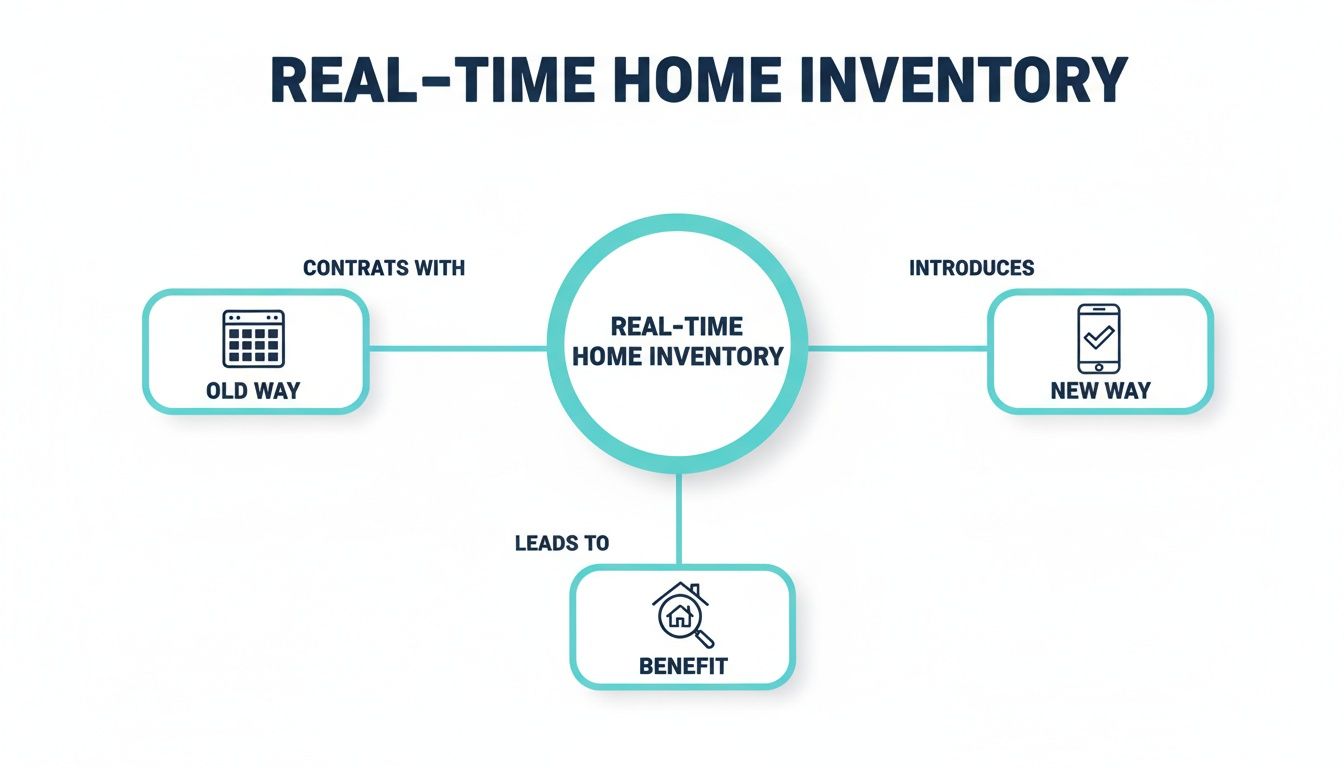
This new way replaces clunky manual tracking, and the biggest win is simple: you can find what you need, when you need it. Let's break down the tech that makes this happen.
Real-Time Sync: The Digital Heartbeat
At the absolute core of any realtime inventory management system is real-time sync. Think of it as a shared digital notebook that updates instantly for everyone in the house.
When you move a box from the basement to the attic and log the change on your phone, your partner sees that update on their tablet at the exact same moment. No lag, no confusion.
This constant connection gets rid of information silos. There’s no more risk of working from an old, outdated spreadsheet because there is only one version of the truth, and it's always live. This digital heartbeat ensures that no matter who makes a change or what device they use, the entire household is perfectly aligned.
AI-Powered Assistants: Image Recognition and Receipt Parsing
Artificial intelligence is what makes modern inventory systems so incredibly easy to use. Instead of fighting with manual data entry, the AI does the heavy lifting for you.
This is especially true in two key areas: recognizing what your items are just from a photo and automatically logging new purchases from your email receipts.
AI Image Recognition: You just snap a photo of an item, like a board game or a power tool, and the AI gets to work. It analyzes the image, identifies the product, and pulls up its name and other details to create a new inventory entry for you. It's like having a personal assistant who knows what everything is just by looking at it.
Automated Receipt Parsing: By connecting to your email, the system can spot new e-receipts from online purchases. When that new kitchen gadget you bought arrives, the app has likely already added it to your inventory, categorized it, and attached the receipt for warranty purposes. All without you lifting a finger.
This isn't just a small convenience; it's what makes maintaining a complete inventory actually achievable. It lowers the barrier to entry, ensuring your catalog grows with you instead of becoming another nagging chore.
To get a sense of the scale, the market for AI in inventory management shot up from USD 7.38 billion to USD 9.54 billion in just one year. That massive growth is a testament to how effective this technology is at solving real-world organization problems.
QR Codes and NFC Tags: The Physical-to-Digital Bridge
While your inventory lives in an app, your belongings are, of course, physical. QR codes and NFC (Near Field Communication) tags are the simple but brilliant tools that bridge this gap. These smart labels create a direct link between a physical container, like a storage bin, and its digital list of contents.
Imagine every box in your garage has a small QR code sticker. Instead of ripping open each one to find your holiday decorations, you just scan the code on a box with your phone. Instantly, a complete list of everything inside appears on your screen.
NFC tags work the same way; just tap your phone near the tag. This simple action turns every closet, shelf, and storage tote into an interactive part of your inventory system.
Let's look at how these pieces fit together.
| Technology | What It Does | Benefit for Your Home |
|---|---|---|
| Real-Time Sync | Instantly updates the inventory across all connected devices. | Everyone in the house sees the same, up-to-the-minute information. No more conflicting lists. |
| AI Image Recognition | Identifies items from a photo to automate data entry. | Saves you from manually typing in names and details. Just snap a picture and you're done. |
| Receipt Parsing | Scans e-receipts to automatically add new purchases. | Your inventory keeps itself updated as you buy things, complete with proof of purchase. |
| QR Codes & NFC Tags | Link a physical box or location to its digital contents list. | Lets you see what’s inside a container without opening it. Just scan or tap. |
Each of these technologies solves a different piece of the puzzle. When they work in concert, they create a system that is not only powerful but also intuitive enough for everyday use.
By putting these tools to work, you can follow our advice on setting up automatic inventory management and build a truly seamless organizational workflow for your entire home.
Why a Smart Inventory Is a True Game Changer
Switching to a real-time inventory system does more than just tidy up your garage; it fundamentally changes how you interact with everything you own. It’s about turning the potential chaos of "stuff" into calm, effortless control. This shift ripples through your finances, your stress levels, and even your relationships. It's a genuine game changer for any household.
The first win is financial, and it’s an immediate one. We've all been there: buying a new pack of AA batteries or a specific lightbulb, only to find a forgotten stash a week later. Those small, unnecessary purchases really add up.
A smart inventory acts as your financial guardrail. Standing in the store, wondering if you’re out of cleaning supplies? A quick search on your phone gives you the answer. This simple check stops you from buying duplicates, making sure you use what you have and spend money on things you actually need.
Reduce Stress and Reclaim Your Time
Beyond the savings, a digital catalog of your possessions is an incredible stress buster. Just think about the last time you tore the house apart looking for an important document, a piece of camping gear, or that one specific cable you know you have somewhere. That frantic energy can derail your morning or an entire weekend project.
A real-time inventory system makes that panic disappear.
With a quick search, the question "Where did I put my passport?" gets answered in seconds, not hours. This isn’t just about convenience; it’s about getting your time and mental energy back for things that actually matter.
Instead of ransacking closets, you just ask your inventory app. Over the course of a year, this frees up countless hours, turning stressful hunts into simple, two-second lookups.
Improve Household Harmony and Accountability
In a family home or an apartment with roommates, managing shared items can be a constant source of friction. Who finished the paper towels? Where did the good tent end up after the last camping trip? Without a clear system, these little mysteries can easily escalate into arguments.
A shared inventory creates a single source of truth that everyone can see.
- Clear Ownership and Location: When everyone knows where shared tools, kitchen gadgets, or sports equipment are supposed to live, it naturally builds a culture of accountability.
- Simplified Coordination: Planning a family vacation is suddenly much easier when you have a definitive list of what you own and where it is. No more last-minute scramble to find the air mattress.
- Reduced Conflict: By making everything transparent, a shared inventory cuts down on the misunderstandings about who’s responsible for what, leading to a much more peaceful home.
This collective visibility gets everyone on the same page, turning potential fights into simple, collaborative tasks.
Prepare for the Unexpected with Confidence
You hope you’ll never need it, but if you do, a detailed record of your assets is invaluable for insurance claims or estate planning. Trying to prove what you owned after a fire, flood, or theft is an overwhelming task, especially when you’re relying on memory alone during a crisis.
A real-time inventory is your comprehensive, digital backup, complete with photos, receipts, and purchase dates. This documentation makes the claims process drastically simpler, helping you recover the full value of your items with far less hassle.
It serves the same purpose for estate planning, providing a clear and organized list of assets for your loved ones. This thoughtful preparation offers immense peace of mind, ensuring you’re ready for life's toughest moments. It transforms a daunting task into a manageable, well-documented process.
Getting Started with Your Smart Inventory System
Jumping into a realtime inventory management system can feel like a huge project, but the secret is to just start small. You don’t need to catalog your entire house in one weekend. By breaking it down into bite-sized steps, you can build an incredibly useful system without getting overwhelmed.
This guide is your roadmap, taking you from the first bit of planning to a fully humming smart inventory that everyone in your house can use.

Step 1: Plan Your Attack
Before you scan a single thing, take a minute to strategize. The best approach is to pick one contained, high-pain-point area. Don't try to tackle the entire garage at once. Instead, zero in on the kitchen pantry, your tool chest, or that one closet that's always a mess.
Choosing a small, specific zone gives you a quick win. That initial success builds momentum and lets you learn the ropes of your inventory app before you dive into bigger, more complicated spaces.
Step 2: Begin Cataloging Your Items
Once you've picked your starting point, it's time to start adding your stuff. This is where modern inventory apps really shine, with features like AI image recognition that can make the process ridiculously fast. As you add items, just be consistent with the details you include.
A great inventory record is more than just a name. It's a useful snapshot that includes a clear photo, where the item is stored, and key details like purchase dates or warranty information.
To make your catalog truly valuable, focus on capturing a few key pieces of information for each item.
- Take a Clear Photo: Good lighting and a simple background make a world of difference. A visual cue is always faster to recognize than reading text alone.
- Add Essential Details: Include the purchase date, price, and any warranty expiration dates. Many apps let you attach digital copies of receipts and user manuals right to an item's entry, which is a lifesaver.
- Be Specific with Locations: Don't just put "Garage." Get granular. Use descriptions like "Garage, Shelf 3, Blue Bin." This is the level of detail that makes finding things effortless later on.
Step 3: Organize Your Physical Space
Your digital catalog and your physical space have to work together. A tidy digital inventory is only as good as the tidy physical space it reflects. Before you can really map everything out, you have to get your actual belongings in order, starting with things like effective closet storage organization ideas. This foundational step ensures your digital map is an accurate mirror of reality.
After you've decluttered, you can bridge the physical and digital worlds using QR codes or NFC tags. These little labels are what make the whole system interactive.
- Generate and Print Labels: Use your inventory app to create unique QR codes for each storage bin, box, or shelf.
- Attach the Labels: Stick the QR code or NFC tag somewhere visible and easy to scan on the container.
- Link the Container: Scan the code with your app. This tells the app that this specific physical container holds a specific digital list of items.
Now, instead of ripping open every box to find that one thing you need, you just scan the label with your phone and see a complete list of everything inside. It’s a game-changer.
Step 4: Build Sustainable Habits
An inventory system is only as good as the information in it. To keep it accurate over time, you need to build simple, sustainable habits for keeping it up to date. The goal isn't to create another chore, but to make updates a natural part of your routine.
Try weaving these small but powerful habits into your day:
- Scan New Purchases: When you bring new stuff home, especially from online orders, use your app's receipt parsing feature to add them automatically. For things you buy in-store, just take a second to scan the receipt or the item itself.
- Update Locations Immediately: If you move something from your office to the basement, update its location in the app right then and there. It takes seconds but is absolutely critical for keeping things accurate.
- "Check Out" Borrowed Items: If a friend borrows a tool, update the item's status. Make a quick note of who has it and when they borrowed it.
Step 5: Share and Collaborate with Your Household
The final step is getting your family or roommates on board. A shared inventory system isn't just about you; it fosters accountability and makes life easier for everyone.
Start by inviting them to your shared inventory through the app. Take five minutes to show them the basics: how to search for things, how to scan QR codes, and how to update an item's location. When everyone is involved, the system stays current and becomes a central, reliable source of truth for the entire household.
How Different Lifestyles Benefit from Smart Organization
A real-time inventory system isn't some rigid, one-size-fits-all tool. Its real power is how it molds itself to your life. From chaotic family homes to the meticulously organized world of a collector, the benefits look different for everyone, solving the unique organizational puzzles we all face. These real-world examples show just how much order a little smart cataloging can bring to any household.
The tech behind it is what makes this flexibility possible. Cloud-based systems are exploding in popularity, with deployments surging at a 14.2% CAGR. For people who move a lot or just love to organize, this means your entire home inventory lives on your phone. You can sync QR-scanned boxes and NFC-tagged shelves instantly across the whole family, unlocking efficiency gains between 20-50%.
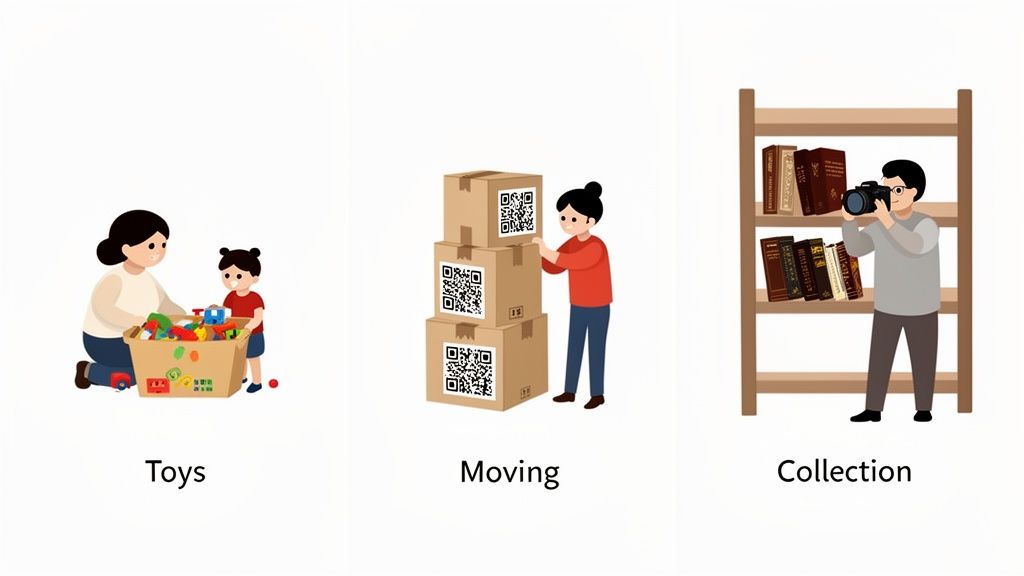
For Busy Parents and Growing Families
For parents, life is a revolving door of gear, toys, and supplies. A smart inventory system becomes a central command center for managing the constant ebb and flow of your kids' belongings.
Picture this: it’s the first cold day of fall. Instead of a frantic, house-tearing search for winter coats and boots, a quick search on your phone tells you they’re in the "Upstairs Hall Closet, Bin 3." The system can also track hand-me-downs, school supplies, and sports equipment, stopping you from buying duplicates and making sure you always know what you have. And for managing groceries, a streamlined pantry is a game-changer. You can pair your digital tools with these smart pantry organization ideas to create a kitchen that actually works for you.
For Frequent Movers and Digital Nomads
Moving is one of the most stressful things we do in life, mostly because of the chaos of packing and unpacking. A QR-coded inventory system completely changes the game.
As you pack, each box gets its own QR code. You snap a few photos of the contents, link them to that code in your app, and seal it up. When you land in your new home, you don’t have to rip open every single box just to find the coffee maker. You just scan the codes until you find what you need, making those first few days feel calm and organized instead of completely overwhelming.
For Meticulous Collectors
If you collect rare books, antiques, or vintage toys, you need more than a simple list; you need a detailed archive. A real-time inventory app provides a secure, digital catalog for your most prized possessions.
For a collector, an inventory system is not just for organization. It's a comprehensive record for insurance, appraisal, and posterity, preserving the value and story of each item.
Each entry can hold high-resolution photos, purchase receipts, appraisal documents, and detailed notes on an item's condition and history. This level of documentation is critical for insurance purposes and gives you peace of mind, knowing every important detail is safely stored and just a tap away.
For Roommates in Shared Households
In a shared living space, keeping track of common supplies can quickly turn into a source of conflict. A synced inventory creates transparency and cuts through the confusion.
Roommates can use a shared digital list to track household essentials like cleaning supplies, paper towels, and shared kitchen gadgets. When someone uses the last of the dish soap, they just update its status in the app, instantly adding it to a live shopping list. This simple system makes sure everyone chips in fairly and finally ends the recurring "who finished the milk?" argument. It's a small change that fosters a much more harmonious home for everyone.
Choosing the Right Home Inventory App for Your Needs
With a ton of options out there, picking the right app is the first real step toward getting your home organized for good. Let’s be honest, not all tools are created equal. The best choice for you hinges on a specific set of features that actually support a real-time inventory management system.
Think of it this way: you’re looking for a partner in organization, not just a digital list you'll abandon in a few months.
The global inventory management software market is expected to explode from USD 2.38 billion to USD 8.48 billion by 2035, growing at a blistering 13.1% CAGR. While big businesses are driving that boom, the powerful tech is finally trickling down to homeowners. You can dig into these market trends and their impact if you're curious.
Core Features You Cannot Compromise On
Before you get dazzled by flashy extras, there are a few foundational features that are absolutely non-negotiable. Without these, an app is more trouble than it's worth.
- Seamless Real-Time Sync: This is the big one. The app must instantly update changes across all your devices and for everyone you share it with. If your partner adds something, you should see it immediately. No exceptions.
- Cross-Platform Availability: Your inventory isn't just a spreadsheet you look at on your computer. You need a robust web app for heavy lifting and a full-featured mobile app for scanning items as you put them away.
- Powerful Search Functionality: A great app feels like Google for your stuff. You should be able to find an item instantly by its name, location, or even a descriptive tag. Fast and accurate is the name of the game.
- Unlimited Item Capacity: Your collection of things will grow. Avoid apps that put a restrictive cap on how many items you can track. You need a system that scales with you, not one that holds you back.
A truly effective inventory app doesn't just store a list of your items; it acts as an intelligent, interactive database that saves you time and reduces stress. The right features make all the difference between a helpful tool and a digital junk drawer.
Advanced Capabilities for Long-Term Value
Once you've nailed down the basics, look for the features that turn a simple list into a powerhouse management tool. These are the capabilities that provide real, long-term value.
- Sharing with Permission Controls: Being able to share your inventory with family or roommates is key. But you also need control. The best apps let you decide who can just view items versus who can add or edit them.
- Robust Security Protocols: You're cataloging valuable information about your belongings. Don't settle for anything less than end-to-end encryption to protect your data, both when it's sitting on a server and when it's moving between your devices.
- Automated Data Entry: This is a game-changer. Features like AI-powered image recognition and automated receipt parsing slash the time you spend on manual entry. Adding new stuff becomes so fast and simple that you'll actually keep up with it.
- Document and Warranty Tracking: The ability to attach receipts, user manuals, and warranty details directly to an item’s entry is incredibly useful. It transforms your inventory into a central hub for everything related to your possessions.
For a detailed breakdown and comparison, check out our guide on the best app for home inventory.
Got Questions? We've Got Answers
Stepping into a new way of managing your home always brings up a few questions. It’s natural. Here are some of the most common things people ask when they're getting started with a realtime home inventory, along with straightforward answers to give you confidence.
Is It a Lot of Work to Catalog Everything I Own?
The idea of documenting everything you own at once sounds like a mountain of a task, doesn't it? But here’s the secret: you don’t do it all at once.
The best way to start is to start small. Seriously. Pick one spot, perhaps the kitchen pantry, a cluttered closet, or that one drawer everyone's afraid of. Modern apps use things like AI image recognition that make adding items surprisingly quick. Once you see how much time and stress you save in that one small area, you’ll actually want to tackle the next one. The upfront effort pays off faster than you'd think.
How Secure Is My Home Inventory Data?
This is a big one, and it should be. Your privacy is everything. Reputable inventory services are built from the ground up with security in mind. You should always look for a platform that uses end-to-end encryption. This is the same level of security your bank uses, scrambling your data so only you can access it, whether it's stored on a server or being sent to your phone.
Before committing, take a minute to read the platform's privacy policy. Make sure they state clearly that your data won't be sold or shared. Choosing a service that’s transparent about its security is non-negotiable for your peace of mind.
A secure system means your detailed home inventory remains exactly that: yours. It’s a private record, and the right platform will use strong encryption to keep it that way, protecting your information from unauthorized access.
Can My Family Members Access and Update the Inventory?
Absolutely, and this is where the magic really happens. A good realtime inventory system isn't just for one person; it's designed for the whole household to use. You can easily invite your partner, kids, or even roommates to join your inventory.
Look for apps that offer different permission levels. This lets you control who can just look at things and who has the power to add, edit, or move items. It’s this shared, collaborative part that stops you from buying a third jar of paprika and finally settles the "where did we put the spare batteries?" debate for good.
Ready to finally conquer your clutter and know where everything is, instantly? Vorby uses AI-powered tools like image recognition and receipt parsing to make cataloging effortless. Start your free 14-day trial today and see the difference for yourself.