Let’s be honest. That feeling of staring at a mountain of unlabeled boxes after a big move is pure dread. Wondering where you packed the winter coats or the good coffee mugs is a frustrating, all-too-common ritual. This is exactly why a smart approach to storing your stuff has become such a game-changer.
The chaos that takes over our closets and garages isn't unique. It actually mirrors the same challenges faced by massive global industries. The warehousing and storage market was valued at an eye-watering $523.8 billion in 2024 for a reason: everyone, from giant corporations to regular homeowners, is desperate for efficiency.
That number is expected to climb to $716.1 billion by 2033, driven by the relentless demands of e-commerce. You can see more data on this industry's explosive growth at the IMARC Group's website. For us at home, this parallel is simpler: disorganized items lead to wasted time, wasted space, and a whole lot of unnecessary stress.
The Modern Fix for an Age-Old Problem
The good news? You no longer need a commercial warehouse system to bring order to your home. Modern tech, especially AI-powered apps, puts professional-grade organization right in the palm of your hand. These tools are built to make a seamless system achievable for anyone, whether you're a busy parent juggling daily essentials or a collector protecting priceless valuables.
This guide is your complete blueprint for mastering your household inventory. We’ll walk through everything you need to know:
- Physical Storage Principles: How to choose the right containers, shelving, and climate controls to keep your belongings safe.
- Digital Labeling Systems: Using tools like QR codes and box mapping so you know what’s inside a container without ever having to open it.
- Protecting Your Valuables: Special techniques for preserving collectibles and keeping track of critical documents like warranties.
- An Actionable Workflow: A simple, step-by-step process for cataloging your items and, more importantly, maintaining your new system.
The goal here isn't just to tidy up. It's to transform the overwhelming task of organizing into a simple, manageable process that actually sticks. By blending smart physical storage with a digital "brain," you create a system that works for you, not against you.
Ultimately, this blueprint will help you move from a state of clutter and confusion to one of clarity and control. You'll always be able to find what you need, exactly when you need it.
Mastering Your Physical Storage Space
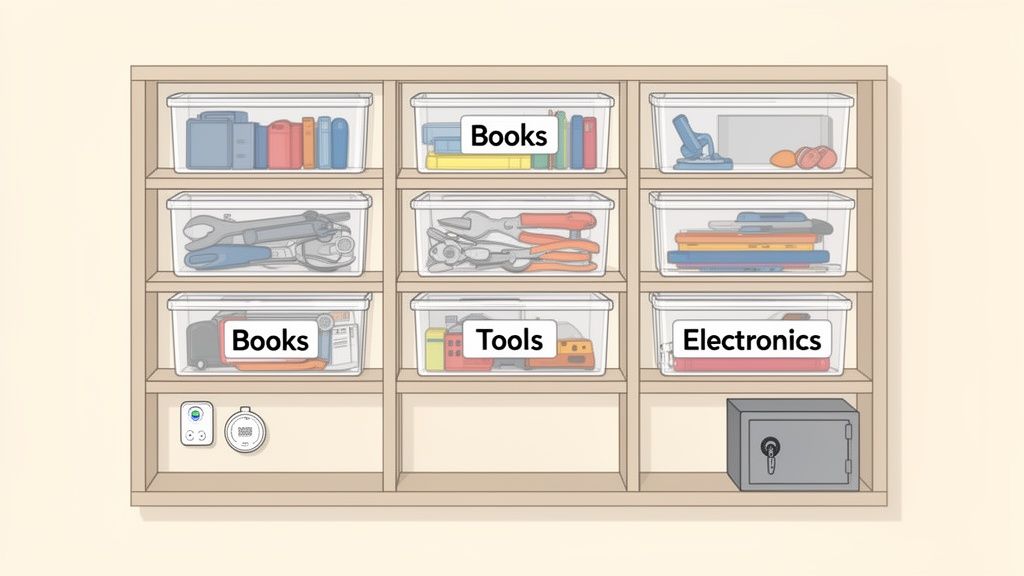
Before you ever scan a QR code or snap a picture, your home inventory system begins in the real world, with your physical storage. Getting this right is the foundation for everything else. When your belongings have a proper home, cataloging them becomes almost effortless and finding them again is a breeze.
Think of it like building a personal library. Your possessions are the books, and the shelves and containers are the infrastructure that keeps everything orderly, safe, and easy to grab. A poorly chosen container can ruin a delicate item, and a disorganized layout is just a frustrating waste of space.
This section is all about getting that foundation right. We'll cover everything from picking the right bins to taming your climate, making sure your stuff is protected and always within reach.
Choosing the Right Storage Containers
The first and most important decision is what you’ll put your stuff in. The right container can be the difference between preserving an item for years and finding it ruined by light, moisture, or pests.
Clear plastic bins are a go-to for a reason: you can see what’s inside instantly. They're perfect for things you access regularly, like the kids’ craft supplies or holiday decorations.
But for light-sensitive treasures, like old family photos, vintage clothing, or important documents, opaque containers are your best friends. They shield contents from the fading and damage caused by sunlight or even harsh indoor lighting. And for anything you really want to protect from the elements, airtight containers are essential for locking out moisture, dust, and critters.
To help you make the right call, here’s a quick breakdown of your options.
Choosing the Right Storage Container
| Container Type | Best For | Pros | Cons |
|---|---|---|---|
| Clear Plastic Bins | Holiday decorations, toys, pantry items | Easy to see contents at a glance | Can cause fading for light-sensitive items |
| Opaque Plastic Bins | Photos, textiles, documents | Protects from light damage, often more durable | Requires excellent labeling to find items |
| Airtight Containers | Seasonal clothing, electronics, food storage | Seals out moisture, dust, and pests | Can be more expensive than standard bins |
| Cardboard Boxes | Short-term moves, non-sensitive items | Inexpensive and readily available | Not durable, susceptible to moisture/pests |
A well-chosen container acts as the first line of defense for your belongings. By matching the container to its contents, you extend the life of your items and simplify the entire storage of inventory process.
Of course, even the best bins are useless without a clear labeling system. For a deep dive on that, check out our guide on the https://vorby.com/blog/best-way-to-label-storage-bins, which covers everything from simple markers to digital tags.
Optimizing Your Space with Shelving
Just stacking bins on the floor is a recipe for disaster. You create a teetering tower of frustration where the one thing you need is always, inevitably, at the very bottom.
In the logistics world, this inefficient use of space is called "honeycombing," and it can kill 16% to 30% of usable capacity in a warehouse. The same principle applies to your garage or basement. The solution is simple: go vertical.
Shelving is your best friend in the fight for space. Here are a few solid choices:
- Heavy-Duty Garage Racks: These steel beasts are built for heavy bins, power tools, and tubs of automotive supplies. Don't be shy about loading them up.
- Modular Closet Systems: Perfect for inside the house, these systems let you customize shelf and rod heights for clothing, linens, or your ever-growing collection of hobby supplies.
- Floating Wall Shelves: For smaller spaces or items you need to grab often, getting things off the floor and onto the wall is a game-changer.
Thinking about the cost of self-storage can be a great motivator to really max out the space you already own. Every square foot you reclaim at home is money saved.
Ultimately, good shelving turns a cluttered pile into an organized, accessible library of your possessions. No more unstacking five heavy boxes just to get to one thing.
The Digital Brain for Your Physical Stuff
Alright, you’ve got your bins sorted and your shelves in order. That’s the hard part done, right? Well, almost. Now it's time to add the digital brain that makes the whole system work. This is where we go way beyond a Sharpie and some masking tape. The real goal here is to connect your physical items to a digital record, ending that frustrating game of opening six different boxes just to find one thing.
Think of it this way: your shelves and containers are the hardware. The digital layer is the software, the intelligence that tells you exactly what’s where, instantly. It turns a static pile of boxes into a dynamic, searchable database of your life's stuff.
This is what makes a truly modern system for the storage of inventory not just possible, but easy.
Supercharge Your Labels with QR Codes and NFC Tags
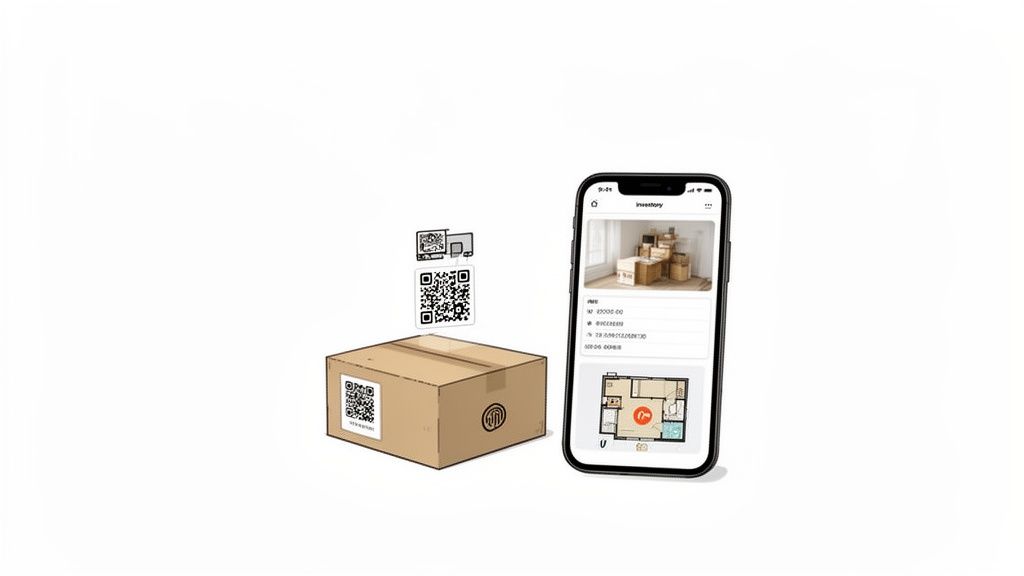
A handwritten label is fine, but it can only tell you so much. A QR code or an NFC tag, on the other hand, can tell you a whole story. These little digital triggers are gateways to incredibly detailed records about what’s inside any given box or bin.
With a quick scan of your phone, you can pull up a complete list of everything inside, complete with photos, when you bought it, and even warranty info. No more squinting at a faded label that just says "Kitchen Stuff."
Here’s how these little wonders transform your setup:
- QR Codes: You know these black-and-white squares. Just print them on some cheap adhesive labels and stick one on each container. Scan it with your phone, and boom, it opens that box’s specific inventory list in an app like Vorby.
- NFC Tags: Near Field Communication tags are small, passive chips you can just tap with your phone. They’re even faster and more seamless, perfect for cabinets or bins you get into all the time.
This isn't some futuristic fantasy; it’s the same logic that powers massive commercial logistics. The global warehousing market, which hit around USD 1.08 trillion in 2024, is expected to jump to USD 1.72 trillion by 2030, mostly thanks to automation and AI. Tools like QR scanning bring that same professional-grade efficiency right into your garage. If you're curious about the numbers, you can explore comprehensive warehouse statistics from Speed Commerce.
The Power of Digital Box Mapping
Beyond just knowing what's in a box, a truly smart system uses box mapping. This is just a fancy way of saying you create a simple digital map of your storage area, such as your garage, attic, or closet.
Now, instead of just knowing the camping gear is in the green bin, you know exactly where that bin is located. An inventory app can show you a visual layout of your storage room, highlighting the precise shelf where you’ll find what you need.
Box mapping is like having a GPS for your belongings. When you need to find your camping gear, the app doesn’t just tell you it’s in "the green bin"; it shows you that the green bin is on the top right shelf in the back of the garage.
This visual approach is a total game-changer, especially if you have a packed-out basement or an off-site storage unit. It eliminates all the guesswork and makes finding things ridiculously easy. When you pair this with the right home inventory software, the whole process feels less like a chore and more like a superpower.
Creating an Inventory That Actually Stays Updated
When you combine digital tags with box mapping, you create an interactive inventory. This is a world away from a static spreadsheet or a paper list that's out of date the second you write it.
With a digital system, making changes is simple. When you take something out of a box or add a new item, just scan the QR code, tap a button in your app, and the record is instantly updated for everyone in the family. This real-time sync is a lifesaver for shared spaces like the pantry or the tool shed.
This approach ensures your inventory is a reliable, living document that reflects reality. It’s the end of outdated lists and the headache of searching for something that isn’t even there anymore. Your system for the storage of inventory finally becomes a dependable source of truth for your entire home.
Protecting Your Valuables and Collectibles

Let's be honest, not everything in your home is created equal. A spare set of bedsheets is perfectly happy folded in a plastic bin. But your grandmother’s wedding photos, that collection of vintage comic books, or a prized bottle of wine? Those items demand a completely different level of care.
For these treasures, storage of inventory isn't just about tidiness; it's about active preservation. Think of yourself as the curator of your own personal museum. Each irreplaceable item has enemies, things like light, humidity, and extreme temperatures, that can cause irreversible damage over time.
This is about defending your most important possessions. We'll dive into the specific techniques for both physical preservation and the digital documentation you absolutely need for insurance and peace of mind.
Preservation Techniques for Different Collectibles
The first rule of protecting valuables is to know what you're up against. For most collectibles, the biggest threats are light, moisture, fluctuating temperatures, and acidic materials. Each type of item needs a slightly different defense strategy.
Paper-based items like old photos, trading cards, or first-edition books have one primary foe: acid. The standard cardboard boxes and paper sleeves you might use for other things contain acids that will slowly yellow and eat away at paper fibers, destroying them from the inside out.
Your job is to create a safe, stable environment. Here are some battlefield-tested tips for common collectibles:
- Photographs and Documents: Always, always use acid-free and lignin-free folders and boxes. These archival-quality materials create a neutral home for your paper goods, stopping chemical damage in its tracks.
- Vintage Textiles and Clothing: Store delicate fabrics in breathable, acid-free boxes or unbleached muslin bags. Plastic is a no-go; it traps moisture and is a breeding ground for mildew.
- Wine Collections: Wine is incredibly sensitive. It hates light, vibration, and temperature swings. A dedicated wine cooler that maintains a rock-solid temperature (around 55°F or 13°C) and humidity is non-negotiable for proper aging.
- Trading Cards and Comics: Double down on protection. Start with individual sleeves made of polypropylene (a stable, safe plastic), then place them in rigid, top-loading cases to prevent bent corners and creases.
For smaller treasures, something like a banded onyx jewelry box can keep precious accessories safe, organized, and beautifully contained.
The Digital Safeguard for Insurance and Appraisals
Physical preservation is only half the battle. What if the unthinkable happens, such as a fire, a flood, or a theft? Without rock-solid proof of what you owned and what it was worth, filing an insurance claim becomes a nightmare. This is where your digital inventory becomes your most powerful financial shield.
A detailed digital catalog isn't just a list; it's indisputable evidence. The more detail you include, the stronger your position.
Your digital inventory is your financial first responder. By meticulously documenting valuables before a disaster, you ensure you can recover their full value after one.
For every single high-value item, your digital record needs to include:
- High-Resolution Photographs: Get clear shots from every angle. Be sure to capture any signatures, serial numbers, or unique identifying marks.
- Purchase Receipts: Scan or snap a photo of the original receipt. This is your proof of ownership and original cost.
- Appraisal Documents: If you’ve had an item professionally appraised (a must for art, antiques, and fine jewelry), that official document is gold. Upload it immediately.
- Certificates of Authenticity: For any collectible, these certificates are crucial for proving provenance and establishing its market value.
Creating a dedicated system for these items is essential. For serious collectors, it's worth learning more about specialized tools for managing a fine art inventory to bring a professional, structured approach to your assets.
Tracking Warranties and Manuals for Appliances
That same digital-first mindset applies to another class of valuables: your major appliances. Your refrigerator might not be a family heirloom, but its warranty and manual are important documents that almost always end up lost in a cluttered drawer.
When you add appliances to your digital inventory, you can attach PDF copies of their manuals and set reminders for warranty expiration dates. A smart inventory app can ping you a month before a warranty runs out, giving you time to act if needed.
It’s a simple step that can save you hundreds in repair costs and endless frustration when you can't find the manual. This transforms your inventory from a passive list into an active household management tool that protects the everyday investments that keep your home running.
How Vorby Ties It All Together
So far, we've walked through the fundamentals of a solid home inventory system, from mastering your physical space to creating a digital "brain" for all your belongings. Now, let's connect the dots. A tool like Vorby is designed to merge all these concepts into a single, seamless system, turning good theory into dead-simple practice.
Instead of wrestling with separate spreadsheets, clunky labeling methods, and disorganized shelves, think of Vorby as the central nervous system for your home. It’s the bridge between the physical item sitting in a box and the digital data that makes it findable in seconds.
Let’s walk through how Vorby makes this happen, transforming the chore of storing your inventory into something you barely have to think about.
Let AI Do the Heavy Lifting: Automatic Cataloging
Let's be honest: the biggest reason most people never start an inventory is the soul-crushing thought of manually typing in every single thing they own. That's where the friction is. Vorby is built to eliminate that friction entirely.
Imagine you just got home from a shopping trip. Instead of sitting down to log your new purchases, you just snap a picture of them.
- AI-Powered Photo Recognition: Vorby’s image recognition gets to work, analyzing the photo to identify each item. It recognizes that new pair of headphones or that kitchen gadget, automatically creating an entry for it, often pulling the product name and other details without you lifting a finger.
- Email Receipt Parsing: For online shopping, it's even more hands-off. You can connect Vorby to your email, and it will automatically scan your digital receipts from retailers. It pulls the product name, purchase date, and price, creating a new inventory entry before the package even lands on your doorstep.
This approach means your inventory is always current with almost zero effort on your part. It turns a massive, daunting project into a simple background process.
Map Your Home with Digital Precision
Once your items are logged, Vorby helps you link them to their physical spots using the QR codes and NFC tags we talked about. The app lets you generate and print unique QR codes to stick on any box, bin, or shelf.
When you pack a container, you just scan its QR code with your phone and add the items to it right there in the app. From that moment on, a quick scan is all it takes to see a complete, photo-rich list of everything inside. It’s box mapping without the guesswork.
Ever buy a second jar of paprika because you couldn’t find the first one buried in your pantry? That small annoyance is a massive problem on a larger scale. Poor inventory management costs businesses billions. The global inventory optimization market, powered by software like Vorby, is projected to explode from USD 5.87 billion in 2025 to USD 12.42 billion by 2032. You can learn more about this growth from a detailed inventory optimization market analysis by Coherent Market Insights. Vorby brings that same enterprise-level efficiency right into your home, helping you stop wasteful duplicate purchases.
Find Anything Just by Asking
This is where it all pays off. Your inventory is built, your boxes are mapped, and everything is in its place. Now, you actually need to find something. Instead of racking your brain trying to remember where you stashed that specific item, you just ask Vorby a simple question.
You can literally ask your phone, "Where are my headphones?" Vorby instantly searches your entire inventory and tells you they're in the "Electronics Bin," which is on the "Top Shelf" of the "Office Closet."
This natural language search changes everything. It completely removes the mental load of having to remember where hundreds of items are located, giving you a personal search engine for your physical world.
It's also a game-changer for shared households. Because Vorby supports shared inventories, everyone in the family can see and update the system in real time. When your partner adds new items to the pantry, you see the update instantly. This shared brain puts an end to the endless "Honey, have you seen my...?" questions for good.
Your Step-by-Step Home Inventory Workflow
Knowing the theory is one thing, but actually putting it into practice can feel like trying to climb a mountain. Where do you even begin?
The key is to forget the mountain and focus on the first few steps. Break the entire process down into a simple, repeatable workflow. This is your practical playbook for turning the abstract idea of "getting organized" into a concrete, achievable plan.
Let’s build a system that gives you total control over the storage of inventory in your home, one step at a time.
Step 1: Declutter and Sort
Before you catalog a single item, you have to decide what’s worth keeping. The first and most important step is always to declutter. Trying to organize stuff you don’t need, want, or use is a massive waste of time and space.
To avoid getting overwhelmed, tackle one room, or even just one closet, at a time. Set up three distinct piles: Keep, Donate, and Discard. Now, be ruthless. If you haven't used it in the last year and don't have a specific plan for it, it’s probably time to let it go.
This initial purge is the foundation for everything that follows. It radically simplifies the next steps by shrinking the sheer volume of things you need to manage.
Step 2: Choose Your Physical Storage
With your "Keep" pile ready, it's time to give everything a proper home. Start by grouping similar items together, like all the camping gear or all the winter clothes, you get the idea. Then, pick out the right containers and shelving for each group, just like we discussed earlier.
Remember to match the container to its contents. Clear bins are perfect for things you access often, while opaque, airtight containers are better for protecting sensitive belongings like old photos or electronics. This is the physical backbone of your entire system.
Step 3: Catalog as You Pack
Here comes the digital magic. Instead of packing everything up and then trying to remember what's inside, do both at the same time. As you place items into a container, use an app like Vorby to snap photos and add them to that specific container’s digital inventory.
This method is a game-changer for accuracy. It saves you from doing the work twice and creates a perfect record of each box's contents at the exact moment you're packing it.
The process inside an app is incredibly simple.
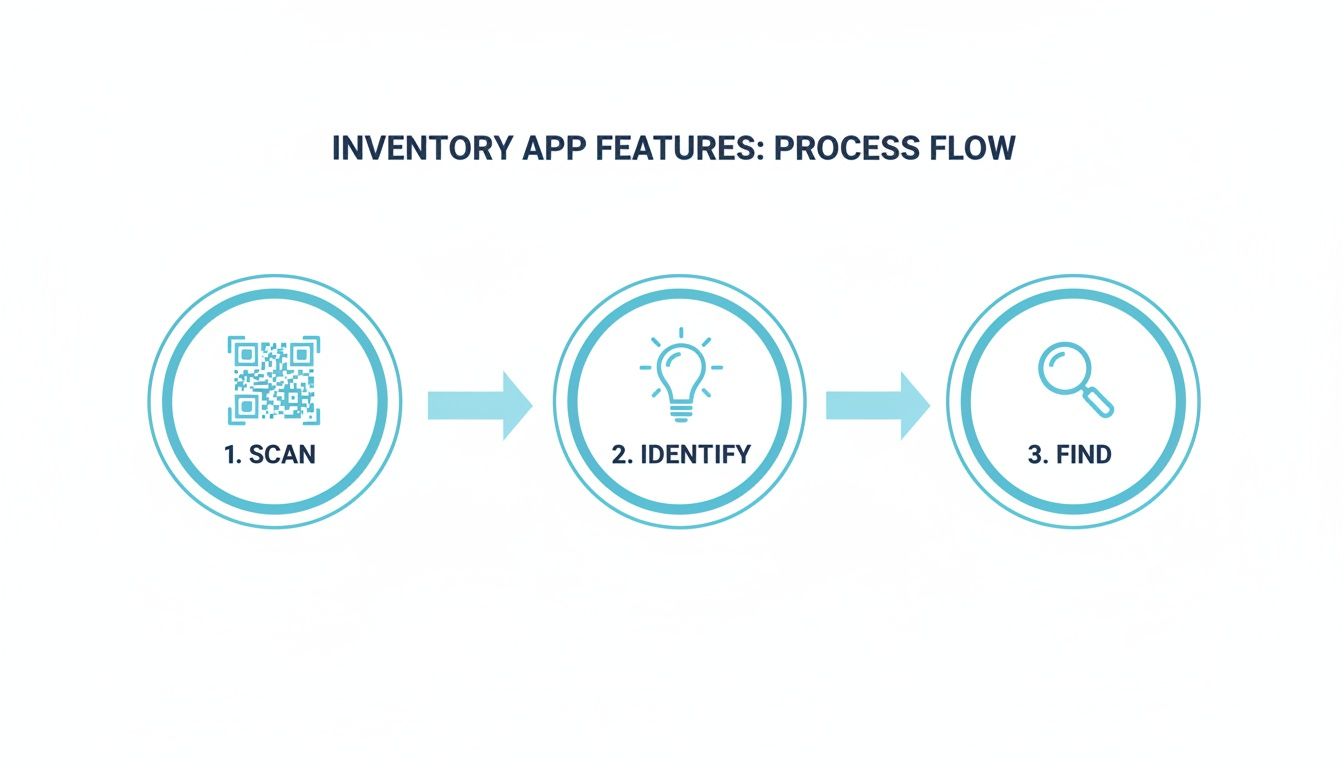
This Scan, Identify, and Find loop is the core of what makes a digital inventory so powerful. You're just a quick scan away from knowing exactly what’s inside any box.
By integrating cataloging directly into your packing process, you turn a tedious task into a simple, efficient habit. This small shift in workflow is the secret to building an inventory that actually gets finished.
Step 4: Label Everything Digitally
With the contents of a box cataloged, the final move is to stick a QR code on the outside. Be consistent; always place the label in the same easy-to-see spot on every container.
Just like that, the physical box is now digitally linked to its detailed inventory list. No more guessing games; just scan the code with your phone and see everything inside.
Step 5: Maintain Your System
A home inventory isn't a "one and done" project; it's a living system. To keep it useful, you have to make cataloging a habit.
When you bring a new item home, take a minute to add it to your system. When you use something up, sell it, or donate it, remove it from the digital record. This small, ongoing effort is what keeps your inventory reliable and turns it into a true source of truth for your entire household.
Got Questions? We've Got Answers
Even with the best game plan, taking on a home inventory can feel a little intimidating. A few nagging questions can be all that stands between you and getting started. Let’s clear up some of the most common hurdles we see people face.
How Often Should I Actually Update This Thing?
There's no single magic number here, it’s all about your lifestyle. The most effective approach is a combination of routine check-ins and real-time updates when life happens.
- The Annual Check-Up: At a bare minimum, block out time for an annual review. This is your chance to do a full audit, get rid of items you've sold or donated, and make sure what's in your app perfectly matches what's on your shelves.
- Update as Life Unfolds: Don't wait a whole year if something big changes. Get in the habit of updating your inventory right after major events. Think big moves, a kitchen renovation, or after the gift-apalooza of a wedding or baby shower.
My House Is a Total Disaster Zone. Where Do I Even Begin?
The thought of cataloging a whole house full of chaos can be paralyzing. So here's the secret: don't even try. The key is to start ridiculously small.
Forget the garage, forget the attic. Pick one drawer. Just one. Or that one small closet under the stairs. The goal isn't to conquer the entire house today; it's simply to get one small win. Nailing that tiny area builds momentum and proves the system works, making the next step feel way less overwhelming.
Don’t try to boil the ocean. Start with a teacup. Successfully inventorying a single junk drawer from start to finish is the proof of concept you need to keep going.
Is It Really Secure to Put All My Valuables in an App?
That's a smart question. When you're cataloging your most valuable possessions, security is non-negotiable. Any reputable home inventory app takes this incredibly seriously. You'll want to look for platforms that offer end-to-end encryption. This basically means your data is scrambled into an unreadable code from the moment it leaves your phone until you access it again.
This level of security ensures that only you, and anyone you explicitly authorize, can ever see your information. Always go with a service that's upfront about its security practices. This is about protecting the sensitive details of everything you own.
Can I Get My Family on Board with This?
Absolutely, and honestly, this is where a digital system really shines. The days of one person being the "keeper of all household knowledge" are over.
Modern inventory apps are built for teamwork. You can invite your spouse, kids, or roommates to a shared inventory where everyone can see and update items in real time, right from their own phones. You can even set permissions, giving certain people view-only access or full editing rights. It creates a single, reliable source of truth for the whole house, finally putting an end to the endless "Honey, where's the...?" game.
Ready to stop searching and start finding? Vorby transforms your chaotic closets into a searchable database. With AI-powered cataloging, smart QR labels, and a system the whole family can use, you’ll never lose track of your things again. Start your free trial and experience effortless organization at https://vorby.com.