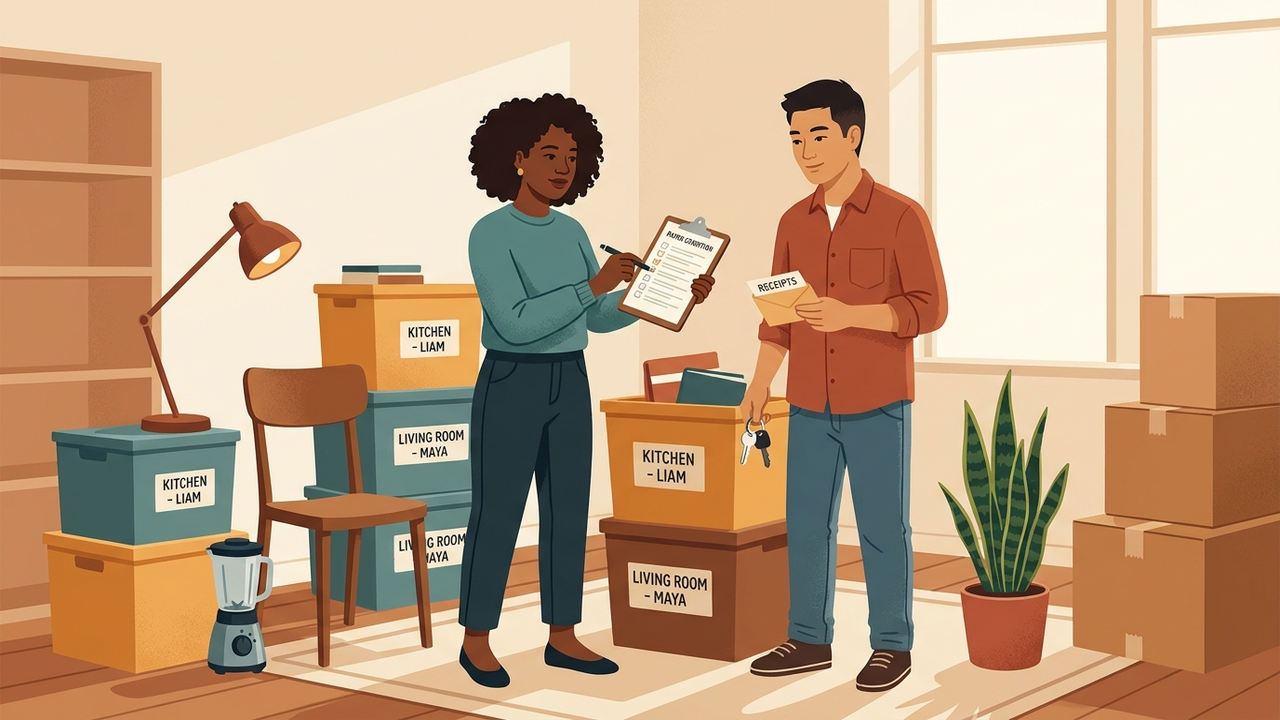
A roommate move out inventory turns the last chaotic weeks of a shared lease into a documented handoff. Instead of arguing over a scratched floor, a missing kitchen appliance, or an unexplained security deposit deduction, roommates can compare dated photos, ownership notes, receipts, cleaning records, and the lease.
That record matters because move-out combines several different questions at once. What condition is the rental in? Which belongings leave with each person? Who owns the furniture everyone used? Who paid what portion of the deposit? If the landlord deducts money, which roommate is responsible? Treating all of that as one conversation almost guarantees confusion.
The better approach is a short, shared process. Build the evidence before boxes hide the rooms, separate property ownership from rental damage, document the final condition, and agree in writing on how refunds or deductions will be divided. This guide shows roommates how to do that without turning move-out into a trial.
Why roommate move-outs create deposit disputes
Shared housing is common, but most rentals are not managed like shared systems. Pew Research Center reported that nearly 79 million U.S. adults lived in shared households in 2017, representing 31.9% of adults. The U.S. Census Bureau reported 45.6 million renter-occupied homes in 2023. Millions of renters are therefore managing leases, possessions, and move-outs in homes where more than one person may be responsible.
The lease may make every named tenant responsible to the landlord, while the roommates have a completely different understanding among themselves. One roommate may have paid the full deposit and collected shares later. Another may have moved in mid-lease. A third may own nearly all the living room furniture. Those arrangements feel obvious while everyone lives together, then become surprisingly hard to reconstruct after people start packing.
One move-out contains three separate inventories
A useful move-out record is really three inventories. The first is the rental condition inventory, which covers walls, floors, fixtures, appliances, keys, and cleanliness. The second is the belongings inventory, which identifies personal, shared, borrowed, and landlord-owned items. The third is the financial inventory, which records deposit contributions, shared purchases, reimbursements, repair costs, and the final refund.
Keep those records connected, but do not blend them. A roommate taking a personally owned couch has nothing to do with a landlord charging for wall damage. A jointly purchased microwave should not be treated as part of the deposit. A cleaning bill may affect everyone, while a broken bedroom door may belong to one person. Separation makes the final math fairer.
Memory gets worse as the deadline gets closer
Move-out is a poor time to rely on memory. Rooms change quickly, boxes block surfaces, people leave on different dates, and the person who remembers a purchase may already be in another city. Even honest roommates can recall the same event differently. The move-in photos are on one phone, the couch receipt is in another person's email, and the landlord's checklist is buried in a portal nobody has opened for a year.
Start the record two to four weeks before the first roommate leaves. If the household already created a roommate move-in inventory, duplicate it as a move-out snapshot rather than editing the original. The baseline and final condition need to remain visible side by side.
Deposit rules depend on where you live
Security deposit laws vary by state and sometimes by city. For example, the New York Attorney General explains that many tenants can request a pre-move-out inspection and receive an itemized statement for deductions. California's Department of Real Estate describes different deadlines and photo requirements. These examples are useful because they show why roommates should check their own lease, state attorney general, housing department, tenant clinic, or local law before assuming a deadline.
This guide provides a documentation and household-management process, not state-specific legal advice. Use local rules to set dates for notice, inspection requests, forwarding addresses, deposit returns, and any written challenge to deductions.
The deposit conversation gets easier when every claim points to a date, a photo, a receipt, or a written agreement instead of a roommate's memory.
Build the shared move-out record before packing
The goal is not to photograph every spoon. The goal is to capture the facts most likely to affect money, ownership, or responsibility. Create one shared move-out folder or household inventory that every departing roommate can access. Give it a clear name, such as “Oak Street Move-Out, November 2026,” and keep the original files rather than screenshots of screenshots.
Gather the lease, baseline, and payment history
Start with the documents that define the household's starting point. Add the signed lease and renewals, roommate agreement, move-in checklist, deposit receipt, pet deposit record, landlord emails, maintenance requests, and any photos or videos from move-in. Include written approval for paint, shelves, pets, locks, fixtures, or other changes that could otherwise look like unauthorized damage.
Then record the deposit history in a simple ledger:
- Total deposit held by the landlord: Use the lease, receipt, or property portal, not a remembered number.
- Each roommate's contribution: Record the date, amount, payment method, and recipient.
- Later transfers: Note buy-ins, buyouts, sublet arrangements, pet deposits, and reimbursements when roommates changed.
- Outstanding balances: Identify unpaid utilities, rent, repairs, or shared purchases separately from the deposit.
This ledger prevents a common mistake: dividing the refund equally even though the original contributions were not equal. It also reveals whether one roommate still owes another before the landlord's refund arrives.
Create a room-by-room condition checklist
Walk through the rental in a fixed order, ideally the same order used at move-in. Cover the entry, living room, kitchen, bedrooms, bathrooms, hallways, closets, laundry area, balcony, garage, storage cage, parking area, and yard if applicable. For each area, record four things: current condition, comparison with the move-in baseline, work still needed, and the person responsible for that work.
- Walls and ceilings: Holes, stains, peeling paint, unauthorized colors, water marks, and smoke residue.
- Floors: Scratches, carpet stains, burns, cracked tile, pet damage, and areas hidden under rugs.
- Doors and windows: Locks, screens, blinds, tracks, handles, broken glass, and missing hardware.
- Fixtures and appliances: Lights, fans, outlets, faucets, drains, toilets, stove, refrigerator, dishwasher, washer, and dryer.
- Cleanliness: Grease, dust, soap residue, trash, abandoned food, adhesive, and personal belongings.
- Access items: Keys, fobs, remotes, parking passes, mailbox keys, and amenity cards.
Use precise notes. “Three nail holes above desk in bedroom two” is useful. “Wall bad” is not. If the group needs a broader method for documenting possessions as well as condition, the renters home inventory guide explains how to connect photos, ownership, receipts, and insurance records.
Take evidence that another person can understand
Photograph each room from the doorway and opposite corner, then take close-ups of damage or repaired areas. Include a wider context photo before every close-up so a landlord, roommate, mediator, or judge can identify the location. Use short videos to show appliances operating, drains flowing, windows locking, and empty storage spaces.
Keep original metadata and add filenames or notes that describe the room and subject. A file named “IMG_8421” is easy to lose. “Kitchen, cleaned oven interior, final day” is understandable. Do not use filters, heavy edits, or cropped images that remove context. If possible, have two roommates present during the walkthrough and note the date and attendees.
Sort belongings, shared purchases, and receipts
Rental condition is only half of a roommate move-out. The other half is deciding what leaves, what stays, what gets sold, and what needs to be returned. Shared use often disguises ownership. Everyone may use the couch, television, vacuum, router, pans, and tool kit, but that does not mean everyone owns them.
Assign every disputed item to one ownership category
Use five categories: personal, jointly purchased, landlord-owned, borrowed, and unknown. Start with expensive, shared, sentimental, or frequently borrowed items. Cheap items can be grouped by category, but do not skip something simply because it lives in a common room.
- Personal: One roommate owns it and can show a receipt, prior photo, gift history, or agreement.
- Jointly purchased: Two or more roommates contributed money with an expectation of shared ownership.
- Landlord-owned: It came with the rental and must remain, even if roommates improved or maintained it.
- Borrowed: It belongs to a friend, relative, former roommate, employer, or other outside owner.
- Unknown: Nobody can establish ownership yet, so it stays out of moving boxes until resolved.
A shared record helps because people can see the same evidence. Vorby's guide to inventorying shared household items offers practical methods for tracking owner, location, receipt, and household status without cataloging every low-value object.
Use receipts as evidence, not as the only rule
A receipt is strong evidence of who purchased an item, but purchase and ownership are not always identical. One roommate may have bought a table and received reimbursements from two others. A parent may have paid for a sofa as a gift to one roommate. The household may have agreed that a departing roommate would leave a shared appliance in exchange for a prior buyout.
For each contested purchase, collect the receipt or order confirmation, payment transfers, reimbursement messages, and any written move-out agreement. Record the conclusion in one sentence: “Dining table owned equally by Sam and Lee,” or “Router owned by Jordan and leaves with Jordan on November 18.” Clear conclusions prevent the evidence pile from becoming another argument.
The Insurance Information Institute recommends that a home inventory include descriptions, purchase details, make and model information, serial numbers, receipts, and appraisals where relevant. It also recommends keeping the record backed up away from the home. That is useful beyond insurance because the same details can establish value and ownership during a move.
Choose a fair exit method for shared purchases
Roommates have four practical options for jointly owned items:
- Buyout: One roommate keeps the item and pays the others an agreed current value for their shares.
- Sale: Sell the item and divide net proceeds according to ownership shares.
- Assignment: One person takes one shared item while another takes something of similar agreed value.
- House item: The item stays with the rental or remaining household, with any departing owner paid or formally waiving a claim.
Use current condition and realistic resale value, not the original retail price, unless everyone agrees otherwise. A three-year-old couch with stains is not worth its purchase price. Settle shared items before moving day so nobody holds a truck hostage while debating a blender.
Protect the security deposit with a two-stage inspection
A single final walkthrough is often too late. By then, the truck is waiting, one roommate has left, and there is no time to clean the oven or patch an avoidable hole. A two-stage process creates time to fix problems and then document the completed work.
Stage one: inspect while the home is still usable
Hold the first inspection 10 to 21 days before the final handoff, adjusted for local law and the lease. Ask the landlord or property manager in writing whether a pre-move-out inspection is available. If they provide a checklist, add every item to the shared task list and save the original message.
Roommates should also perform their own inspection. Mark each task as household-wide or person-specific. Cleaning a shared refrigerator may be everyone's responsibility. Removing adhesive from one bedroom wall belongs to that occupant. Repairing damage from a known event should be assigned to the person who caused it, unless the household previously agreed to share the cost.
Do not make risky repairs that could create more damage. Match paint only when authorized and reasonably confident. Report leaks, electrical issues, broken landlord equipment, or structural problems rather than improvising. Save receipts for approved supplies, professional cleaning, disposal, and repairs.
Stage two: document the empty, cleaned rental
Conduct the final inspection after every personal item and bag of trash is gone. Open closets, cabinets, the refrigerator, oven, dishwasher, storage areas, and exterior spaces. Photograph behind doors and where furniture stood. Test lights, locks, appliances, and plumbing again. Record meter readings if relevant.
Take a final video that begins outside the unit, shows the date verbally, and moves through every room without cuts where possible. Video provides continuity, while still photos provide detail. Keep both. Photograph all returned keys and access devices together, then get written confirmation of the handoff.
The Rhode Island landlord-tenant handbook, for example, encourages tenants to take pictures at both move-in and move-out because disputes often concern whether damage was pre-existing or ordinary wear. New York's Attorney General similarly notes that photographs may support a tenant disputing claimed damage. Local procedures differ, but clear before-and-after evidence is useful almost everywhere.
Coordinate cleaning without vague standards
“Clean your part” is not a move-out plan. Assign visible tasks with a completion date: degrease oven, empty refrigerator, wipe cabinet interiors, scrub shower, remove wall adhesive, vacuum carpet edges, mop floors, clear balcony, photograph storage cage, and take trash to the approved location.
Use the lease and landlord checklist as the minimum standard. If roommates hire cleaners, define the scope in writing and keep the invoice. A general cleaning receipt does not prove that carpet treatment, appliance cleaning, wall washing, or haul-away service was included. Photograph completed work before anyone uses the room again.
Divide refunds and deductions without punishing the wrong roommate
The landlord may send one refund or deduction statement even when several roommates contributed to the deposit. That creates a second accounting process inside the household. Decide how it will work before the check, transfer, or statement arrives.
Write the deposit distribution formula in advance
A simple agreement should identify who receives the landlord's payment, when that person must share the statement, how quickly roommate shares will be distributed, and what evidence is required before changing anyone's share. The default formula can start with each person's documented contribution, then apply agreed deductions.
For example, if three roommates contributed different amounts, return the undisputed balance in those same proportions. Charge a person-specific deduction to the responsible roommate only when the group has clear evidence or a prior agreement. Divide shared deductions, such as general cleaning of common areas, using the contribution ratio or another formula everyone accepted in writing.
Separate landlord liability from roommate responsibility
A lease may allow the landlord to pursue all named tenants for an unpaid amount. That does not automatically mean every roommate should bear the cost equally among themselves. The household can distinguish external lease liability from internal responsibility.
- Private-room damage: Usually assigned to that room's occupant when the evidence is clear.
- Known incident: Assigned to the person who caused it or accepted responsibility.
- Common-area damage with a known cause: Assigned to the responsible person, not automatically split.
- Common-area damage with no known cause: Split by the written roommate agreement or an agreed formula.
- Ordinary wear: Review local law and the lease before accepting it as a chargeable roommate deduction.
- Unpaid rent or utilities: Keep separate from physical damage and cleaning.
Do not silently subtract unrelated roommate debts from a deposit refund. If someone owes for a utility bill or shared purchase, show that as a separate line with its own evidence. Clean accounting makes it easier to resolve one disagreement without freezing every dollar.
Challenge questionable deductions as a group
When a deduction looks wrong, collect the lease, move-in and move-out photos, maintenance requests, inspection notes, receipts, and the landlord's itemized statement. Build a one-page timeline. Ask for clarification or supporting documentation in writing, using the process and deadline required where you live.
Roommates should agree on who communicates with the landlord and copy the others. One organized message is stronger than three conflicting messages. Keep the tone factual: identify the charge, state why the record does not support it, attach relevant evidence, and request the specific correction.
If the issue remains unresolved, consult a local tenant organization, legal aid office, housing agency, attorney general resource, or lawyer. Security deposit deadlines and remedies vary widely, so a generic internet rule should never replace the rule for the rental's location.
Roommate move-out inventory FAQ
What should be included in a roommate move-out inventory?
Include room-by-room condition photos, the move-in baseline, lease documents, cleaning and repair receipts, keys, personal and shared property ownership, deposit contributions, and the final deduction statement. Focus on facts that affect money, ownership, or responsibility.
When should roommates start documenting move-out?
Start two to four weeks before the first roommate leaves. That allows time for a pre-move-out inspection, repairs, cleaning, ownership decisions, and a final walkthrough after the rental is empty.
How should roommates split a security deposit refund?
Start with each roommate's documented contribution, then apply agreed person-specific or shared deductions. Write the formula and payment timeline before the landlord sends the refund.
Who pays when the landlord deducts for damage?
The roommate responsible for clearly documented damage should generally bear that deduction under the household's agreement. Unknown common-area damage can be divided using a pre-agreed formula, while local law determines what the landlord may deduct in the first place.
Do roommates need separate renters insurance inventories?
Each roommate should keep a record of personal belongings and confirm coverage with their insurer. Triple-I notes that regulations and policy terms for roommate coverage vary, so roommates should not assume one person's policy automatically covers everyone.
Leave the shared home with a record everyone trusts
A good move-out inventory gives roommates one version of the facts. It shows how the rental changed, who owns the belongings, what work was completed, how the deposit was funded, and why each final payment is fair.
Document the home before packing, settle shared property before the truck arrives, and put the deposit formula in writing. Vorby gives roommates one place to keep that move-out record clear from the first photo through the final refund.


