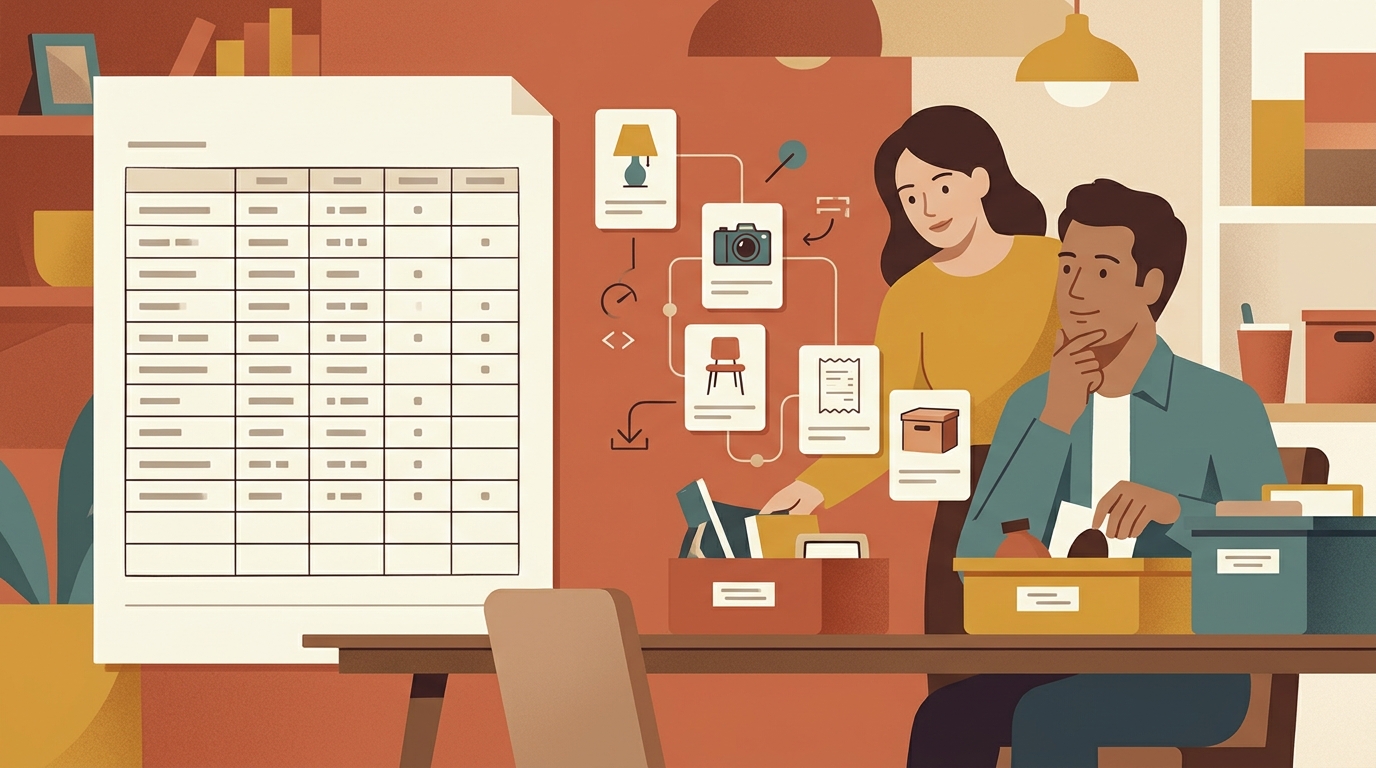
When several people share a home, the question is rarely whether the household owns a blender, cordless drill, camping tent, or television. The question is who bought it, who can take it when someone moves, where the receipt went, and whether everyone agrees on the answer. A practical system to inventory shared household items replaces fuzzy memories with a record that couples and families can actually use.
This matters in more homes than the traditional nuclear-family picture suggests. The U.S. Census Bureau reported that 64% of households were family households in 2024, while 57% of adults ages 18 to 24 lived in a parental home. Pew Research Center's 2026 analysis found that 22% of the U.S. population lived in multigenerational households in 2024. Shared living includes married and unmarried couples, parents with adult children, blended families, grandparents, siblings, and relatives combining space and expenses.
An inventory should not turn the home into a warehouse or make every coffee mug a legal negotiation. Its job is to document the belongings that would be expensive, confusing, or contentious to replace, divide, insure, lend, or move. These seven approaches help households build that record without creating a second full-time job.
1. Agree on What Counts as Shared Before You Start
The fastest way to create tension is to begin labeling possessions before anyone agrees on the categories. One person may view the dining table as a shared family asset because everyone uses it. The person who paid for it may see it as personal property temporarily placed in a common room. Both interpretations feel obvious to the people holding them.
Use three ownership categories
Start with a simple classification that works across most living arrangements:
- Individually owned: One person bought, inherited, or received the item, and intends to keep it if the household changes.
- Jointly owned: Two or more people deliberately purchased or accepted the item together, with shared ownership understood at the time.
- Household-use item: The item belongs to one person or an outside party, but everyone has permission to use it. A furnished rental's television and a parent's loaned lawn mower fit here.
The third category is especially important. Shared use does not automatically create shared ownership. Writing down that distinction can prevent a familiar move-out argument: “We all used it, so I thought it belonged to everyone.”
Set a practical recording threshold
Do not spend Saturday afternoon assigning ownership to every fork. Choose a threshold based on replacement cost, emotional importance, or dispute potential. Many households record electronics, appliances, furniture, tools, sports equipment, musical instruments, collectibles, jewelry, art, inherited objects, and anything purchased from a shared account.
Also include lower-cost items when the collection matters more than one piece. A shelf of board games, a full set of cookware, or a garage cabinet of power-tool accessories can be costly to rebuild even when each item seems minor. The goal is useful visibility, not perfect accounting.
Write the rules in plain language
Turn the categories and threshold into a short household policy that anyone can understand. For example: “We record shared purchases over $100, individually owned items over $300, all inherited or sentimental property, and any object that another person may eventually take out of the home.” Put the rule at the top of the inventory so a new family member, partner, or caregiver does not have to reverse-engineer the system.
Include a rule for gifts. A wedding gift addressed to both partners is different from a birthday gift addressed to one. A couch given by a parent may be a gift to the couple, a gift to their adult child, or a loan that the parent expects back. The inventory cannot decide the giver's intent, but it can preserve what everyone understood when the item entered the home. If the intent is unclear, ask while the answer is easy to obtain.
2. Inventory the Home Room by Room
A room-by-room pass is easier than asking everyone to remember what they own from the couch. Physical movement creates prompts. Opening the hall closet reveals the vacuum, luggage, folding chairs, and borrowed carpet cleaner that nobody remembered during the planning conversation.
Begin with shared spaces
Start in the kitchen, living room, garage, laundry area, storage spaces, yard, and other places where ownership is least visible. Bedrooms can come later because personal ownership is often clearer there. In each room, move in one direction and record the most significant items before opening drawers and cabinets.
For each item, capture a short name, room, owner, ownership category, and one clear photo. Add brand, model, serial number, purchase date, price, receipt, warranty, or condition when relevant. A useful entry might read: “Makita cordless drill kit, garage workbench, owned by Elena, household use, bought May 2025, receipt attached, two batteries and charger.”
Let each person identify their contributions
A shared walkthrough works better than assigning one household member to make every judgment. Each person can identify what they brought, what was a gift from their family, and what they remember buying together. If memories conflict, mark the ownership as “needs review” instead of forcing a decision while standing in the garage.
Families with adult children or grandparents should pay special attention to objects that moved between households. Our guide to multigenerational household inventory management explains how to separate ownership, stewardship, and inheritance expectations when several generations share one address.
Group collections without losing useful detail
Not everything needs its own entry. Group ordinary books, dishes, linens, toys, holiday decorations, and hand tools into collections when individual ownership does not matter. Name the collection, photograph it, identify the owner, and estimate the quantity or replacement range. Create individual entries only for pieces that are valuable, sentimental, under warranty, frequently lent, or likely to leave the collection separately.
This mixed approach keeps the inventory readable. “Kitchen cookware, jointly owned, approximately 18 pieces” is easier to maintain than 18 nearly identical records. The premium Dutch oven with a lifetime warranty can still have its own entry. Consistent grouping also helps households compare what they own before buying duplicates, especially when two people combine established homes and discover three slow cookers, four sets of wine glasses, and no place to put them.
A shared inventory is not about keeping score. It is about giving everyone the same set of facts before the facts become urgent.
3. Record Ownership, Contribution, and Exit Plans Separately
Ownership is not always the same as payment. One partner may buy a sofa while the other pays for delivery, assembly, and a matching chair. Parents may give a couple a dining set as a joint gift. Siblings may split the cost of a television unevenly but still agree that each owns half. A good inventory records the household's actual agreement rather than trying to infer it from a payment trail.
Capture who owns it and who paid
Use separate fields for owner and purchaser or contributor. This small distinction handles common situations without twisting them into one label:
- Jordan owns the mixer, although it was a birthday gift from Jordan's mother.
- Priya and Mateo jointly own the sectional, although Priya paid 60% and Mateo paid 40%.
- The family owns the patio set together, although it was purchased from a household account.
- Grandpa owns the snowblower, while everyone in the home is allowed to use it.
Keep the description factual. The inventory is a household operations record, not a substitute for a cohabitation agreement, estate plan, separation agreement, or legal advice. When ownership has legal or financial stakes, use the inventory as supporting documentation and consult the appropriate professional.
Decide what happens when the household changes
For jointly owned items, add a short exit rule while everyone is getting along. Options include selling the item and splitting the proceeds, allowing one person to buy out the others, assigning it to a named person, or revisiting the decision at move-out based on current value.
This is particularly helpful for unmarried couples, blended families, and relatives who expect the arrangement to be temporary. Roommates can use the same approach. The roommate move-in inventory guide covers move-in condition, personal contributions, jointly purchased goods, and move-out documentation in more detail.
4. Attach Photos, Receipts, and Replacement Details
An ownership label answers “whose is it?” Evidence answers “what exactly was it, and what was it worth?” That information matters after theft, fire, water damage, warranty claims, returns, estate work, and household transitions. It also prevents a shared purchase from turning into competing memories about whether it cost $300 or $900.
Create evidence that survives the item
The Insurance Information Institute, also known as Triple-I, recommends photographing belongings, keeping proof of value such as receipts and appraisals, backing up digital records, and storing an inventory somewhere accessible if the home is damaged. Its advice to begin even if the inventory is incomplete is useful for shared households. A solid record of the important half is more valuable than a perfect system nobody starts.
For ordinary items, one room photo and one item entry may be enough. For higher-value goods, photograph the item from several angles, the serial or model label, included accessories, and its current condition. Attach the receipt, order confirmation, appraisal, or warranty document when available. If the original proof is gone, note an estimated purchase date and replacement cost without presenting the estimate as a receipt.
Distinguish purchase price from current value
Purchase price, resale value, and replacement cost answer different questions. A five-year-old television may sell for little, yet replacing it with a comparable model costs far more. A vintage chair may have appreciated. A jointly purchased mattress may have almost no practical resale value, even though it was expensive.
Record the original price when known and a rough replacement cost for insurance planning. Reserve appraisals for property that justifies the expense. If coverage is the main reason for the project, review how to estimate personal property coverage and ask your insurance professional how ownership and coverage work when belongings from several people share one address.
Make the inventory usable after a loss
A record stored only on a computer inside the home can disappear in the same event that damages the belongings. Keep a cloud backup or an encrypted copy outside the home, and make sure at least two trusted household members know how to reach it. Test access once a year rather than assuming an old password, expired account, or departed family organizer will not become a barrier.
Organize evidence so another person can understand it under stress. Use recognizable item names, connect each receipt to the correct entry, and avoid file names such as “IMG_4821” or “receipt-final-2.” If an item belongs to one resident but sits in a shared room, that fact should be visible without opening several attachments. A claims conversation, evacuation, or urgent move is not the time to decode somebody else's private filing system.
5. Choose a System Everyone Can Actually Update
The best inventory tool is the one the household can open when someone buys a television, lends out a pressure washer, or needs a receipt. A beautifully designed private spreadsheet fails if only its creator knows where it lives. A shared app fails if the rest of the household refuses to use it. Access and routine matter more than technical sophistication.
Match the tool to the household
Common options include a notebook, shared spreadsheet, cloud folder, database tool, or dedicated home inventory app. A paper binder is easy to understand but difficult to search, duplicate, and protect from a disaster in the home. A spreadsheet is flexible and exportable, but photos and receipts often end up scattered across separate folders. A database or inventory app can connect each item with images, locations, documents, categories, and notes.
If your household is choosing between general-purpose tools, this comparison of Notion and spreadsheets for household inventory explains the tradeoffs in structure, collaboration, calculations, and maintenance. Whatever you choose, confirm that more than one person can access it and that the data can be exported or backed up.
Use one record, not parallel lists
Couples often begin with two personal lists, then discover that nobody has a reliable view of joint purchases. Families may have a parent tracking appliances, an adult child tracking electronics, and a folder of receipts maintained by someone else. Consolidate those fragments into one source of truth, while using owner fields or filters to preserve individual views.
This becomes more important as homes accumulate connected devices and accessories. Statista reported, based on comScore data, that the average U.S. household had 10 active connected devices, rising to 19 in households with four or more people. Even though the underlying data is older, the example captures the tracking problem: chargers, hubs, remotes, subscriptions, warranties, and serial numbers can multiply faster than anyone's memory.
Set permissions without creating a gatekeeper
Everyone who contributes items should be able to view the inventory, and at least two people should be able to update it. In a large family, unrestricted editing may be unnecessary, but one designated gatekeeper creates risk if that person is unavailable. A simple arrangement is to let all adults submit changes while two household organizers maintain categories and resolve duplicates.
Decide how private property will appear. Jewelry, financial documents, firearms, medical equipment, and high-value collections may require limited visibility. The shared record can note that an item or collection exists, identify its owner and secure location in general terms, then restrict detailed photos, values, or serial numbers to the people who need them. Useful collaboration does not require publishing every sensitive detail to the entire household.
6. Build Inventory Updates Into Household Events
An inventory becomes stale when updates depend on someone remembering to “work on the inventory” later. Tie updates to events that already happen. The record then grows as part of normal household management instead of requiring another organizing campaign every year.
Use purchase and disposal triggers
Create a simple rule: any shared purchase above the household's threshold gets recorded before the packaging is recycled. Photograph the item, attach the digital receipt, assign the owner, and save the warranty information in the same sitting. This takes a few minutes while the details are fresh.
Use the same rule in reverse when something is sold, donated, returned, recycled, broken, or transferred to another relative. Change its status instead of deleting it immediately. A short history can answer future questions about where the old laptop went or whether the family still owns the borrowed table saw.
Review at predictable transition points
Schedule quick reviews around events that already bring household property into focus:
- Moving in or moving out
- Insurance renewal
- Marriage, separation, or combining homes
- A child leaving for college or returning home
- A parent or grandparent joining the household
- Major renovations, garage cleanouts, or storage-unit changes
- Holiday and birthday gift seasons
A quarterly ten-minute review can handle normal drift. A larger annual walkthrough can catch missing photos, outdated room locations, disposed items, and purchases that never made it into the system. Triple-I also advises adding significant purchases while details are fresh and keeping inventory backups separate from the home.
The housing market itself reflects how often families are combining needs under one roof. The National Association of REALTORS' 2026 generational report found that 14% of buyers purchased a multigenerational home, commonly for aging-parent care, cost savings, and adult children returning home. Inventory habits should adapt when the people and generations in the home change.
7. Create a Calm Process for Disputed or Sensitive Items
Some entries will expose disagreement. That is not evidence that the inventory failed. It means the system found ambiguity while the household still has time to address it. Treat those entries as a review queue, not an invitation to settle every relationship issue in one sitting.
Mark uncertainty instead of rewriting history
Use statuses such as “ownership unclear,” “joint decision needed,” “borrowed,” or “family history needed.” Add the known facts: who has the receipt, who remembers the gift, where the item came from, and whether anyone outside the household may have a claim. Avoid changing the owner field in private after a disagreement.
For sentimental property, record the story as well as the owner. “Walnut side table made by Aunt Rosa, currently cared for by Malik, intended for Nina” is much more useful than “old table.” Photos, maker marks, inscriptions, letters, and family notes can preserve provenance that has little to do with market value.
Use a short household review conversation
Discuss disputed items in a planned conversation, not during an argument or move. Review a small batch, let each person explain their understanding, and write down the agreement immediately. If no agreement is possible, keep the status unresolved and identify the next appropriate step, such as checking a bank statement, asking the gift giver, reviewing an estate document, or seeking professional advice.
The tone matters. Speak in terms of the record: “The list shows this as joint, but you remember buying it personally. What evidence can we add?” That phrasing is more productive than accusing someone of claiming property. In a couple or family, the aim is a record everyone recognizes as fair enough to rely on.
Frequently Asked Questions
What household items should couples inventory?
Start with furniture, electronics, appliances, tools, jewelry, collectibles, inherited objects, sports equipment, and purchases made from joint funds. Add any lower-cost item that could cause disagreement or would be costly to replace as part of a set.
How do you divide ownership of items bought together?
Record the ownership agreement separately from payment contributions. Couples can choose equal ownership, percentage shares, assignment to one person, or a buyout or sale plan if the household changes.
Should shared household items be listed for renters insurance?
Each resident should ask their insurer whose belongings the policy covers, because policy terms and household relationships vary. Keep ownership, receipts, photos, and replacement details clear so each person can document their property.
How often should a shared home inventory be updated?
Add significant purchases and disposals as they happen, then do a brief quarterly review and a room-by-room check once a year. Update immediately after a move, household membership change, major renovation, or insurance change.
What if nobody remembers who bought an item?
Mark it as unresolved, record the facts everyone agrees on, and check receipts, order histories, bank statements, gift records, or family members who may know. Do not assign ownership based only on who currently uses it most.
Shared homes run better when ownership is visible and agreements are recorded. Vorby gives couples and families one place to organize the belongings they own, use, and manage together.