It’s a feeling we all know. That sudden, heart-stopping jolt when you ask the dreaded question, "Where did I put my keys?" That sinking sensation isn't just about misplacing an object; it's about the immediate disruption, the stress, and the fear of being late or completely locked out. This isn't some personal failing; it's a universal consequence of a busy, distracted mind.
Why We Lose Our Keys So Often
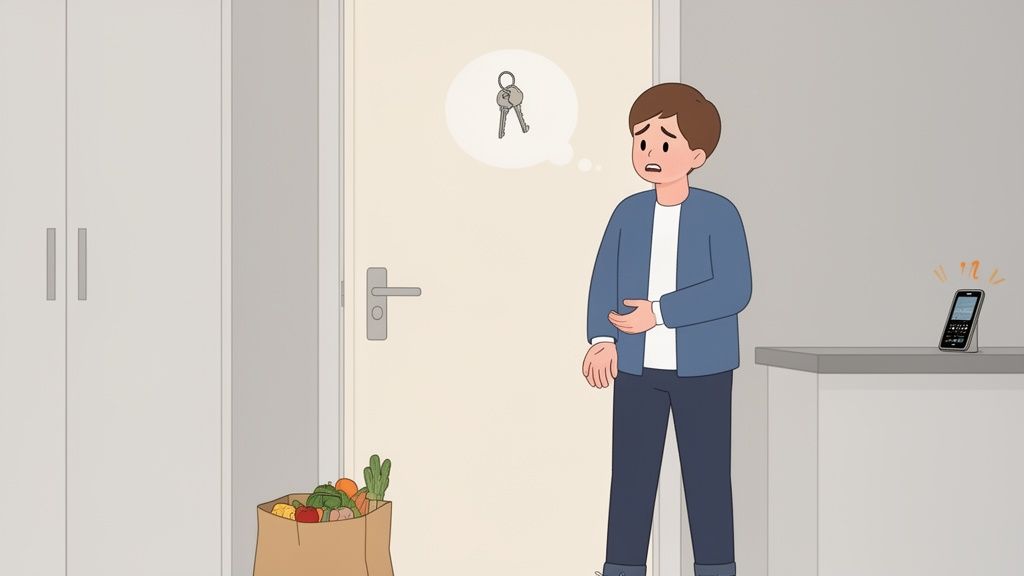
The reason you can't find your keys often has less to do with your memory and more to do with your attention. When our brains are overloaded with tasks, we slip into autopilot. We perform routine actions, like setting down our keys, without forming a conscious memory of doing it. That’s precisely why you can’t recall where you put them just moments later.
This happens most often during what I call "transitional moments." Picture this: you walk through the door after a long day, juggling grocery bags, glancing at a text message, and maybe even dodging an excited pet. In that brief moment of distraction, your brain prioritizes the most demanding tasks. Placing the keys becomes an unconscious, background action.
The Role of Distraction and Stress
The real culprit behind most misplaced items is multitasking. Studies reveal that nearly half of Americans blame their habit of losing things on trying to do too much at once. When you consider that a staggering 28% of Americans lose their car and house keys at least once per week, it's clear this is a widespread issue baked into our modern habits.
This constant mental juggling leads to what psychologists call "inattentional blindness." Your eyes might literally see where you put the keys, but your brain doesn't register the action because its focus is split. Stress just pours gasoline on this fire.
When you're stressed, your brain's prefrontal cortex, the part responsible for memory and executive function, becomes less effective. This makes it even harder to form the small, crucial memories that help you remember where you left things.
While the panic of losing keys is unique, some general strategies for managing stress, like those used for major life events like moving, offer valuable perspectives on how to calm down and think clearly.
Breaking the Autopilot Cycle
The key to breaking this frustrating cycle isn't about trying to have a perfect memory; it's about building mindful habits. It means creating intentional, repeatable actions that don't require much mental energy but are powerful enough to cut through the noise of daily life.
The first step is simply acknowledging the problem isn't forgetfulness, it's the lack of a system.
A Calm Method for Finding Your Keys Right Now

The second you realize your keys are gone, your stomach drops. The instinct is to tear through the house in a frantic, disorganized panic. Stop. That’s the worst thing you can do.
The most powerful tool you have right now is a moment of stillness. Before you overturn a single cushion, take a deep breath, close your eyes, and try a "mental rewind."
This isn’t just about remembering; it’s about recreating the scene. Zero in on the last moment you can say with certainty, "I had my keys." Were you unlocking the front door? Grabbing them from the car’s ignition? Play that exact moment back in your head, frame by frame.
Retrace Your Steps by Engaging Your Senses
What else was happening in that moment? Were you fumbling with grocery bags, answering your phone, or grabbing the mail? Our brains are wired to connect actions, so remembering one detail can unlock the memory of another.
Think about what you heard or saw. Did the dog bark as you came inside? Did you immediately turn on the TV? These small sensory details are like breadcrumbs leading you back to the exact moment of distraction when you set your keys down without a second thought. This core technique is a game-changer for how to find lost items of any kind.
Once you have a clearer mental picture, you can start a physical search. A chaotic dash through the house just elevates your stress and causes you to overlook the obvious. Instead, let's target the high-probability "hotspots" first.
Check the Most Common Key Hotspots
Studies on lost items reveal that our search patterns are surprisingly predictable. We have a few go-to places we check first, and there's a good reason for that; it's usually where the keys are hiding.
When you're searching, don't just glance. You need to physically interact with these spaces. That means feeling deep inside coat pockets, lifting every single couch cushion, and taking everything out of your bag.
The data shows a pretty clear pattern in where people lose, and find, their stuff. A huge chunk of the time, our keys are sitting in one of just a handful of places.
Top 5 Places to Look for Your Keys First
This table breaks down the most statistically common places people find their lost keys, helping you focus your immediate search efforts.
| Hotspot Location | Why Keys End Up Here | Quick Search Tip |
|---|---|---|
| Purse or Bag | This is the most common place to look (21% of the time) because it's our default catch-all. | Don't just rummage. Empty the entire bag onto a clear surface like a table or the floor. |
| The Couch | You sit down, relax, and keys slip out of your pocket. It's the #2 spot, with 18% of finds. | Lift every cushion and feel deep within the crevices between the cushions and the frame. |
| Pockets | We're creatures of habit. 14% of keys are found in the pockets of yesterday's pants or jacket. | Check every piece of clothing you wore since you last saw them, especially outerwear. |
| Entryway Table | This is the "drop zone" where you unload everything when you walk in the door. | Clear off mail, sunglasses, and other clutter. Check behind and under everything. |
| In the Lock | It happens more than you'd think. We unlock the door and simply forget to take them out. | Check the front door, back door, and even your car door lock. |
Even with these common hotspots, it’s frustrating to learn that around 33% of lost items are never recovered, which really makes the case for having a system.
A methodical, room-by-room search is always better than a random one.
- Scan Transitional Zones: This means the kitchen counter where you set down the mail, the top of the microwave, or the nightstand next to your bed.
- Investigate Unusual Places: Did you put the keys in the refrigerator by mistake while unloading groceries? It sounds bizarre, but autopilot brain is a real thing.
- Look Near Your Last Activity: If you were paying bills, check the desk. If you were getting ready for bed, look in the bathroom or near the laundry hamper.
By staying calm and following a deliberate process, you shift from panic mode to problem-solving mode. You're not just looking for a lost object; you're retracing a memory, and that dramatically boosts your odds of success.
Creating a 'Never Lose Your Keys Again' System
Finding your keys today solves the immediate panic, but what if you could eliminate the problem for good? That's the real win. The secret isn't a flawless memory; it's about building a few simple, rock-solid habits that eventually become as automatic as breathing. It all starts with creating a single, non-negotiable "home" for your keys.
This spot, your "landing zone," should be the first place you go when you walk in the door and the last place you check before you head out. Don't overcomplicate it. In fact, simpler is almost always better.
Establish a Dedicated Landing Zone
The heart of this entire system is consistency. Your keys need one place, and only one place, to live when they aren't in your hand, pocket, or car ignition.
Here are a few ideas that actually work in the real world:
- For busy households: A set of sturdy hooks mounted right by the main entry is a classic for a reason. Give each family member their own hook, and you’ve created an organized, grab-and-go station that even the kids can use.
- For apartment dwellers: A small, decorative bowl on an entryway table or a sleek magnetic key holder on the wall works wonders. The visual cue is powerful, silently reminding you to drop your keys the second you walk in.
- For minimalists: No need for new gadgets. A specific corner of a console table or a designated pocket in the bag that always hangs by the door serves the exact same purpose.
The specific item you choose matters far less than your unwavering commitment to using it. You're training your brain to forge an automatic connection, which completely removes the mental energy needed to track them.
Build a Routine Around the System
Having a spot is only half the battle. The routine you build around it is what makes the system bulletproof. This means creating tiny, repeatable actions that link putting your keys away with other daily habits. Think of it as your "shutdown procedure" for arriving home or your "launch sequence" for leaving.
A great way to cement this is by creating a simple mental checklist. Every single time you walk through that door, you run the same sequence without thinking.
The goal is to make placing your keys in their spot as automatic as taking off your shoes. It’s a small, conscious effort at first that quickly becomes an unconscious, stress-saving habit.
For example, your "arrival routine" could be as simple as this:
- Unlock and open the door.
- Step inside and close it behind you.
- Walk directly to the landing zone and hang up your keys.
- Then, and only then, do you put down your bags, take off your coat, or glance at your phone.
Even the keyring itself can subtly reinforce your system. Some people find that a more substantial or uniquely shaped one, like some of the styles discussed in "Promotional Keyrings That People Actually Keep," makes their keys harder to ignore and easier to handle.
Your "departure routine" is just as critical. Before your hand even touches the doorknob to leave, do a quick physical check, the classic "phone, wallet, keys" pat-down. Pat your pockets or glance in your bag to confirm you have all three essentials. This final checkpoint prevents you from walking out the door unprepared. It’s a two-second investment that saves you from minutes, or even hours, of frantic searching later.
Using Technology to Keep Track of Your Keys
Building solid habits is the bedrock of staying organized, but let's be honest, sometimes you need a safety net. Technology offers some incredibly powerful tools to completely eliminate that "where did I put my keys?" panic. Modern solutions range from simple trackers to full-blown digital inventory systems, each designed to give you a bit more peace of mind.
The most common gadgets you’ll see are Bluetooth trackers. Think of devices like Apple AirTags or Tiles. You just attach one of these small tags to your keyring. When your keys are somewhere nearby (usually within a 30 to 200-foot range), you can pull out your phone, tap a button in an app, and make the tag ring. It leads you straight to them.
This is a game-changer for finding keys hiding under a couch cushion or accidentally left in a coat pocket from last winter. But their reliance on Bluetooth means they’re really built for short-range recovery inside your home or car.
Beyond Simple Trackers
For a more robust, long-term fix, you can integrate your keys into a digital home inventory. This shifts the goal from just finding a lost item to remembering its designated spot in the first place. It’s about preventing the loss before it even happens.
An app like Vorby lets you create a digital record of your keys and their official "home." Just snap a quick photo of your keys hanging on their hook by the door and log it as "Entryway, hook by door." The next time you have that flicker of doubt, you can just ask the app, "Where are my keys?" and it instantly shows you exactly where they belong.
This approach turns your smartphone from a simple finder into a complete organizational partner. It's about creating a reliable map of your belongings, and you can see how powerful this gets when you explore smart location tracking.
Using QR Codes for Different Key Sets
This system becomes even more useful when you’re juggling multiple sets of keys. We all have them: the keys to the shed, a file cabinet at the office, or your parents' house. It’s way too easy to mix them up or forget which key opens which lock.
By using simple QR code labels, you can create a detailed, scannable catalog for everything.
- Labeling Keyrings: Stick a small QR code on the keyring for your shed. When you scan it with your phone, your home inventory app instantly pulls up its record, confirming, "Shed Keys." No more guessing.
- Organizing Spares: Put all your spare house and car keys into a small box in a drawer. Place a single QR code on the box lid. A quick scan shows you a complete list and photos of every key inside, saving you from rummaging through a tangled mess of metal.
This digital map provides instant clarity, turning a chaotic collection into an organized, easily searchable system.
Choosing Your Key Tracking Method
With a few different tech options available, how do you pick the right one? This table breaks down the most popular methods to help you decide which is the best fit for your lifestyle and needs.
| Method | How It Works | Best For | Limitations |
|---|---|---|---|
| Bluetooth Trackers | A small tag on your keychain connects to your phone via Bluetooth. Use an app to make it ring when nearby. | Finding keys misplaced within your home or a short distance away (e.g., in the car). | Limited range (typically under 200 feet); less effective for items lost far from home. |
| Digital Inventory App | You photograph your keys in their designated spot and log the location. The app reminds you where they belong. | Reinforcing habits, preventing loss in the first place, and managing multiple sets of keys. | Requires the initial setup of creating the inventory record for your items. |
| QR/NFC Labels | Attach a scannable label to keyrings or storage boxes. Scanning it with your phone pulls up its digital record. | Identifying multiple, similar-looking key sets and organizing spare keys in storage. | You need your phone to scan the label; doesn't actively track location like Bluetooth. |
Ultimately, the best tool is the one that complements your habits. A Bluetooth tracker is great for reactive finding, while a digital inventory and QR codes are proactive tools for staying organized.
The simple flowchart below illustrates how establishing a consistent system is the first step, no matter what tech you use.
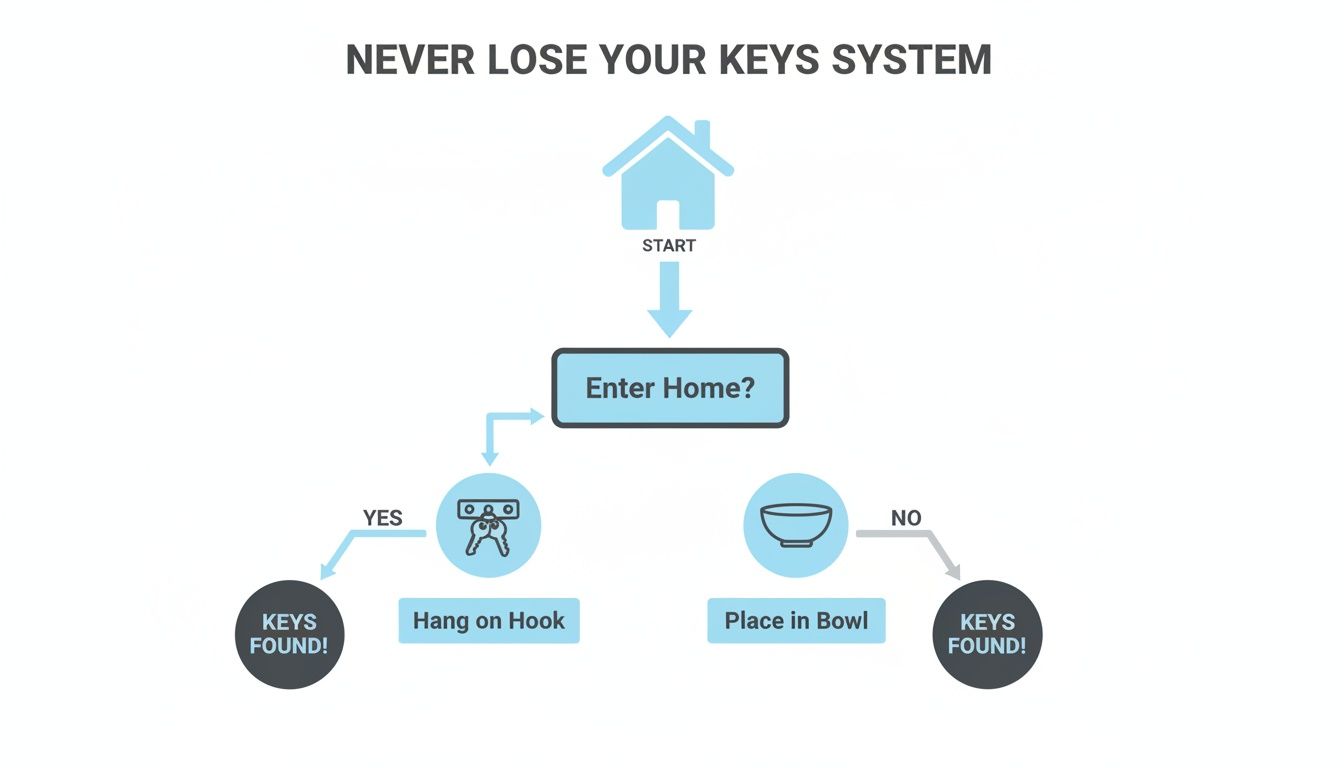
The real insight here is that the specific tool, whether it's a simple hook or a fancy bowl, matters less than your commitment to a single, dedicated spot.
Ultimately, technology’s greatest strength is its ability to support and reinforce the good habits you create. It acts as a digital safety net, ensuring that a moment of distraction doesn't turn into a day of frustration.
Turn Your Home Inventory Into a Key-Finding Machine
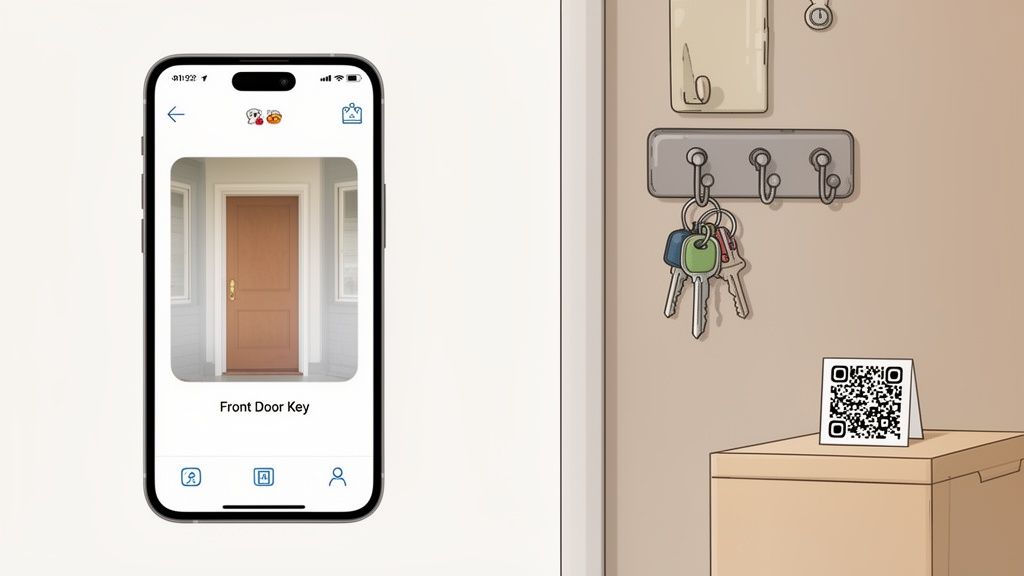
This is where all our physical systems, like the designated spot and the mental checklist, get a serious upgrade. Moving from a physical habit to a digital one turns your key management strategy into a searchable, visual database for your entire household.
A home inventory app like Vorby becomes more than just a list of your belongings; it’s a powerful tool that ends the daily frustration of asking, "Where on earth did I put my keys?" The process is simple, but the result is a permanent, reliable record of where your keys belong.
Creating Your First Digital Key Entry
Let’s start with the keys you use every day. Grab your primary set and place them in their new "landing zone," whether that’s a hook by the door or a specific bowl on the entryway table.
Now, open your inventory app and create a new item. The goal here is to capture all the useful details in just a few seconds.
- Snap a clear photo. Take a picture of the keys right there in their landing zone. This visual context is a surprisingly powerful memory trigger.
- Give it a specific name. Instead of just "Keys," get descriptive. Think "Main Car and House Keys" or "Sarah's Work Keys."
- Log the location. Be precise. Note the exact spot, like "Entryway, on the magnetic hook next to the light switch."
- Add descriptive tags. Use tags like
car key,front door,mailbox, orfob. This makes searching a breeze later on.
As you can see, the interface lets you add a photo, name, location, and detailed notes, creating a complete and easily searchable record in moments. The next time you feel that flicker of panic, you can just ask your inventory app where your keys are. It will instantly show you their designated spot, complete with a photo for confirmation.
Take It to the Next Level with QR Codes
This system really shines when you apply it to all those other keys, the ones you rarely use but can never find when you actually need them. I'm talking about the key to the shed, the rooftop access door, or the spare set for your parents' house.
By using QR codes, you can transform a messy junk drawer into an organized, scannable archive. It's the ultimate solution for those miscellaneous keys that cause so much confusion.
Here's how it works: Gather all your spare and miscellaneous keys and put them in a small container or a ziplock bag. Generate a unique QR code within your inventory app and stick it right on the container.
When you scan that code, your phone will instantly pull up a detailed list (with photos!) of every single key inside. You'll never have to guess what that old, mysterious key opens ever again. This simple process turns your entire collection of keys into part of a larger, smarter system. For more ideas on structuring your catalog, check out this excellent home inventory list template for some inspiration.
Of course, even the most dialed-in system isn't foolproof. That sinking feeling when you ask, "wait, where are my keys?" often brings a few specific worries to mind. Let's tackle some of the most common questions head-on.
Why Do I Keep Losing My Keys in the Same Places?
This almost always comes down to one thing: autopilot. Think about it. You walk in the door juggling groceries, distracted by a podcast, or thinking about dinner. Your brain, seeking the path of least resistance, defaults to pure muscle memory.
That muscle memory might lead you to repeatedly drop your keys in a convenient but totally random spot, like the kitchen counter, the entryway table, or that one specific chair. It feels easy in the moment, but it's a habit that costs you later.
The only real solution is to consciously and deliberately break the cycle. For the next week, make it your one and only mission when you walk in the door to go directly to your designated "landing zone" and place the keys there. That focused repetition forges a new, stronger neural pathway that will eventually become your new, much more organized, autopilot.
Are Bluetooth Key Finders Worth the Money?
Bluetooth trackers are fantastic for one specific job: finding your keys within a limited range, like somewhere in the house or buried in your car. For that immediate, short-distance recovery mission, they are incredibly effective. If that's your main problem, they're absolutely a worthwhile investment.
But if your goal is broader home organization, that's where their utility stops. Integrating your keys into a comprehensive home inventory system like Vorby gives you so much more. It helps you track not just where your keys belong, but also warranties, spare parts, and every other important item in your home. It’s the difference between a quick fix and a holistic solution to staying organized for good.
What Should I Do If I Think My Keys Are Lost Outside?
First, take a breath. Resist the immediate urge to panic and mentally retrace every single step of your day. Instead, take action.
Call any stores, cafes, or offices you visited. Get in touch with the lost and found for any public transit or ride-share services you used. Acting quickly is your single biggest advantage and dramatically improves your chances of getting them back.
If you have a Bluetooth tracker, check its "last known location" in the app. This can give you a crucial starting point. And if you have a strong reason to believe they were actually stolen, don't wait. Contact the local police to file a report and, most importantly, call a locksmith to have your locks changed. Your peace of mind is worth it.
Ready to build a permanent, stress-free system for your keys and everything else you own? Vorby gives you the tools to create a digital map of your home, so you always know exactly where things belong. Start your free trial and see how an organized home can change your daily life.