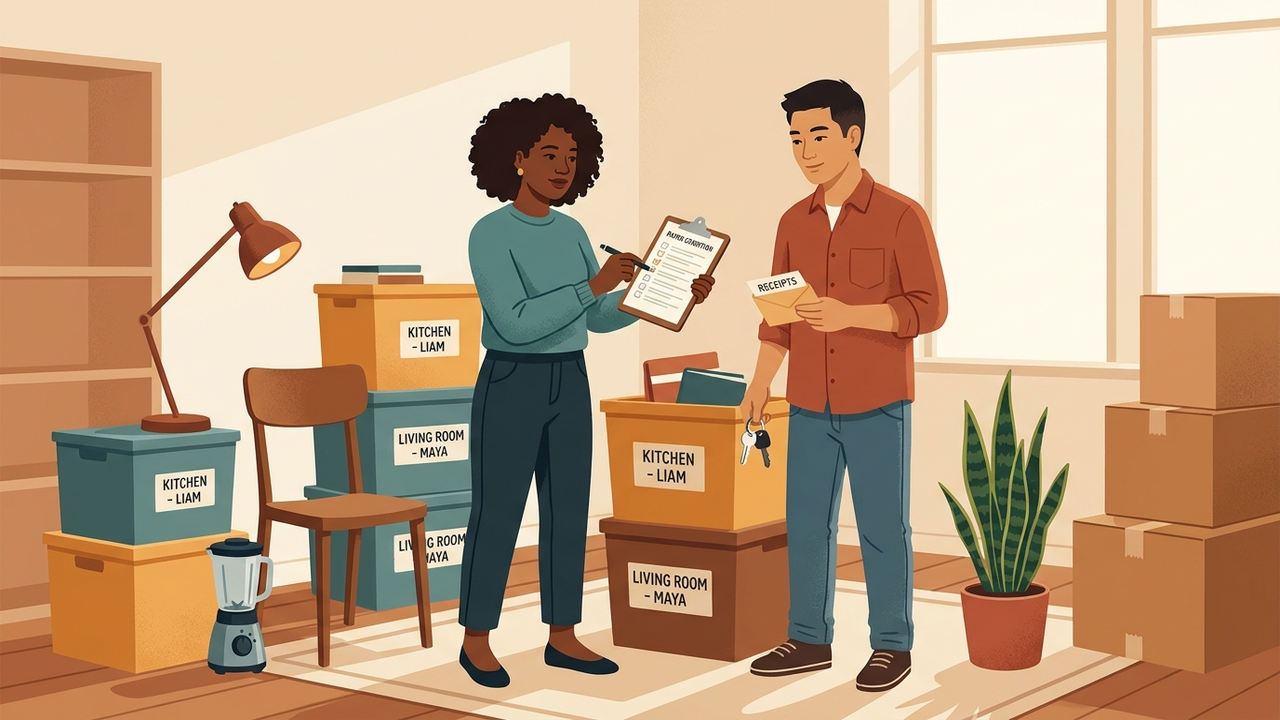
Choosing an inventory app vs spreadsheet for roommates sounds like a minor household decision until the blender disappears, the television breaks, or someone moves out and claims the air fryer. Shared homes blur the line between personal property, communal purchases, landlord-owned fixtures, and items one roommate simply lets everyone use. The right inventory system makes those boundaries visible before memory, money, and competing assumptions turn a practical question into an argument.
Both tools can work. A spreadsheet is flexible, familiar, and nearly free. A dedicated inventory app is faster for photos, easier to update from a phone, and better at connecting each object to its owner, room, receipt, and condition. The best choice depends less on technical sophistication than on how your household actually behaves: how many people share the space, how often items move, whether roommates buy things together, and whether anyone will maintain the system after the first enthusiastic weekend.
Why Roommate Inventory Is Different From a Personal List
Shared homes create several kinds of ownership
A personal home inventory asks, “What do I own?” A roommate inventory has to answer more questions: Who owns it? Who paid for it? Is it shared or merely available for shared use? What happens to it when the lease ends? A couch purchased 50/50 is different from a couch one roommate brought from home. A landlord-provided microwave is different from the microwave the household replaced after move-in. A gifted coffee maker may belong to one person even if everyone uses it daily.
That complexity is common, not unusual. The Pew Research Center reported that nearly 79 million U.S. adults, or 31.9% of the adult population, lived in a shared household in 2017. Pew’s definition is broader than roommates alone, but it shows how many adults live in arrangements where property, expenses, and household responsibilities cross individual boundaries. The U.S. Census Bureau counted 25.5 million shared households in 2019, containing 81.2 million adults.
The real problem is not counting objects
Most roommates do not need a museum-grade catalog of every fork and paperback. They need enough evidence to settle recurring household questions quickly. Which vacuum is ours? Did Jordan pay for the patio furniture? Is the damaged desk the landlord’s? Where is the receipt for the television? Did the outgoing roommate take a lamp that belonged in the living room?
This is why a useful inventory needs context, not just item names. At minimum, shared possessions should have an owner or ownership split, current location, purchase date, approximate value, condition, and photo. Receipts, serial numbers, warranty details, and notes are worth adding for electronics, appliances, furniture, bikes, tools, and other items that would be expensive or contentious to replace.
Housing costs make shared systems more relevant
Roommate living often reflects financial reality. In the National Association of Realtors’ 2017 Student Loan Debt and Housing Report, 28% of respondents rented with roommates, making it the most common living arrangement in that survey. Statista, citing Zillow data, also reported that the share of U.S. adults living in doubled-up households rose from 25.4% in 2002 to 32% in 2012. Those measures cover more than conventional roommate apartments, but the pattern is clear: sharing housing is a major part of how adults manage space and cost.
When several people combine furnishings and household purchases, a simple ownership record protects both the relationship and the budget. It reduces duplicate buying, makes shared costs easier to divide, and creates a clean starting point for move-out decisions.
Consider a common living-room setup. One roommate contributes a television bought two years earlier, two people split a new media console, a third brings a game system, and the landlord provides the wall mount. From the sofa, it looks like one shared entertainment area. On paper, it contains four different ownership arrangements, several purchase dates, separate warranties, and different responsibilities if something breaks. A useful inventory preserves those distinctions without requiring anyone to reconstruct them during a stressful move.
The record also gives roommates a neutral way to discuss boundaries. An item can be available for everyone to use without becoming communal property. That distinction matters for cookware, tools, furniture, streaming devices, sports gear, and anything borrowed from a family member. Labeling it clearly is not unfriendly. It is the household equivalent of putting a name on a suitcase before a group trip.
Where a Spreadsheet Works Well
It is familiar, flexible, and inexpensive
A spreadsheet is the easiest inventory system to start because most people already understand rows, columns, filters, and shared links. Google Sheets and similar tools allow multiple roommates to edit the same file without buying new software. A household can create columns for item, owner, room, purchase price, purchase date, condition, and notes in a few minutes.
That open structure is a genuine advantage. Roommates can add whatever fields matter to them, from “split percentage” and “who keeps it” to “replace before move-out.” A student apartment tracking basic furniture may need only eight columns. A house shared by four adults might add serial numbers, warranties, storage locations, and links to receipt files. No dedicated app can anticipate every unusual household agreement as quickly as a blank sheet can.
Bulk entry and sorting are efficient
Spreadsheets are especially good when the household already has a written list or needs to enter many similar objects at once. Kitchen supplies, books, board games, tools, and pantry appliances can be typed down a column quickly. Filters make it easy to show everything owned by one roommate, everything in the garage, or every shared purchase above a chosen value.
A carefully designed sheet can also calculate each person’s contribution to jointly purchased items. If three roommates split a $900 couch unevenly, formulas can preserve the original percentages and show each person’s stake. That is useful when the agreement is reimbursement rather than simply deciding who takes the couch.
A good spreadsheet can be a strong starter system
For two roommates with a small apartment, stable ownership, and few expensive shared items, a spreadsheet may be entirely sufficient. The key is to set it up as a household record rather than a casual list. Use one row per meaningful item, standardized owner names, dropdowns for rooms and ownership type, and a separate folder for photos and receipts. Freeze the header row, protect formula columns, and agree that major purchases get added immediately.
The spreadsheet becomes weaker when photos live in a separate folder, receipt links break, entries use inconsistent names, or updates depend on one detail-oriented roommate. Those are management problems rather than spreadsheet failures, but the household still has to live with the result.
If you choose a spreadsheet, create a short instruction tab and treat it as part of the system. Define exactly what counts as a recordable item, which ownership labels are allowed, where photos belong, and how shared contributions are written. Include one completed example row. This takes ten minutes and prevents each roommate from inventing a different method.
The best roommate inventory is not the most elaborate system. It is the one every roommate can update before the receipt disappears and the ownership story changes.
Where Spreadsheets Start to Break Down
Photos and receipts become attachments to attachments
A row of text can describe a television, but a claim, warranty request, or move-out dispute is easier to handle with a clear photo of the item, serial number, existing damage, and receipt. Spreadsheets can link to those files, yet the process usually involves taking a photo, uploading it to cloud storage, naming it, setting permissions, copying the link, and pasting it into the correct row. That is enough friction for roommates to say they will do it later.
Later is where inventories go stale. New purchases never appear, moved items keep their old room, and the sheet gradually describes the apartment as it existed six months ago. A spreadsheet can store excellent records, but it does not naturally capture objects at the moment people are standing beside them with a phone.
Shared editing can create quiet inconsistencies
One roommate writes “Sam,” another writes “Samuel,” and a third uses “S.” Someone sorts one column instead of the full range. A copied formula misses the final row. A receipt folder is reorganized and twenty links stop working. None of these problems is dramatic by itself, but each makes filters and totals less trustworthy.
Spreadsheet research focuses mainly on business models, not roommate inventories, so its error rates should not be pasted directly onto a household list. Still, the underlying warning applies. Research summarized in the paper Impact of Errors in Operational Spreadsheets found errors in 0.8% to 1.8% of formula cells across 50 operational spreadsheets, depending on the definition used. Household sheets use fewer formulas, but they also receive less testing. Simpler does not mean self-correcting.
The sheet does not match how people search at home
Roommates usually think visually and spatially. They remember the red toolbox, the lamp near the sofa, or the food processor in the upper cabinet. A spreadsheet asks them to remember the exact label, scan rows, or apply filters. That is manageable for 40 entries and irritating for 400.
The gap grows when possessions move between bedrooms, closets, storage units, and shared spaces. If your household regularly lends gear, rotates seasonal storage, or has roommates moving in and out, a flat grid becomes a small database that the roommates have to design and administer themselves.
Permissions create another practical wrinkle. If the inventory links to private receipt folders or personal cloud accounts, a new roommate may not have access and an outgoing roommate may remain connected long after leaving. The household needs a shared storage location, a clear account owner, and an offboarding routine. Otherwise the spreadsheet may survive while the evidence behind it becomes inaccessible.
What a Dedicated Inventory App Does Better
Capture begins with the object
A household inventory app is built around the phone in your hand. You can photograph a standing mixer, assign it to the kitchen, identify the owner, add the purchase price, and attach a receipt in one flow. That reduces the distance between noticing an item and recording it. For roommates, that difference matters more than a long list of advanced features.
The Insurance Information Institute, also known as Triple-I, recommends recording receipts when available, along with cost, purchase timing, make, and model. Its home inventory guidance explains that an up-to-date record can help people choose insurance coverage and make a claim easier. Triple-I also notes that a renters policy covers the tenant’s belongings, while the landlord’s policy generally covers the building, not the renter’s possessions. In a roommate home, each person should understand that distinction and document the property connected to their own coverage.
Structure is built in
A dedicated app creates consistent item records without asking the household to invent a schema. Rooms, photos, descriptions, values, identifiers, and ownership details stay connected to the same object. Search works across the collection, and visual browsing helps someone find an entry even when they do not remember what it was called.
That structure is useful during transitions. A move-in record can separate pre-existing damage, landlord property, and roommate belongings. Our guide to creating a roommate move-in inventory explains how to document the starting condition and ownership baseline before boxes are unpacked. At the other end of the lease, a roommate move-out inventory helps the household assign shared items, check rooms, and preserve evidence related to deposits.
Apps reduce the burden on the household administrator
Every roommate house tends to produce an unofficial operations manager. That person tracks whose turn it is to buy detergent, remembers who owns the drill, and knows which closet contains the camping stove. A shared inventory app moves some of that knowledge out of one person’s head and into a record everyone can check.
Vorby is designed for this object-centered approach. Roommates can organize belongings by room, add photos and details, search the household, and keep a shared record without turning one roommate into the permanent spreadsheet custodian. If you want a broader set of methods before choosing a tool, compare these seven ways to inventory shared household items.
A dedicated app can also make the inventory useful between emergencies. The household can check whether it already owns a stud finder before buying another, look up the model of a shared appliance while shopping for a replacement part, or confirm which storage bin holds holiday decorations. Repeated everyday usefulness is what keeps the record alive. A system opened only during moves or insurance claims is more likely to be outdated when those events arrive.
Inventory App vs Spreadsheet: A Practical Roommate Comparison
Choose a spreadsheet for control and simplicity
- Best fit: Two roommates, a small number of shared possessions, and someone willing to maintain the file.
- Setup: Fast if you already know which columns you need.
- Customization: Excellent. You can add any field, formula, or special agreement.
- Photos and receipts: Possible, but usually stored elsewhere and linked manually.
- Mobile capture: Functional, though slower and less pleasant for detailed entry.
- Consistency: Depends on validation rules and careful editing.
- Portability: Strong. CSV and spreadsheet formats are easy to export and archive.
- Cost: Often free with tools the household already uses.
Choose an inventory app for participation and evidence
- Best fit: Three or more roommates, frequent purchases, valuable belongings, storage areas, or regular turnover.
- Setup: More guided, with item records and rooms already defined.
- Customization: More limited than a blank spreadsheet, but better aligned with household objects.
- Photos and receipts: Kept with the item, which improves context and retrieval.
- Mobile capture: A central strength. People can add items where they find or purchase them.
- Consistency: Stronger because each item follows the same record structure.
- Portability: Depends on the app’s export and account policies, which should be checked before committing.
- Cost: May involve a subscription, so the time saved must justify the price.
Score the choice against real household behavior
Do not choose based on which demo looks more impressive. Ask each roommate to imagine adding a new television after a late delivery, finding the receipt eight months later, and deciding who keeps it during a move. Then score each option on five questions:
- Can everyone add an item from a phone in under a minute?
- Can roommates tell personal, shared, and landlord-owned property apart?
- Can one person find an item without knowing the exact name used by another?
- Can photos, receipts, serial numbers, and condition notes stay with the item?
- Can the household export or preserve the record when people move out?
If both tools pass, use the simpler one. If the spreadsheet passes only because one roommate promises to manage everything, that is a warning. A shared system should survive that person being busy, traveling, or leaving the household.
How to Build a System Roommates Will Actually Maintain
Agree on ownership labels before entering items
Use a small set of categories that everyone understands. “Personal” means one named roommate owns the item. “Shared” means the household purchased or received it together. “Loaned for shared use” means one person owns it but allows communal use. “Landlord” covers appliances, furniture, and fixtures included with the rental. “Undecided” gives the household a temporary category for purchases that need a conversation.
For shared items, record the agreement at purchase. Equal contribution does not automatically answer who keeps an indivisible object. Decide whether the item will be sold, bought out by one roommate, assigned by mutual agreement, or taken by a named person who reimburses the others. A short note now is more useful than a long debate at move-out.
Inventory high-consequence items first
Start with objects that are expensive, easy to confuse, likely to move, or important to an insurance claim. That usually includes electronics, appliances, furniture, bicycles, tools, musical instruments, outdoor gear, and jointly purchased kitchen equipment. Add landlord-owned items and photograph their condition. Then cover lower-value shared supplies if duplicate purchases are a recurring problem.
Do not let completeness delay usefulness. A household can gain immediate value from 50 well-documented items even if nobody has counted the drinking glasses. Triple-I recommends adding significant purchases while details are fresh and storing the inventory somewhere safe and accessible. Cloud-based records help prevent the only copy from being lost in the same theft, fire, or water damage that affects the belongings.
Create one maintenance rule
The strongest rule is simple: the person who brings in or buys a meaningful household item records it before putting away the receipt. For joint purchases, the buyer adds the entry and the other contributors confirm the ownership note. During a monthly household check-in, spend five minutes reviewing new shared purchases, removed items, and anything marked undecided.
Also schedule inventory moments around transitions. Review the record when a new roommate arrives, before renewing the lease, before changing renters insurance, and four to six weeks before anyone moves out. These are the points when ownership and condition matter most.
Common Questions About Roommate Inventory Tools
Is a spreadsheet enough for a roommate inventory?
Yes, if the household has relatively few shared items and everyone follows consistent naming, photo, and update rules. It becomes less effective when files are scattered, roommates change often, or the list depends on one person to stay current.
What columns should a roommate inventory spreadsheet include?
Use item name, owner, ownership type, room, purchase date, price, condition, receipt link, photo link, serial number, and move-out plan. Add contribution percentages only when roommates split the cost of an item.
Should roommates inventory personal belongings too?
Each roommate should keep a personal inventory for insurance and recovery, while the shared household record should focus on common spaces, jointly purchased property, landlord items, and possessions that could be mistaken for communal property.
How should roommates handle items bought together?
Record who paid, each person’s contribution, and the agreed exit plan when the item is purchased. The exit plan can name a future owner, require a buyout, or call for the item to be sold and the proceeds divided.
Can an inventory help with renters insurance?
Yes. Photos, receipts, values, model numbers, and serial numbers can make it easier to describe losses, but each roommate should confirm coverage and documentation requirements with their own insurer.
A spreadsheet wins when a small household wants maximum flexibility and will maintain a disciplined shared file. An inventory app wins when roommates need fast phone capture, connected photos and receipts, consistent records, and a system that remains usable through purchases, room changes, and move-outs. The deciding factor is the amount of friction between seeing an object and recording it correctly.
Shared homes run better when ownership is visible. Vorby gives roommates one dependable place to keep the household record. Start the inventory before the next shared purchase lands on the counter.