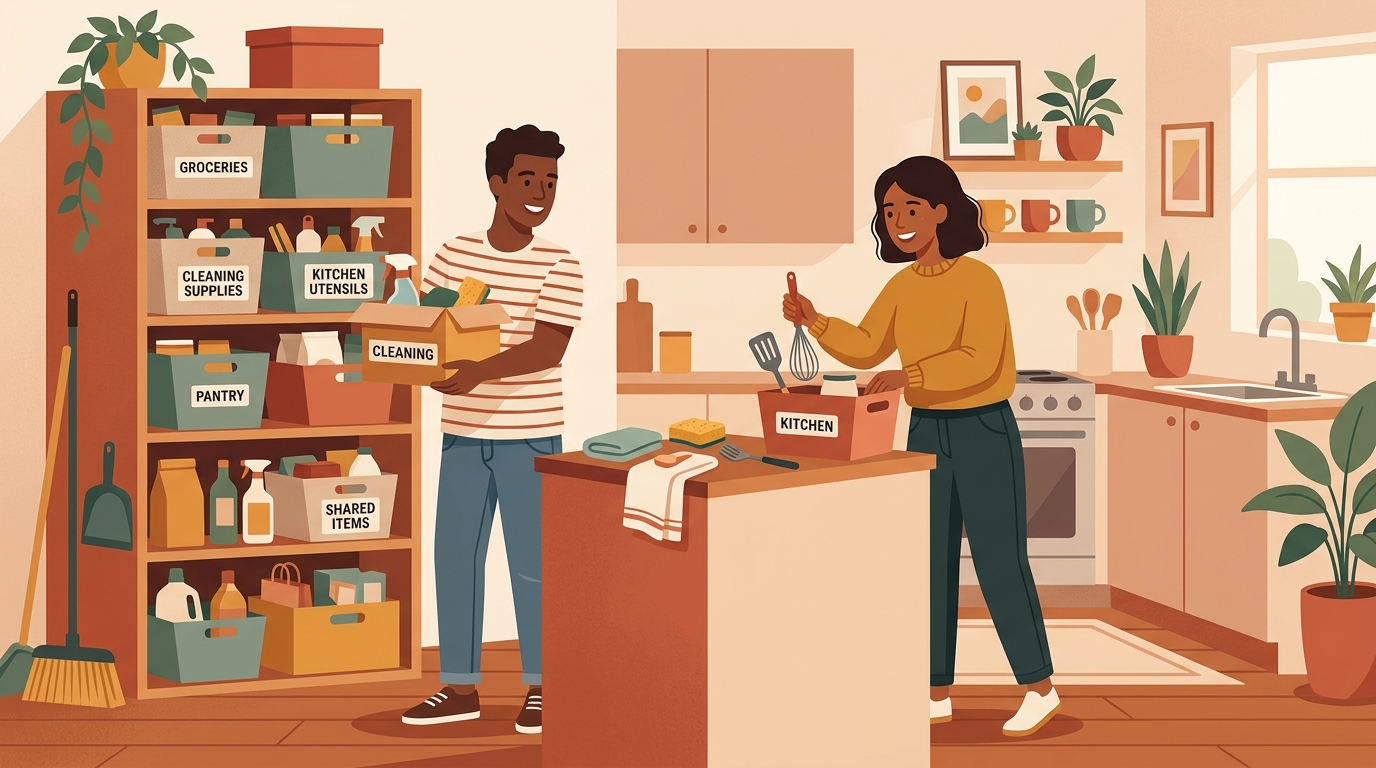
A kitchen can look organized and still hide an expensive coordination problem. One roommate buys an air fryer because the existing one is buried in a hall closet. A couple owns two immersion blenders because each brought one from a previous apartment. Someone finds a waffle maker, but nobody remembers who bought it, whether it works, or whether it can be donated. A tracking shared kitchen gadgets app gives everyone the same answer before another appliance enters the home.
This is not pantry tracking. Flour gets consumed; a stand mixer has an owner, a purchase history, attachments, a warranty, and a place it should return to after use. Shared kitchens need a record that covers those details without turning dinner prep into an accounting exercise.
The goal is simple: make it easy to see what the household already owns, who owns each item, where it is stored, and what information will matter if it breaks or someone moves out. Vorby supports that system with photos, AI-assisted item recognition, detailed locations, multi-user homes, search, QR codes, purchase email integration, and warranty tracking. The useful part is not cataloging every spoon. It is creating shared context for the gadgets that cost money, occupy space, and cause confusion.
Why Shared Kitchens Keep Producing Duplicate Gadgets
More adults are combining belongings under one roof
Shared kitchens are not an edge case. Pew Research Center reported that nearly 79 million U.S. adults, or 31.9 percent of the adult population, lived in a shared household in 2017. The U.S. Census Bureau's Households and Families: 2020 report counted 323.2 million people living in 126.8 million households and explicitly described nonfamily households as including people living with roommates, housemates, or unmarried partners.
Couples and roommates often combine homes gradually. A rice cooker arrives with one person. A blender is purchased together. A food processor belongs to a parent who loaned it for the holidays and never asked for it back. The objects share a kitchen, but they do not share the same ownership story.
Cost pressure also encourages people to combine space. The National Association of Realtors reported that 17 percent of 2024 buyers purchased a multigenerational home, the highest share in its data series, and 36 percent cited cost savings as a reason. Different household structures create different agreements, but all of them benefit from knowing what is already in the kitchen.
Duplicate buying is usually an information failure
Most duplicate purchases are not caused by an irresistible urge to own a second citrus press. They happen because the person shopping cannot answer one of four questions: Do we own this? Where is it? Is it usable? Does it belong to someone who is leaving soon?
A 2020 Jabil consumer survey found that 92 percent of respondents had mistakenly bought something they already owned. In that same survey, 92 percent said an updated list of what they owned would be useful while shopping, and 61 percent preferred an app that could help them check frequently used household items while away from home. The sample focused on smartphone-owning consumers responsible for household purchases, so it should not be treated as a national estimate. It still describes the exact failure that shared households recognize: the information exists somewhere in the home, but not where the shopper can use it.
Before buying another gadget, the household should be able to search for ordinary phrases such as “air fryer,” “hand mixer,” or “small appliance in the hall closet.” A current inventory turns a purchase decision from a group-chat guessing game into a quick lookup.
Kitchen gadgets are harder to track than pantry supplies
Statista's 2024 U.S. kitchen appliance survey covered microwaves, toasters, mixers, blenders, food processors, air fryers, grills, rice cookers, kettles, waffle irons, and other categories. That range hints at the real challenge. Gadgets differ in value, size, frequency of use, and number of components. Some live on the counter; others disappear into cabinets for eleven months.
A pantry list asks how many units remain. A gadget inventory asks different questions:
- Identity: Which model is this, and what accessories belong with it?
- Ownership: Is it personal, jointly owned, borrowed, or available for shared use?
- Location: Which cabinet, shelf, bin, or off-site storage area holds it?
- Condition: Does it work, and is any part damaged or missing?
- Documentation: Is there a receipt, serial number, warranty, or service record?
A shared kitchen inventory should answer more than “Do we own one?” It should answer “Whose is it, where is it, and what happens to it next?”
Build a Gadget Record That People Can Actually Use
Start with a photo that establishes identity
A useful photo does more than make an inventory attractive. It tells household members which black blender is being discussed, what condition it was in, and which parts belong to the set. Photograph the complete gadget first. Then add clear images of attachments, the model label, the serial number, and any existing damage that might matter later.
For a stand mixer, include the mixer, bowl, paddle, whisk, dough hook, and splash guard. For an immersion blender, include the motor body and every interchangeable head. If a gadget has a complicated packed state, take one photo showing how the parts fit in the storage bin. That picture can save time every time the appliance is put away.
Vorby's AI recognition can help identify and categorize items from photos, which reduces the blank-form problem that makes many household inventories stall. Review the resulting name and details before saving. The record should use the language your household will search, not only the manufacturer's formal product name.
Name items for human search
“Mixer” is too vague. “KitchenAid KSM150PSER Artisan Series 5-Quart Tilt-Head Stand Mixer” is precise but not necessarily how a roommate will look for it. A practical name combines the household's language with a distinguishing detail: “Maya's red stand mixer,” “shared six-quart air fryer,” or “Luis's immersion blender and attachments.”
Add the brand, model, color, capacity, or size in separate details or notes when those facts improve identification. Natural names help search work when someone remembers the object but not the catalog terminology. They also prevent two similar records from becoming indistinguishable.
Create one record for each appliance or meaningful set. Do not group the toaster, kettle, and rice cooker under “counter appliances.” Grouping hides ownership and warranty details. On the other hand, keep a gadget and its dedicated attachments together when they function as one set. The record should match how people use, move, repair, and divide the property.
Capture only the details that change a decision
Detailed does not have to mean exhausting. Record the fields that help someone buy, find, use, service, insure, lend, or move the gadget:
- Owner: One person, multiple people, the household, or an outside lender.
- Shared-use status: Whether everyone may use it and whether permission is needed.
- Location: A specific cabinet, shelf, container, garage zone, or storage unit.
- Purchase information: Date, retailer, price, purchaser, and contribution split.
- Documentation: Receipt, warranty terms, model, and serial number.
- Components: Included bowls, blades, racks, cords, cases, and manuals.
- Condition: Working, needs repair, missing a part, or ready to donate.
- Loan status: Borrower, date loaned, and expected return.
Skip fields that nobody will maintain. A complete record that goes stale is less useful than a focused record that the household updates. If you want a broader starting framework, Vorby's guide to inventorying shared kitchen gadgets provides a practical category-by-category approach.
Separate Ownership, Payment, and Permission to Use
Possession does not prove ownership
Shared kitchens blur three different facts. Possession describes who currently has the item. Payment describes who paid for it. Ownership describes who is entitled to keep it. Those facts often overlap, but not always.
Suppose Jordan bought an air fryer with a personal credit card and Maya reimbursed half. The receipt names Jordan, but the couple considers the appliance jointly owned. Luis keeps an immersion blender in the same cabinet and lets everyone use it, but it remains his property. A food dehydrator has been in the apartment for six months, yet it belongs to a friend. Each item needs a different record.
Write ownership in plain language: “Luis owns; shared use allowed,” “Maya and Jordan own equally,” or “Borrowed from Priya; return before December 15.” These notes prevent the person who uses an item most from being mistaken for its owner. They also stop long-term storage from quietly turning borrowed property into assumed household property.
Record the agreement when money changes hands
The easiest time to document a shared purchase is when everyone still remembers the conversation. Record the price, who paid at checkout, who reimbursed whom, and what the ownership agreement is. Payment data alone is not enough. One person might put the full amount on a rewards card while both people own the appliance equally.
For an expensive joint purchase, add one sentence about what happens if the household changes. Options include one person keeping the item and reimbursing the other, selling it and splitting the proceeds, or assigning ownership at purchase. The app does not decide the legal result. It preserves the facts and the agreement that the people involved made.
This matters for couples merging kitchens as much as it does for roommates. Two people may each own a coffee grinder, toaster oven, or blender before moving in together. Review the inventory before deciding what to sell or donate. The couples' guide to merging a home inventory covers that larger process, while the kitchen records provide item-level clarity.
Make shared use explicit without policing every meal
A household inventory should reduce tension, not create a surveillance system for toast. Track permissions only where they matter. A roommate may be happy to share a rice cooker but prefer that nobody use a chef's knife set. A couple may treat most appliances as communal while keeping a specialty espresso grinder personal.
Use neutral notes such as “ask before lending outside the home,” “hand wash the blade assembly,” or “owner uses gluten-free only.” Avoid passive-aggressive commentary and records of ordinary use. The system should communicate boundaries that protect the item or the owner, not score household behavior.
If ownership conflicts are already common, agree on a simple vocabulary for personal, shared-use, jointly owned, and borrowed items. Vorby's article on preventing roommate ownership disputes with an inventory gives a broader framework for documenting those categories throughout the home.
Connect the Digital Inventory to Real Cabinets and Bins
Use locations people can understand immediately
“Kitchen” is not a useful location. Neither is a code that only the person who invented it can decode. Good locations match the way household members give directions: “island, lower left cabinet,” “pantry, appliance shelf,” “hall closet, top bin,” or “garage rack, box K3.”
Vorby lets a home create rooms, storage spaces, and containers, so the inventory can reflect the actual nesting of the kitchen. A waffle maker might be assigned to Hall Closet, Top Shelf, Brunch Bin. A food processor can live in Kitchen, Island Cabinet, Back Left. Search remains useful because the location describes where the item is now, not where everyone assumes it should be.
Attachments sometimes need their own location note. The food processor base may be in a cabinet while specialty blades are in a locked drawer. The stand mixer may be on the counter while its pasta attachment is in a pantry bin. Keep the parts connected in the item record and state where the separated components live.
Choose the right level for QR labels
QR labels are most useful when they remove a physical ambiguity. Vorby can generate QR codes for locations and items, letting a household scan a label to reach the relevant record or contents. There are three practical ways to apply them:
- Item-level label: Use for a valuable, frequently borrowed, or easily confused appliance.
- Container label: Use on a bin that holds mixer attachments, baking tools, or several specialty gadgets.
- Location label: Use on a cabinet, shelf, or storage zone when people need to see everything assigned there.
Place labels on a cool, dry, visible surface. Avoid heating elements, vents, removable washable parts, and food-contact areas. A cord tag, storage case, or cabinet label may be safer than sticking a code directly to an appliance. Use removable labels on personally owned gadgets when the owner does not want a permanent mark.
A scan should answer a real question: What is this? Who owns it? Which pieces go with it? Where should it return? If scanning adds no value beyond reading the product name, label the bin or location instead.
Define when a location update is required
Real kitchens are active. An air fryer may sit on the counter for a week and return to a cabinet on Sunday. Requiring an update for every temporary move creates chores and guarantees abandonment.
Use an event-based rule. A location update is required when the gadget moves to a different cabinet, room, vehicle, home, or storage site. Lending an item should record the borrower and expected return date. Moving it from the cabinet to the counter for tonight's dinner does not need an update.
Assign responsibility to the person who moves the item. With multi-user home access, each household member can keep the shared record current instead of sending every change through one unofficial kitchen administrator. This is the difference between a household system and one person's private spreadsheet.
Keep Receipts, Warranties, and Insurance Details with the Gadget
A receipt becomes useful when it is attached to the item
A receipt buried in one person's email is not shared documentation. Save the receipt, retailer, purchase date, price, order number, and purchaser with the gadget record while the details are fresh. Vorby's email integration can identify purchase emails and add items, which helps capture online purchases before confirmations disappear into an inbox archive.
The Federal Trade Commission advises consumers to save a copy of a product warranty and keep the receipt with it. The receipt helps prove the purchase date and that the claimant is the original owner. That matters when a shared air fryer stops heating, a blender motor fails, or a retailer requires proof for a return.
Receipts also support household questions that have nothing to do with warranty service. They confirm the original price, show who completed the purchase, and provide evidence for reimbursement. Store a digital copy where both authorized household members can find it, rather than relying on a text thread from two years ago.
Turn warranty data into a deadline
“Still under warranty” is only useful if the household knows when coverage ends and what is required. Record the warranty duration, expiration date, serial number, registration status, support contact, and any important exclusions. Vorby's warranty tracker and reminders make the expiration date visible before a claim window closes.
When an appliance needs service, update the record with the claim number, repair date, replacement details, and any new coverage period. Keep the model and serial number legible in a photo because labels under appliances can fade, collect grease, or become difficult to reach once the item is installed.
The strongest routine is immediate: add the purchase, attach the receipt, photograph the label, and set the warranty information on the day the gadget arrives. If your household has a pile of old papers already, the guide to tracking warranties without a shoebox offers a focused cleanup process.
Document the item before an insurance claim
The Insurance Information Institute, also known as Triple-I, recommends recording where an item was purchased, its make and model, price, serial number, photos, and proof of value. Triple-I says an up-to-date home inventory can help settle a claim faster, verify losses for tax purposes, and help a household choose an appropriate amount of insurance.
Shared households need one more detail: whose policy may cover the item. Triple-I's renters insurance guidance notes that rules for roommates and domestic partners vary by state and insurer. Some insurers allow joint coverage for unmarried couples, while a domestic partner may need to be named specifically. Ask your insurer how your arrangement works and keep ownership records consistent with the answer.
An inventory is evidence, not a guarantee of coverage or payment. Record personal and jointly owned gadgets accurately, note borrowed items, and keep a backup accessible outside the physical home. A kitchen fire, theft, or water loss is the worst time to reconstruct a cabinet from memory.
Set Up a Shared Kitchen Inventory Without Making It a Second Job
Begin with the five gadgets most likely to cause confusion
Do not wait for a free weekend to catalog the entire kitchen. Start with five items that meet at least one of these tests: expensive, jointly purchased, personally owned but shared, frequently misplaced, covered by a warranty, stored outside the kitchen, or made of several easy-to-separate parts.
A strong first batch might be a stand mixer, air fryer, immersion blender, food processor, and espresso machine. Add one complete record at a time. Take the photos, confirm the owner, assign the real location, and attach available purchase details. The small batch teaches the household what information is useful before anyone creates fifty inconsistent entries.
Then work by contained area. Triple-I specifically suggests starting with a manageable space such as a small kitchen appliance cabinet. Finish that cabinet, label it if helpful, and move to the next zone. This method produces usable coverage immediately instead of an ambitious half-finished master list.
Use a simple division of responsibility
A shared system needs clear habits, not a full operations manual. Use four rules:
- The purchaser creates the record. New items enter the inventory before packaging and receipts are discarded.
- The owner confirms ownership. This is especially important when someone else paid at checkout or received reimbursement.
- The mover updates the location. Permanent moves, loans, and off-site storage changes belong in the record.
- The discoverer records a problem. Missing attachments, damage, repairs, and recall information should not live only in conversation.
Vorby's multi-user homes let the work follow the action. One person does not have to become the household archivist. Smart search also means everyone can retrieve the same information without learning a complicated filing system.
Keep the group chat for decisions. Use the inventory for facts. “Should we sell the extra blender?” is a conversation. “Whose blender is this, and where is its lid?” should be answered by the record.
Review at natural household transitions
Instead of scheduling constant audits, review the kitchen inventory when life already creates a reason: before a major sale, after holiday gifts, during spring cleaning, when renewing insurance, before moving, or when a roommate joins or leaves.
For a move-out, filter or review items by owner. Group each gadget with its attachments, confirm its current location, and photograph its condition before transfer. Joint purchases can be handled according to the recorded agreement. Borrowed items can be returned instead of accidentally packed. Vorby's roommate move-out inventory guide expands this workflow beyond the kitchen.
For couples, the same record helps when households merge, storage changes, or responsibilities shift. The point is not to prepare every relationship for conflict. It is to keep ordinary facts from becoming contested simply because nobody wrote them down.
FAQ About Tracking Shared Kitchen Gadgets with an App
Which kitchen gadgets are worth adding?
Track items with meaningful value, unclear ownership, multiple components, warranty coverage, frequent lending, or storage outside the kitchen. Skip inexpensive utensils when recording them would cost more effort than replacing them.
Should jointly purchased appliances have one owner or multiple owners?
The record should reflect the household's actual agreement. Note who paid, how the cost was split, who owns the item, and what should happen if one person moves out.
Where should a QR label go on a kitchen appliance?
Use a cool, dry, visible, non-food-contact surface away from vents and heating elements. For washable or hot appliances, label the cord tag, storage bin, cabinet, or shelf instead.
How often should gadget records be updated?
Update by event, not by calendar. Make a change when ownership changes, the item moves to another storage zone, it is loaned out, warranty service occurs, or a component is added, damaged, or lost.
Can an inventory app help when roommates move out or a couple separates?
Yes. Photos, ownership notes, receipts, contribution details, locations, and condition records make the division of belongings more factual. The inventory documents information and agreements; it does not replace legal advice or a binding property agreement.
Start with five kitchen gadgets that are valuable, shared, or frequently misplaced, then give each one a clear owner and location in Vorby. Your next purchase, warranty claim, cabinet cleanup, or move will start with answers instead of guesswork.